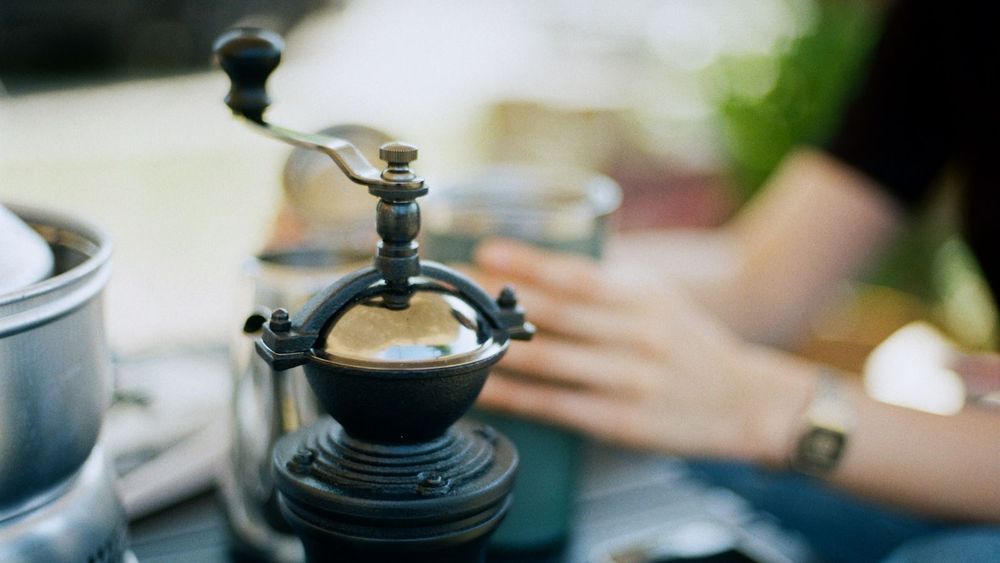
Ten reviews, eight places, and what made the cut
In our hand grinders category, ten grinders with their own review are listed as of 15 September 2026. Eight of them landed here, namely the eight with the highest overall score, from 9.4 points at the top to 7.9 at the bottom. We did not pre-sort by price class or brand. That the number alone decided can be seen from where the places came from: Hario makes three of the ten models and one of them is on the list, while Timemore and 1Zpresso occupy two places each.
We have not cranked any of these grinders, and we have not drunk from any cup that one of them filled. What can only be judged with a hand on the knob, the effort needed and the noise while grinding, is therefore left out here. Everything else comes from the review of the respective grinder, and we rewrote all ten reviews in September 2026: manufacturer pages and instruction manuals as the basis, the Amazon catalogue data as a cross-check. For the Porlex Mini II this cross-check does not apply, because our Amazon export contains no record for its item number; there, every figure is backed by the manufacturer itself.
Behind the overall score there is no formula, but our assessment, supported by four individual scores: build quality, performance, handling, value for money. Eight different scores appear here, but only seven different guide prices: the 1Zpresso Q Air and the Porlex Mini II are both at approx. €69.00 on Amazon.de. The list spans a wide range: approx. €39.80 for the Hario Skerton N against approx. €236.90 for the Comandante C40 MK4, so between the first and the last table row there is a factor of just under six.
Ceramic or steel, and what follows for the sink
In this category the type of burr set decides more, in our assessment, than any other feature, and the eight fall into two camps on it.
Two grind with ceramic. In the Porlex Mini II the burr is porcelain, it absorbs no water, and Porlex rules out rust and a metallic smell for it. For the Skerton N, Hario specifies a ceramic burr set that never rusts, gives off no metallic smell and, according to the European product page, transfers less heat than steel. The flip side is materials science, and the classification is ours: ceramic is hard and brittle at the same time. The two rules alongside come from Hario: do not expose the burr set to impact from hard material, and do not drop the device. Porlex, conversely, advertises the Mini II as suitable for the outdoors, but gives no figure for its resistance to falls.
For four of the eight, steel in the burr set is documented. The Comandante C40 MK4 has a burr made of the special stainless steel Nitro Rex with over 17 per cent chromium, which is hardened and tempered after the tooth geometry is cut. The KINGrinder K6 has a heptagonal stainless steel burr in the burr set, with an aluminium body. The 1Zpresso Q Air lists 420 and 304 stainless steel in its materials list. And for the Timemore Chestnut C3 ESP Pro, Timemore names the S2C660 burr set made of stainless steel, CNC-milled, whose hardness the European store gives as 55 to 58 HRC.
For two models the material stays open, and they are place two and place three of the price order. For the 1Zpresso J-Ultra, no manufacturer page says more than “coated”, neither the material of the burr nor that of the coating. For the Timemore C5 ESP Pro, stainless steel and aluminium appear as materials of the grinder in the table, without Timemore assigning them to individual components. So for neither do we write “steel burr”, even if the price makes it seem likely.
The difference becomes practical at the sink, and here the two camps are far apart. The Porlex comes apart into five parts, which its instructions list one by one; you brush the ceramic burr, wash the other parts with a soft sponge under water and then let them dry well. Dishwasher and microwave are prohibited there, as are boiling, scouring agents and metal sponges. At Hario, only the glass parts are dishwasher safe; the burr set is taken apart, soaked in diluted neutral cleaner and dried completely. On the other side, no water may get into the device at all: Comandante prohibits the dishwasher and soaking and prescribes a dry brush, 1Zpresso forbids washing the J-Ultra and Q Air and allows only water or alcohol for wiping, KINGrinder specifies a brush or blower, and for the Timemore grinders the documents likewise mention only the brush.
The second point is the espresso machine, and it depends not on the material but on the click steps and on the manufacturer’s approval. For five of the eight, the respective manufacturer expressly provides for espresso, for three it does not. For the Q series, 1Zpresso’s grind reference of 23 April 2026 lists AeroPress, moka pot, drip machine, siphon, pour-over and French press; for the espresso machine its own model advice points to other ranges. Porlex mentions espresso only for the Mini Professional, which is the only one that goes up to 9 clicks below the zero point. And the grind table in the Skerton instructions covers seven preparations, including cold brew, siphon and cloth filter; an espresso machine is not among them.
Reading it off or counting: the second dividing line
Two of the eight show the grind setting as a number on the housing. On the K6 the adjustment ring sits on the outside, the scale and turn counter can be read from outside, and the catch container stays on while you adjust. One number on the scale stands for ten clicks, 60 clicks make one revolution, the ring runs over four turns, and one click moves the grinding gap by 16 micrometres. The J-Ultra also has the adjustment ring on the outside, with ten labelled numbers and 100 clicks to one revolution, and one click moves the burr by 8 micrometres.
On the other six you count without a readable scale, from a mechanical stop or from a zero point that you have to find by feel. Comandante describes it via the crank, which in this detent no longer drops down by itself; the C40 is set to 24 at the factory, and it has no numerical scale anywhere. The Q Air carries the adjustment inside on the axle, the numerals turn with the adjustment wheel and are read at a marker. Porlex works with an adjustment screw and describes the zero point as the state in which the axle can only just still be turned with a finger; Timemore adjusts with a wheel that, on the C3 series, sits expressly on the inside. The most laborious is the Skerton N: for every new grind setting the fixing screw, crank and stopper come off, and as guide values Hario gives two figures, four detents for fine and seven for medium fine.
Why this is more than a matter of convenience comes down to the brewing method. In the espresso machine a pump pushes the water in about half a minute through a firmly pressed puck of ground coffee; the particle size determines the resistance there, and a single step on the adjustment shifts the flow time by seconds. In a pour-over and a French press, gravity draws the water through a loose bed over minutes, and the same step hardly matters there. Manufacturers therefore build fine click steps for the espresso machine. Add to that everyday life with two bags in the cupboard, a light one for filter and a dark one for espresso: anyone who switches daily counts every time on six of these eight grinders and notes down the result. How to approach a setting systematically is covered in the guide Setting the grind size.
Six step sizes can be set side by side, and they follow the price without a single reversal: 8 micrometres per click for the J-Ultra, 15 for the C5 ESP Pro, 16 for the K6, 23.3 for the Chestnut C3 ESP Pro, 25 for the Q Air and on average 37 for the Mini II. Only the last two cost the same; otherwise, in this series every finer step is also the more expensive one. Two grinders are missing from this series, and they are the two end points of the price range: Comandante and Hario do not give the step size, neither for the most expensive nor for the cheapest of these eight. What is in circulation about it for the C40 comes from retailers, and we do not adopt it. The finest quantified division on the list is therefore the J-Ultra, and that is deliberate: by its own account, 1Zpresso designs this grinder for espresso.
Why each grinder sits in exactly this place
Comandante C40 MK4 Nitro Blade, place 1 with 9.4 points
The manufacturer’s spare parts shop listed 49 items on 6 September 2026, and the whole drivetrain is in there: centre shaft and ball bearing set together cost €14.30, they are ordered individually, and the grinder does not have to leave the house for it. Two sealed stainless steel ball bearings guide the burr so that it stays on track at a narrow gap, and according to Comandante, manufacture and assembly take place in the area around Munich. In our assessment, with the Comandante C40 MK4 at approx. €236.90 you therefore pay for the years after the purchase and not for the grind result, and that only pays off if you want to run one grinder for decades and replace parts individually.
The grind result, after all, cannot be documented: Comandante publishes not a single measured value from its own laboratory. Two deductions belong with it. A complete burr set is not among the 49 items, and the grinder has no numerical scale anywhere; you count clicks from a zero point that you find by feel yourself.
1Zpresso J-Ultra, place 2 with 9.1 points
Ten labelled numbers on the adjustment ring, 100 clicks per revolution, 8 micrometres of burr travel per click: on the 1Zpresso J-Ultra you read the grind setting off instead of counting it from a point you found by feel, and according to 1Zpresso no other grinder of the brand is graduated more finely. In addition there is a burr with a diameter of 48 millimetres, which pulls more bean through the gap per revolution, and a magnetic catch container for 35 to 40 grams that one twist releases. By its own account, 1Zpresso designs it for espresso, and anyone who grinds there daily and often changes the bean saves failed attempts with the scale. The burr set, on the other hand, cannot be bought as a replacement: among the twelve spare parts items of the J-Ultra the grinding burr is missing, and the manufacturer FAQ describes an exchange service as still in the works.
Timemore C5 ESP Pro, place 3 with 8.9 points
42 millimetres of burr diameter instead of 38, seven cutting edges, 30 grams in the grinding chamber and 25 grams in the catch cup: the Timemore C5 ESP Pro is the expanded version of the smaller C3, and its espresso wheel clicks in steps of 0.015 millimetres, 50 clicks to one revolution, three revolutions over the whole range. You pay for this with size, 172 millimetres in height and around 640 grams. Two gaps belong to the place: for the C5 series no spare parts section can be found on timemore.com, and the same product page contradicts itself on the number of steps per revolution. It suits you if espresso by hand is the main brew and the handle should stay on the device.
KINGrinder K6, place 4 with 8.8 points
9.2 for value for money, the highest individual score of this kind on the list: the value pick that the KINGrinder K6 carries with us hangs on that. For approx. €99.00 there is a burr with a diameter of 48 millimetres inside, the same figure that 1Zpresso gives for the J-Ultra, plus 16 micrometres per click over 240 detents and a German manual with five starting values, from 20 clicks for Turkish coffee to 120 for the French press. Anyone who wants to read off instead of count and has to stay at around €100 will find nothing equivalent on this list. The steel grade and retention remain open, and KINGrinder gives the diameter only in its comparison article on the smaller K5. The crank does not fold against the body; to stow it you take it off and lay it alongside.
Timemore Chestnut C3 ESP Pro, place 5 with 8.7 points
The European Timemore store gives 55 to 58 HRC for the S2C660 burr set of the Timemore Chestnut C3 ESP Pro, CNC-milled according to Timemore, and its ESP click setting goes in steps of 0.0233 millimetres right down to espresso fine. Body of 147 by 52 millimetres, 530 grams according to the Amazon catalogue, folding handle. It carries our beginner pick because the gap to the K6 is so narrow; the calculation for this is below under the price tiers.
It is limited in quantity. Timemore gives 20 grams, two double espressos in a row would be 36 grams, and neither timemore.com nor timemoreeu.com lists spare parts, so a worn burr set ends the grinder. For a first attempt with a grinder that should also keep up at the espresso machine, it is still enough.
1Zpresso Q Air, place 6 with 8.5 points
365 grams at 14.5 by 15 by 4.6 centimetres, which gives the 1Zpresso Q Air the lowest quantified weight on this list; according to the manufacturer it also fits into the barrel of an AeroPress. Not all eight can be compared, though: for the Mini II and the C40 MK4, Porlex and Comandante give no net weight at all, and the values of the Chestnut C3 ESP Pro and the K6 are in the Amazon catalogue, not with Timemore or KINGrinder. Its housing is plastic, listed in the materials list as polycarbonate. For six brewing methods 1Zpresso gives concrete starting values in numerals instead of the words coarse, medium and fine; the espresso machine is not one of them. Anyone who counts every gram in their luggage accepts one detail for it: the handle cannot be folded, unlike on the two sister models of the Q series, and costs the full length in the rucksack.
Porlex Mini II, place 7 with 8.3 points
The Porlex Mini II has the same guide price as the Q Air, approx. €69.00, and two things separate the two. The first is the material, porcelain instead of stainless steel, with 37 micrometres on average per click against 25 for the Q Air, so the coarser division over 18 steps. The second is water, and there the relationship turns around: after washing, Porlex requires all parts to dry well, and the crank has its own rule, it must not lie in water for long and is wiped dry afterwards. That is exactly why it stands here, for filter coffee on the move, provided it is washed afterwards. According to its own statement, Porlex develops its ceramic burrs itself and makes them in its own plant in Kirishima, the manufacturer includes a crank holder with precisely this model, and beans over about 9 millimetres in diameter are a matter for the more expensive Mini Professional.
Hario Skerton N, place 8 with 7.9 points
A glass container whose contents Hario gives as 100 grams before it has to be emptied underneath, and which becomes a coffee canister with the storage lid: for this and for the ceramic burr set, the Hario Skerton N carries our editors’ pick. At approx. €39.80 it is the cheapest of these eight, but not the cheapest in the category; more on that below. According to the instructions, only beans for one to two cups belong in the hopper, with top-ups in between. Anyone who grinds filter coffee at home gets by with it, because at 210 millimetres in height and with a glass base it is a kitchen appliance and not travel luggage. Hario Europe sells three spare parts for this model; the burr set is not among them.
One feature per grinder, plus price and score
| Model | The difference | Price | Our score | Pick this if |
|---|---|---|---|---|
| Comandante C40 MK4 Nitro Blade | 49 items in the spare parts shop, axle and bearings can be ordered individually | approx. €236.90 | 9.4 | you want to repair the grinder over the years instead of replacing it |
| 1Zpresso J-Ultra | Adjustment ring on the outside, 8 micrometres per click | approx. €199.00 | 9.1 | you grind espresso daily and often change the bean |
| Timemore C5 ESP Pro | 42 mm burr with seven cutting edges, 25 g in the catch cup | approx. €119.00 | 8.9 | you need two filter cups in a row and want to fold the handle |
| KINGrinder K6 | Scale and turn counter on the outside of the body, 240 detents | approx. €99.00 | 8.8 | you want to read off instead of count and stay at around €100 |
| Timemore Chestnut C3 ESP Pro | Stainless steel burr set with 55 to 58 HRC according to the European store | approx. €91.99 | 8.7 | you first want to find out whether grinding by hand suits your mornings |
| 1Zpresso Q Air | 365 g, fits into the barrel of the AeroPress according to the manufacturer | approx. €69.00 | 8.5 | you count every gram in your luggage |
| Porlex Mini II | Porcelain burr, five parts washable by hand | approx. €69.00 | 8.3 | you want to rinse the grinder after the weekend |
| Hario Skerton N | Glass container that becomes a storage jar with a lid | approx. €39.80 | 7.9 | you grind filter coffee at home and leave the grinder standing |
The figures in the price and score columns appear as they do in the data sheets of the eight reviews, reconciled on 15 September 2026. The guide prices behind them carry a different date: for the C5 ESP Pro the figure comes from our own price list of July 2026, for the Mini II and the Skerton N from our price box with no retrieval date. What the table cannot do is compare grind uniformity: none of the six manufacturers publishes comparable measured values on particle distribution, and we have none of our own.
What more money buys in this category, and where it stops
Under €70 there are five of the ten models in our category, three of them on this list: the Skerton N, the Q Air and the Mini II. All five reviews have been revised, and in none of them does the manufacturer provide for the espresso machine. Anyone looking for a grinder for the espresso machine for less than €70 will find none among these five. Four of them instead bring an adjustment that is quantified or counted in detents, and a burr of ceramic or stainless steel; for the Mini Slim Plus, the click guide values from 5 for fine to 20 for coarse come from an FAQ sheet on its predecessor, the MSS-1, and for the Plus itself Hario gives no detents. For the Mini II, Porlex expressly writes porcelain; for the Skerton N, the MM-2 and the Mini Slim Plus, Hario sticks to the word ceramic and does not name the type.
Between €69.00 and €91.99 the catalogue lists nothing. The middle class then starts with three models. Between the Chestnut C3 ESP Pro and the KINGrinder K6 there are €7.01, between the KINGrinder K6 and the C5 ESP Pro €20.00. With these seven euros the decision is not about price but about whether you want to read off or count, plus ten millimetres of burr diameter, 48 against 38. The €20 above buy the folding handle, the 30 gram chamber and a click step one micrometre finer, but compared with the K6 they cost you six millimetres of burr diameter. All three have in common a quantified step size under 25 micrometres, and that is the difference from the tier below: on the Q Air and the Mini II the steps are larger, and on the Skerton N Hario counts only in detents, with no micrometre value. A shot that ran through too fast you therefore take back in the middle class by exactly one step, instead of guessing.
Two stand at the top. The J-Ultra for approx. €199.00 and the C40 MK4 for approx. €236.90, a gap of €37.90. Here the extra price no longer changes how finely the grinder clicks but what you are paying for: at 1Zpresso for the finest division in the brand’s own range, at Comandante for spare parts and manufacture in Germany. Neither buys a documented particle distribution. According to its FAQ, Comandante develops and checks its burr sets in its own laboratory and publishes nothing from it, and 1Zpresso describes the speed of the J-Ultra with the words “speedy” and “grind quickly” instead of seconds. In our assessment, the measurable return therefore ends at the figures of the middle class; above that you pay for material and the ability to buy parts again.
None of the eight has running costs; there are no filters or descaler to buy again. Money goes only on accessories, and two items belong before the purchase. Comandante sells the finer click setting Red Clix RX35 for €42.00 as an accessory, the standard version is the coarser axle, and the parts cannot be mixed. For the Q Air the carrying bag costs extra, US$20.00 in the manufacturer’s shop for the Carrying Case.
Who takes which grinder, in six cases
You grind espresso every morning and try a different roaster every two weeks. Then a readable scale pays off in saved failed attempts, and two models on this list qualify for it, the J-Ultra and the K6. Anyone who sticks with one bean and touches the grind setting once a year pays for the scale without needing it.
Four cups at once, and that every morning: then you are working against the design, whatever the model, and the quantities show why. The C5 ESP Pro holds 30 grams in the chamber and 25 in the cup, the Chestnut C3 ESP Pro 20 grams, the Q Air 15 to 20, the Mini II around 20. For the K6, KINGrinder gives 25 to 30 grams on the product page and 30 to 35 in its own blog. For the C40 MK4, the two supplied Bean Jars hold 40 grams each; Comandante does not state a capacity for the grinding chamber. And the 100 grams of the Skerton N concern the glass container underneath, not the hopper above. A one-litre pot needs three fills at 60 grams per litre and three rounds of cranking; anyone who does this every morning is done sooner with an electric grinder. Those are in the Best electric grinders 2026 list, the coffee finder sorts out the preliminary decision between hand and motor, and the brew calculator works out the quantity for your recipe.
You take the grinder with you. 365 grams for the Q Air, which according to the manufacturer fits into the barrel of an AeroPress. 530 grams at 147 millimetres in height for the Chestnut C3 ESP Pro, whose handle folds against the body, around 640 grams at 172 millimetres for the C5 ESP Pro with the same mechanism. The K6 weighs around 630 grams at around 17 centimetres in height, and its crank comes off and lies loose alongside. For the Mini II, Porlex publishes no dimensions at all, and anyone buying it for a particular piece of luggage measures it themselves beforehand.
After the weekend the grinder should go under the tap. Then of these eight the two ceramic grinders remain. Porlex advertises that all parts down to the ceramic burr can be removed and washed; Hario calls the Skerton N fully washable in the product features, but approves only the glass parts for the dishwasher. For the other six, what is said above at the sink applies: brush instead of water.
You have small children in the kitchen. Comandante’s manual calls the burr teeth extremely sharp and expressly warns against letting children handle the grinder. Hario’s instructions exclude use by children and require storage out of their reach, and in the case of the Skerton N there is also the glass container, which must not be used at all if it has cracks or heavy scratches. And for the Q Air, 1Zpresso writes that the grinder is to be kept away from children for safety reasons. In our assessment, none of these grinders should be left standing out on the worktop if someone small can reach for it.
You want to repair rather than replace in ten years. Then the way leads to the C40 MK4, with deductions. There are 49 items in its spare parts shop, against twelve for the J-Ultra, three for the Skerton N and none for the two Timemore grinders. For none of these eight models does a manufacturer list a complete replacement burr set. At Hario there is one, but for a model outside this list: Hario Europe sells the inner and outer burr parts of the Hario Mini Slim Plus separately, €6.50 and €8.50, so together €15.00 for the burr set, as of 15 September 2026. In the documents of the other nine models in our catalogue, a burr set to buy again is not mentioned, and at Porlex and KINGrinder the route in any case runs only through a contact form with no list behind it. Porlex supplies individual parts, the form is on the manufacturer’s page in Japan; at KINGrinder a bag of spare parts is in the box for this, whose contents can vary depending on the production batch.
Two Hario models and a whole design are missing here
The tightest is the Hario MM-2 with 7.8 points and approx. €50.98, a tenth behind eighth place. It grinds with a ceramic burr into a drawer in the wooden body, Hario gives 24 grams, and the preparation table in the instructions lists no espresso machine. What it costs in our score is the adjustment: the same procedure as on the Skerton N, plus an adjustment nut that is then fixed again with the stopper. In addition there is the wooden body, which the instructions want to see neither immersed nor in the dishwasher, because corrosion, rust and cracks in the wood threaten. It costs around €11 more than the Skerton N and holds less per run.
The second is the Hario Mini Slim Plus, with 7.6 points and approx. €31.14 the cheapest hand grinder in our catalogue. It is three tenths short of the Skerton N, and that is the reason, not its review: that has been revised and is backed with manufacturer sources, which is why the reasons may be stated here. Its burr is ceramic inside and outside, Hario gives 24 grams per fill, and the grind table in the instructions lists seven preparations, from cold extraction to the French press. Espresso is missing there. Under €39 this list therefore offers nothing, and the category offers exactly this one grinder.
A whole design is also missing: the flat burr. Two parallel discs crush the bean in a narrow gap and need speed to do so, and speed is the scarce quantity on a hand crank. That is why every one of these eight grinders has a conical burr. Anyone who grinds for four people in the morning, or wants espresso without torque at the crank, is better off in the best-of list of electric grinders; which other features distinguish a hand grinder is sorted out by our hand grinder buying guide. One figure stays open throughout this category, across all eight: how long you crank for 18 grams is stated by none of the six manufacturers, and nobody here has measured it.
All products on the list side by side
| Product | Type | Rating | Price | |
|---|---|---|---|---|
| C40 MK4 Nitro Blade | Hand grinders | ★★★★★ 4.7 | approx. €236.90 | View on Amazon → |
| J-Ultra | Hand grinders | ★★★★★ 4.6 | approx. €199.00 | View on Amazon → |
| C5 ESP Pro | Hand grinders | ★★★★★ 4.5 | approx. €119.00 | View on Amazon → |
| K6 | Hand grinders | ★★★★☆ 4.4 | approx. €99.00 | View on Amazon → |
| Chestnut C3 ESP Pro | Hand grinders | ★★★★☆ 4.4 | approx. €91.99 | View on Amazon → |
| Q Air | Hand grinders | ★★★★☆ 4.3 | approx. €69.00 | View on Amazon → |
| Mini II | Hand grinders | ★★★★☆ 4.2 | approx. €69.00 | View on Amazon → |
| Skerton N | Hand grinders | ★★★★☆ 4.0 | approx. €39.80 | View on Amazon → |
The prices are guide values from our price boxes and change with the retailer. Prices are in euros from Amazon.de and may differ in your country. You will find the current status for each product on the linked product pages, and all products side by side in the comparison table.