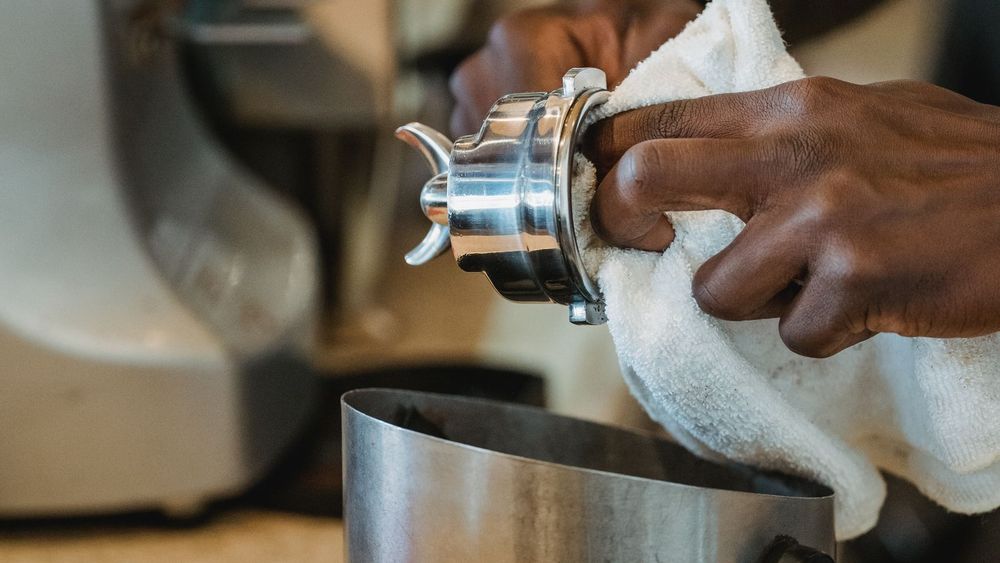
The short answer: The SCA Standard 320 for household grinders (filter coffee) requires cleaning instructions but gives no interval. The manufacturers set the intervals themselves: from care after use (Porlex and Caso, De’Longhi for fresh coffee) to cleaning at least every three months with daily use (Fellow). We would start with a monthly rhythm and brush sooner with a dark roast or an espresso grind size.
Cleaning the grinder, step by step by design
Beans out, residue brushed out, hopper washed or wiped out, everything dried completely: that is the basic pattern running through the manufacturers’ instructions, manuals and FAQs that we reviewed (as of October 2026). For Timemore, we rely on timemoreeu.com and the Amazon catalogue text for the C3, on timemore.com alone for the C5, and for individual models on how our German reviews reproduce the sources; the source is stated each time. What is allowed in between is set by the manufacturer of the particular model. The instructions for your model take precedence over any rule of thumb here.
Electric grinder with flat or conical burrs
- Remove the beans and pull the plug. Sage requires that for every cleaning you switch the appliance off, unplug it and let it cool down. Before that, the bean hopper is emptied, and beans that cannot be removed are ground up. Fellow has you run the empty grinder for ten seconds before cleaning to clear beans from the burrs and the grounds chute. This is not uniform: Tchibo prohibits running the grinder empty in the instructions for its coffee grinder, and Rommelsbacher says for the EKM 400 never to run the appliance idle. So only grind out as far as your instructions allow. With no beans in the grinding chamber, nothing jams between the burrs when you brush, and with the plug pulled the motor cannot start while you work in the chamber (our deduction).
- Take off the hopper and the upper burr to reach the grinding chamber and the outlet. At Baratza this is part of routine cleaning; on the Encore ESP removal is not necessary according to the manual, but allows a more thorough clean. Sage removes the upper cone and brushes out both cones and the grinder outlet, with the supplied brush on the Smart Grinder Pro.
- Wash the containers as far as the instructions allow. Eureka has you wash the inside of the container with water and neutral soap to remove the oil layer from the beans, at least once a week and not in the dishwasher. Graef specifies warm water with a little washing-up liquid and thorough drying. In the instructions for its coffee grinder (as of 04/2021), Tchibo requires the bean hopper to be completely dry before beans go back in. Fellow, Sage and Graef rule out abrasive agents. Sage also names alkaline cleaners and steel wool, because they can damage the surface.
- Clean the burrs dry, because Baratza, Fellow, Eureka and Ninja allow no water at the burrs (details in the section on water). Eureka lists a dry brush or dry cloth, and if necessary a vacuum cleaner or compressed air. For the EKM 400, Rommelsbacher names the brush in the container lid or compressed air spray, and has you remove the grinding plunger for easier cleaning. On the De’Longhi Dedica KG 520.M you set the dial to OPEN, lift out the upper burr and brush it off with a stiff brush, and clean the lower one with a brush and vacuum cleaner. The Caso Barista Crema has a removable burr set, which the instructions say to clean carefully with the cleaning brush because the burrs and the grinding screw can be sharp. Rommelsbacher expressly rules out a steam cleaner for the EKM 400.
- Loosen caked coffee. Here the manufacturers contradict each other. Baratza has you loosen compacted coffee in the plastic chamber with a hard tool, such as a small hex key or the handle of the cleaning brush, and its blog mentions a straightened paper clip. Rommelsbacher has you carefully loosen powder stuck in the outlet of the EKM 200 with a pointed object such as a toothpick, followed by the brush. Graef advises against scraping off stubborn dirt with hard objects. We would start with the softest tool named in your instructions and only use metal where the manufacturer itself suggests it.
- Reassemble dry, and only open what the instructions let you open. Rommelsbacher wants the container and lid of the EKM 200 completely dry before use. For the Svart Uniform+, Wilfa says not to open the product, otherwise the purchase warranty expires. At Sage, customer service carries out all maintenance work except cleaning. At the start of chapter 6 of the manual, Eureka writes that maintenance and cleaning work must be done by personnel authorised by the manufacturer, but sections 6.2 and 6.3 describe the cleaning of the container and the grinding system for the user. The manual contradicts itself here.
Hand grinder with steel burrs
According to the Q-Series manual, a 1Zpresso can be taken apart without tools. You loosen the adjustment dial anticlockwise, take off the handle and pull the shaft out of the hopper. The adjustment dial, inner burr, spring and lower bearing cover are cleaned with a brush and air blower. You do not take apart the burr-ring unit or the outer burr ring. With the J-Ultra, a brush and a blower bulb are in the box. For the Q Air, our German review records the same: washing and soaking are prohibited, and cleaning is done with a brush and air blower.
According to its manual, the KINGrinder K6 wants a brush or blower bulb and no water. The outer burr stays in, and taking it apart with tools is not intended. You should avoid grinding again, because coffee powder can clog the components, and store the grinder dry.
On the Comandante C40 MK4, according to the manual, you turn the adjustment wheel all the way open and take out the cone. The small steel spring in the cone can be pulled off with a twisting motion. The cone is cleaned with the brush. The burr ring is centred at the factory and anchored with special screws and must on no account be removed, otherwise screw heads can twist off or the centring can be lost. According to the manual, the two bean containers, made of glass and polymer, are easy to clean with hot water. In its FAQ, Comandante names mineral or olive oil only for a squeaking oak knob on the handle, not for the axle or burrs.
Hand grinder with ceramic burrs
Hario describes the burr set of the Skerton N as fully washable; the parts are made of ceramic and stainless steel. To wash it, you take it apart, soak it in diluted neutral detergent if there is a coating of coffee oil, rinse it thoroughly and dry it completely. The inner burr and shaft stay together. According to Hario, ceramic does not rust. On the Mini Slim Plus the burr set can likewise be removed for washing; with coffee oil it goes into a mild cleaning solution, is rinsed well and dried completely. Bleach and oil are prohibited there.
According to the Japanese instructions, the Porlex Mini II can be taken apart into five parts (body, outer burr, inner burr, inner burr base, adjustment screw). The ceramic burr is cleaned with a small brush such as a toothbrush, the other parts with a soft sponge in water. Then dry well, do not leave the handle lying in water for long (rust) and do not remove the spring in the body. Scouring agents and metal sponges scratch the parts, boiling is prohibited, as are the dishwasher with drying and the microwave.
Ceramic is fragile. For the MM-2, Hario warns that knocks against hard surfaces or a fall could break the ceramic burr set or make it chip, and on the Skerton N the ceramic burr can flake. Porlex prohibits turning it empty because of the risk of the blades breaking. Hario prohibits oil for care on all three grinders.
Blade grinder
The Bosch TSM6A has neither flat nor conical burrs but an impact blade. The instructions (read as a retailer copy, a PDF from 2018 according to its metadata) call the appliance maintenance-free and have you wipe out the container and lid with a brush or dry cloth. The lid may be rinsed cold or lukewarm. The base unit never goes into liquid or the dishwasher, the housing is wiped with a damp cloth, and abrasive cleaners and steam cleaners are ruled out. The appliance should not be run idle.
Grinder in a bean-to-cup machine, an espresso machine and a filter machine
For bean-to-cup machines, the instructions focus on the bean hopper. On the JURA E6 you occasionally wipe it out with a dry, soft cloth because the beans leave a layer of fat. The Melitta CI Touch wants a soft, dry cloth. The De’Longhi Rivelia prescribes emptying the grinder, removing and emptying the container, and wiping it inside and out with a soft, damp cloth. You clean the seat with a brush, cloth and crumb vacuum, after which everything must dry completely.
In espresso machines with their own grinder, the procedure is more detailed. On the Sage Barista Express Impress and the Sage Barista Pro you unlock and empty the hopper, let the grinder run empty, remove the hopper and upper cone, and brush out both cones and the chute. Sage points out that the burr set is extremely sharp. The extended cleaning with a 10 mm socket (Express Impress) or a 10 mm socket and needle-nose pliers (Pro) is intended only for a blockage between the burrs and the outlet.
The Ninja Luxe Premier wants the plug pulled, the beans removed, the hopper taken off and the upper grinding ring unscrewed, followed by dry cleaning with the brush. On the De’Longhi La Specialista Arte you clean the locking area and the coffee chute at the burrs with the C9 brush. If the grinding tools wear out, customer service is responsible (maintenance by trained personnel).
Filter machines with a grinder are documented differently. The Melitta Aromafresh X wants the burrs cleaned as soon as dirt is visible, then the powder channel. You pull the grind size dial straight up and out, and a suitable brush is included. On the Grundig KVA 6230, the coffee powder chute and the burr outlet are to be cleaned with the cleaning brush.
The grind setting after taking it apart
Several manufacturers warn against settings that are too tight. KINGrinder warns against grinding the K6 at the zero point or below 15 clicks, or cranking it empty, as that could damage the burrs. According to its manufacturer FAQ, 1Zpresso advises against cranking in the first clicks from the zero point, because that can damage the cone set.
For the Skerton N, Hario writes that an adjustment nut turned too far clockwise makes the ceramic burrs grind against each other and could lead to a malfunction. Porlex advises not to tighten the adjustment screw too much, because the burrs can strike each other, and not to force a handle that jams at the zero point but to loosen the screw until it turns easily. On the C40, the three screws on the burr ring are not to be loosened; they hold the factory centring of the burr ring, and loosening them can damage the grinder and cost you the warranty.
According to its FAQ, 1Zpresso states that all the brand’s grinders can be taken apart without the burr set needing recalibration. The Q-Series manual says that ground coffee remaining in the burr set can shift the zero point. Note the setting before taking it apart, check the zero point after reassembly as your manual describes it, and never approach it by force. Which setting suits which brewing method is covered in the guide Coffee grind size.
What builds up in a grinder
A considerable part of coffee is fat. Green, that is unroasted, Arabica beans contain on average around 15 per cent lipids, Robusta around 10 per cent (Speer and Kölling-Speer, Brazilian Journal of Plant Physiology, 2006).
The darker the roast, the more oil lies on the bean surface. In a procurement specification for coffee (USDA AMS, Commercial Item Description A-A-20213B, 2004), the US Department of Agriculture describes the roast levels qualitatively: light roasts (Agtron 80 to 90) generally without oil on the surface, medium-dark (Agtron 40 to 50) with some oil, and dark (Agtron 30 to 40) with a shiny, oily surface.
What becomes of this in a Baratza grinder is in the Encore ESP manual: ground coffee can stick to the coffee oils in the burr set and clog it. Baratza names two causes. One is coffee that backs up above the maximum fill level of the grounds container. The other is dark, oily or flavoured coffee that is often ground without regular cleaning.
The Baratza blog “Grinder Cleaning Essentials” adds oils, fine particles and, depending on the roast level, chaff, which collect in the grinding chamber and the chute and can affect flavour clarity, grinding speed, evenness and the risk of clogging. Dark roasts need cleaning more often, it says; light ones are less oily but produce more chaff. Further causes of clogging according to the blog: very fine grinding, regrinding already ground coffee, frozen or chilled beans (condensation) and too much coffee at once in the grounds container. Baratza advises grinding as needed and keeping the container less than two thirds full.
Bean-to-cup manufacturers also reckon with oily beans. In the instructions for the EQ6 plus, Siemens advises against oily beans because they do not fall into the grinder. In the fault table of the Melitta CI Touch, under “Grinder does not grind” the cause is “coffee beans too oily”, with other beans as the remedy. Rommelsbacher ties the cleaning interval of the EKM 200 to fineness and oil content: the finer the grind size and the oilier the powder, the more often the outlet opening wants cleaning. Wilfa writes that the Svart Uniform+ can occasionally stop at the finest setting.
A second cause of residue is static. On a Mahlkönig EK 43, a commercial grinder with 98 mm burrs, Méndez Harper and colleagues (Matter, 2024) found that roast colour and grind fineness influence the electrical charge during grinding. Fine, darker roasts reached charges per mass such as are also assumed for particles in volcanic plumes and thunderclouds. According to the authors, finer settings on the EK 43 lead to more breakage events, longer contact with the burrs and more fines, and the charge makes ground particles clump together. The Baratza blog takes the opposite view on roast colour: light roasts produce more static.
Does leftover coffee in the grinder go rancid?
Rancidity is a recognised feature of old coffee. The literature review by Emma Sage (SCAA, 2012 according to the address) names it as one of the characteristic aromas of ageing, caused by lipid breakdown, that is by chemical oxidation or pyrolysis of fats. The process is accelerated by moisture, oxygen and temperature, and it is linked to the surface area of the ground coffee. Grinding raises porosity and the ratio of surface to volume, which speeds up degassing and ageing. So ground coffee ages faster than whole beans.
The storage studies that we draw on concern coffee in packs or containers (for Huynh-Ba, the review does not state the set-up) and not residues in grinders, so no time spans until grinder residues go rancid can be derived from them. According to the SCA review by Emma Sage, the oxidation of lipids to volatile compounds occurred in the first 24 hours after roasting and grinding (Huynh-Ba et al., 2001), and trained assessors detected rancidity in coffee packed in air after four months (Marin et al., 2008). Vila and colleagues stored two ground roasted coffees for 180 days: the fatty acid profile did not change significantly, and the content of free fatty acids rose, faster in the blend of 80 per cent Arabica and 20 per cent Robusta (Journal of the American Oil Chemists’ Society, 2005).
The manufacturers word it more cautiously, mostly with “can”. On the CM800 and CM802, Graef writes that old coffee left in the appliance can oxidise and impair the result, up to an unpleasant and undrinkable taste. According to the Japanese Porlex instructions, residual powder oxidises over time and can affect the taste the next time you grind. The Baratza blog says the oil of dark roasts can give a sour taste. At Eureka, a neglected burr set can have a negative effect on coffee output and on dosing and grinding accuracy. According to Sage, regularly cleaned cones give more even grinding results, especially for espresso.
Our assessment: the sources are enough to justify not leaving ground residue sitting. The grinder is one possible cause of off-flavours among several.
Water at the burrs: what the manufacturers allow
| Grinder | Burrs and water according to the manufacturer | Source |
|---|---|---|
| Baratza Encore ESP and Virtuoso+ | Do not wash burrs with water, otherwise they rust; the ring burr must not get wet; do not immerse the burr housing | Encore ESP manual p. 7 and 9, Virtuoso+ p. 7 |
| Fellow Opus | Do not wash burrs with water; do not immerse the burr set; outside only a damp cloth | Manual pp. 44 to 45 |
| Eureka Mignon | Grinding system dry; brush, cloth, if necessary vacuum cleaner or compressed air; do not let inner parts come into contact with liquids | Manual ch. 1 and 6.3 |
| Ninja Luxe Premier and Pro | Burr set must not come into contact with water; with water contact, contact customer service immediately | Instructions, as reproduced in our German review |
| Comandante C40 MK4 | Dry brush only, no harsh cleaners; do not soak, as this can damage the wood veneer and ball bearing cartridges over time; the manual mentions water only for use with spices; C40 Ironheart is made of carbon steel, not stainless, and goes without water | Manual and FAQ |
| Comandante C60 and X25 Trailmaster | Can be rinsed with water, also with mild natural cleaners; then take apart and dry completely | Comandante FAQ |
| 1Zpresso J-Ultra and Q Air | J-Ultra: do not clean or wash with water, wipe only with water or alcohol; Q Air: do not wash, do not soak | Q-Series manual (German), J-Ultra manual (English), FAQ |
| KINGrinder K6 | Do not clean with water; brush or blower bulb | Manual p. 4 |
| Mahlkönig (supplier of the Grindz tablet) | Reason given for the tablet: water cannot be used on burrs and around electric motors | Mahlkönig Grindz FAQ (04/2020) |
| Hario Skerton N | Ceramic burr set fully washable; take apart to wash, soak in diluted neutral detergent if there is an oil coating, rinse thoroughly, dry completely | Instructions MSCSN-2, p. 8 |
| Hario Mini Slim Plus | Burr set removable for washing; with coffee oil, soak in mild cleaning solution, rinse, dry completely | Instructions, as reproduced in our German review |
| Hario MM-2 | Do not immerse in water (corrosion, rust, cracks in the wood) | Instructions, as reproduced in our German review |
| Porlex Mini II and Mill II | Ceramic burr with a small brush, other parts with a soft sponge in water; dry well; do not leave handle lying in water for long (rust) | Instructions p. 5 |
| Graef CM800 and CM802 | Burr set with the supplied brush; water (warm, with a little washing-up liquid) only for the bean and ground coffee containers; the instructions say nothing about water at the burrs | Instructions p. 13 |
| Timemore C3 | timemoreeu.com and the Amazon catalogue text mention only taking apart and the brush; nothing about water there. We have not read an instruction manual: according to our German review (as of September 2026), the Download Center lists no file for this model | timemoreeu.com and Amazon catalogue text, as reproduced in our German review |
| Timemore C5 | The care information on timemore.com is only the cleaning brush included; there is no manufacturer information on taking apart, water or the dishwasher, and we also have no Amazon catalogue data on the C5. We have not read an instruction manual: according to our German review, the Download Center had no file for the C5 series on 6 September 2026 | timemore.com, as reproduced in our German review |
The documents give rust (Baratza, Comandante Ironheart, and for the handle at Porlex) as well as damage to wood and ball bearing cartridges (Comandante C40) as reasons.
Ceramic alone is no permission: the Hario MM-2 has a ceramic burr set and still must not be immersed in water. Whether something may be cleaned wet is stated in the instructions for your model. Where the documents are silent, as with Graef (instructions) and Timemore (for the C3, timemoreeu.com and the catalogue text name only taking apart and the brush; for the C5, timemore.com lists only the cleaning brush included), we would stick to the brush at the burrs and limit water to the removable containers.
For the dishwasher, most of the instructions we reviewed say no: Baratza (hopper, lid and grounds container hand wash only), Eureka, Sage (grinder parts and accessories), Fellow (no parts), Porlex, Hario for the MM-2 and Mini Slim Plus, Comandante, and Siemens for the lid of the bean hopper of the EQ600. There are exceptions: for the Skerton N, the instructions allow the glass part in the dishwasher, with a note to read the dishwasher’s instructions first. For the JURA E6, the instructions name three parts that may go in the dishwasher; the bean hopper is not one of them.
How often to clean? The manufacturers’ range
We found no independent source (standard, authority, consumer advice centre) with an interval for household grinders; we did not search DIN databases. SCA Standard 320-2021 (household grinders for filter coffee, espresso grinders excluded) requires that cleaning instructions come with the grinder, and gives no interval. That leaves the manufacturers:
| Manufacturer and grinder | Interval | Source |
|---|---|---|
| De’Longhi Dedica KG 520.M | after every use for fresh coffee | Instructions, as reproduced in our German review |
| Porlex Mini II | care after use recommended, no numerical interval | Japanese instructions p. 5 |
| Caso Barista Crema | clean straight after use, otherwise cleaning gets harder and in extreme cases impossible | Instructions ch. 7.1, as reproduced in our German review |
| Comandante C40 | weekly with heavy use, monthly with light use; not necessary between individual grinds | Comandante FAQ |
| Graef CM800 and CM802 | depending on use, at least once a week | Instructions p. 13 |
| Eureka Mignon | wash the bean hopper at least once a week | Manual ch. 6.2 |
| Mahlkönig and Urnex (commercial, tablets) | espresso grinder weekly, large filter grinder monthly | Mahlkönig Grindz FAQ (04/2020), Urnex FAQ |
| Baratza Encore ESP | with daily use, brush the burrs about once a month; blog: routine cleaning every 4 to 6 weeks, more often with dark roasts | Manual p. 9; Baratza blog |
| 1Zpresso J-Ultra | take completely apart once a month | 1Zpresso FAQ |
| KINGrinder K6 | take apart and clean at intervals of 30 days at most | Manual p. 4 |
| Fellow Opus | with daily use, burrs at least every three months; exit chute after about 60 grinding cycles | Manual pp. 44 to 45; Gear Guide |
| Melitta Aromafresh X | as soon as dirt is visible | Instructions, as reproduced in our German review |
| Rommelsbacher, Sage, Hario, Wilfa, Tchibo, Krups, Bosch | regularly or no information | Respective instructions |
| Timemore C3 and C5 | no information | C3: timemoreeu.com and Amazon catalogue text; C5: timemore.com |
Individual manufacturers give reasons for the spread of intervals. Baratza points to dark roasts that leave oil in the burr set, and Urnex justifies the weekly rhythm for espresso grinders by saying that espresso beans tend to be darker and oilier and leave more residue on the burrs. For care after use, Porlex names residual powder on the burrs, which can miss the desired grind size or cause a malfunction. At Fellow, the interval for the exit chute depends on grinding cycles: according to the Gear Guide, the anti-static technology works best for about 60 cycles, after which the chute is wiped with the brush. If you grind two portions a day, you get there after about a month on paper.
Our assessment: with daily use we would start with a monthly rhythm, because several manufacturers name it and it lies in the middle of the range. With dark roasted beans, flavoured varieties or a fine espresso grind size we would shorten the interval, and with infrequent grinding lengthen it. If the manufacturer gives its own interval for your model, its figure applies.
Cleaning agents: tablets, oats, rice
Several manufacturers themselves name tablets for grinders. For cleaning the inside of the burr set, Baratza allows only grinder cleaning tablets and recommends them with frequent use of dark, oily or flavoured coffee, so that they absorb the oils. Fellow names Urnex Grindz as an example: the tablets are meant to prevent clogging by loosening coffee particles stuck to the burrs and to absorb or remove odours and coffee oil residue. In its warranty terms, Fellow excludes grinding anything other than roasted beans or grinder cleaning tablets. For complete hygiene, Eureka recommends commercially available cleaning tablets for coffee grinders and requires that all cleaning agents be approved for food.
Urnex and Mahlkönig sell such tablets, and their claims about effect are manufacturer statements with a vested interest. Urnex lists a cereal product (listed twice) and a potassium salt as the ingredients of Grindz; Mahlkönig describes the tablet as grains, cereal and pharmaceutical binders in the shape of a coffee bean.
The quantities differ: for espresso grinders Urnex specifies one scoop of Grindz (35 to 40 g) at a medium setting; on the Opus, Fellow has you run beans through for 10 to 20 seconds, set the grind to 11 and grind all the tablets into the catch container. After that you grind beans through. Urnex has you repeat the same procedure with coffee beans, Mahlkönig recommends about twice the amount of coffee, and Fellow about 30 g for the Opus and gives the purpose as removing tablet residue. Purging is also known from tasting, though with no connection to household grinders: the SCA cupping protocol (Coffee Sensory and Cupping Handbook, Edition 01, 2021) has a rinse amount of the sample run through the grinder before each sample is ground, presumably because of the grounds left from the previous sample (our deduction; the protocol gives no reason).
Among the manufacturers we reviewed, only 1Zpresso recommends oats, for its own grinders. Against odour and coffee oil, you grind rolled or instant oats, wipe with a damp, not wet, cloth and dry immediately.
None of the manufacturers we reviewed recommends rice for cleaning. Eureka (according to the notes on use; for cleaning, the same instructions recommend tablets), Porlex and KINGrinder allow only roasted beans in the grinder, and Hario nothing but coffee beans: on the Skerton N the product could otherwise be damaged, and on the MM-2 the burr set could break. In the manual, Comandante provides for the dry brush, and in the texts we reviewed Timemore names only the brush. Among the manuals we reviewed, only Rommelsbacher mentions the word rice, in the safety note on the material to be ground: the EKM 400 is not suitable for processing poppy seeds, rice, nuts, sugar and the like, and ignoring this voids the warranty.
Two tablet suppliers warn expressly. In a FAQ on Grindz (04/2020), Mahlkönig writes that rice risks jamming the motor as it passes through and is crushed into a fine powder, and leaves a starchy, hard-to-remove residue on the mechanism. Urnex adds that rice leads to more and more frequent build-up. They also do not compare rice with coffee, but speak of the hardness and shape of their own tablet. That rice is harder than coffee is not stated in these documents, and we found no measurement that compares the two under the same conditions.
Our assessment: we would not use rice, even where the documents name only the brush (Comandante: manual, Timemore: manufacturer page and catalogue text).
Water on the beans: the Ross Droplet Technique
The Ross Droplet Technique (RDT) does bring water into the grinder after all: it is not applied directly to the burrs but to the whole beans, yet it goes in with them and briefly raises the humidity there. According to Méndez Harper and colleagues, the technique was reportedly first presented in an online forum (Home-Barista.com, 2012). Baristas are said to have observed less charge anecdotally. The group measured it in 2024 in the journal Matter.
The water was applied to the beans with a pipette. The charge of all the coffees examined fell as the amount of water rose, and even 5 microlitres per gram of beans reduced the electrostatic aggregates of coarse and fine particles. In the authors’ hands, almost no ground coffee stayed behind in the grinder; they report this as an observation and hold out a measurement for later. For an espresso with constant parameters on the EK 43 (18.0 g of coffee to 45.0 g of beverage, setting 1.0, 94 degrees, 7 bar), the extraction time with added water was almost 50 per cent longer. The authors consider a different flavour profile likely without assessing it. As an explanation for the longer extraction time they name a denser coffee bed, because fine and coarse particles no longer attract each other electrostatically.
The group’s second paper (iScience, 2024) measured retention, again on the EK 43 and at grind setting 2.0. With no measure, around 12 per cent of the ground coffee stayed in the grinding chamber; with high-voltage ionisation at the outlet, likewise around 12 per cent; with 10 microlitres of water per gram, around 2.5 per cent. According to the authors, too much water could lead to clumping or corrosion in the grinder, and the limit depends on the coffee and the grinder. In their experiment with 0 to 50 microlitres per gram, the relative humidity in the grinding chamber rose for some tens of seconds to as much as 75 per cent, without condensation, and was back to normal within minutes.
In the authors’ view, residual water in the grinding chamber could favour bacterial growth or corrosion of the burrs; by their own account they have not observed this. Measurements were taken only on a commercial grinder. Whether water on the beans makes steel burrs in household grinders rust, we found investigated nowhere. Among the manufacturers, KINGrinder comments: according to the K6 manual, with the RDT method no water should be sprayed directly onto the grinder, but into a separate container, from which it is put into the grinder (presumably meaning the beans). Our assessment: on a grinder with burrs prone to rust, we would only use RDT if the manufacturer approves it.
Fault patterns: symptom, cause, remedy
The table lists only fault patterns that appear in the documents. A deduction of ours is marked as such.
| Symptom | Cause according to the document | What you change | Source |
|---|---|---|---|
| Coffee backs up in the burr set, the grinder clogs | Ground coffee above the max line; dark, oily or flavoured coffee without regular cleaning; according to the blog also very fine grinding, regrinding ground coffee, frozen or chilled beans | Pull the plug, remove the conical burr, empty the grinding chamber, loosen compacted coffee, clear the exit chute; keep the container less than two thirds full | Baratza Encore ESP p. 11; Baratza blog |
| Appliance stops at the finest setting | according to Wilfa, occasionally happens at the finest setting | Set coarser (Wilfa gives setting 25 as an example), let coffee run through, clean with the brush | Wilfa Svart Uniform+, manual p. 79 |
| Grinder does not grind | Coffee beans too oily | Other beans | Melitta CI Touch, fault table |
| Powder is stuck in the outlet | the finer the grind size and the oilier the powder, the more often | Clean the outlet opening more often, loosen the powder carefully | Rommelsbacher EKM 200, p. 9 |
| Ground coffee clumps | static charge, stronger with a fine grind size and dark roast (measured on the EK 43) | Clean thoroughly and watch whether the clumps return; if they do, that points to static rather than residue in our assessment | Méndez Harper et al., Matter 2024 |
| Handle jams at the zero point | the instructions warn against an adjustment screw tightened too far | Do not force the handle, loosen the screw until it turns easily | Porlex Mini II, instructions p. 1 and 2 |
| Grinding performance drops, the amount that can be ground falls | Wear: the burrs can become blunt with long use | Replace the grinder (according to Hario) | Hario Skerton N; Mini Slim Plus |
| Unpleasant taste, beans unchanged | Graef and Porlex: old coffee or residual powder in the appliance can oxidise and affect the taste | Clean the burrs, outlet and ground coffee container, then compare (our deduction) | Graef instructions p. 13; Porlex instructions p. 5 |
When the burr set is worn out
Cleaning does not bring back a worn burr set. In the Skerton N instructions, Hario writes that the burrs can become blunt with long use, and that the grinder should be replaced when the amount of beans that can be ground falls markedly. For the Mini Slim Plus, the German instructions name falling grinding speed as the sign, the English part the markedly falling amount that can be ground; according to our German review, the instructions advise replacing the whole grinder. Separately from that, Hario Europe sells individual burr sets for the Mini Slim Plus: the inner BI-MSS-1-EX for €6.50, the outer BO-MSS-1-EX for €8.50 (as of 15 September 2026, according to our German review).
The manufacturers state service life in kilograms of coffee. According to its FAQ, 1Zpresso expects a service life of 100 to 200 kg of beans (“up to” in the original) and has a replacement service for burr sets in development. For the Mignon Specialità, Eureka’s manual says to check the burrs every 250 kg and replace them if necessary, the product page gives 300 kg of service life; for the Libra 16CR, the instructions require a check after 300 kg. Among bean-to-cup machines, the ceramic burr set of the Saeco Xelsis is designed for at least 20,000 cups according to Philips.
What we cannot document
- There is no study on extraction time or extraction as a function of how dirty a grinder is, only manufacturer statements (Sage on more even grinding results, Eureka on dosing and grinding accuracy, Graef and Porlex on taste), and these statements carry no measured values.
- We know of no study that traces an off-flavour in the cup to grinder residue or determines its share.
- Measured values for the retention of individual household grinders from an independent source are not in our documents; SCA Standard 320 only sets limits.
- Claims that oil in grinders hardens into rubbery films or that cutting performance drops by a particular percentage appeared only on blogs and AI-adjacent sites; there is no primary source for them.
- On the microbial load of grinder residue there is a master’s thesis (SLU Uppsala, 2020) on a single commercial grinder left uncleaned for a long time, with no household relevance, no health assessment and no peer review by a journal. We do not use it.
- Whether aluminium, of which the housing of the Timemore C3 is made, for example, tarnishes in the dishwasher cannot be documented from manufacturer or authority statements.
- We know of no manufacturer instruction to clean the grinder of a bean-to-cup machine with granules or grinder cleaning tablets. JURA, De’Longhi and Melitta mention wiping out the bean hopper; for Siemens (EQ6 plus, EQ600) our German reviews say nothing on this. The De’Longhi Rivelia has you empty the grinder before cleaning the hopper and when changing bean variety in Switch mode, and the machine grinds the remaining beans in the process.
- The cleaning chapter of the Severin KA 4810 lacks the bean hopper and grinding chamber; it covers filter parts, jug, filter door, hotplate and housing surface.
- Whether Baratza, Fellow, Comandante, 1Zpresso, Eureka, Sage and Graef approve or exclude the RDT is not in the documents we reviewed.
- How many oats 1Zpresso intends for cleaning, the FAQ does not say.
Cleaning products and grinders in our catalogue
We do not carry a burr cleaner like Urnex Grindz in our catalogue. The Coffeeano cleaning tablets clean the brew group of bean-to-cup machines: the tablet goes into the compartment for ground coffee, then the cleaning programme runs, and according to Coffeeano the machine manufacturer’s instructions always take precedence. The tablets that manufacturers such as JURA sell for bean-to-cup machines run through the powder chute during the cleaning programme and therefore also belong to the brew group.
Which burr types exist is covered in the Coffee grinder guide.