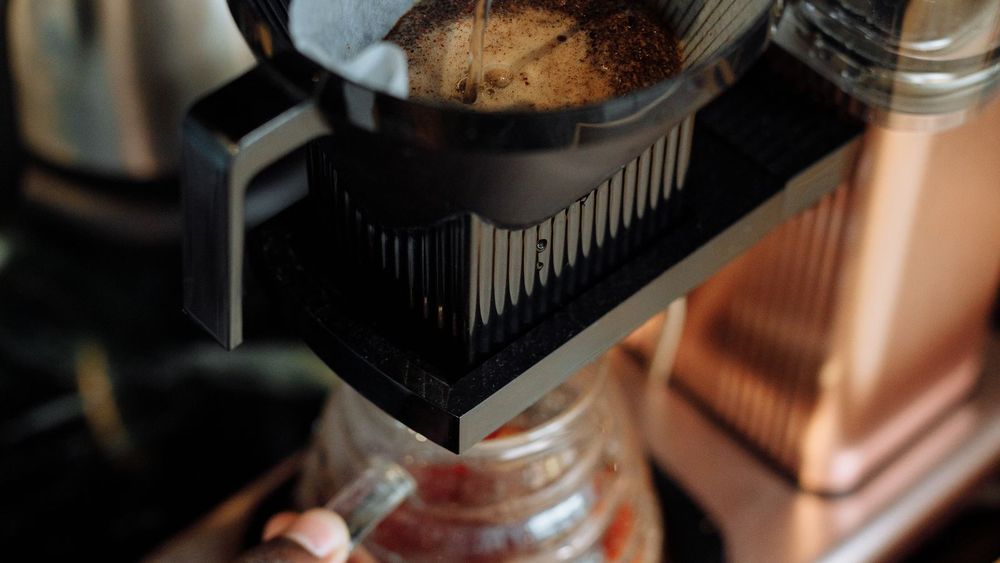
The short answer: The manufacturers’ V60 and Kalita recipes range from 1:14 (Hario Japan) to 1:18 (Kalita), and the SCA (Specialty Coffee Association) certifies machines at 55 g of coffee per kg of water (1:18.2). We would start at 1:16, grind medium-fine and use water at 92 to 96 °C, as Hario UK states. According to Batali et al. (2020), temperature between 87 and 93 °C hardly changes the sensory profile as long as brew strength and extraction yield stay the same; both depend on dose and grind size.
Making pour-over coffee: the method step by step
The steps follow the recipes from Hario (Japan and UK), Kalita and the Deutscher Kaffeeverband (German Coffee Association). Where the sources differ, the range is given in the sections after this one.
- Match the paper and the dripper. The Hario V60 is a cone with a 60 degree opening angle, and according to the review of the V60 Starter Set a trapezoid filter does not fit into it. The Kalita Wave 185 is a flat-bottom dripper with three holes, and Kalita specifies no paper for it other than the Wave filter 185, neither trapezoid nor cone. With the Chemex, according to the manufacturer only its own bonded filters are intended. Which paper fits therefore depends on the device.
- Rinse the paper with hot water and discard the water. Hario gives as reasons that the device warms up and the smell of paper disappears; Hario UK rinses at the same time to preheat the dripper and cup. Kalita expects less paper taste and a more stable brewing temperature. Chemex does not consider pre-rinsing a mandatory step; it removes paper fibres and warms the carafe.
- Grind the coffee medium-fine and put it into the paper. Which source says medium-fine and what Chemex and Kalita state differently is covered in the section on grind size.
- Put the dripper with the pot on the scale and tare it. Hario UK works in grams: 15 g of coffee, pouring until the scale shows 250 g. That way you keep a ratio exactly, without a measuring jug.
- Wet the grounds and wait (bloom). Hario pours slowly from the centre outwards until all the grounds are wet. The sources give different amounts and waiting times; the range is in the bloom section.
- Then pour in spirals. Hario Japan uses three pours, each four times the amount of coffee; Hario UK pours slowly in circles until the target weight is reached; the Kaffeeverband begins with a small first splash and then tops up in small amounts, and exactly when is given in the bloom section. Both Hario instructions leave out the edge of the paper. Our conclusion: water that runs down along the paper bypasses the ground coffee.
- Keep an eye on the time. Hario Japan wants the brew finished within 3 minutes regardless of the number of cups, Hario UK gives about 2.5 minutes for 250 ml, Kalita gives 2 to 3 minutes in its last step until the water has run through, and the Kaffeeverband gives 3 to 5 minutes of draw-down time. The brew is finished when all the water has run through (Hario). Bodum requires that the filter only be removed then, as there is a risk of scalding.
Brew strength and extraction yield: what happens during brewing
Two quantities describe a filter coffee. Brew strength (TDS) is the share of dissolved substances in the beverage, in per cent. Extraction yield (PE) is the share of the ground coffee that has passed into the beverage. The dose mainly sets the strength, while grind size and draw-down time mainly determine the extraction yield (our classification).
The classic Brewing Control Chart goes back to Lockhart (1957) and appears in Lingle’s SCA Coffee Brewing Handbook. As the ideal zone it gives 1.15 to 1.35 per cent TDS and 18 to 22 per cent extraction yield, and equates it with the SCA Golden Cup Standard. The SCA standard 310-2021 for machines aims at 1.15 to 1.55 per cent TDS at 55 g/kg, and the European Coffee Brewing Centre (ECBC) requires 1.30 to 1.55 per cent according to Moccamaster’s manufacturer information. Converted into extraction yield, that gives 18.7 to 25.3 per cent at 55 g/kg (our calculation, the formula is in the FAQ). The standard thus allows more extraction yield than the classic zone.
Several studies at UC Davis have examined whether the zone matches taste. Batali, Ristenpart and Guinard (2020, Scientific Reports 10, 16450) had trained panellists rate drip coffee of varying strength and extraction yield. TDS had the greatest influence, extraction yield a smaller one. Bitter, astringent and viscous rose with TDS, with no significant relationship to extraction yield. Sour, citrus and berry rose with TDS and fell with rising extraction yield: it was sourest at high TDS and low extraction yield, and for the attribute sour about 20 points (out of 100) lay between the extremes. The authors note that this differs from the classic chart, which places bitterness at high extraction yield. Their limits: one Arabica, one drip machine.
Frost, Ristenpart and Guinard (2020, Journal of Food Science 85(8)) brewed one Arabica at three roast levels and nine target combinations of TDS and extraction yield. 21 of 30 attributes differed significantly, seven of them (including sour and bitter) could be described significantly from TDS and extraction yield at all three roasts, and sweetness fell with rising TDS at all three roasts. On bitterness: according to Batali et al., Frost et al. found that, generalised across roasts, bitterness and viscosity increase with TDS and extraction yield, differing by roast (of Frost et al. we only had the abstract, and this part comes from the account by Batali et al.). On the relationship between bitterness and extraction yield, the two studies therefore disagree. Cotter et al. (2021, Journal of Food Science 86(1)) had 118 mostly young consumers of black coffee rate samples and found two groups whose preferences varied mainly with TDS. Guinard et al. (2023, Journal of Food Science 88(5)) combine the drip studies into new charts and consider the classic one too coarse.
Read practically, and only according to Batali et al.: bitter notes grew there with the strength that you adjust through the dose (our classification), and not significantly with extraction yield; with Frost et al., as described above, it looked different. Batali et al. summarise how both build up during brewing, following Lee, Kempthorne and Hardy (1992), as follows: half of the measured coffee constituents dissolve in the first quarter of the brew volume, and more slowly soluble aroma compounds such as methyl cinnamate and indole come later. That further water dilutes the fast substances and gives the slow ones more time is Batali et al.’s own conclusion, not part of the 1992 work.
How much coffee for how much water?
The sources differ. For certifying household machines the SCA uses 55 g/kg (1:18.2), and its standard 310-2021 explicitly excludes hand pour-over. The ECBC requires 60 g per litre (1:16.7) according to Moccamaster’s manufacturer information, and Hario UK works with 15 g per 250 ml for the V60, likewise 60 g per litre. Hario Japan, with twice the coffee amount for the bloom and three pours of four times each, arrives at 14 times the amount of coffee in water (1:14, our calculation). Kalita recommends 20 g to 320 g of water (1:16) and gives 1:16 to 1:18 as a framework. On its website the Deutscher Kaffeeverband uses 7 to 10 g per cup at 125 to 150 ml, and in its brochure about 7 g per cup and about 65 g/l.
Our assessment: as a starting value we take 1:16, that is 62.5 g per litre. This is what the Kalita recipe says and what the instructions for the Fellow Opus say; the value is close to Hario UK and the ECBC (Moccamaster’s manufacturer information) at 60 g and below the 65 g of the Kaffeeverband brochure. From there you feel your way within 1:15 to 1:17. Cotter et al. (2021) found that consumers prefer black coffee across a wide range of strength and extraction yield, so how strong it should be is up to you. One thing is pure arithmetic: even 1:17 is still stronger than the SCA certification ratio of 1:18.2.
| Amount of water | 1:14 (Hario Japan) | 1:15 | 1:16 (our starting value) | 1:17 | 55 g/kg = 1:18.2 (SCA certification value) |
|---|---|---|---|---|---|
| 250 ml (2 cups) | 17.9 g | 16.7 g | 15.6 g | 14.7 g | 13.8 g |
| 500 ml (4 cups) | 35.7 g | 33.3 g | 31.3 g | 29.4 g | 27.5 g |
| 750 ml (6 cups) | 53.6 g | 50 g | 46.9 g | 44.1 g | 41.3 g |
| 1,000 ml (8 cups) | 71.4 g | 66.7 g | 62.5 g | 58.8 g | 55 g |
For other amounts, divide the water in grams by the ratio. The number of cups is only useful as a measure if you know the cup: WMF, Severin and Braun count 125 ml, Melitta and Moccamaster 1.25 l for ten cups, the Kaffeeverband 125 to 150 ml, Chemex 5 oz (about 148 ml) and the Bundesinstitut für Risikobewertung 200 ml for filter coffee. In the table we count 125 ml per cup.
Which grind size is right for filter coffee?
Medium-fine is what Hario says for the V60, and the Kaffeeverband, WMF and Dallmayr say it too. Kalita and Chemex say medium-coarse, and Kalita compares it with sea salt. For the AeroPress, AeroPress Inc. recommends medium-fine at 30 seconds and medium at 60 seconds. A fixed ranking according to which filter coffee should be ground coarser or finer than for the AeroPress cannot be derived from these statements.
In its grinder FAQ, Hario gives as approximate particle sizes: fine 0.5 to 0.8 mm, medium-fine 0.5 to 1.0 mm, medium 1.0 to 1.5 mm, coarse 1.0 to 2.0 mm. The ranges overlap, and fine lies entirely within medium-fine. In the instructions for hand grinders, paper filters are given as fine to medium for the Skerton N and medium-fine to medium for the Mini Slim Plus, and for the filter coffee machine medium-fine to medium (Skerton N). We did not find a standard that defines fine, medium and coarse. It only becomes measurable in micrometres: the SCA reference grind for machines with a conical basket consists of at least 68 per cent particles between 425 and 850 µm, at most 20 per cent below and less than 12 per cent above. These are certification values for machines.
Grinder manufacturers give starting values in their own scales, and these cannot be transferred. In the manual of the Virtuoso+, on a scale from 1 (very fine) to 40, Baratza gives 15 for the V60, 18 for the filter machine, 20 for the Chemex and 28 for the French press, and writes that the exact setting can only be found by trying. For the Fellow Opus it is 5 to 9 on the outer ring for pour-over, for the Wilfa Svart Uniform+ 14 to 28, and for the 1Zpresso Q Air 18 to 32. The Comandante C40 MK4 gives, according to the manufacturer FAQ, 18 to 35 clicks from the zero point for pour-over, depending on dose and brewer, and the KINGrinder K6 starts at 100 clicks according to the manual (16 µm per click). The detents of the Hario MM-2 count from the zero point: 4 fine, 7 medium-fine, 9 medium, 11 coarse. How to readjust in small steps from a starting value is covered in our guide on coffee grind size.
The Kaffeeverband advises using the powder as fresh as possible and storing it cool and airtight. When grinding, the beans are crushed and cut, and a large part of the carbon dioxide they contain and volatile aromas are released.
Water temperature: which range applies, and where is it measured?
The number depends on who states it. SCA 310-2021 requires certified machines to reach 90 to 96 °C in the coffee bed: at the latest when 33 per cent of the water has been added, the bed must be in this range and stay in it until the end of the draw-down, measured with three thermocouples at one-second intervals. The ECBC demands 92 to 96 °C (198 to 205 °F) according to the manufacturer information from Moccamaster and Melitta. Hario UK likewise gives 92 to 96 °C water temperature for the V60, and Kalita 195 to 205 °F (on the US site without a unit, meaning Fahrenheit, converted 90.6 to 96.1 °C). In the Japanese part of its instructions Bodum gives about 90 to 95 °C, and Dallmayr a little over 90 °C. The Kaffeeverband says 88 to 95 °C on its website, 88 to 96 °C in the brochure, but never above. The standard measures in the coffee bed, while the recipes give the water temperature: two numbers with the same degree sign are therefore not the same thing.
Batali et al. (2020) examined what the range does. They brewed drip coffee from the same Arabica roast at 87, 90 and 93 °C and adjusted grind size, dose and flow time so that TDS and extraction yield stayed the same (270 brews, trained panellists, blind, served at 65 °C). Multivariate analysis showed no significant temperature effect, and of 31 attributes only nutty differed, by about one point out of 100. The authors conclude that at the same TDS and extraction yield, temperature had a negligible influence on perceived quality. They also note that none of the sources they reviewed provides data for the SCA range of 92 to 96 °C (the older SCA specification that they cite; SCA 310-2021 gives 90 to 96 °C). Limits: one coffee, one programmable machine, only 87 to 93 °C. The study says nothing about 100 °C or about hand pour-over.
Older work took a different approach. Pangborn (1982) and Andueza et al. (2003) come second-hand, via Batali et al.: Pangborn found, with stirred pour-over using distilled water at 65, 80, 90 and 100 °C, that bitterness and acidity generally increased with temperature. Andueza et al. varied espresso from 88 to 98 °C, and hotter water raised TDS and extraction yield and brought harsher, roastier, bitter and sour notes. Klotz, Winkler and Lachenmeier (2020, full text read) had 24 panellists compare espresso in a triangle discrimination: 80 against 128 °C was recognised by 15 of 24 (significant), 80 against 93 °C by 11 of 24 (not significant). With Andueza et al., the higher temperature went together with higher TDS and higher extraction yield, while Batali et al. hold both constant and see the effect disappear. Our reading: temperature acts mainly through these two quantities.
On boiling water, the Kaffeeverband says that, unlike tea, coffee is generally not brewed with it because aromas would be destroyed; the association does not back this with a measurement. How long water needs after boiling to reach the range depends on kettle, amount and room. The only number we found: Rune et al. (2026) let 900 g of water stand for one minute after boiling until it reached 92 °C. That is their set-up with a Bodum French press, not a law of nature; with a kitchen thermometer you can check your own kettle. Our assessment: we would let boiled water stand briefly and stay within the manufacturers’ range, but if the coffee is too sour or bitter, adjust grind size or dose first and leave the temperature alone.
What does blooming do for filter coffee?
The escape of gas is documented, the effect is not. According to Chemex, the bloom is the gas trapped in the beans from roasting, which escapes when they are wetted; afterwards aroma compounds and oils can be extracted unhindered, which improves the flavour. Kalita writes that the bloom releases carbon dioxide and possible sourness and lets the bed swell, and that you should not skip it. Both are manufacturer statements.
Amount and duration differ. Hario Japan uses twice the amount of coffee and waits 30 seconds, Kalita three times (60 g to 20 g of coffee) and 30 to 45 seconds, and Hario UK just enough to wet all the grounds and about 30 seconds. According to its website the Kaffeeverband has you pour again after a few seconds, according to its brochure after about ten to 30 seconds, and Chemex gives neither amount nor duration.
How much gas is in the coffee also depends on the time since roasting: according to the Kaffeeverband, beans degas for hours up to two months after roasting. How age and storage interact in the bloom, and a measurement linking the duration or water amount of the bloom to extraction or taste in hand pour-over, we did not find. Smrke et al. (2018) describe CO2 release as a freshness indicator that influences extraction and possibly the sensory profile, but is little studied.
Our assessment: we would include the bloom because Hario, Kalita and Chemex all provide for it and it costs little, about 30 seconds and two to three times as much water as coffee. Whether it demonstrably makes the coffee better, we leave open.
Which water is best for filter coffee?
A coffee beverage is about 98 per cent water, write the Kaffeeverband and Melitta. Set against the target strength of the SCA standard, it is 98.45 to 98.85 per cent. What is dissolved in it affects taste, only the sources disagree on what exactly. Melitta writes that very soft water intensifies the acidity of the coffee and very hard water weakens it. The Kaffeeverband considers hard, limescale-containing and chlorinated water to be bad. Neither presents figures or measurements for this.
The most recent study we found is Rune et al. (2026, Journal of Food Science 91(9), e71434). A medium-roast Colombian coffee was brewed in a French press (50 g to 900 g of water, 92 °C, 4 minutes) with ultrapure water plus calcium, magnesium and hydrogen carbonate and rated by untrained and trained panellists. Hardness alone, calcium up to 264 mg/l and magnesium up to 80 mg/l, produced no notable differences.
Hydrogen carbonate was different. In the duo-trio method, untrained panellists only just recognised a difference from ultrapure water at 120 mg/l hydrogen carbonate (20 of 30 correct, p = 0.049) and clearly at 240 mg/l (24 of 30, p < 0.001). In the descriptive assessment with ten trained panellists, 300 mg/l hydrogen carbonate dampened acidity, fruitiness and complexity and strengthened bitterness and roasted notes, and acidity fell from 12.0 to 2.9 on the 15 cm scale. The authors see alkalinity as the main cause of the changes, not hardness, and suspect that the narrow hardness windows in water recommendations reflect machine protection rather than a documented flavour benefit. Limits: one coffee, one roast level, French press instead of filter, TDS and extraction yield not measured, no consumers surveyed. Older sensory work (Lockhart 1955, Pangborn 1971, via Rune et al.) found brews from distilled water too sour and brews from water rich in carbonate flat and bitter.
The industry’s recommendations are lower. The SCA 310 reference water has a calcium hardness of 50 to 175 ppm CaCO3 (about 2.8 to 9.8 °dH, German degrees of hardness, our conversion), an alkalinity of 40 to 70 ppm and pH 6 to 8. The SCAE Water Chart (Wellinger, Smrke, Yeretzian, ZHAW, 2017) gives hardness 50 to 175 and alkalinity 40 to 75 ppm, but admits there is not enough data to describe the effect precisely. Brewed coffee tends to need less alkalinity than espresso, and water with high total hardness can also make a good filter brew. For the explanation there is a calculation and a counter-finding: Hendon et al. (2014) calculated how sodium, magnesium and calcium bind to coffee acids; Bratthäll et al. (2024) found only limited differences in the acid content of brews at concentrations typical of drinking water.
How far tap water can be from this is shown by Hamburg Wasser (Hamburg’s water utility) in its 2025 analysis values for the Schnelsen groundwater works: total hardness on average 13.96 °dH, carbonate hardness 9.9 °dH, acid capacity to pH 4.3 of 3.54 mmol/l, calcium 85 mg/l, magnesium 9 mg/l. That corresponds to about 177 mg/l as CaCO3 and about 216 mg/l hydrogen carbonate (our conversion). This value applies to the waterworks, not to every household in Hamburg. Your supplier must publish the hardness: the Trinkwasserverordnung (§ 46 para. 1 no. 3) requires it under § 9 of the Wasch- und Reinigungsmittelgesetz (German Detergents and Cleaning Agents Act), together with calcium, magnesium and potassium. Hydrogen carbonate or acid capacity is not listed in that point, but may appear in the analyses. According to the law, water is soft below 1.5 mmol calcium carbonate per litre (below 8.4 °dH), medium from 1.5 to 2.5 (8.4 to 14 °dH) and hard above that (our conversion at 5.608 °dH per mmol/l).
On water filters, the authorities advise caution. The Umweltbundesamt (German Environment Agency) does not generally consider additional treatment of drinking water in the home necessary, and filters without regular replacement can become contaminated with germs. The Verbraucherzentrale (German consumer advice centre) advises regular cartridge replacement and cleaning for table filters. Stiftung Warentest (test magazine 7/2022) found that almost all fresh jug filters softened water of 16 to 17 °dH, but after the first quarter of the stated capacity managed only medium-hard water; in the simulated holiday scenario all the jugs examined contained bacteria, and one model also contained moulds. Hario UK, by contrast, advises filtered water in its brew guide where possible. We would first read the supplier’s analysis and not buy a filter on suspicion. More on hardness and taste is in the guide on water hardness and coffee.
Making filter coffee in a machine
SCA 310-2021 concerns electric household filter machines at atmospheric pressure; hand pour-over devices, French press, espresso and capsule machines are explicitly excluded. Its figures are certification conditions: 55 g of coffee per kg of fresh water at 17 ± 3 °C, 90 to 96 °C in the coffee bed, and with a heated pot 80 to 85 °C in the coffee. The standard contains no minimum or maximum brewing time. The instructions of a certified machine must contain a grind size recommendation, the ratio of 55 g/kg (or the equivalent in other units), the recommended filter type and cleaning instructions. The assessment uses 100 per cent Arabica in a medium roast, at least one to one and a half weeks after roasting.
According to Moccamaster USA, the ECBC arrives at different values: 60 g of coffee per litre, 4 to 6 minutes brewing time, 198 to 205 °F in the filter basket (to be reached within the first minute), a pot that does not let the coffee fall below 176 °F (80 °C) in the first 30 minutes, and at most 75 mg of sediment per 100 ml. Melitta explains the ECBC’s Golden Bean award in Oslo with the same figures, 92 to 96 °C and 4 to 6 minutes. For 15 filter machines examined (test magazine 11/2024), Stiftung Warentest by contrast gives eight to twelve minutes for a full pot; for the KBG Select Moccamaster gives about 6 minutes for 1.25 l. According to a reply from the editors in the comments on the report, Stiftung Warentest did not rate the aroma because water hardness, coffee variety, grind size, amount and machine settings influence it too much.
On dosing, the manufacturers go their own ways. Moccamaster counts 60 g per litre (75 g for the full pot), the Melitta AromaFresh X 6 to 8 g per cup in powder mode, and the WMF Stelio Aroma 5 to 7 g medium-fine per cup at 125 ml. Converted to grams per litre with 125 ml cups, that is 48 to 64 for Melitta and 40 to 56 for WMF, so in part below the SCA certification ratio of 55 g. For the Severin KA 4810 a spoon table applies in powder mode, for example 4.5 to 6 spoons for 6 cups and 8 to 10 for 10 cups. The Braun PurShine KF 1500 limits the powder to 10 spoons. The grind size rule is in the Severin manual: light roast fine, dark roast coarse.
Keeping warm: hotplate, thermal pot and the 40 minutes
The standards concern the coffee in the pot, not the hotplate. SCA 310-2021 requires heated pots to keep the coffee at 80 to 85 °C for 30 minutes, and the heating element must never bring it above 85 °C. According to Moccamaster’s manufacturer information, the ECBC requires at least 80 °C in the first 30 minutes. For comparison: water only boils at 100 °C. For the hotplate of the KBG Select, Moccamaster gives 80 to 85 °C, says the coffee arrives in the pot at 82 to 85 °C, and switch-off follows 40 minutes after the start of brewing.
The duration is regulated in the EU by the Ecodesign Regulation: since 1 January 2015, new household coffee machines must switch automatically to standby or off, filter machines with a non-insulated container (glass pot) after at most 40 minutes, with an insulated container after at most 5 minutes, and the other household coffee machines after at most 30 minutes (Regulation (EU) No 801/2013, read in the legal text; likewise the Umweltbundesamt and Stiftung Warentest 2014). Regulation (EU) 2023/826, applicable from 9 May 2025, carries on the same times in Annex III. The 40 minutes at Melitta, WMF, Braun, Russell Hobbs and Moccamaster lie right on this limit, while Severin stops after 35 minutes. No manufacturer source documents that the rule is the reason; that is our conclusion. By contrast, the product description on the WMF manufacturer page for the Stelio Aroma advertises that the hotplate keeps the coffee warm all morning, while the instructions have the keep-warm function end after 40 minutes and the data sheet line on the same WMF page shows a no for keeping warm (according to our review). With the Melitta AromaFresh X the time can be set to 20, 40 or 60 minutes, and the factory setting is 40.
On quality there are association statements and studies. The Kaffeeverband and Melitta advise drinking freshly brewed coffee as soon as possible because aroma evaporates and the coffee tastes bitter; they give no times. Stiftung Warentest wrote in 2014 that coffee should not be kept warm for longer than half an hour and becomes more sour over time, an editorial statement with no stated measurement.
Batali et al. (2023, Journal of the Science of Food and Agriculture) had trained panellists rate light, medium and dark drip coffee that was held for up to 3 hours in a glass pot on a hotplate, a thermal jacket or a vacuum pot (six time points from 15 minutes to 3 hours). With light and medium roasts acidity rose, more attributes decreased than increased, and the authors suspect loss of volatile aroma compounds. A panel of 93 coffee industry professionals showed, blind, no preference for freshly brewed coffee (30 minutes old) over coffee 180 minutes old. The authors conclude that perceptible changes do not necessarily reduce overall liking. A poster from the same group (ASIC 2021, not peer-reviewed) considers 90 minutes or longer possible without notable loss of quality and saw unheated, insulated pots ahead on quality.
Our assessment: none of these sources supports a number of minutes after which coffee on the hotplate tastes burnt. We would still not leave the coffee on the hotplate for long, because the Kaffeeverband and Melitta advise against it and aroma degrades according to Batali et al., and for longer standing times we would reach for a thermal pot. That cools too: for the thermal variant KBGT, Moccamaster gives 80 °C after up to three hours and 50 °C after eight hours. In 2024 Stiftung Warentest examined keeping warm after 20 and 40 minutes (with thermal pots additionally after 120 minutes) and found three machines where the coffee was not very warm or cooled too quickly; whether these have glass or thermal pots is not stated in the freely readable part.
Why does my filter coffee taste bitter or sour?
The manufacturers sort faults by grind size, the studies by strength and extraction yield. The rule of thumb that sour means under-extracted and bitter means over-extracted does not hold throughout according to Batali et al. (2020), and Frost et al. (2020) found effects that differed by roast: a thin coffee without a sour peak is a different fault pattern from a strong, sour one, and the effect depends on roast level. The right-hand column is therefore a sequence to try, not a diagnosis.
| Symptom | What the sources say | What you can change |
|---|---|---|
| Thin, watery | Kaffeeverband: if ground too coarse, part of the water runs through too quickly. Severin: grind too coarse or too little powder. Hario UK: if the coffee is too weak, grind finer. | Grind finer or use more coffee per litre |
| Slightly sour | Melitta: ground too coarse tastes sour. Kalita: if sour, a little finer. Batali et al. 2020: highest acidity at high TDS and low extraction yield. | Grind a little finer |
| Bitter | Melitta: ground too fine the coffee becomes bitter. Kalita: if bitter, coarser next time. Kaffeeverband: too fine tastes harsh, the contact time becomes very long. Batali et al. 2020: bitterness grows with strength. | Grind coarser or use less coffee per litre |
| Water stands in the filter, draw-down very slow | Hario UK: if the water drips through too slowly, grind coarser. Chemex: if the coffee backs up and floods the filter, coarser; if it runs through too fast, less coarse. | Grind coarser |
| Machine filter holder overflows | Moccamaster: blocked drip stop, grind too fine (espresso grind) or decaffeinated coffee. WMF: ground too fine. Russell Hobbs: take the pot out for only about 20 seconds. | Use a filter grind, check the drip stop, remove the pot only briefly |
| Machine brewing time gets longer | Melitta: limescale on the heating element worsens heat transfer and lengthens the brewing time. WMF: limescale lowers coffee quality. | Descale according to the instructions |
Change only one setting per brew, otherwise you will not know which one worked. More on causes beyond grind size and dose is in our guide on why coffee tastes bitter or sour, and for limescale in the guide on descaling.
Pour-over or filter machine: which suits you?
According to the Hario recipes the brew itself takes about 2.5 to 3 minutes, and Kalita allows 2 to 3 minutes for the draw-down. Boiling water, grinding and weighing come on top. The amount sets the limits. Hario specifies the size 02 V60 for 1 to 4 cups, Kalita the Wave 185 for 2 to 4, and the 6-cup Chemex holds 30 oz (about 887 ml) and, according to the review, becomes impractical below about 400 ml. The Bodum Pour Over holds 1 l, and the machines from WMF, Severin and Braun up to ten cups of 125 ml.
That the machine extracts more evenly than hand pour-over is not documented. SCA 310 requires certified machines to reach an extraction evenness of at least 60 out of 100 points, but does not compare with hand pour-over. Batali et al. report variation from brew to brew, presumably through channelling, also with the machine. Our assessment: pour-over is worthwhile for one to four cups and for anyone who likes to adjust, the machine for more cups or when you do not want to have to control anything in the morning. The Russell Hobbs Textures+ has a timer for this, and anyone who uses it the evening before fills in the ground coffee already in the evening. Cold coffee is brewed by different rules, and our guide on cold brew at home has them. If you prefer to brew by hand with pressure, see the AeroPress guide.
The numbers at a glance
| Quantity | Value | Applies to | Source |
|---|---|---|---|
| Brew ratio | 55 g/kg (1:18.2) | Certification of electric household machines | SCA 310-2021 |
| Brew ratio | 60 g/l (1:16.7) | Machines, ECBC criterion | ECBC figure per manufacturer information from Moccamaster USA |
| Brew ratio | 15 g to 250 ml (1:16.7) | V60 | Hario UK, Expert V60 Brew Guide |
| Brew ratio | 1:14 (2 times plus 3 times 4 times, our calculation) | V60 | Hario Japan, V60 basic recipes |
| Brew ratio | 20 g to 320 g (1:16), framework 1:16 to 1:18 | Kalita Wave | Kalita USA |
| Brew ratio | 1:16 (20 g for one person) | Pour-over | Fellow Opus instructions per review |
| Dose per cup | 7 to 10 g (125 to 150 ml); brochure about 7 g, about 65 g/l | Filter coffee | Deutscher Kaffeeverband |
| Dose per cup | 6 to 8 g (powder mode) | Melitta AromaFresh X | Instructions per review |
| Dose per cup | 5 to 7 g (125 ml) | WMF Stelio Aroma | Instructions per review |
| Dose per cup | 7 to 12 g | Pour-over | Dallmayr per review |
| Water temperature | 90 to 96 °C in the coffee bed, at the latest at 33 % water added and until the end | Machines | SCA 310-2021 |
| Water temperature | 92 to 96 °C | Machines (ECBC, manufacturer information from Moccamaster USA) and V60 | Moccamaster USA, Melitta, Hario UK |
| Water temperature | 195 to 205 °F (90.6 to 96.1 °C) | Kalita Wave | Kalita USA |
| Water temperature | about 90 to 95 °C; a little over 90 °C | Bodum Pour Over; pour-over | Bodum (Japanese part); Dallmayr per review |
| Water temperature | 88 to 95 °C (website), 88 to 96 °C (brochure), never above | Filter coffee | Deutscher Kaffeeverband |
| Brewing time | within 3 minutes; about 2.5 minutes for 250 ml; 2 to 3 minutes until the water has run through | V60; V60; Kalita Wave | Hario Japan; Hario UK; Kalita USA |
| Brewing time | 3 to 5 minutes; about 4 minutes for 1 l | Filter coffee; Bodum Pour Over | Deutscher Kaffeeverband (brochure); Bodum |
| Brewing time | 4 to 6 minutes; 8 to 12 minutes for a pot | Machines (ECBC); 15 machines | Moccamaster USA, Melitta; Stiftung Warentest 11/2024 |
| Bloom | 2 times the coffee amount, 30 seconds; 60 g to 20 g, 30 to 45 seconds | V60; Kalita Wave | Hario Japan; Kalita USA |
| Grind size | medium-fine; medium-coarse | V60, machines; Kalita Wave, Chemex | Hario UK, Kaffeeverband, WMF; Kalita USA, Chemex FAQ |
| Keeping warm | 80 to 85 °C in the coffee, 30 minutes; at least 80 °C | Heated pot | SCA 310-2021; ECBC per manufacturer information from Moccamaster USA |
| Switch-off | at most 40 minutes (glass pot), 5 minutes (thermal pot) | New household filter machines in the EU since 2015 | Regulation (EU) No 801/2013 and 2023/826; Umweltbundesamt, Stiftung Warentest 2014 |
Which device, which beans
Statements about devices here come from our rewritten German reviews.
For pour-over, the Hario V60 Starter Set consists of the size 02 in plastic, a 600 ml glass server, 40 filter papers and a measuring spoon. Scale, grinder and kettle are not included. The Hario Start-Stop Dripper Set has a lever valve in the silicone base with a stainless steel ball, which stops the draw-down and so allows immersion. The manual recipe uses a medium grind, 20 g to 240 ml and 2 minutes standing time, then the lever; that is 1:12 (the editors’ calculation), stronger than our range. The result is 200 ml, the silicone base is rated up to 180 °C according to the manual, and the switch up to 100 °C. For the Kalita Wave 185, Kalita advises warming the dripper before brewing; the recipe is above. The 6-cup Chemex carafe has bonded filters and no breakage protection.
The Bodum Pour Over has a permanent filter of stainless steel mesh, and 1 l corresponds to 8 cups of 1.25 dl. Bodum counts one heaped teaspoon per cup, hot rather than boiling water and about 4 minutes of draw-down. The mesh lets oils and fines through, while paper largely holds back cafestol (a deduction from filter technology, not tasted by us; Urgert et al. did not examine metal filters). Glass and filter are dishwasher safe according to Bodum, cork and leather are not.
Among the machines, the Moccamaster KBG Select has, according to the manufacturer, a brewing temperature of 92 to 96 °C, but no grinder and no timer. The Melitta AromaFresh X has a ceramic grinder with 11 settings, and according to the instructions coffee ground too fine becomes bitter and too coarse sour. The WMF Stelio Aroma has 1,000 W, and the Emerio CME-122933 has a wire filter (permanent filter) and also 1,000 W; as with the Bodum, the wire mesh lets more oil and fines through than paper, so a slightly coarser grind suits (the editors’ conclusion). The Severin KA 4810 has a conical grinder and a dial without a number of settings. The Braun PurShine holds ten cups of about 125 ml according to the instructions, and the glass pot with lid is dishwasher safe according to the instructions. With the Russell Hobbs Textures+, the pot may only be out of the machine for about 20 seconds according to the manufacturer, otherwise the filter holder overflows.
For the dose, two scales are in the catalogue: the Bagail displays in 0.1 g but only promises accuracy from 0.3 g, carries 3,000 g and so also copes with a full filter pot. The Maestri House Mini resolves to 0.1 g, carries 2,000 g (too tight for a filter pot with the water poured in), has a timer up to 9:59 and is not waterproof according to the manual. The Porlex Mini II holds about 20 g; four cups of 125 ml need about 31 g at 1:16, so two fillings.
On beans, Dallmayr specifies the Prodomo decaffeinated for hand pour-over, French press and filter coffee machine, and according to the review gives 7 to 12 g of freshly ground coffee per cup (medium-fine) for pour-over. For the Amazon Colombian Medium Roast, Amazon gives the grind as filter medium, and the review uses 1:16 to calculate the cost per litre and per cup as an example.
What cannot be documented, and what we have not read in the original
Everything on this page comes from the sources named, not from brews of our own. The research is as of 12 October 2026.
For hand pour-over we found no peer-reviewed measurement of the temperature in the coffee bed. For ground coffee we know of no measurement for the first hours, only the monthly study from the FAQ. The brewing temperatures of the machines from Melitta, WMF, Braun, Emerio, Russell Hobbs and Severin are not stated; Stiftung Warentest measured the temperature in the pot in 2024, and the values are not in the freely readable part. Chemex gives neither a water temperature nor a dose in grams, and Hario defines no cup size and gives no brewing temperature for the Start-Stop set.
SCA 310-2021 returned a 404 error when retrieved on 12 October 2026, and the SCA lists it as members-only. We read the copy on coffeegeek.com, which carries the SCA note that reproduction is permitted with consent and attribution of the source. We read the EU switch-off rule in the legal texts on EUR-Lex (Regulation (EU) No 801/2013 and Regulation (EU) 2023/826). Of Guinard et al. (2023), Frost et al. (2020) and Batali et al. (2023) we only had the abstract, not the full text; what Frost et al. found on bitterness we know only from Batali et al. (2020). Lockhart, Pangborn, Andueza and Lee we know only via Batali et al. and Rune et al. The ECBC criteria are a manufacturer statement from Moccamaster, and the account there is not the ECBC document.