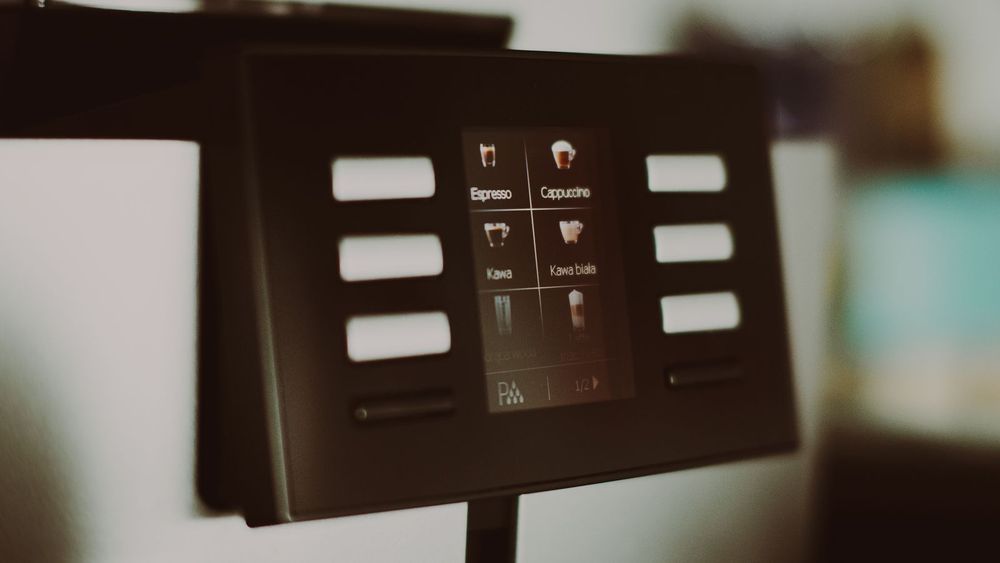
The short answer: Your budget decides less than the price lists suggest. Stiftung Warentest (Germany’s consumer testing foundation) writes (as of 17.07.2026) that minimalist bean-to-cup machines for roughly €280 to €630 often match the more expensive ones on espresso. More important are the hand movements after a milk drink, the brew unit and the running costs.
The catalogue on this site lists 18 bean-to-cup machines, with guide prices from about €229 to about €1,049 (mostly as of September 2026). The figures below come from our German reviews, from manuals and from the freely readable parts of Stiftung Warentest. We have not handled any machine and have measured nothing. Where a value comes from a calculation, it says so.
What does a bean-to-cup machine cost, and what do you get for it?
No source documents a fixed price threshold above which a bean-to-cup machine becomes good. Stiftung Warentest explicitly examines whether price and quality are related, and writes that from the same espresso beans the machines delivered quality that differed, in part considerably. According to its methodology, its prices come from Geizhals (a German price comparison site).
Our catalogue sorts itself like this:
| Price band (guide price) | Machines in the catalogue | Milk | Brew unit |
|---|---|---|---|
| under €400 | Tchibo Esperto mini 229, Grundig KVA 6230 229.99, Melitta Solo 268.98, De’Longhi Magnifica S 319.90 | steam wand by hand (Magnifica S, Grundig) or none at all (Solo, Esperto mini) | removable on all four |
| €400 to €800 | 13 machines, from Philips 5400 (424.48) to Siemens EQ600 (779) | automatic on all 13 | removable on twelve, fixed on the Jura E6 |
| over €800 | Jura E8 (1,049) | automatic, rinse starts by itself | fixed |
So the machines under €400 all have a removable brew unit. What they almost always lack is the automatic milk system. Prices from our price box and from the manufacturer sometimes differ widely: the Jura E6 is listed with us at €699, whereas the JURA online shop showed €899 to €979 on 24.09.2026, and the recommended retail price according to Jura’s announcement of 12.08.2025 was also there. Check the current price with the retailer.
Our assessment: do not start with the budget, but with the question of whether you drink milk drinks. Everything else follows from that.
Milk system: four designs, four hand movements
Whether a milk system is convenient depends on what you have to do after the drink. The catalogue knows four designs.
With the tube from an external container, the machines differ widely. The Jura E6 has one rotary knob per milk drink and requires daily cleaning with Jura milk system cleaner (about two minutes). On the Jura E8 the rinse starts by itself 15 minutes after the drink. The Siemens EQ600 and EQ6 plus clean with steam after every drink, and Nivona rinses after milk drinks with the tube plugged into another socket. The Saeco models GranAroma and Xelsis have a 0.6 l container, and you take the Cappuccinatore apart weekly.
Then there is the carafe on the machine (Rivelia, Dinamica Plus, Magnifica Plus). On the Rivelia it can be taken apart and is dishwasher safe. The Philips LatteGo (5400 and 5500) works without a tube, consists of two parts according to Philips (the manual additionally counts a storage lid) and is removed and rinsed after every milk drink. The fourth design is the steam wand by hand on the Magnifica S and Grundig KVA 6230: the frother comes off after every use and is cleaned.
According to its hygiene article of 27.07.2026, Stiftung Warentest gives the same advice for all milk systems: rinse after every milk drink, take the parts apart by hand according to the instructions, and empty the grounds container and drip tray daily, otherwise germs may form. It is therefore not possible to say that a tube system generally means more effort than a wand. Siemens rinses the milk system automatically with steam after every drink (autoMilk Clean), yet on the EQ6 plus the manual still requires cleaning after every use. The wand of the Magnifica S requires manual work.
Authorities have examined milk from commercial coffee machines: on 07.07.2025 the Kantonales Labor Zürich (Zurich cantonal laboratory) found Enterobacteriaceae above the guideline value in 4 of 15 samples. These were catering machines, not household machines, but it shows where germs can form in milk-carrying parts. De’Longhi specifies time limits for its carafes: hot milk at most 2 days in the fridge, cold milk at most 1 day, after that empty, take apart and clean. The water in the tank should be changed at least every 3 days for hot drinks.
We found no source documenting whether a steam wand or an automatic system makes the finer foam. More on milk temperature and fat content is in the guide How to froth milk.
Brew unit: removable or not?
16 of the 18 machines have a removable brew unit. Only the Jura E6 and E8 are fixed. On the E6, “fixed” does not appear verbatim in the manual; we conclude it from the fact that the manual nowhere lists the unit as a removable part. It is cleaned with a tablet programme, which is requested after 180 preparations or 80 switch-on rinses and runs for about 20 minutes.
The other manufacturers’ rhythms are far apart. You should rinse weekly on the Philips 5500, Saeco Xelsis and Tchibo Esperto mini. De’Longhi and Nivona prescribe at least once a month, with water only and never in the dishwasher. For the EQ600, Siemens mentions regular cleaning without a number and without washing-up liquid. On the Philips 5500, a degreasing tablet monthly and greasing every two months are added.
Stiftung Warentest lists weekly rinsing only as a recommendation of “many providers”. In a reply to a reader comment (08.01.2026), its editorial team advises servicing by a specialist workshop every one to two years.
We found no documentation that a removable brew unit prevents deposits or extends service life. According to workshops, the most frequent faults in 2018 were different ones (see below). In its announcement of 12.08.2025, Jura reports “very good” for the E6 on cleaning and descaling; that is a manufacturer’s statement. The tablet programme is Jura’s intended procedure, not an emergency solution. And because the unit is called brew group or brew unit depending on the manufacturer, a search for only one of the two words misses machines.
Grinder: what can be compared and what cannot
The manufacturers name different materials. In the data sheet, Siemens describes the grinder of the EQ6 plus as “made of wear-free ceramic”. Philips and Saeco state 100 per cent ceramic and 12 settings, and for the Xelsis, according to Philips, at least 20,000 cups. Nivona fits a conical grinder made of hardened steel; Melitta, Grundig and Tchibo name steel or stainless steel. Jura (only the designation P.A.G.2) and De’Longhi name no material.
We have found no independent measurement of heat, wear or taste for ceramic versus steel in household bean-to-cup machines. The statement that ceramic is harder but more brittle than steel is editorial knowledge from our German Xelsis review and not a manufacturer’s statement. Nivona excludes damage caused by foreign objects in the grinder, such as stones, from the warranty.
The number of settings also says little. Stiftung Warentest assesses the grind by the particle size distribution of the powder at the coarsest and finest setting. Our catalogue ranges from 5 settings (Melitta) through 7 (Jura E6) and 12 (Philips, Saeco) to 13 (Grundig, Rivelia according to the catalogue). How to adjust the grind is covered in the guide Bean-to-cup machine settings.
Running costs: a calculation with catalogue prices
There are no flat annual costs; the systems are too different for that. Stiftung Warentest puts water filters at a good €40 to over €100 a year (27.07.2026) and considers regular descaling generally cheaper. Our calculation with prices from September 2026:
| Item | Price | Annual calculation |
|---|---|---|
| De’Longhi filter DLSC002 | €7.49 per filter, change about every 2 months | six a year: €44.94 |
| Siemens BRITA Intenza | €19.99 for three, 50 l or at most 2 months | six a year: about €40 |
| Philips AquaClean | €19.99 for two, up to 95 l or at most 3 months | at least four a year: about €40 |
| Nivona CLARIS | €13.95 single, €39.95 for the set of three, about 50 l or 2 months | six a year: €79.90 in the set |
| Jura CLARIS Smart+ | €46.99 for three (€15.66 per cartridge) | depends on litres and hardness, see below |
Jura changes by volume only: 65 l at 1 to 5 °dH (German degrees of hardness), 40 l at 26 to 30 °dH. Assuming 365 litres a year (one litre a day, an assumption of our calculation), that would be 6 cartridges with soft water (about €94) or 10 with hard water (about €157). There are German reviews of the filters: De’Longhi DLSC002 and Siemens BRITA Intenza. Your water supplier can tell you how hard your water is; more on that in the guide Water hardness and coffee.
For descaling, De’Longhi EcoDecalk (€7.98 for 500 ml, five uses) costs about €1.60 per descaling. Jura’s 3-phase tablets (€9.99 for 6) come to about €1.67 per cleaning. How often descaling happens is not given as a fixed number in the sources for this calculation: on most machines the machine signals it according to the hardness setting, operating time or number of drinks. One exception is the Melitta CI Touch, for which the manual gives every 3 months without a water filter. Details in the guide Descaling and cleaning.
The biggest item can be the milk system. For the Jura E6, with four drinks a day, one of them a milk drink, we calculated about €272 a year, without a filter. Two thirds of that goes on the milk cleaner: one bottle (€14.99) lasts for 30 cleanings, and anyone making milk every day needs a good twelve. This is an example profile, not an average.
Beans come on top. Two drinks a day make 730 a year. With the 7 to 11 g per cup that Nivona gives, that is roughly 5 to 8 kg. At the per-kilo prices of our bean reviews (€13.63 to €35.95), this comes to roughly €70 to €290 a year. For opened packs, Stiftung Warentest advises using the beans within a few weeks. Basics on choosing are in the guide Coffee beans basics.
How long does a bean-to-cup machine last?
There is no reliable current figure. The last independent figure comes from Stiftung Warentest in 2018, based on the network of independent workshops and a survey of readers and workshops: bean-to-cup machines break down on average after five years, three times in ten years. Around a third of the repair requests there concerned bean-to-cup machines, and in 84 per cent of cases the machine was repaired. The most frequent weak points were the heater (on average €145), worn valves (€100) and the pump (€110). The foundation worked out an example: a machine costing €810 with three repairs at €118 each, the first after five years, costs less over ten years than two new machines.
The manufacturers calculate differently and in different units (survey 2018, not a measurement): De’Longhi 7 years, Jura 20,000 drinks, Melitta at least 15,000, Miele around 25,000. BSH and Philips gave no information. On spare parts, the Siemens manual for the EQ600 names original spare parts for up to 10 years after placing on the market. Stiftung Warentest now also rates repairability: an expert assesses the providers’ statements, and repair attempts are added on the heater, the pump and the seals on the brew unit and water tank. The results are behind the paywall.
How quickly a repair is done varies greatly. In 2021 the foundation sent bean-to-cup machines with the same three prepared faults to nine services, and the waiting times ranged from four working days to twelve weeks. The earlier text on this page said “five to eight years”. We found no source for that range, which is why it is no longer there.
Warranty: buying from a specialist retailer matters
Jura (25 months) and Nivona (24 months) tie their manufacturer warranty to purchase from an authorised specialist retailer. Nivona additionally requires purchase and operation in the EU. Jura excludes wear parts such as seals, grinding discs and valves, and Nivona excludes seals and valves as well as filters and cleaning as consumables. That is a reason to pay attention to the seller before buying, especially with prices far below the manufacturer’s shop.
Placement: dimensions and tank
Measure the niche before you order. De’Longhi requires 15 cm of clearance above the machine. For the Rivelia (390 mm high) that means 54 cm up to the underside of the cabinet, for the Dinamica Plus 380.95 51 cm. The Tchibo Esperto mini (about 16 x 40 x 30.5 cm) needs 150 mm of wall clearance, which gives about 46 cm of width, and according to the manual its tank is pulled out upwards.
The tanks in the catalogue hold 1.1 to 2.2 litres: Nivona about 2.2 l, Grundig 2.0 l, Jura 1.9 l (without filter), Rivelia 1.4 l, Melitta Solo 1.2 l, Esperto mini about 1.1 l. The housing height without the manufacturer’s clearance is 34 cm for Nivona, 34.8 for Jura, 37.7 for Philips and 38.2 for Siemens (according to our comparison page).
Profiles, app and number of drinks
Every manufacturer counts drinks differently. Siemens counts app programmes: the EQ600 has 22 drinks on the machine and 41 with the Home Connect app, 19 of them only via the app. De’Longhi gives 16 and 8 for the Rivelia, and Philips counts the travel mug. The number is therefore no use as a yardstick.
On profiles, the reviews are more precise. The Philips 5400 stores four profiles plus a guest and works without an app, the 5500 has two plus a guest, the Saeco GranAroma four plus a guest. On the 5400, the settings end up in the active profile after every drink.
What Stiftung Warentest examines, and what we do not conclude from it
The foundation’s page of 17.07.2026 lists 36 machines, 13 of them new, with quality ratings ranging from good to satisfactory. Who is in front is behind the paywall, so we name no winner. The weightings are freely readable: espresso 20, cappuccino 20, daily use 20, handling 20, environmental properties 10, pollutants 5 and safety 5 per cent. Four coffee sommeliers taste first at factory settings, then after their own optimisation. Handling includes cleaning the milk system and brew unit, and environment includes whether the recommended descaler contains sulfamic acid. According to the page, older results from the programme up to 12/2025 are not comparable.
You need to put manufacturer advertising into context. In an announcement of 12.08.2025, Jura writes that in the online publication of June 2025 the E6 received the rating good (2.0) and “a first place”. The predecessor variant with eleven specialities is the one described; today’s E6 ED has 17. In its newsroom (21.11.2024), De’Longhi calls the Rivelia the winner of the foundation’s examination; we have not checked its current placement.
Bean-to-cup machine, espresso machine or single-serve machine?
If you are unsure whether a bean-to-cup machine suits you at all, the comparison Bean-to-cup machine or espresso machine helps. If you are considering capsules or pods, you will find the cost calculation in Capsule or pod machine. How to readjust a bean machine when the cup is too thin or too bitter is not covered here but in Bean-to-cup machine settings. For espresso machines there is the Espresso machine buying guide.
Which machine suits which household?
From the figures above follows an order of questions: milk or no milk, how much manual work after the drink, how much space, how much running cost.
| Model | The difference | Price | Our rating | Choose this if |
|---|---|---|---|---|
| Tchibo Esperto mini | no milk system, 16 cm wide | approx. €229 | 8.0 | you drink black coffee and have little space |
| De’Longhi Magnifica S | steam wand by hand | approx. €319.90 | 8.3 | you make one or two milk drinks a day at most |
| Philips LatteGo 5400 | LatteGo in two parts, no tubes | approx. €424.48 | 8.6 | you are happy to rinse the milk yourself after each drink, but without a tube |
| De’Longhi Rivelia | two bean containers of 250 g, one grinder | approx. €660 | 8.9 | you switch between two varieties |
| Siemens EQ600 | tube with steam cleaning after every drink | approx. €779 | 8.8 | the hand movement after the milk drink should disappear |
| Jura E8 | rinse starts by itself after 15 minutes, brew unit fixed | approx. €1,049 | 9.4 | you do not want to take the brew unit out and the budget is there |
The table compares guide prices from September 2026. The rating is our editorial assessment based on data. More models are in our German ranking of the best bean-to-cup machines 2026 and in our German bean-to-cup machine hub.
Two limits from the reviews: according to the review, the Magnifica S makes sense only for one or two milk drinks a day at most. According to the review, the Jura E6 (approx. €699, 17 specialities) suits up to about eight drinks a day, of which one or two at most with milk. The Nivona NICR 790 (approx. €750) has a 2.2-litre tank and draws milk from a container of your choice.
If you do not want to commit, our German coffee finder narrows it down with a few questions.