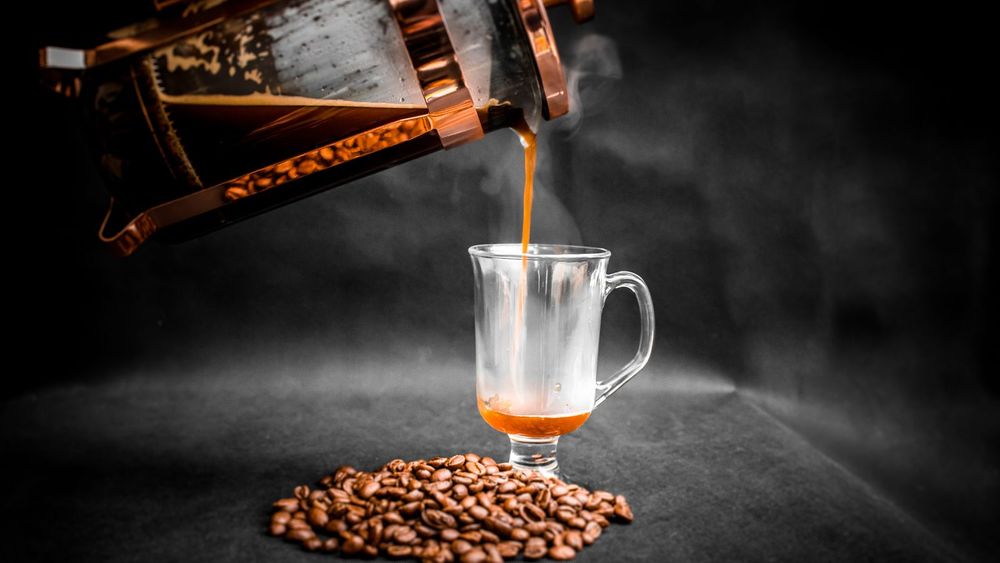
The short answer: Grind coarse, pour on hot but not boiling water, let it steep for four minutes and press slowly. Bodum, Espro and Grønenberg agree on this; we would pour out straight afterwards (see step 7). On the ratio, manufacturer figures range from 1:12 to 1:18 (Espro); we would start at 1:15, so about 30 g of coffee per 450 ml of water.
Making French press coffee: the instructions step by step
The order follows Bodum’s combined instructions for its coffee makers (2019 edition). Where Espro or Grønenberg do something differently, it is noted at the relevant step.
- Weigh the coffee and grind it coarse. The amount is in the section on the ratio; why Bodum allows only coarsely ground coffee is in the section on grind size.
- Put the grounds into the empty pot and place the pot on a coaster or trivet. Bodum explicitly requires this.
- Pour on hot, not boiling water and leave at least 2.5 cm free at the top. Grønenberg splits the pour: first only enough water to cover the grounds, let it bloom for 30 seconds, then fill up. Bodum has no such intermediate step.
- Stir once. Our reasoning: lumps that float dry on top have no contact with the water. Then put on the lid with the plunger pulled up, and with Bodum turn it so that the spout is closed (according to the instructions, this is not possible with the Brazil series).
- Let it steep, according to Bodum for at least four minutes. What other manufacturers state is further below.
- Press slowly. Bodum writes: “The best results are achieved by pressing the plunger down slowly with minimal pressure.” Hold the handle firmly and turn the spout away from you. According to Bodum, excessive force can make an already damaged pot break, and then hot water shoots out.
- Pour out, into cups or a second pot. We would do this straight after pressing. Our reasoning: after four minutes extraction is not at its end (see the next section), and with a simple metal screen the coffee stays in contact with the grounds beneath it. For its double filter, Espro says it stops extraction when you press. Only the liquid below the filter keeps brewing with the grounds, and you should not drink that. So leave a remainder in the pot.
What happens in the pot while it steeps
The French press is a full immersion method: grounds and water sit together the whole time, and nothing runs through. Liang, Chan and Ristenpart at UC Davis studied exactly this principle (2021, Scientific Reports 11, 6904). In the lab they brewed in 1 l beakers, with brew ratios from 2 to 25 and temperatures from 80 to 99 °C. There was no French press on the bench; it appears in the paper only as an example of immersion.
Three results matter for the pot at home. First, the share of dissolved solids (TDS, total dissolved solids) rises with time and only reaches a plateau after about 20 minutes, which is how the authors summarise it for all ratios and temperatures examined; at lower temperature it took longer according to their curves (more on this below). So after four minutes extraction is not finished, it is interrupted. According to the authors, anyone who wants to extract less has to stop earlier.
Second, the extraction yield at equilibrium settles near 21 per cent (20.70 ± 1.08 per cent from a brew ratio of 3 upwards), almost independently of how much coffee is in the water. Instead, the ratio shifts the strength: TDS falls roughly in inverse proportion to the ratio. The authors conclude that the simplest way to change the taste of an immersion brew is the brew ratio.
Third, temperature, grind size and stirring mainly change the speed. Finer grounds reached only slightly higher values at equilibrium, with yields between about 19 and 23 per cent.
The Brewing Control Chart shows how this relates to taste. In the classic version after Lingle (2011), the ideal zone lies at about 1.15 to 1.35 per cent TDS and 18 to 22 per cent yield. Guinard and colleagues (2023, Journal of Food Science 88(5), funded by the SCA, the Specialty Coffee Association) revised the chart with newer sensory data: acidity and citrus notes appeared at high strength and low yield, bitterness and roast notes at high strength and high yield. The measurements were made on filter coffee. Neither study determined where a French press lands on this chart after four minutes.
How much coffee for how much water?
There is no standard. We found no SCA recipe or SCA standard specifically for the French press, and the manufacturers calculate differently:
- In its FAQ, Espro gives the ratio as 1 g of coffee to 15 to 18 ml of water.
- The Espro brewing guide for the 18 oz pot scales by roast: 1:18 for dark, 1:15 for medium, 1:12 for light roasts and cold brew.
- Bodum doses in spoons. The instructions give one heaped tablespoon or one Bodum measuring spoon per cup of 1.25 dl, and the Chambord product page gives one heaped teaspoon per cup of about 120 ml. The two Bodum sources contradict each other, and neither gives a figure in grams.
- Angeloni and colleagues (2023, European Food Research and Technology) brewed their French press in the lab with 25 g in 250 g of water at 95 °C for five minutes, so 1:10.
Spoons are the least precise measure here, because a heaped spoon is not standardised and Bodum does not say how much its measuring spoon holds.
Our assessment: start at 1:15, for example 30 g of coffee in 450 ml of water. That is within Espro’s range and is Espro’s value for medium roasts. If the coffee is too thin for you, use more coffee rather than more time, up to 1:12, as Espro sets for light roasts. According to Liang et al., that adjusts exactly the quantity that makes the difference in immersion.
| Water | 1:18 (Espro, dark roast) | 1:15 (Espro, medium roast) | 1:12 (Espro, light roast) |
|---|---|---|---|
| 300 ml | 17 g | 20 g | 25 g |
| 450 ml | 25 g | 30 g | 38 g |
| 700 ml | 39 g | 47 g | 58 g |
| 900 ml | 50 g | 60 g | 75 g |
The gram values are our calculation from the Espro ratios, rounded.
How long should French press coffee steep?
Four minutes is the figure most manufacturers can agree on, but not all of them mean the same thing by it. In its instructions Bodum says at least four minutes, and on the Chambord product page four. In its brewing guide Espro says up to four minutes, and in a blog article generally four to five, depending on preference three to six. After the 30 seconds of blooming, Grønenberg allows four minutes. For the Preziosa, Bialetti states at least four in the instructions and about five minutes on the Italian product page. The grinder manufacturer Wilfa assumes six minutes, and the lab recipe of Angeloni et al. five.
None of these sources documents that bitter compounds take over from five minutes on; two manufacturers themselves recommend five and six. Only the direction is documented: with every minute extraction keeps rising, up to the plateau, which is reached after about 20 minutes at 99 °C and later at lower temperatures.
Our assessment: stay at four minutes until ratio and grind size are right, and only then adjust the time. Espro’s rule of thumb: if the coffee is too bitter, let it steep for less time; if it is too thin, use more coffee or wait a little longer.
Water temperature: just below boiling
Bodum’s instructions say only “hot, not boiling”, without a temperature. On the Chambord product page Bodum gives about 92 to 96 °C. Espro gives 195 to 205 °F, which converts to roughly 91 to 96 °C, and writes that boiled water is at 212 °F and should be left to stand for a few moments. In the instructions Grønenberg gives 94 °C, on the product page 90 to 94 °C, and as a rule of thumb: leave the kettle to stand for one minute after it has boiled.
Liang et al. found the equilibrium of immersion between 80 and 99 °C hardly dependent on temperature, but the speed very much so. Hotter water reached a stable TDS value faster: at 99 °C and a brew ratio of 5, the brew was above 4 per cent TDS after 20 minutes, while at 94 and 80 °C that took more than 30 minutes. Because the French press is stopped well before equilibrium after four minutes, hotter water extracts more in that time; that is how we read these curves. Batali, Ristenpart and Guinard (2020, Scientific Reports 10, 16450) had a trained panel assess 270 brews at 87, 90 and 93 °C, matching strength and yield so that temperature would not act through extraction. The study concerns filter coffee, not the French press. Only the attribute nutty differed significantly.
Our assessment: we would stick to Bodum’s 92 to 96 °C, because all three manufacturers are in that range. Without a thermometer, Grønenberg’s minute after boiling is enough. All three avoid boiling water, and in its blog article on steep time Espro gives the reason: it can lead to bitter coffee.
Which grind size suits the French press?
Coarse, say Bodum, Espro, Bialetti and Grønenberg unanimously. Bodum and Bialetti justify this not with taste but with safety: finely ground coffee could clog the filter and build up pressure in the pot. Espro argues similarly. The Deutscher Kaffeeverband (German Coffee Association) is a touch more cautious and in its brochure writes of a “medium to coarser grind” for the French press; the finer the grind, the more aroma compounds could dissolve.
Where “coarse” sits on your grinder is in its manual. Baratza sets the French press at step 28 of 40 on the Virtuoso+ and at 32 on the Encore ESP, Sage at 55 to 60 of 60 on the Smart Grinder Pro and at 46 to 55 on the Dose Control Pro. Wilfa gives 30 to 38 of 41 for the Uniform, Comandante 25 to 35 clicks for the C40. These values apply per device and cannot be converted between them. More on this is in the guide Setting your grind size.
On the type of grinder: Stiftung Warentest (Germany’s consumer testing foundation; magazine issue 12/2019, 15 grinders) sees blade grinders as suitable for occasional use, and says a good result is hard to repeat with them; a burr grinder, once set, delivers the same grind size every day. The ETM Testmagazin (5/2025) writes that blade grinders never grind quite uniformly, which is still passable for the French press. Nobody has measured whether fine dust from blade grinders is the main cause of sediment in the cup. And more uniform does not automatically mean more extraction: in the lab experiment by Angeloni et al. with an EK 43, unsieved grounds with two particle size peaks extracted more than sieved, uniform fractions, with the yield at 21.4 ± 0.9 per cent. Taste was not assessed there. Our assessment: a burr grinder is worthwhile for the French press because of the repeatability. Which grinders come into question is covered in the grinder guide.
The numbers at a glance
| Variable | Range in the sources | Who says what | Our starting value |
|---|---|---|---|
| Ratio | 1:10 to 1:18 | Espro 1:12 to 1:18, Angeloni et al. 2023 1:10 (lab), Bodum only spoons | 1:15 |
| Steep time | 3 to 6 minutes | Bodum at least 4, Espro up to 4 (blog 3 to 6), Bialetti 4 to 5, Wilfa 6 | 4 minutes |
| Water temperature | 90 to 96 °C | Bodum product page 92 to 96 °C, Espro 195 to 205 °F, Grønenberg 90 to 94 °C | 92 to 96 °C |
| Blooming | 0 or 30 seconds | Grønenberg 30 seconds, Bodum none | as you like |
| Grind size | coarse to medium | Manufacturers coarse, Coffee Association medium to coarser | coarse |
| Headspace at the top | at least 2.5 cm | Bodum instructions | 2.5 cm |
Which pot size suits you?
Bodum offers its glass beakers in four sizes and calculates with a cup of 1.25 dl:
| Nominal volume | Cups according to Bodum |
|---|---|
| 0.35 l | 3 |
| 0.5 l | 4 |
| 1.0 l | 8 |
| 1.5 l | 12 |
Espro builds its pots at 530 and 950 ml. For the large P5, the product page gives about 710 ml as the minimum brew quantity.
Two things make the usable quantity smaller than the nominal volume. Because of Bodum’s 2.5 cm headspace, a 1 l pot does not take a full litre of water. And the grounds hold back liquid: in the lab, Liang et al. measured on average 2.48 ± 0.19 g of liquid per gram of coffee. As a rough estimate of our own: 30 g of coffee holds back about 75 g, so from 450 ml of water more like 375 ml ends up in the cups. In a pot with a plunger the value may differ, but nobody has measured it there.
Our assessment: choose the pot by the number of mugs you need at once, not by Bodum’s cup figure. For the one-litre Chambord, in our German review we arrive at four to five with 200 ml mugs.
Why does French press coffee taste bitter, watery or full of sediment?
| Symptom | Likely cause | What you change | Source |
|---|---|---|---|
| Thin, watery | Too little coffee per water, brew strength is low | More coffee, for example from 1:15 to 1:12 | Liang et al. 2021; Espro blog |
| Bitter | High strength and high yield | Less coffee, shorter steep, do not pour on boiling water | Guinard et al. 2023 (filter coffee); Espro blog |
| Sour | High strength at low yield | Steep longer so that more dissolves | Guinard et al. 2023; Liang et al. 2021 |
| Sediment in the cup | Fines pass through the metal screen | Grind coarser; a pot with a finer screen | Bodum, Espro; our German review of the Espro P3 |
| Plunger is hard to press | Ground too fine, the screen clogs | Pull the rod out, stir, press slowly again; coarser next time | Bodum instructions; Espro FAQ |
Water that is too hot is included in the bitter row. Espro warns against boiling water, and according to Liang et al. hotter water dissolves faster and so drives the yield up in the same steep time. How strongly that can be tasted in the cup after four minutes was not examined by any of the studies. One often-cited cause is left out on purpose: that pressing too hard brings more sediment into the cup is not stated in any source; Bodum justifies pressing slowly with better results and the risk of breakage.
Some fines at the bottom of the last cup come with the design. In our German review of the Bodum Chambord, it is listed as a drawback of the method, not of the model.
Cleaning a French press properly
Bodum requires that the filter unit be unscrewed and cleaned after every use. Grønenberg gives the same reason: residues in the plunger could turn rancid over time and affect taste and hygiene. Without a paper filter the coffee oils go into the cup, and presumably some of them stay on the screen and plates.
- Empty out the grounds and rinse the pot with warm water.
- Unscrew the press unit: screen, cross plate and spiral plate on Bodum, the two screens on Espro.
- Wash the parts one by one. Espro specifies water and soap, meaning washing-up liquid, so that the oils come off.
- Dry everything before you reassemble the unit, as Grønenberg requires in its instructions.
On the dishwasher, the manufacturers differ. Bodum: “Only the filter and the glass, plastic and chrome parts are dishwasher safe.” Espro allows all parts on the top rack, but warns that the machine can shorten the life of the glass, and recommends a deep clean once a month with its own cleaner. Grønenberg approves the stainless steel pot for the dishwasher, coloured variants by hand only. In the Preziosa instructions, Bialetti recommends hand washing and crosses out the dishwasher symbol, while the product pages call the glass dishwasher safe.
None of these manufacturers says anything about limescale on the screen, neither about descaler nor about vinegar or citric acid. General advice exists only for other appliances: the Verbraucherzentrale (German consumer advice centre) names diluted citric acid for kettles and coffee machines, and Stiftung Warentest warned against vinegar for coffee machines in 2003 because it could attack metal and plastic parts. Whether this carries over to the seals of your pot, none of the sources says. In that case we would ask the manufacturer. More on limescale and water is in the guides on descaling and cleaning and water hardness.
French press or pour-over: what is the difference?
The filter. Paper holds back what a metal screen lets through. The Deutscher Kaffeeverband explains it this way: with filter coffee, few fats get into the coffee, because the pores of the filter hold back larger molecules. In the French press, oils and fines come into the cup.
A paper by Gloess and colleagues (2013, European Food Research and Technology 236) hints at what this means for body. They compared nine preparations, including a lungo from the French press, instrumentally and by sensory analysis. The amount of total solids was linked there to texture and body, caffeine and chlorogenic acids to bitterness and astringency. The abstract does not provide a direct comparison of French press against pour-over for body. How the pour-over works is explained in Pour-over and filter coffee; for a single cup the AeroPress is also an option, and the direct comparison is in AeroPress or French press.
On the material of the pot, the calculation is less clear-cut than often claimed. Glass shows the fill level but is not shatterproof: in the data sheet Bodum lists the Chambord under Shatter Proof with No. Double-walled stainless steel is opaque and needs no glass component. It is not necessarily more expensive. In our price box on Amazon.de, the double-walled OZAVO Thermo is at about €27.99, below the glass Chambord at about €34.99.
Which pot from our comparison?
All details come from our German reviews, the prices from our price box.
- Bodum Chambord: borosilicate glass, 1 l, frame of chrome-plated stainless steel. Bodum lists the glass, screen and both plates individually as spare parts. About €34.99.
- Bodum Brazil: the same glass and the same range of spare parts, but a housing of BPA-free plastic. About €16.89.
- Amazon Basics French Press: 1 l, according to Amazon five to six cups, hardly any manufacturer documents and no documented spare parts offer. At about €11.54, the pot with the lowest price in our category.
- Bialetti Preziosa: 1000 ml glass in a stainless steel carrier. The Bialetti shop does not carry replacement glasses. About €26.90.
- Espro P3: 530 ml, two micro filters with silicone seal, plastic frame. About €29.75.
- Espro P5: 950 ml, the same double filter in a stainless steel cage. About €50.
- Grønenberg Edelstahl Thermo: 1 l, double-walled 304 stainless steel, no glass. About €36.99.
- OZAVO Thermo: 1000 ml, double-walled, with a three-layer plunger filter and five spare filters in the box.