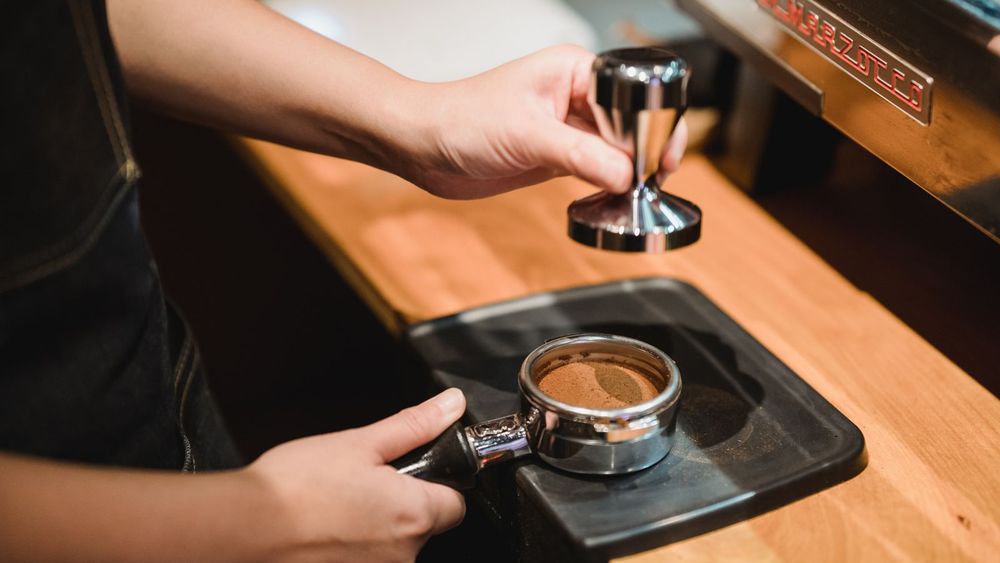
The short answer: With coffee gifts, fit matters more than price. Cleaning products, water filters, tampers and baskets are tied to the person’s brand and machine. If you do not know them, a voucher, a small amount of beans or a device with no system tie-in is the safer choice. According to our reviews, a portafilter espresso machine in our catalogue costs between €123.99 and €1,187.29 on Amazon.de, and a grinder usually comes on top as a separate item.
Three questions before you put anything in the basket
Which machine is in the kitchen? Bean-to-cup machine, portafilter machine, filter machine, moka pot or none of these. That answer alone decides whether accessories fit, and for cleaning products and water filters the brand matters too.
How does the coffee become powder? The Deutscher Kaffeeverband (German Coffee Association) writes that whole beans are used for portafilter machines and bean-to-cup machines and are ground only shortly before brewing. Pre-ground coffee suits the filter coffee machine. Grinding breaks open the cells and volatile aromas escape. If you give accessories to someone with a portafilter machine, think of the grinder at the same time.
How much do they drink? A kilo pack is too much for two cups a week, as the freshness figures further down show.
If you know nothing about any of the three, ask someone who does, or go for a voucher or a small amount of beans. If you want to pick a machine, the guide Bean-to-cup vs espresso machine helps with the choice between a bean-to-cup machine and a portafilter machine.
What a coffee gift can cost
We found no survey on coffee gifts. The only reliable German figure concerns Christmas as a whole: in a YouGov survey for the Handelsverband Deutschland (HDE, the German Retail Association) from October 2025, respondents planned to spend €263 on gifts on average, €34 less than the year before, and a quarter planned less than €100. Just over 2,000 people aged 18 and over were surveyed. We only know the figures from FashionUnited’s reporting, as we could not read the original HDE release. This is the total budget, not the price of a single gift.
We have therefore dropped blanket ranges such as “€20 to €60 for most gifts”. The table instead shows examples from our catalogue with the prices from the reviews and, for each, the condition that should be clear beforehand. They are examples, not a market distribution.
| Example from the catalogue | Price | Clarify first |
|---|---|---|
| Vicloon Tamper 51 mm | approx. €10.79 | Inside diameter of the basket (the mat in the set is for 58 mm) |
| De’Longhi milk jug DLSC060 | approx. €16.99 | Is the milk frothed by hand with a steam wand? |
| Hario V60 Starter Set | approx. €24.87 | Scale, grinder and kettle already there? |
| Normcore WDT tool V2.1 | approx. €25.99 | Is there a portafilter machine? |
| Bialetti Moka Express | approx. €28.87 | Which type of hob? |
| AeroPress Original | approx. €41.08 | Paper filters at home, a suitable grinder |
| Timemore Chestnut C3 ESP Pro | approx. €91.99 | Should it grind for espresso? |
| Baratza Encore ESP | approx. €179.95 | Is there already a grinder? |
| Comandante C40 MK4 | approx. €236.90 | A clear budget and a wish for a hand grinder |
| Sage Barista Express Impress | approx. €379.00 | Does the person want to learn espresso? |
The table is not suitable as a price comparison across retailers. The prices are our reference values, and the right-hand column is our assessment of which question to ask first.
Accessories and care: what depends on brand and machine
Where the manufacturer states a diameter, the portafilters in the catalogue differ. The Sage models Bambino Plus, Barista Express, Impress, Pro and Touch have 54 mm, the Gaggia Classic Evo Pro and Classic Up 58 mm. For Lelit, the manufacturer gives 58.55 mm for the LELIT58 group of the Elizabeth and the Victoria, while the Anna has a different group at 57.35 mm. Rancilio names a 58 mm tamper for the Silvia but no group diameter, and De’Longhi and Ninja give no diameter. Tampers, baskets and WDT accessories depend on the diameter. The Sage Smart Grinder Pro comes with two holders (50 to 54 mm and 58 mm), which is an exception.
With cleaning products the situation is worse. JURA 3-phase cleaning tablets cost approx. €9.99 for six, which is around €1.67 per cleaning. JURA tunes them to the cleaning programme of its own bean-to-cup machines, and the instructions for the Z10 and A1 require JURA care products. The Coffeeano tablets (approx. €12.99 for 80, around 16 cents per cleaning) are intended for all brands according to the supplier, but do not fit the insertion slot on the Krups EA. Coffeeano itself writes that the machine manufacturer’s instructions take precedence. The product carries the signal word Danger (H318) and does not descale.
Descalers follow the same logic. The durgol swiss espresso (approx. €13.80 for four 125 ml bottles) is not intended for filter machines and kettles, and for tanks over one litre a descaling needs two bottles. The De’Longhi EcoDecalk costs approx. €7.98 for 500 ml, is enough for five uses and is corrosive according to the leaflet. If the machine’s instructions prescribe a product, those instructions apply. As a surprise without knowing the machine, this is a risky purchase.
The Urnex Cafiza (approx. €12.55 for 566 g) is only worth it for backflushing if the portafilter machine has a 3-way valve and a blind basket that fits the portafilter is available; this is how Sage UK describes it. Without both, soaking remains the option.
Water filters are tied to brands. The De’Longhi DLSC002 (approx. €7.49) only fits De’Longhi machines with a filter coupling in the tank. The Siemens Brita Intenza cartridges (three pieces, approx. €19.99) are for Siemens EQ and built-in bean-to-cup machines, and the Philips AquaClean CA6903/22 (two filters, approx. €19.99) for Philips and Saeco machines with the AquaClean sticker. According to these documents there is no water filter set that fits every machine.
Milk jugs are less tricky, but only useful if the person froths with a steam wand. Sage UK advises filling the cold milk only up to half; the De’Longhi DLSC060 holds 350 ml, which is 175 ml when half full. For latte art, Sage UK names a narrow spout and a rather small jug, which keeps the heat better while frothing. The source does not speak of a “pointed” spout. The NewGF jug (approx. €11.04, 350 ml, with a latte art pen) has no manufacturer website and no instructions. For electric frothers, the catalogue has devices from approx. €20 to €130, for example the Rafow 4-in-1 (approx. €29.97, up to 130 ml of foam) and the Nespresso Aeroccino 3 (approx. €79.00, 120 or 240 ml); the Covvy is a manual pump for 400 ml at approx. €12.99.
Mistakes with cause and fix
| Mistake | Cause | Better |
|---|---|---|
| Tamper does not fit the basket | Diameter not measured | Ask for the basket’s inside diameter, otherwise a voucher |
| Cleaning tablets end up in a cupboard | Machine brand unknown | Care products only with the brand known |
| Precision scale with “0.1 g accuracy” | Resolution and accuracy mixed up | Read the data sheet, see below |
| Portafilter machine without a grinder | No grind setting | Plan the grinder as a separate item |
| Kilo pack of beans | Quantity does not match consumption | 250 g or a voucher |
The table summarises causes that can be derived from the manufacturers’ information. We do not know how often they occur in practice.
On scales: the Bagail coffee scale (approx. €39.99) displays in 0.1 g steps, has a capacity of 3,000 g and a timer. The manufacturer only promises exact readings from 0.3 g, however. So 0.1 g is the display step here, not the accuracy. The Maestri House Mini (approx. €29.99) weighs up to 2,000 g, and its timer ends at 9:59. The product page advertises water resistance, the manual does not call the scale waterproof, and the warranty is given as one or two years, depending on the source.
For WDT tools, both catalogue models are under €30: Normcore V2.1 (approx. €25.99, 50 mm needles) and Subminimal Flick (approx. €29.95, retractable needles, 0.5 mm as delivered). Our reviews do not measure any effect on espresso quality. The Motta 8100/M costs approx. €23.97, is 58 mm with a wooden handle and should be washed by hand.
Hand grinder and portafilter machine: what belongs together
The catalogue lists ten hand grinders, from the Hario Mini Slim Plus at €31.14 to the Comandante C40 MK4 at €236.90. Not a single one lies between €69.00 and €91.99. A “hand grinder for around €80” therefore does not exist with us.
What matters more is what the manufacturer permits. According to the reviews, only the Comandante C40, 1Zpresso J-Ultra, the two Timemore models (C3 and C5 ESP Pro) and the KINGrinder K6 explicitly provide for espresso. Not intended for it are the 1Zpresso Q Air (€69.00, grind reference of 23 April 2026 without an espresso range), the Porlex Mini II (espresso only on the Mini Professional model), the Hario Skerton N and the Hario Mini Slim Plus, whose tables contain no espresso machine. Our conclusion: for owners of a portafilter machine, a hand grinder is worthwhile from around €92. Below that it is a gift for filter, French press or AeroPress. All models are in the hand grinder section of our German site.
The Timemore C3 ESP Pro is the cheapest with an espresso dial. As of 7 September 2026, timemore.com and timemoreeu.com have no spare parts section, to our knowledge. The KINGrinder K6 (approx. €99) has 240 clicks of 16 micrometres each, its manual gives starting values, and for espresso the manufacturer gives 40 clicks as a starting point. The retailer list names no German specialist retailer, and the crank cannot be folded onto the body. The Comandante C40 MK4 has 49 spare parts items, and its RRP is €269. In its own FAQ Comandante gives 7 to 13 clicks for espresso, and the finer Red Clix RX35 adjustment costs €42 extra. The manufacturer publishes no measurement of the grind result, so a documented quality advantage is missing.
If you want to put the gift in a rucksack: the Hario Mini Slim Plus holds 24 g per fill. According to the instructions, its ceramic burr can jump or break on impact or a fall. “Shatterproof” therefore does not apply to any of the hand grinders we read about.
For electric grinders, those for a portafilter machine start in the catalogue at approx. €87.99 (the Rommelsbacher EKM 200 at €54.99 and the Caso Barista Crema at €39.99 advertise espresso but have no portafilter holder): the Rommelsbacher EKM 400 has settings 1 to 5 for pump espresso machines according to the instructions, and its removable portafilter holder is designed only for approx. 60 mm diameter. The De’Longhi Dedica KG 520M (approx. €131.89) grinds into the portafilter via an accessory part, according to De’Longhi only for standard sizes. The Graef CM800 costs approx. €139.99, and the Baratza Encore ESP with a 40 mm burr and 40 settings including an espresso zone approx. €179.95. For a portafilter machine gift, depending on the grinder, roughly €90 to €180 therefore comes on top as a separate item, based on these four models.
And the portafilter machine itself? The catalogue runs from the De’Longhi Dedica EC685 at €123.99 via the La Specialista Arte (€369.00, integrated grinder) and the Sage Barista Express Impress (€379.00) to the Lelit Elizabeth at €1,187.29; the Gaggia Classic Up is at €950.89. The Sage Barista Express is at €489.00 and the Bambino Plus at €479.90 without a grinder. The earlier rule of thumb “over €500: portafilter machine with a stand-alone grinder” therefore applies only to part of the catalogue: under €500 there are portafilter machines with a built-in grinder.
The Impress has a conical burr grinder and assisted tamping, plus a 54 mm portafilter. According to our review, the Dedica comes with pressurised or double-wall baskets and therefore runs without an espresso grinder. That does not replace a grinder if the person wants good espresso; we have no measurement on this. In the Barista Express instructions, Sage explicitly distinguishes: single-wall baskets for freshly ground beans (less than 30 days after roasting), double-wall baskets for pre-ground coffee or coffee without a roast date. According to the manufacturer, a portafilter machine can therefore also be used with bought powder. Our assessment: freshly ground beans remain the Kaffeeverband’s recommendation, but “worthless without a grinder” is wrong.
For bean-to-cup machines we have evaluated only a sample of six models: Melitta Solo €268.98, De’Longhi Magnifica S €319.90, Magnifica Plus €649.99, Nivona NICR 790 €750, Siemens EQ600 €779 and Jura E8 €1,049. That is not a complete price list of the catalogue.
Pour-over, French press, AeroPress, moka pot: small gifts with a catch
All four count as cheap ways in. “No learning curve” and “ready to use straight away” are true of none of them, and that has to do with the grinder.
For the press pot, Bodum requires coarsely ground coffee, as finely ground coffee can clog the filter. The Bodum Chambord costs approx. €34.99, has 1 litre of borosilicate glass and a replacement glass for €18.90; glass breakage is not covered by the warranty according to the Bodum FAQ. The Espro P3 (approx. €29.75, 530 ml) has two filters that must be washed individually after every brew, and it too is only for a coarse grind. The Amazon Basics is the cheapest pot in the category at approx. €11.54, and there is hardly any manufacturer documentation for it.
On the AeroPress Original, the brewing chamber holds 296 ml, which the manufacturer says is one to two cups. Every cup is manual work: grind, dose, pour, stir, press. Paper filters must be in the house (350 pack) or a stainless steel filter for US$14.95. The manufacturer’s recipes scale temperature and quantity by roast, for the AeroPress Go (approx. €44.00) for example 80 to 85 °C. The Go holds 8 ounces, around 237 ml, all parts fit in the mug, which may only go in the top rack of the dishwasher. The Go Plus model with an insulated mug costs US$89.95 but leaves no room for the AeroPress in the mug.
The Hario V60 Starter Set contains a size 02 dripper, a 600 ml glass server, a measuring spoon and filter paper. Scale, grinder and kettle are missing. Hario UK expresses the recipe in grams, 15 g to 250 ml according to our review. The Chemex for 6 cups (approx. €56.67) is intended only for Chemex’s own bonded filters, the warranty excludes breakage, and the lid costs extra (US$9.50). If you give a pour-over dripper, you also give filter paper.
For the moka pot, Bialetti names gas and electric for the Moka Express (aluminium, 6 cups). For induction you need the induction plate (€19.90), because aluminium does not couple with the field. The Bialetti Moka Induction (approx. €26.14) is induction compatible but has only 2 cups; the Morgenheld Flow (approx. €39.95) is made of stainless steel and is induction compatible. We have dropped “works without electricity”: a moka pot needs a heat source. The manufacturer of the Morgenheld Flow names camping as a use, but our review did not check this.
Giving beans: quantity and freshness
How fast coffee ages depends on what you measure. The Kaffeeverband writes that with an opened pack, even laypeople can taste a change after four weeks at the latest. Ground coffee loses aromas sooner than whole beans. In 2019 Stiftung Warentest wrote in a grinder comparison that ground coffee loses its aroma within a very short time, without a measurement series. We would therefore only say “weeks to months” and prefer beans.
After roasting, beans degas, for hours up to two months according to the Kaffeeverband. Smrke et al. (2018, Journal of Agricultural and Food Chemistry) describe CO2 release as a freshness indicator: part of the gas stays in the bean and escapes abruptly during grinding. How fresh beans need to be for espresso is an open question. In one set of instructions Sage gives two limits, 2 weeks and 4 weeks from the roast date; there is no standard.
Two kilo packs from our catalogue: Incapto Single Origin Colombia at €35.95 per kilo (the 84 SCA points are a manufacturer claim with no testing body and no date) and 360° Rundum Ehrlich Bio Honduras at €35.59 per kilo, the second-highest kilo price among 23 bean reviews. For 360°, the roast date and best-before date are missing on the product page and in the Amazon catalogue. That does not suit light drinkers; if you want to buy less than a kilo, look for smaller packs in the bean section of our German site.
We give no price for sample packs, as we have no catalogue value.
When to buy: shipping, exchange, voucher
Two to three weeks before the occasion is our recommendation, not a law. The only thing documented is what the parcel carrier says: DHL describes Christmas as the busiest time of the year with high shipment volumes. For regular collection up to and including Tuesday 22 December 2026, parcels are generally delivered by Thursday 24 December according to DHL; there are no collections on 24 December. This applies to business customers, that is, to retailers. When your order will arrive is not stated there. We could not document whether small roasteries only roast to order and whether deliveries back up.
In a shop, according to the Verbraucherzentrale Hamburg, “once bought, it’s bought”. There is no statutory right of exchange if you simply do not like the item; taking it back is goodwill, and the retailer must take it back only for defects. Ask when buying whether they exchange. Online, the right of withdrawal applies: 14 days after receiving the goods, without giving reasons. The period runs from delivery, not from the gift-giving. Example: a hand grinder delivered on 20 November can be withdrawn from until 4 December. By Christmas the period is then over.
Vouchers usually run for three years. The worry that you are giving “just a deadline” is therefore overstated across the board. The risk lies more with the provider, if it closes, and with whether the person shops there at all.