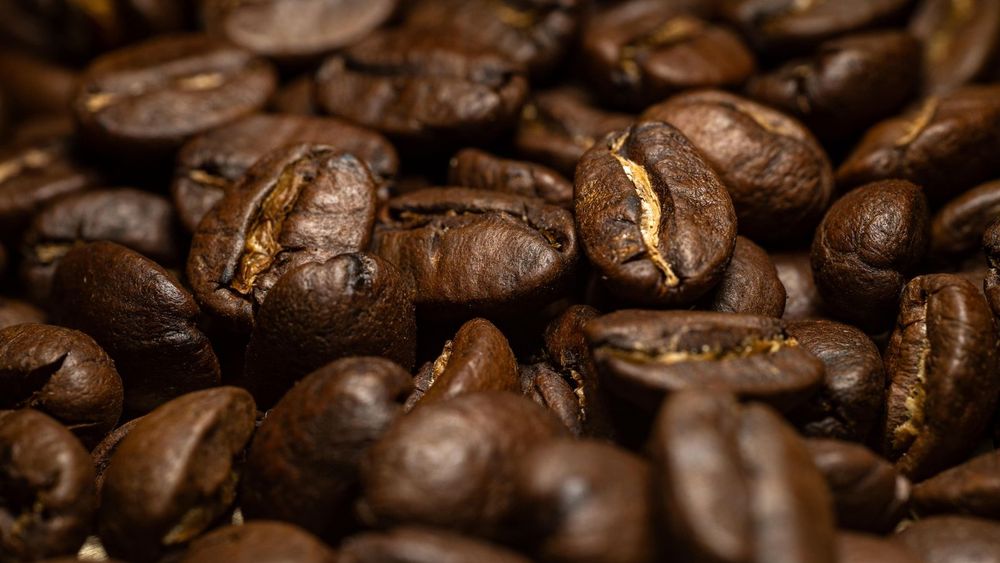
The short answer: According to Illy and Navarini (2011), Robusta contains about twice as much caffeine in the drink as Arabica, and the CBI writes of almost twice as much. The Deutscher Kaffeeverband gives 1.7 to 3.5 per cent against 0.8 to 1.5 per cent in its table. The roast level shifts acidity and roast aromas: according to Anokye-Bempah (2024), titratable acidity peaks at first crack, and according to the Kaffeeverband, lightly roasted coffee is milder and darkly roasted coffee is considerably stronger. On freshness, the Kaffeeverband writes that a change can be tasted at the latest four weeks after a pack is opened. On the fridge, the sources contradict each other.
Choosing a bean: five things before you buy
Five points help with the choice. The order is our assessment.
- The type of coffee. Arabica and Robusta differ in caffeine, fat and chlorogenic acids, and the figures are below. For blends the ratio is usually not stated, and an overview follows at the end of the guide.
- The roast level. It determines how much acidity and how much roast aroma is in the bean, and it roughly dictates the preparation: light for filter, dark for espresso (Kaffeeverband). The catalogue does not stick to this everywhere, and Lavazza names the lightly roasted Tierra for Planet for espresso and moka pot.
- The date. A roast date shows how long ago the roasting was. If it is missing, you are left with the best before date, and that applies only to the unopened pack.
- The quantity. A smaller pack is easier to use up within the period given in the section on freshness (our derivation from a statement by the Kaffeeverband, not an association recommendation).
- The grinder. Some manufacturers exclude oily and sugar-treated beans for their grinding mechanism, and the grind setting needs to be readjusted whenever you change the roast.
Arabica and Robusta
Of roughly 124 known Coffea species, only two are economically significant according to the Deutscher Kaffeeverband: Coffea arabica, Arabica for short, and Coffea canephora, known in the trade as Robusta. According to the association, they make up about 57 and 43 per cent of the world harvest, with no reference year. In their review (Foods, 2021), Olechno and colleagues give production figures for 2020, from which we calculate 60 to 40. The order of magnitude agrees in both sources, and the exact figure depends on source and year. Even the number of species varies: Illy and Navarini speak of more than 60 in 2011.
The Kaffeeverband describes Arabica as having a broad flavour spectrum from sweet through acidic to spicy or fruity, and Robusta as bitter, earthy and harsh. The Dutch CBI paints the same picture in its market study on Robusta (updated 29 October 2025): Arabica tastes smoother and fruitier, Robusta more earthy, and Robusta mostly goes into blends, instant coffee and strong, dark-roasted espresso drinks.
Laboratory findings show what may be behind this. Šeremet and colleagues (Molecules, 2022) examined six medium-roasted samples, four Arabica (two of them decaffeinated) and two Robusta. The green Arabica contained more oil and sucrose, and the green Robusta more caffeine, 3-caffeoylquinic acid and total phenols. In the sensory evaluation by a panel of 20 members of the faculty’s staff, Robusta drinks were regarded as more astringent regardless of the preparation, which the authors attribute to the higher content of chlorogenic acids. The CBI, by contrast, explains the bitterness of Robusta by its caffeine. In the same evaluation, however, decaffeinated Arabica drinks were regarded as more bitter, so in this study caffeine does not explain the bitterness on its own. Panel and sample numbers were small.
Robusta, too, can exceed the 80-point mark. Bollen and colleagues (Frontiers in Sustainable Food Systems, 2024) write that coffees from 80 points are regarded as Specialty for Arabica and as Fine for Robusta (the SCA documents themselves were not accessible to us, so the limit rests here on this secondary statement), and that the SCAA proposed the first cupping protocol for Arabica in 2003. The Robusta genetic resources from the DR Congo that they examined reached 75.75 to 84.75 points.
In cultivation, Robusta is somewhat more resilient according to the Kaffeeverband, the CBI attributes a lower susceptibility to disease to it and lists Arabica as the more expensive species. On altitudes, the two sources agree on the pattern, Arabica higher and Robusta lower, but not on the limits.
| Feature | Arabica | Robusta | Source |
|---|---|---|---|
| Caffeine, reference basis not stated | 0.8 to 1.5% | 1.7 to 3.5% | Deutscher Kaffeeverband, brochure (PDF created 15 March 2024), p. 20 |
| Caffeine, dry matter of green coffee | 0.9 to 1.2% | 1.6 to 2.4% | Olechno et al. 2021, Foods 10(6):1208 |
| Caffeine, green beans from Lombok (mean) | 1.09% | 2.09% | Zainuri et al. 2023, Biotropia 30(3) |
| Caffeine, working paper (weakly documented) | 0.8 to 1.4% | 1.7 to 4.0% | Simmerman 2013, University of Tennessee, only the abstract read |
| Fat, reference basis not stated | 15 to 18% | 8 to 9% | Deutscher Kaffeeverband, p. 20 |
| Lipids, dry matter of green coffee | 12 to 18% | 9 to 13% | Olechno et al. 2021 |
| Oil, dry matter in the laboratory | 15.16 to 16.85% | 10.43 to 10.93% | Šeremet et al. 2022, Molecules 27(2):448, n = 4 and 2, two Arabica decaffeinated |
| Chlorogenic acids, dry matter | 5.5 to 8% | 7 to 10% | Olechno et al. 2021 |
| Altitude according to the Kaffeeverband | 600 to 2,000 m | up to 900 m | Deutscher Kaffeeverband, p. 16 and 20 |
| Altitude according to the CBI | 1,200 to 2,000 m | 600 to 1,200 m | CBI 2025, Robusta market study |
What happens during roasting
According to the Kaffeeverband, the roaster heats the beans dry and without fat using hot air. Water evaporates, the internal pressure rises, the beans almost double in volume and burst at first crack. Light roasts are stopped there, and for darker ones the roaster waits for second crack. The beans are then cooled immediately, otherwise they keep roasting. The weight loss, which the Kaffeeverband calls Einbrand (roast loss), it puts at 11 to 20 per cent depending on the roast.
More happens chemically than the colour shows. In the work of Šeremet and colleagues, the sucrose content of the roasted beans was 84.40 to 98.27 per cent below that of the green samples. Caffeoylquinic acids decrease during roasting, and the literature they cite names quinic acid and chlorogenic acid lactones as breakdown products. Caffeine survives roasting, and an increase relative to dry matter could, according to the authors, be due to mass loss and/or to released, trapped carbon dioxide.
Acidity does not simply disappear in a dark roast. Anokye-Bempah and colleagues (Scientific Reports, 2024) ran profiles of equal total duration in a 5 kg drum roaster: total titratable acidity, which correlates strongly with perceived acidity, rose to a maximum by first crack and fell back to the starting value by second crack. The peak value hardly differed between the profiles. Kim and colleagues (Foods, 2024) found a matching pattern in the pH of bean extract, which fell to a chromaticity value of 75 and rose again with darker roasting. On the authors’ scale, 75 is a medium roast, and a single origin was examined (Cameroon Blue Mountain). They attribute this to chlorogenic and caffeic acid, and the isomers of chlorogenic acid differ in thermal stability. According to this, a dark roast has less acidity than one at first crack, but by second crack it falls, according to Anokye-Bempah, to the starting value and not to zero. For even darker roasts the study says nothing.
From the composition data one can derive why the same roast does not taste the same in Arabica and Robusta, although this chain was not measured as such. The two species start with a different composition, Arabica with more oil and sucrose, Robusta with more chlorogenic acids. Roasting breaks down sucrose and chlorogenic acids, and after the same roast programme, something different remains of both and of their breakdown products depending on the species. The sensory finding of Šeremet and colleagues fits this: with a consistently medium roast, Robusta drinks were regarded as more astringent.
Light, medium, dark: three names, no common scale
In its brochure the Kaffeeverband distinguishes three levels and shows them with pictures, without numbers. Light roast (Blonde, Mild, Cinnamon Roast) is suited to filter preparation, medium to filter or café crème, and dark (Dark Roast) is ideal for espresso. It says nothing about AeroPress, portafilter machines or bean-to-cup machines. In its FAQ the association adds that lightly roasted coffee is milder in taste and darker roasted coffee considerably stronger, and that temperature and duration depend on the green coffee and the desired taste.
If you want numbers, you end up at the Agtron system: the higher the value, the lighter the bean. In its US procurement specification A-A-20213B of 2004, the USDA describes four levels, and Coffee Review uses seven. The same Agtron range carries a different name depending on the source, and the figures are not fully comparable: Coffee Review names by the mean of the whole bean and ground readings, whereas the USDA gives only one Agtron number for beans or ground coffee.
| Agtron range | Name according to USDA CID A-A-20213B (2004) | Name according to Coffee Review (Roast Definitions) |
|---|---|---|
| 80 to 90 | Light, usually no oil on the surface | Light (above 80) |
| 50 to 60 | Medium, possibly slightly oily surface | Medium-Dark |
| 40 to 50 | Moderately dark, some oil | Dark |
| 30 to 40 | Dark, shiny oily surface, pronounced bitterness | Very Dark (25 to 40) |
The SCA lists an SCA standard for roast level (SCA-131, Coffee Roast Level) as in development on its standards page. The intensity figures given by manufacturers do not follow a common scale either: Lavazza gives the Tierra for Planet an intensity of 6 out of 10, Gimoka gives the Armonioso 8 out of 13. Our assessment: we would not read any Agtron value as a boundary, but would treat the levels as an industry convention, and where information contradicts itself, follow the manufacturer of the specific bag. The Armonioso shows why this is necessary: Gimoka calls it light, the Amazon title medium roasted.
On milk drinks the Kaffeeverband says only general things. Milk gives coffee a slightly sweetish taste and can mask unwanted acids or bitter compounds in a profile that is not quite balanced, and with too much milk the fine taste of good coffees no longer comes through properly. The association does not say which roast holds its own against milk, and we found no study on it. The rule of thumb “dark for milk coffee” therefore remains undocumented.
Acidity, bitterness, body: what the words mean
World Coffee Research explains the terms in its Sensory Lexicon 2.0 (2017) through reference solutions. Sour is the taste impression associated with a citric acid solution: 0.015 per cent citric acid corresponds to an intensity of 1.5, and 0.05 per cent to an intensity of 3.5. Bitter is the impression of a caffeine solution, with 0.01 per cent caffeine corresponding to 2.0 and 0.05 per cent to 6.5. Both are taste impressions on reference solutions, and pH measures something different.
On body, the lexicon lists Body/Fullness as an aspect of amplitude, the overall impression, and defines only fullness: Fullness is the foundation of the flavour notes that gives the product substance, the perception of a strong flavour rounded out with body. Thickness is listed separately under mouthfeel: Thickness is the thick feeling of the drink when you press your tongue through it, with a 5 per cent sugar solution corresponding to 2.0 and tomato juice to 4.0. Fullness and Thickness are separate entries in the lexicon. If a retailer writes “body” in a listing, it can therefore mean fullness or thickness.
Caffeine: the species matters more than the roast level
Four sources, four different figures: the table under Arabica and Robusta shows that there is no universally valid number for caffeine content, because the source, the reference basis and the origin of the samples change. The sources agree only on the order of magnitude of the ratio. Two sources state it explicitly: Illy and Navarini (2011) for the drink (about twice as much caffeine in Robusta) and the CBI (almost twice as much). From the ranges of the Kaffeeverband the factor emerges only roughly: the ranges, at 1.5 against 1.7 per cent, lie close together, and depending on the end values one would arrive by our own calculation at a factor of about 1.1 (1.7 divided by 1.5) to 4.4 (3.5 divided by 0.8), while the association itself gives no factor. In the Lombok study it works out at 1.9 (2.09 against 1.09 per cent). Narrower ranges such as 1.2 to 1.5 per cent for Arabica and 2.2 to 2.7 per cent for Robusta appear in none of these sources. Remember the factor of two, not a percentage figure.
According to these sources, the roast level moves the amount of caffeine less than the species does. Šeremet and colleagues write that caffeine is thermostable. Duke and colleagues (Journal of Food Quality, 2025) roasted Arabica from Ethiopia (Kercha, West Guji) at 200, 212.5 and 225 degrees for 7 to 12 minutes and found 1.30 to 1.53 grams of caffeine per 100 grams in the ground bean. Lighter roasting and finer grinding gave higher values, and the authors name less thermal degradation and higher extraction efficiency as reasons. This is a single study with one origin, and it explains the difference differently from Šeremet. According to these sources, anyone who wants to save caffeine should choose the species first and the roast colour only afterwards. Whether a scoop of dark roast contains less caffeine than one of a lighter roast cannot be derived from the sources, with more on this under “What cannot be documented”.
Crema and Robusta
The claim that Robusta brings more and more stable crema does not hold across the board in the studies. Illy and Navarini (Food Biophysics, 2011) regard the claim that Robusta is indispensable for the crema of an Italian espresso as largely refuted by more recent experimental data. Among others, they summarise Nunes and colleagues (1997): pure Arabica from Brazil and pure Robusta from Uganda, roasted from light to very dark, degassed for two days, 6 grams each in 40 millilitres. The foam volume was 1.2 to 3.9 millilitres, with no significant difference between the species. The persistence of the foam reached its maximum at a medium roast level, 33.9 minutes for Arabica and 48.6 minutes for Robusta, and fell again with darker roasting. In this study, foam formation correlated strongly with protein content, stability with high-molecular-weight polysaccharides, and fat correlated negatively with foam formation.
The picture is different for blends very rich in Robusta. In three studies that Illy and Navarini report, the foam volume of blends of 20 parts Arabica and 80 parts Robusta was above that of pure Arabica, in the first at 6.8 against 4.4 millilitres (laboratory espresso, 7.5 grams in 40 millilitres). Sources with higher volume at the same time showed lower persistence. Our assessment: “more crema” holds for blends very rich in Robusta. On persistence the findings are inconsistent, pure Robusta lasted longer in Nunes, and the blends with higher volume lasted less long. How much Robusta a commercial blend contains is mostly not stated (overview at the end of the guide). Then there is the gas: the gas phase of crema is predominantly carbon dioxide formed during roasting and trapped in the cell structure.
Freshness: degassing, roast date and best before date
After roasting, the beans keep releasing gas for hours, in part for up to two months (Kaffeeverband). Smrke and colleagues (Journal of Agricultural and Food Chemistry, 2018) call the release of carbon dioxide from roasting to the cup an indicator of freshness. It plays a role in shelf life and packaging, influences extraction and can change the sensory profile. Part of the gas stays in the porous structure and is released slowly during storage and abruptly during grinding and extraction. How much is in there depends on the roast: Illy and Navarini give 4.0 to 8.6 milligrams of CO2 per gram of coffee directly after grinding (mean 5.7), for pure Arabica on average 4.6, for pure Robusta 6.9, and more for a dark roast than for a medium one. If beans still release gas during brewing, that is an indication of freshness, but not a measure of the day of roasting.
According to the Kaffeeverband, packs with an aroma valve let gases escape but no oxygen from outside reach the beans. According to the association, commercial packaging is mostly vacuum-sealed or sealed with nitrogen or carbon dioxide.
According to the Verbraucherzentrale (German consumer advice centre), the best before date is the point up to which the manufacturer guarantees that the unopened food keeps its specific properties when stored correctly. After opening it no longer applies. Storage instructions such as “dry and cool” (the Verbraucherzentrale gives coffee as an example) are, in its words, imprecise and interpreted differently by manufacturers. An example from the catalogue: the batch of Schwiizer Schüümli Crema Mild that Migros-Shop.de sold on 25 September 2026 was best before at least 31 January 2027, a good four months from that day.
A roast date to go by is missing for the beans in the catalogue almost everywhere. In 21 of our 23 bean reviews it is noted that it is not stated online (reviews as of September 2026), and for the Dallmayr Crema d’Oro and the Jacobs Krönung Caffè Crema the review says nothing on it. Incapto advertises a visible roast date in general terms, but none is documented for the pack delivered by Amazon. “Buy by roast date” is therefore for now a wish addressed to the trade and hardly feasible before purchase.
| Statement | Source |
|---|---|
| Beans release gas after roasting, in part for up to two months | Deutscher Kaffeeverband, brochure, p. 48 |
| Opened pack: after four weeks at the latest, a change can be tasted even by laypeople | Deutscher Kaffeeverband, brochure, p. 47 |
| Use beans or powder from opened packs within a few weeks | Stiftung Warentest, coffee FAQ |
| Use coffee within 2 to 6 months of roasting, ground coffee within one month | Lavazza Deutschland, page on ground coffee |
| Vacuum-sealed coffee stays fresh in the pantry for five to six months at most; ground coffee frozen up to two years if vacuum sealed, otherwise keeps for no longer than six months | Lavazza Deutschland, page on ground coffee |
| One month at 5 against 20 degrees, opened beans in foil bags: the lower temperature slowed changes in the aroma profile | Gantner et al. 2024, Foods 13(24):3995 |
A single freshness window in days cannot be derived from these statements. We would use up an opened pack within the four weeks of the Kaffeeverband, which matches the advice of Stiftung Warentest to use beans and powder within a few weeks.
Storage: light, heat, oxygen, moisture
The Kaffeeverband recommends an opaque, airtight container because light, heat, oxygen and foreign odours affect the aroma negatively. Ground coffee loses aromas sooner than whole beans, so you should grind fresh and in portions. During grinding, volatile aromas and a large part of the carbon monoxide and carbon dioxide contained are released. That ground coffee loses faster is, by our derivation, additionally due to the larger surface, which more air reaches.
On temperature there is a study covering one month. Gantner and colleagues (Foods, 2024) opened Arabica, Robusta and an 80 to 20 blend one month after roasting, sealed the rest in foil bags and stored it for one month at 5 or at 20 degrees. Espresso and cold brew were evaluated with an electronic nose and sensory assessment. At 5 degrees, aldehydes, alcohols, pyrazines and furans changed more slowly according to the authors, and the aroma profile stayed closer to its initial state. Cold brew from the chilled beans showed, according to the authors, similar properties to that from unstored beans. Significant differences, however, appeared only in individual attributes, such as earthy and smoky smell, which increased at 20 degrees for pure Arabica and pure Robusta. In overall quality, the Arabica cold brew from 5-degree beans, at 4.66, was significantly below the fresh one (5.61) and numerically also below that from 20 degrees (5.00). For espresso, both storage conditions showed a similar sensory profile, with less coffee aroma and chocolate taste and more acidity and rum note than the fresh sample, and the overall quality did not change significantly as a result.
On the fridge, the sources diverge. In its FAQ the Kaffeeverband advises storing the opened pack airtight, for example in an airtight tin as additional outer packaging, in the fridge. Its brochure (PDF created March 2024) does not mention the fridge. In its tips on storing ground coffee, Lavazza expressly advises against it, because the coffee is exposed to moisture there, and names dry room temperature. Stiftung Warentest, too, considers the fridge unsuitable because of moisture and foreign odours, and says coffee belongs in a tightly closing tin. On the product pages it is mixed: the Mount Hagen Espresso Bio is to be kept airtight, dry and cool, but not in the fridge, and Dallmayr writes for the Crema d’Oro, in the reply of its management, dark, cool and dry, well sealed. The Amazon listing of the Gorilla Super Bar Crema, by contrast, recommends keeping the beans after opening in an airtight, opaque container in the fridge.
The objection behind this is condensation: according to Lavazza, at fridge temperature water condenses from the air in the tin, penetrates the coffee and impairs the taste. We know of no study that measures this effect for coffee, and Gantner stored in sealed foil bags. What is shown is an advantage of cold for the aroma profile and for individual attributes of cold brew, in whose overall quality it was not clear-cut, and for espresso the panel saw no difference between 5 and 20 degrees. If you will have finished the pack within four weeks, you do not need to decide the question. If you keep stocks, the FAQ below has the statements on freezing.
Grinding and oily beans
The Kaffeeverband writes that the grind size should be set correctly depending on the preparation method and the roast, and that the finer the grind, the more aroma compounds dissolve during brewing. It follows that the grind size needs readjusting for every bean with a different roast. How to go about it is in the guide Coffee grind size.
For oily beans, the manufacturers become specific. For the EQ.600 and the EQ.6 plus, Siemens prescribes putting only pure, roasted espresso or bean-to-cup bean blends into the container. Glazed, caramelised and sugar-treated beans are excluded, and the instructions advise against oily beans because they do not fall into the grinder. In the fault table of the Melitta CI Touch there is the entry “grinder does not grind” with the cause “coffee beans too oily” and the remedy of using other beans, and Melitta also excludes freeze-dried and caramelised beans. The manual of the Baratza Virtuoso+ says in essence that oil in the burrs can clog and damage them, and that anyone who often grinds dark, oily or flavoured coffee may need grinder cleaning tablets.
At Jura, only roasted beans without any treatment are permitted, and beans treated with additives or caramelised beans, as well as ground and freeze-dried coffee in the bean hopper, damage the grinder of the Jura E6. De’Longhi excludes green, caramelised and candied beans for its bean-to-cup machines Magnifica, Dinamica Plus and Rivelia, because they stick to the grinder and can damage it. For the grinder Dedica KG 520.M the instructions say that grinding oily beans is not advisable. That oily beans gum up the grinder over time is stated in none of these instructions. They speak of beans that do not fall into the grinder, of a grinder that does not grind, and of oil that can clog; according to De’Longhi, green, caramelised and candied beans can stick. Which roasts are oily is shown by the Agtron table above: for the darkest levels, the USDA describes a shiny oily surface.
Blend and single origin
According to the Kaffeeverband, roasters mix coffees of different origin, variety and quality to create a particular aroma profile. Mixing is done either before roasting or after roasting each individual origin. Coffees that are not mixed are called sortenrein (single origin, literally “pure by variety”). We found no legal definition of single origin, and the association speaks only of sortenrein.
Processing shapes the taste as well. According to the Kaffeeverband, coffee is processed wet, dry or semi-dry. Above all, Arabica from certain countries is wet processed and is called Milds in the trade, while Robusta and Brazilian Naturals are mostly dry processed. Processing affects character, aroma and quality. More on origin and processing is in the guide Coffee origin and flavour.
Fairtrade, direct trade and other labels
The Fairtrade minimum price is a floor: according to the press release of Fairtrade International of 30 July 2026, it applies only if market prices fall below it, and if the market price is higher, more can be earned. So far it is 1.80 US dollars per pound of washed Arabica, and from 1 December 2026 it will be 2.00. For Robusta (naturals) it rises from 1.20 to 1.30, while the Fairtrade premium of 0.20 and the organic differential of 0.40 US dollars remain. According to Fairtrade, the coffee price has not been below 2.00 dollars per pound since March 2024 (no price series stated).
Direct trade, by contrast, has no label. Guimarães and colleagues (Internext, 2020) write that there is no uniform definition because no independent certifier regulates the practice, and that the term is misused for product differentiation. They themselves define direct trade as a shortened supply chain without the exclusion of all intermediaries, focused on securing the supply of exceptional quality. Individual roasters set their own standards, and according to the authors there is no independent certifier. The Kaffeeverband (brochure, p. 34 to 35) describes direct trade as coffee that goes directly from smallholders or a cooperative to the roaster, with no further intermediaries involved according to it, and writes that the farmers get a far higher price than the market rate this way.
In their market check on crema and espresso (as of September 2025), the Verbraucherzentralen (German consumer advice centres) of Baden-Württemberg and North Rhine-Westphalia speak of a “label jungle” of Rainforest Alliance, Fairtrade and company-owned seals, which makes it hard to understand the meaning and to judge whether fair working conditions are guaranteed. Fair is not the same as organic, they say, and the fair trade seals are primarily social seals. According to the market check, which relies there on the Forum Fairer Handel (a German fair trade association), sales of fair trade coffee in 2024 were around 977 million euros, a market share of 5.3 per cent. In the catalogue, according to the seller, labels are carried by, for example, Mount Hagen (organic, Fairtrade, Naturland) and the J. Hornig Caffè Crema Bio (organic, Fairtrade).
Typical problems
Errors in brewing temperature, time and water quantity are outside this guide.
| Symptom | Possible cause | What you change |
|---|---|---|
| The coffee tastes flatter after a few weeks | The aroma fades in an opened pack (Kaffeeverband, see Storage) | Use up the opened pack within the four weeks from the section on freshness, buy smaller packs, use an airtight and opaque tin, grind whole beans only just before brewing |
| The cup is sour | Acidity and roast level are linked, see the section on roasting (acidity maximum at first crack, pH low point at medium roast) | Try darker than medium, because according to both studies acidity decreases after the maximum (first crack or medium roast respectively); whether a bean bought as light brings less acidity one level darker is not shown by the studies, because the level names have no common scale; if it is down to preparation, the guide Coffee tastes bitter or sour helps |
| The cup is bitter or harsh | Robusta was regarded as more astringent in the sensory evaluation (Šeremet 2022), and the USDA describes dark roasts with pronounced bitterness | Choose pure Arabica or one level lighter; if it is down to preparation, the guide Coffee tastes bitter or sour helps |
| The grinder does not grind or clogs | Oily, glazed, caramelised or candied beans (instructions from Siemens, Melitta, De’Longhi, Jura and Baratza) | Use other beans; anyone who often grinds oily coffee may need grinder cleaning tablets according to Baratza |
| The espresso has little crema | The gas phase of crema is trapped CO2, which escapes even without grinding (Illy and Navarini 2011); that older beans bring less gas is derived by us, not measured | Use beans from the opened pack within the four weeks, brew straight after grinding |
| The crema collapses quickly | The persistence of the foam had its maximum at a medium roast level (Nunes 1997), cited after Illy and Navarini 2011 | Try a medium roast |
| Beans bought as light look dark | The names of the levels are not uniform, see the roast level section | Compare the manufacturer’s page and the bag, not just the name |
What cannot be documented
For these statements we found no source that we accept. Undocumented does not mean wrong, it means: not checked by us.
- A Robusta share of 10 to 30 per cent in Italian espresso blends. The CBI import figures say nothing about it, and details are in the FAQ.
- A freshness window of five days to four weeks after roasting. What we found instead is degassing over weeks and the periods in the table above.
- A best before date of 12 to 18 months after roasting. Stiftung Warentest gives a shelf life of 12 to 24 months for vacuum-packed beans according to suppliers, with no reference to the roast date. A batch of Schwiizer Schüümli (above) still had a good four months to the best before date on the day of sale, and its roast date is not known. That 12 to 18 months after roasting is usual is not documented by any source we checked.
- Pressing on the pack as a sign of freshness. On the opening pressure of aroma valves and on pack pressure, we found only manufacturer pages from valve makers, no source from professional bodies or studies.
- More soluble solids in Robusta. The primary source (Bicho et al. 2013, International Journal of Food Properties) could not be opened. Documented are higher chlorogenic acid and caffeine contents in Robusta and more oil and sucrose in Arabica, not the soluble solids.
- Residual moisture as an explanation of how finely a bean breaks. Uman and colleagues (Scientific Reports, 2016) ground four Arabica samples in the narrow range from light to medium (Agtron 59 to 68) and found no dependence of the particle size distribution on origin and processing. For roast level and residual moisture as an explanation this provides nothing, and a comparison with dark roasts is missing. We also lack a source for “light beans are denser and harder”.
- A scoop of dark roast contains less caffeine because the beans are larger and lighter. That is a consideration without a measurement. The Kaffeeverband names the roast loss and the almost doubled increase in volume when roasting to first crack, but no volume comparison per roast level. How much caffeine a scoop contains depends on the number of beans in it, and none of the sources recorded that.
- A blend that tastes more consistent over the year, and a single origin that varies from harvest to harvest. The Kaffeeverband describes the blend as a means to a particular aroma profile, and says nothing there about consistency.
- Direct trade that pays more than Fairtrade. The Kaffeeverband compares with the market price, and we found no comparison of the two models in any source.
What the catalogue has in beans
The catalogue has pure Arabica in every roast level. According to the listing, the Amazon Colombian Medium Roast is 100 per cent Arabica, single origin Colombia without a region stated and, according to the item table, medium roasted, and neither a roast date nor a best before date is given in the listing. According to the manufacturer, the Incapto Single Origin Kolumbien is 100 per cent Arabica from Huila, medium roasted and rated at 84 SCA points, which we could not verify. Lightly roasted according to Lavazza is the Tierra for Planet (100 per cent Arabica according to Lavazza), and dark according to the product information is the Starbucks Espresso Roast (100 per cent Arabica according to the bag). For the Schwiizer Schüümli Crema Mild, 100 per cent Arabica is on the pack, and “light” only in the Amazon catalogue.
If you care about growing altitude: according to the seller, the 360° Rundum Ehrlich Bio Honduras is single origin Honduras, 100 per cent Arabica and washed, with a growing altitude above 1,300 metres.
For blends the ratio is rarely stated. The table shows what the sources yield for individual varieties.
| Blend | Ratio | Source |
|---|---|---|
| Gorilla Super Bar Crema | 80 to 20 (Arabica to Robusta) | only in the Amazon listing, missing on the Joerges pages |
| Gimoka Armonioso | 50 to 50 | Amazon catalogue, the statement is missing on gimoka.com |
| Dallmayr Crema d’Oro | Arabica and Canephora (that is, Robusta), no ratio | Dallmayr product page, whereas the English Amazon text says 100 per cent Arabica |
| J. Hornig Caffè Crema Bio | Arabica and Robusta, no ratio | Amazon catalogue text |
| Segafredo Intermezzo | not stated; dark roasted in all sources, Robusta-heavy by our reading, and Segafredo’s current texts do not reveal an Arabica share | Product page (classic Robusta blend), Amazon catalogue and earlier shop page also mention South American Arabica |
| Lavazza Espresso Italiano Cremoso | not stated, 40 to 60 only on retailer pages | a manufacturer statement is missing |
Decaffeinated is the Dallmayr Prodomo, according to Dallmayr 100 per cent Arabica and gently decaffeinated; Dallmayr names neither a method nor its own residual caffeine value. More on methods and residual caffeine in decaffeinated coffee in general is in the guide Decaf coffee. The bean reviews with prices and ratings are in our German category on beans and roasteries, and eight of the 23 varieties are ranked by rating in our German best-of list for coffee beans 2026.