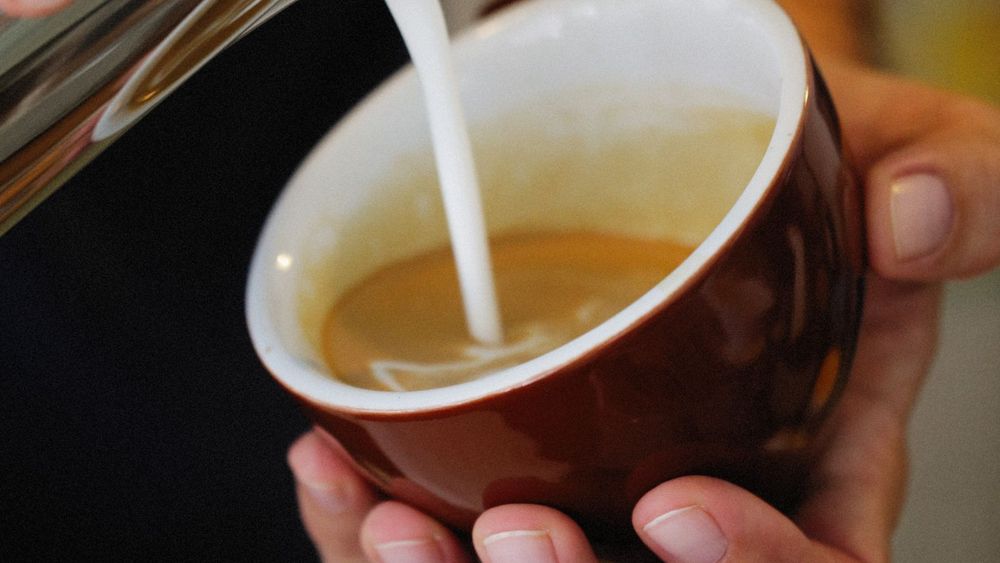
The short answer: Cold milk, nozzle just below the surface, first draw in air, then dip deeper and hold the jug at an angle so that a whirlpool forms. Sage gives 60 to 65 °C as the final temperature, Lelit sets the limit at 65 °C, and the manufacturers’ figures (recommendations and fixed device temperatures) go up to approx. 74 °C. We would stop at around 65 °C and use a thermometer for that.
The process at the steam wand
Sage UK (blog) and Lelit (Victoria manual) describe the same sequence, and the laboratory protocol of a milk foam study (Ho et al., 2024a) also has two phases: first draw in air, then texture and heat the milk.
- Take the milk cold from the fridge (Lelit assumes 5 °C, Rancilio advises storage at 5 °C at most). Cold milk takes longer to reach the final temperature, so the nozzle has more time to draw in air (Sage UK, Lelit).
- Fill the jug no more than half full (Sage UK, Lelit). The reason is given in the section on fill quantity.
- Release steam for about 2 seconds before frothing. Lelit and Rancilio give condensation water as the reason.
- Draw in air. Place the nozzle just below the surface and follow the milk down with the jug so that the nozzle stays at the same depth. For this, Lelit gives a depth of about 1 cm near the jug wall and ends the phase at about 37 °C or when your hand feels warmth.
- Dip the nozzle deeper and hold the jug at an angle. A whirlpool forms that breaks up large bubbles (Sage UK). Lelit lowers the nozzle fully and heats to the desired temperature. For the Dedica, De’Longhi advises turning the container in your hand with slow movements from bottom to top for creamier foam.
- Close the steam before you take the jug away.
- Tap the jug lightly and swirl the milk (Sage UK, Lelit). According to Sage UK, tapping removes large bubbles. Lelit then lets the foam rest for at least half a minute.
- Wipe the nozzle with a damp cloth immediately and release a little steam. Sage prescribes both, first wiping, then steam. Rancilio names the same two steps in the reverse order. On the Lelit Anna this is done so that milk residues do not obstruct the steam. De’Longhi recommends cleaning the frother after every use for hygiene reasons.
The Sage Barista Express has its own start-up procedure. According to the manual, the steam heats up while the light flashes. As soon as it stops, you set the dial back to STANDBY, dip the tip 1 to 2 cm deep into the milk within 8 seconds (3 o’clock position, right side of the jug) and quickly turn the dial back to STEAM. The 8 seconds are the length of the pause, and according to the manual the pause prevents milk from splashing out of the jug. Before removing the jug, Sage requires you to set the dial back to STANDBY.
The laboratory protocol of Ho et al. (2024a) ran on an espresso machine (Sunbeam Café Series EM6910) with 100 ml of reconstituted skimmed milk (1.5 to 15% solids) at 5 °C: nozzle about 2 mm below the surface until the milk reached 45 °C, then deeper until stopping at 65 °C. This works only to a limited extent as a recipe for kitchen milk, and we read it as evidence for the order of the phases. Lelit already changes phase at about 37 °C, so every source sets the switching point differently. How to pour the finished foam into the cup is covered in the guide Latte art for beginners.
Why milk froths
Milk proteins quickly move to the interface between air and liquid and unfold there. According to Ho et al. (2024a, International Journal of Dairy Technology), how long the foam lasts depends on the strength and viscoelasticity of this protein layer. Fast foam formation and high foam stability are not the same thing: proteins with high foamability do not necessarily give a particularly stable foam, and vice versa. The authors describe the foam in their experiments as a uniform microfoam structure with a considerable share of very small air bubbles.
Which protein is responsible for what remains open. According to Ho et al. (2024a), many studies found more foam volume with more casein and more stable foam with more whey protein, while other work contradicts this. The authors conclude that protein type, concentration, pH, temperature, salts and frothing method act together.
Milk sugar plays a part too, at least according to the literature: lactose binds a lot of water and raises the viscosity of the milk. This hinders the migration of the proteins to the interface and lowers foamability, but it slows liquid drainage and bubble coalescence and so supports stability (Gamboa and Barraquio, 2012, cited in Ho et al., 2024b, Food and Bioprocess Technology). In the same authors’ own experiment, the lactose content of the skimmed milk powder solutions rose from 0.8 to 8.3% and the viscosity from 1.9 to 3.4 mPa s, without foamability or stability changing significantly.
Foam ages in any case. In the study by Ho et al. (2024b), the bubbles in all samples were larger after ten minutes than directly after frothing, because liquid drains from the foam and the bubbles merge. Part of the volume is lost on its own, even with good texture.
How hot the milk may get
The sources do not agree on the final temperature. The figures lie between 55 and approx. 74 °C, partly as a recommendation, partly as a fixed built-in device temperature, and Severin lets you set 45 to 65 °C:
| Source | Milk temperature given | Where found |
|---|---|---|
| De’Longhi Dedica EC685 | Ideal value 60 °C | Manual, cappuccino section, p. 8 |
| Sage Barista Express | 60 to 65 °C, indicator strip on the jug | Manual SES875, p. 13 |
| Sage UK | 60 to 65 °C, do not overheat | Blog How to froth milk at home |
| Subminimal NanoFoamer Lithium | Warm the milk yourself beforehand to about 55 to 65 °C, according to the manufacturer for sweetness and texture | Help article NanoFoamer, Quick Start Guide V2 and Lithium |
| Lelit Victoria | Desired temperature, without exceeding 65 °C | Manual, p. 21 |
| Severin SM 3586 and SM 3587 | 45 to 65 °C adjustable | Data sheet SM 3586, product page SM 3587 |
| Tchibo induction milk frother | fixed approx. 60 to 70 °C | Manual |
| Simpletaste 4 in 1 | approx. 60 to 70 °C, ideal according to the manufacturer | Manual 706DE-0014, p. 17 |
| Barista Eric Wolf | 65 to 70 °C | Stiftung Warentest (Germany’s consumer testing foundation) interview, test 2/2018 |
| Philips Milk Twister | fixed approx. 74 °C | Manual |
| Ho et al. (2024a) | Steam frothing in cafés heats to 65 to 70 °C | International Journal of Dairy Technology 77(3), p. 875 |
In its manual, Philips gives the approx. 74 °C for the best foam and taste, which puts it 9 °C above the upper limit Lelit sets.
Specialist authors describe the problem as one of hitting the target. Ho et al. (2024a) write in the introduction, without measuring themselves: steam injection is the usual method in cafés and heats the milk to 65 to 70 °C at the same time, which according to the authors is the desired drinking temperature of many hot drinks. Hitting the final temperature is difficult and overheating is a high risk, which the authors link to strong protein denaturation, a scalded taste, loss of flavour and bitter notes in the foam.
Three manufacturers also justify the limit, without giving measured values. Sage UK speaks of denaturation when overheated to around 70 °C, with a cooked taste and poorer foam as the result, and of overheating impairing sweetness and texture. In the NanoFoamer Quick Start Guide, Subminimal writes that the proteins of the milk begin to break down at 70 °C and the milk then loses its sweetness. Philips writes that with excessive heating the milk proteins break down and burn.
A laboratory measurement shows that the cooked taste depends on time and temperature. Zhang et al. (2025, Foods) heated raw milk in a water bath for 10 or 30 minutes at 60, 75 or 100 °C, and a descriptive panel rated the cooked flavour. At 60 °C after 10 minutes the score (2.75) was not above that of the raw milk (2.83). At 60 °C after 30 minutes, at 75 °C after 10 minutes and in all other batches it was significantly higher. The authors attribute this to denatured whey proteins that expose sulfhydryl groups.
According to Zhang et al. (2025), denaturation proceeds step by step: above 60 °C it begins, mainly with β-lactoglobulin and α-lactalbumin, and at 100 °C it is almost complete. The series of measurements ran at 60, 75 and 100 °C, and the samples spent minutes in the water bath rather than in a jet of steam. Ho et al. (2024a) frothed only up to 65 °C at most and note that frothing above that could change protein properties, foam and re-frothability. They refer to Kamath (2007), according to whom whey proteins only denature when milk is heated for 1 minute at 75 to 85 °C.
The 65 °C has a second source that has nothing to do with foam. In its press release No. 244 of 15 June 2016, the IARC (WHO) calls beverages very hot if they are drunk at more than 65 °C.
Our assessment: Sage and Lelit draw the upper limit of 65 °C at the steam wand, Subminimal for the pre-warmed milk of its whisk, and Severin at the adjustable temperature of its devices, while De’Longhi, at 60 °C, lies just below. Tchibo, Simpletaste and Philips go beyond it, as do Wolf and Ho et al. (2024a) with their 65 to 70 °C. The 65 °C is not a physical threshold: Sage does not explain the narrow window in the manual, and we know of no measured value that shows or rules out a tipping point at 65 °C. We would still not take the milk above about 65 °C. Sage and Lelit draw the line there, and there is also the IARC mark of 65 °C for drinking very hot beverages.
Thermometer, colour strip or hand check
Sage UK and Lelit name a milk thermometer. The Barista Express manual also mentions a Temp Control jug whose indicator strip shows the milk temperature by changing colour, according to the manual.
The Sage manuals describe the hand check inconsistently. For the Barista Pro (SES878) and the Bambino Plus (SES500), the milk is at the right temperature (60 to 65 °C) when the jug feels hot to the touch, for the Barista Express Impress (SES876) when it feels pleasantly warm. The troubleshooting table of the Barista Express (SES875), on the other hand, advises warming the milk until the jug is too hot to touch, and that of the Impress calls the milk correctly heated when the jug is too hot to touch, both without a figure in degrees. In the Sage UK blog, the jug should feel warm but not too hot to hold. We found no measurement that links wall feel to milk temperature. Lelit uses the hand only for the intermediate point in the air phase.
For the final temperature, we would use a thermometer or a jug with a colour strip.
Fill quantity and jug
Lelit describes a stainless steel jug with a spout, and the milk should fill no more than half of the jug volume. Sage UK gives the same limit and justifies it with room for expansion. The Sage manuals for the Barista Pro (SES878), the Barista Express Impress (SES876) and the Bambino Plus (SES500) give a fill level between the MIN and MAX marks of the milk jug. De’Longhi says how much the milk grows: the volume increases to two to three times, with about 100 g of milk per cappuccino, and Lelit assumes 100 ml.
According to De’Longhi, the De’Longhi milk jug holds up to 350 ml. The NewGF jug has a nominal volume of 350 ml and a measuring scale inside which, according to the photo, runs from 150 to 350 ml. Of a nominal volume of 350 ml, the half-full rule of Sage UK and Lelit leaves at most 175 ml of milk by calculation.
On material, one manufacturer note on frothing is documented: for the Barista Pro, Sage provides for frothing in the supplied stainless steel milk jug (480 ml according to the product page), and according to Sage other containers can pose a risk. Rancilio’s aluminium note, by contrast, concerns cleaning: the Silvia E manual says not to use an aluminium vessel when cleaning the steam wand daily with milk cleaning solution.
Fat and protein: which cow’s milk
On fat, two camps are talking about different things. Foam research describes fat as a disruptive factor for the formation and stability of foam. Huppertz (2010, International Journal of Dairy Technology, review article) writes that skimmed milk foam can be extraordinarily stable, especially when formed at 40 to 50 °C. Lipids could impair formation and stability, especially at a temperature at which milk fat is partly crystalline (for example 20 °C), and phospholipids, free fatty acids and partial glycerides impair frothing strongly.
Kamath et al. (2008, International Dairy Journal) examined cow’s milk from 5 to 85 °C. Skimmed milk foam was most stable at 45 °C, and milk fat had a negative effect in whole milk mainly between 15 and 45 °C, which homogenisation and UHT treatment mitigated. Whole milk foam had smaller bubbles but more bubble breakage through coalescence. Ho et al. (2024b) add that fat can disturb the interactions of the proteins at the interface (Nylander et al., 2019).
In the laboratory of Ho et al. (2024b) it looked like this: the experimental solutions had 0.5% protein, whereas real milk contains 3.2 to 3.5% according to the authors. With 0.5% protein each, reconstituted skimmed milk powder solutions formed around 16 times more foam volume in mechanical frothing than solutions made from whole milk powder and from whole milk. With steam injection the difference was smaller, and the steam foam of all samples lost about 60% of its initial volume in 10 minutes, particularly fast in the whole milk samples.
In its market check of 14 March 2022, the Verbraucherzentrale Niedersachsen writes, without evidence, that protein molecules enclose the air bubbles (the more protein, the more stable the foam), and that fat molecules ensure fine-pored, creamy foam by settling around the bubbles next to the protein molecules. On fat, this is only partly supported. The smaller bubbles of whole milk foam mentioned above under Kamath et al. were also found by Ho et al. (2024b): directly after frothing, the whole milk powder foam had the smallest bubbles, closely followed by the whole milk foam. They also write in the introduction that in milk with protein and fat, the two compete for the interface, so fat is involved there. Foam research does, however, describe fat as a disruptive factor for formation and stability. It does not document that fat supports the foam. On protein, the picture is mixed: Ho et al. (2024b) recommend milk with more protein and stress the protein to fat ratio (skimmed milk powder solution 49:1, whole milk about 1:1 at 0.5% protein). Between 0.5 and 5% protein, however, they found no significant difference in foamability and stability in skimmed milk powder solutions, and none either in whole milk with added protein. These measurements therefore do not support the Verbraucherzentrale’s statement on protein. The introduction of Ho et al. (2024a) also names opposing findings: Martinez-Padilla et al. (2014) saw higher foamability and stability with more protein (3.6 to 9.0%), Borcherding et al. (2009) practically the same stability at 1 to 6% protein.
Creaminess and taste are a different question from foam stability. Lelit writes that fresh whole milk gives a smoother, creamier and more flavourful foam. In the Stiftung Warentest interview (test 2/2018), the barista Eric Wolf recommends fresh whole milk with at least 3.5% fat. Whole milk foam stays creamy for a long time, shines and tastes sweet, and the fat as a flavour carrier brings out the coffee aroma better. In Francis et al. (2005, Journal of Food Science), a descriptive panel rated unfrothed milk served cold at 4 and 15 °C. Serving temperature did not change the taste, and the panel described skimmed milk as more sour, more bitter, more cooked, somewhat flatter and less sweet than whole milk. The authors conclude that fat content and fat composition shape the taste more than serving temperature.
The fat levels are set by law:
| Designation | Fat content | Source |
|---|---|---|
| Whole milk | at least 3.50% (also non-standardised whole milk) | Regulation (EU) No 1308/2013, Annex VII Part IV Section III (applies in the EU) |
| Semi-skimmed milk | at least 1.50% and at most 1.80% | same regulation |
| Skimmed milk | at most 0.50% | same regulation |
Milk outside these levels may not be labelled as whole, semi-skimmed or skimmed milk. The manufacturers recommend very different things:
| Source | Recommended milk |
|---|---|
| De’Longhi Dedica EC685 | skimmed or semi-skimmed milk at fridge temperature (approx. 5 °C), for thicker, more homogeneous foam |
| Bodum Chambord milk frother | preferably skimmed or low-fat milk |
| Nespresso Aeroccino 3 | cold semi-skimmed or half-fat milk (approx. 4 to 6 °C), the versions contradict each other |
| Nespresso Aeroccino 4 | cold, semi-skimmed milk (approx. 4 to 6 °C, a tip in the manual gives 5 to 6 °C) |
| Philips Milk Twister | semi-skimmed cow’s milk at fridge temperature |
| Tchibo Cafissimo Milk | fridge-cold milk with at least 1.5% fat |
| Severin SM 3586 | milk with the highest possible protein content, fridge-cold |
| Simpletaste 4 in 1 | whole milk (fat content over 3.0%), fresh and chilled |
| Lelit Victoria | fresh whole milk |
| Sage UK | milk with a high protein content, such as oat or whole milk |
| Barista Eric Wolf | fresh whole milk with at least 3.5% fat |
| Verbraucherzentrale Niedersachsen | fresh whole milk, justified by the vitamin content; a tasty foam experience is possible without a surcharge or additives |
Our assessment: if you are after foam stability, milk with less fat is in line with the studies we read and with several manufacturers, for example semi-skimmed as at De’Longhi and Philips. If you put taste and creaminess ahead of the foam, you follow Lelit and Wolf and take whole milk. The laboratory figures come from powder solutions with 0.5% protein.
Barista milk and plant drinks
According to the market check of the Verbraucherzentrale Niedersachsen (2022, not representative by its own account), barista milk contains additional milk protein that comes from the filtration of skimmed milk and is added back to the milk. The Verbraucherzentrale names more protein and more stable foam as the advantage, and less fat and presumably a less full-bodied taste, as well as fewer vitamins through ultra-high-temperature treatment and skimming, as the disadvantage. In the laboratory, added protein made no significant difference: Ho et al. (2024b) added skimmed milk powder or milk protein concentrate to whole milk up to a total protein content of 3.5 and 4% respectively, and likewise buttermilk powder (0.5 and 1% total solids, not protein). Foamability and foam stability did not differ significantly from plain whole milk (steam injection: p = 0.76 and 0.81; mechanical: p = 0.99 and 0.88). Whether this holds for barista milk off the shelf, the study leaves open.
According to the Verbraucherzentrale, ordinary plant drinks generally lack the protein and fat needed for frothing. In the same market check, barista plant drinks generally contain more protein, added for example via soy or pea protein, and many have a raised fat content (rapeseed oil, sunflower oil). Stabilisers, acidity regulators or emulsifiers are added to individual products, in some cases phosphate salts. Oat is the base ingredient of most barista drinks there.
On the foamability of barista drinks, we read the measurements by Tarasov et al. (2025, Food Systems). They did not compare the drinks with the standard versions, and the protein and fat contents are pack declarations. They examined ten ultra-high-temperature plant drinks (soy, oat, almond, hazelnut, coconut and blends) and one cow’s milk for cappuccino, all of Russian production and labelled barista or professional on the pack. Foamability after steam injection at 65 °C was between 93 and 202% for the plant drinks and 197% for the milk. With mechanical whisking at 65 °C it was 15 to 262% against 258% for the milk, at 10 °C 0 to 196% against 200%. The coconut drink frothed at 65 °C but not at 10 °C. The authors conclude: with steam injection, all the barista plant drinks examined are usable alternatives to milk in terms of quantity and stability, with mechanical whisking they are not.
The study does not support added fat as an explanation. In these drinks, fat correlated negatively with foamability in whisking (p < 0.05) and tendentially with steam (p = 0.08), and there was no correlation with protein content. The authors suspect an interplay of proteins and stabilisers. According to the pack, the ten drinks contained 0.4 to 2.0 g of protein and 1.0 to 3.5 g of fat per 100 g. The barista oat drink had 1.0 g of protein and 1.0 g of fat, the barista soy drink likewise 1.0 g of fat, the coconut drink 2.5 g. Nine of ten contained stabilisers (gellan, guar gum, carrageenan), five of them additionally emulsifiers, while the coconut drink contained only lecithin and no stabiliser. The Verbraucherzentrale, by contrast, speaks of individual products and advises looking at the ingredient list for barista plant drinks.
There are manufacturer statements on oat and other drinks. Sage UK describes, without measured values: oat gives evenly creamy foam, soy gives reliable foam and can curdle when overheated, almond gives thinner foam, coconut less stable foam. Whether a device provides for plant drinks is stated in the manual: the Severin SM 3587 has no oat programme of its own, but programmes for cashew, soy and lactose-free milk, and for the Aeroccino 4 Nespresso allows soy, almond and oat milk.
Common faults and their causes
Coarse bubbles instead of fine foam: the whirlpool in the second phase breaks up large bubbles, and tapping removes them (Sage UK). Derived from this: if you skip the whirlpool or hold it too briefly, you keep coarse bubbles. The remedy is dipping the nozzle deeper and a longer whirlpool. Wolf names another cause. If the milk is not at the 65 to 70 °C he gives, the foam becomes coarse-bubbled and collapses faster.
Little or no foam: if the Dedica produces no foam, De’Longhi lists in the troubleshooting table, among other things, milk that is not cold enough and a ring set to HOT MILK instead of CAPPUCCINO. If you want to be safe, start with milk fresh from the fridge. For electric devices, according to the manual the Philips Milk Twister does not start if the milk was filled in too warm.
Small quantity, weak structure with electric devices: Tchibo lists fat content, long-life or fresh milk, milk temperature and brand as influences on foam quantity and quality. If you want to improve the result with the device, therefore first change the type of milk and the milk temperature, following the manufacturer’s recommendation from the table above.
Cooked taste or bitterness: one possible cause is the overheating described in the temperature section, in which case stopping earlier helps, with a thermometer or colour strip as a check. The type of milk can also play a part: in Francis et al. (2005), the panel described skimmed milk as more bitter and more cooked than whole milk even when cold.
Without a steam wand: hand frothers and blenders
For the Chambord milk frother (0.08 l, a hand device of its own and not the coffee French press), Bodum describes it like this: fill milk up to the maximum mark, preferably skimmed or low-fat milk, pump the plunger up and down for 30 to 45 seconds until the volume has doubled. The Latteo (0.25 l) is filled with cold milk up to the maximum mark, about 240 ml. The plunger is pressed down 60 to 90 times (about 30 seconds), after which the milk stands for a minute. For vegans, Bodum names barista-style oat or almond milk.
For households without a steam wand, Sage UK lists hand blenders (heat the milk beforehand, low setting), jug blenders (warm milk, 20 to 30 seconds on high) and stick blenders (heat the milk, blend in a deep vessel). Whether you start cold or warm therefore depends on the device: Bodum fills the Latteo with cold milk, Sage UK heats beforehand for the blenders.
Cordless hand whisks have no heating element, so the milk must be warmed beforehand. The Subminimal NanoFoamer Lithium has two interchangeable NanoScreens (Fine and Superfine). The OUTIN LattoGo has a mesh foam whisk with two speeds. According to the manufacturer, the Powerlix Pro runs at 10,000 rpm, and the auto-stop after 120 seconds comes from the Amazon catalogue. With the manual COVVY, with double mesh and 400 ml, you move the lever up and down for about 30 seconds according to the seller, and the milk for warm foam is warmed separately beforehand.
The Bialetti Cappuccinatore is a stainless steel foam whisk lid for the hob with a capacity of 330 ml. In the manual, Bialetti prescribes filling it to one third. That is the specification for this lid, and the half-full rule from above applies to jugs at steam wands. If the figure of 330 ml means the total contents, that is by calculation around 110 ml of milk. You control temperature and foam quantity yourself, and nothing switches off automatically.
Devices from our comparison at a glance
In the Warentest interview, the barista Eric Wolf considers portafilter machines with a nozzle ideal, although frothing takes practice. For everyone who lacks the leisure to practise, he considers electric frothers a good solution: you need no prior knowledge and it is quick, ideal for people who do not aim for top quality in the cup, but nothing for the high art of milk frothing. For the machines with a steam wand, manuals and reviews record the following:
| Model | Milk according to manual and review |
|---|---|
| Sage Barista Express | manual steam nozzle with a 360 degree swivel radius, the milk is frothed by hand |
| Sage Barista Express Impress | milk drinks in two steps; take the portafilter out of the brew head before frothing; stainless steel jug with 480 ml in the box |
| Sage Barista Pro | milk by hand at the steam nozzle; take the portafilter out of the brew head before frothing |
| Sage Bambino Plus | Auto MilQ with three milk temperatures (Warm, Ideal, Hot) and three foam levels; manual texturing possible, then 60 to 65 °C according to the manual |
| De’Longhi Dedica EC685 | adjustable cappuccino system, ring set to CAPPUCCINO or HOT MILK |
| De’Longhi Classic EM450 | adjustable cappuccino system; target temperature ideally 60 °C according to the manual, the volume roughly doubles |
| Lelit Victoria | multidirectional steam wand with a handle against burns; steam temperature adjustable according to the manual |
| Lelit Anna | multidirectional steam nozzle with scald protection |
| Rancilio Silvia | single-boiler machine with a 0.3 litre boiler, espresso and milk foam only one after the other; steaming in twelve steps according to the manual |
| Gaggia Classic Evo Pro | stainless steel frothing nozzle with two holes; after steaming, the boiler temperature must be lowered by dispensing water, otherwise there is a risk of burns |
For the electric devices, the first thing to decide is whether you want to set the temperature yourself (the figures in degrees are in the temperature table above):
| Model | Details according to manual, data sheet and review |
|---|---|
| Severin SM 3586 | induction, frothing 120 to 350 ml, heating up to 700 ml, temperature adjustable, three programmes |
| Severin SM 3587 | induction, 13 programmes, temperature adjustable; tip for particularly firm foam: froth cold first, then froth hot once more |
| Tchibo induction milk frother | foam up to approx. 250 ml, heating up to approx. 475 ml according to the manual; heating and stirring stop at a fixed temperature |
| Simpletaste 4 in 1 | electric jug with four programmes, up to 115 ml foam and 240 ml heating; temperature not adjustable |
| Rafow 4 in 1 | four programmes, 75 to 130 ml foam, up to 300 ml heating |
| Morpilot 4 in 1 | 500 ml hot milk or 250 ml foam according to the manufacturer, glass container |
| WMF Stelio | three programmes (hot foam, cold foam, hot milk), foam 100 to 150 ml |
| Philips Milk Twister | magnetic frothing coil, 120 ml milk for two cappuccinos, temperature fixed |
| Nespresso Aeroccino 3 | max. 120 ml for frothing, 240 ml for heating; approx. 60 seconds cold foam, 70 to 80 seconds hot |
| Nespresso Aeroccino 4 | 120 ml foam, 240 ml heating, four preparations; parts dishwasher-safe (max. 70 degrees) |
| Tchibo Cafissimo Milk | milk container on the capsule machine; take the container apart and clean it once a day |
Our assessment: if you want to set the final temperature yourself, you need a steam wand or a frother with adjustable temperature such as the two Severins. With Tchibo, Simpletaste and Philips the manufacturer sets the temperature and you accept it. For choosing a type of frother there is the guide Milk frother buying guide, and for the basics of the milk drinks, see the guide Espresso basics.
What cannot be documented
For this guide we have not tried or measured anything: every figure comes from the sources named or is calculated from them. Some statements found in blogs and advice portals we could not find in any usable source and so left out. An SCA document with a milk temperature was not freely accessible. The range of 55 to 65 degrees we found, apart from Subminimal, a manufacturer statement without a measured value, only in blogs and roaster texts. The page of the Istituto Nazionale Espresso Italiano on the certified cappuccino contains no temperature or fat values; we found such figures only in secondary sources. Subminimal claims a sweetness optimum of milk at 55 to 65 degrees (warming to this range for sweetness and texture), and Sage UK gives sweetness as a reason against overheating. Neither bases this on a measured value, and we found no measurement. We also found no study on the learning curve of steam frothing, and no source that describes oat as more heat-sensitive than cow’s milk. The manufacturers of Rafow, Morpilot, WMF Stelio and Nespresso (Aeroccino 3 and 4) do not give target temperatures in degrees, and for the Bambino Plus the figures in degrees for the three automatic levels are missing. There is likewise no manufacturer statement on the heating method of Morpilot and WMF Stelio.
Two further gaps: the rule of thumb of filling to just below the base of the spout (as stated in the review of the De’Longhi milk jug) appears in none of the manuals we read. And Ho et al. (2024a) give no definition of microfoam, although they use the term for the foam in their experiments.
Of Huppertz (2010) and Kamath et al. (2008) we had only the abstracts; the full texts are paywalled. The evaluation table of Stiftung Warentest on milk frothers (test 2/2018) is behind a paywall, and we read only the freely accessible barista interview. The fat levels of Regulation (EU) No 1308/2013 come from the copy on legislation.gov.uk, because EUR-Lex blocked retrieval, and agree with the summary of the Austrian agriculture ministry.