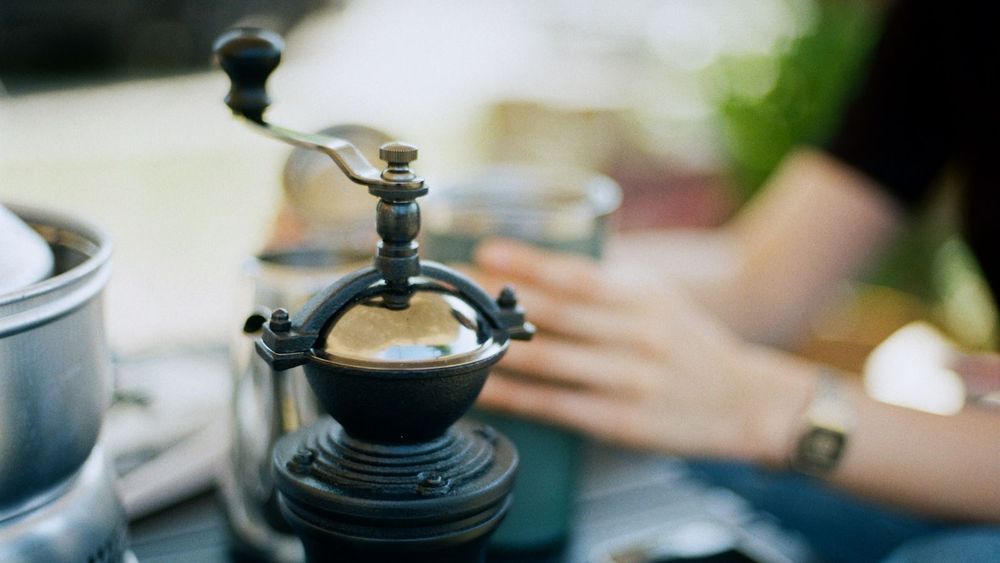
The short answer: Buy a hand grinder by what its manufacturer states, not by rules of thumb about its design. Four questions carry the decision: Does the manufacturer intend it for espresso and give a starting value? How many micrometres does one click move? How is the axle supported? How many grams does one fill hold? In our catalogue the manufacturers intend five of ten grinders for espresso, and the cheapest of them costs about €91.99 according to our price box on Amazon.de.
The numbers in this guide come from the manufacturers, from three studies in the journal Scientific Reports and from our German reviews of the ten hand grinders in the catalogue. We did not measure anything on any grinder. Where a number comes from a laboratory study on electric grinders, we say so, because a study only documents what it examined under its conditions. Whether you should grind by hand at all, and how flat burr and conical burr grinders differ, is covered beforehand in the grinder guide.
How to go about buying
- Decide what you grind. Espresso narrows the choice the most, because only some manufacturers intend their grinders for it at all. For filter coffee and French press the choice is much wider.
- Look for the adjustment distance per click in micrometres. It tells you how finely you can adjust, and it is the only figure that lets you compare grinders of different brands. Click counts alone are no use for that.
- Read how the axle is supported. The grinding gap is only as even as the guidance of the burr.
- Set your usual portion against the capacity. The manufacturers give values between 15 and 100 grams; the bean chamber table puts them side by side.
- Read the care rule before you buy. Whether water may touch the burrs differs fundamentally from brand to brand.
- Set your budget. Our price boxes list guide prices for the ten hand grinders from about €31.14 to about €236.90, mostly as of September 2026.
Steel or ceramic: which burr set should it be?
All ten hand grinders in our catalogue grind with a conical burr; the question is the material. The Hario Mini Slim Plus, the Skerton N, the MM-2 and the Porlex Mini II have ceramic. The 1Zpresso Q Air, the KINGrinder K6 and the Timemore Chestnut C3 ESP Pro have stainless steel. For the C40, Comandante names a special steel called Nitro Rex, 1Zpresso describes the J-Ultra burr set only as coated, and for the Timemore C5 ESP Pro the material is left open in our German review. None of our hand grinders has a flat burr set. What can be documented on flat versus conical is summarised in the grinder guide; it found no measurement in the sources it read showing that flat burrs grind more evenly.
Whether steel grinds better than ceramic has hardly been studied scientifically. We found no peer-reviewed comparative study. There is a bachelor’s thesis by V. S. T. Pe (2022, De La Salle University Manila) that compared three ceramic and three steel conical grinders using laser diffraction, 150 grams per grinder in portions of 15 grams. The ceramic grinders showed a wider spread of particle size there. Which models they were and whether they were hand-operated is left open in the thesis, and its actual question was the seasoning of new burr sets, which showed no effect. That is not enough to claim a general superiority of steel.
More reliable is what the manufacturers themselves intend. For none of the four ceramic grinders in our catalogue does the manufacturer intend espresso. In Hario’s grind tables for its three ceramic grinders, espresso is missing everywhere; Porlex names espresso only for the Mini Professional, which also has ceramic but is not in our catalogue. Conversely, steel is not documented across the board for the five espresso grinders: for the C3 ESP Pro, the K6 and the C40 it is, for the J-Ultra 1Zpresso names only a coated burr set, and for the C5 ESP Pro the material is left open. Our assessment from this: if you want to grind espresso, buy a grinder whose manufacturer expressly intends it for that; a ceramic grinder is currently never that in the catalogue. For filter and French press, nothing documented speaks against ceramic. In our catalogue ceramic goes up to €69, steel starts at €69.
The diameter of the burr is the second number on the burr set. Timemore gives 38 millimetres for the C3 ESP Pro and 42 for the C5 ESP Pro; KINGrinder and 1Zpresso each give 48 for the K6 and J-Ultra. Comandante, and 1Zpresso for the Q Air, do not state it. That a larger burr grinds faster is claimed by 1Zpresso in its advertising (“speedy 48mm design”); we know of no measurement on that.
Why the axle bearing matters for the grind
The burr sits on an axle and turns in a fixed ring. Between the two lies the grinding gap, and its width determines how large the particles become. Our explanation of why the bearing matters: the burr has to run concentrically in the ring. If the axle wanders under load, the gap changes, and with it the particle size. In its FAQ, Comandante itself puts it more briefly: the cone follows the centring of axle and grinding ring while grinding. The outer grinding ring was aligned to the axle at the factory with three special screws in the base, and nobody should adjust these screws.
We found no measurement of the effect of the bearing on hand grinders. There is, however, a principle from the laboratory. Uman et al. (2016, Scientific Reports 6, 24483) write about the grinding discs of their electric EK 43 that, as with all grinders, they could fall out of parallel, and they show in the appendix an example of how the distribution shifts when the burr set is misaligned. That is a flat burr grinder with a motor. It supports only the statement that the geometry of the gap changes the grind, not the superiority of any particular bearing design.
What the manufacturers in the catalogue write about the bearing varies widely. Comandante fits two sealed stainless steel ball bearings. For the C3 series Timemore names a double-supported central axle, KINGrinder for the K6 a double bearing construction, 1Zpresso for the Q Air a double bearing. For the J-Ultra the manual and spare parts list show an upper bearing with an upper and a lower bearing cap. Whether ball bearings or plain bearings, is stated nowhere except for Comandante. A double bearing is therefore already found in the travel grinder Q Air at €69, so it does not have to be expensive.
A wobble check on the empty crank attachment, as it is often recommended as a buying aid, we consider misleading. Comandante writes that the floating-mounted cone can sit slightly off-centre without beans and only centres itself under load.
Click adjustment or adjusting nut: what counts in daily use
What matters is not whether the adjustment sits outside or inside, but whether it clicks in fixed steps of a known width. That a grinder in the catalogue adjusts continuously without detents is documented nowhere. For the Hario Mini Slim Plus, however, the manual names no detents; Hario describes clicks only in an FAQ sheet for its predecessor, the MSS-1. The Q Air clicks internally with 30 clicks per turn, the Porlex Mini II with 16 clicks per turn and 18 steps, the Hario Skerton N and the MM-2 in notches. For the C3 series Timemore describes an internal wheel, and yet according to the manufacturer the C3 ESP Pro is meant for espresso. It becomes awkward with the Hario MM-2: to adjust it, the crank and the stopper have to come off.
The K6 and the J-Ultra have external rings with a scale. The advantage is practical: you read the setting off instead of counting it up from zero. With the Comandante you count from a zero point you find yourself.
Grinders only become comparable through the distance per click. According to the manufacturers, as given in our German reviews: J-Ultra 8 micrometres, Timemore C5 ESP Pro 15, KINGrinder K6 16, Timemore C3 ESP Pro 23.3, Q Air 25, Porlex Mini II 37 on average. For further models of the brand, 1Zpresso lists on its reference page 0.02 millimetres for the K-Ultra and 0.022 for the K-Plus, K-Pro and K-Max. Comandante gives no value, and we do not adopt retailer figures on this.
From this it follows why the same click count means something completely different on two grinders. For espresso Comandante names 7 to 13 clicks from zero, KINGrinder a starting value of 40 clicks at 16 micrometres per step for the K6. A starting value applies only to the grinder for which its manufacturer gives it.
Whether finer stepping is a matter of price is shown by our catalogue for the six grinders with a manufacturer figure: as the price rises, the step per click gets smaller. The Porlex Mini II and Q Air cost €69 each and click in 37 and 25 micrometres, the Chestnut C3 ESP Pro for €91.99 in 23.3, the K6 for €99 in 16, the C5 ESP Pro for €119 in 15 and the J-Ultra for €199 in 8. For Comandante and the Hario grinders the figure is missing. Whether this is down to price or design, the numbers do not document.
How big does the bean chamber need to be?
Big enough that your usual portion fits in one pass. The manufacturers in our catalogue give very different amounts for this.
| Grinder | Fill according to the manufacturer | Source |
|---|---|---|
| 1Zpresso Q Air | 15 to 20 g | 1Zpresso, per our German review |
| Porlex Mini II | about 20 g | Porlex manual |
| Timemore Chestnut C3 ESP Pro | 20 g | Timemore, per our German review |
| Hario Mini Slim Plus, Hario MM-2 | 24 g each | Hario, per our German reviews |
| Porlex Mill II (not in the catalogue) | about 30 g | Porlex manual |
| KINGrinder K6 | 25 to 30 g (product page), 30 to 35 g (manufacturer’s blog) | KINGrinder, per our German review |
| Timemore C5 ESP Pro | 30 g grinding chamber | Timemore, per our German review |
| 1Zpresso J-Ultra | 35 to 40 g in the catch container | 1Zpresso, per our German review |
| Comandante C40 MK4 | 40 g per Bean Jar | Comandante, per our German review |
| Hario Skerton N | up to 100 g in the glass container | Hario, per our German review |
There is no binding gram figure for the double espresso. The Italian association INEI regulates only the single one, at 7 grams, and Smrke et al. (2024) worked in the laboratory with 20 grams. We would work with 18 to 20 grams; that is a common range, not a standard. On that basis every grinder on the list is enough for a double, and with the Q Air it gets tight at the lower end of its range. For a large French press most chambers are not enough for one pass, the Skerton N excepted.
For the Porlex Mini II the manufacturer additionally sets a limit on bean size: no more than about 9 millimetres thick.
Why the grind setting controls extraction
Water dissolves substances from the surface of the particles. The smaller a particle, the more surface it has in relation to its mass. Uman et al. (2016) give this as the reason why small particles extract faster than large ones. Ground coffee does not have a uniform size, though. In the same study the particle distribution appears clearly bimodal: the fine particles make up the majority of the accessible surface, and alongside them lie particles that are one to two orders of magnitude larger.
With espresso, pressure comes in as well. Smrke, Eiermann and Yeretzian (2024, Scientific Reports 14, 5612) explain that finer grounds produce a higher pressure drop in the coffee bed, and the shot therefore takes longer. They deliberately varied the fines fraction below 100 micrometres: more fines lower the permeability of the coffee bed, the flow rate falls and the shot time rises. According to the study, different grinding technologies produce different amounts of fines at the same median. Grinding there was done electrically on a Bentwood Vertical 63.
For buying, that means: with espresso a small change to the grind setting shifts the shot time, which is why the distance per click matters there. With hand filter or in the French press, the water runs without pressure and much longer, and one step more or less matters less. That is our inference from the mechanism. Typically around 20 percent of the coffee substance is dissolved in espresso, write Smrke et al.
The numbers: grind setting per preparation
Every manufacturer counts differently. Hario gives its grind settings in millimetres: fine about 0.5 to 0.8, medium-fine 0.5 to 1.0, medium 1.0 to 1.5, coarse 1.0 to 2.0. Comandante and KINGrinder give clicks from their zero point. The table puts the three sources side by side; the clicks apply only to the grinder in question.
| Preparation | Hario Skerton N (manual) | Comandante C40 (clicks from zero) | KINGrinder K6 (clicks from zero) |
|---|---|---|---|
| Turkish coffee | not listed | 3 to 8 | 20 |
| Espresso | not listed | 7 to 13 | 40 |
| Moka pot | not listed | 14 to 20 | not reliably legible |
| AeroPress | not listed | not listed | 65 |
| Paper filter, hand filter | fine to medium | 18 to 35 | 100 (pour-over) |
| Dripper without paper | medium to coarse | not listed | not listed |
| French press | medium to coarse | 25 to 35 | 120 |
| Cold brew | fine to medium-fine | not listed | not listed |
| Source | Hario manual MSCSN-2 | Comandante FAQ | KINGrinder K6 handbook, page 2 |
Hario itself qualifies that the recommendation may vary depending on the device, and Comandante writes that the setting depends on preference and recipe.
On cold brew, the sources do not agree. You often read that cold brew needs the coarsest setting of the grinder. In the Skerton N manual, Hario instead recommends fine to medium-fine; whether that line means dripping or immersion, the manual does not say. Fuller and Rao (2017, Scientific Reports 7, 17979) compared a medium with a coarse grind and found no significant difference for caffeine and 3-chlorogenic acid. The two did not study flavour, and caffeine and 3-chlorogenic acid reached equilibrium in their samples after only 6 to 7 hours. Comandante and KINGrinder do not list cold brew. Our assessment: for cold brew you do not have to choose the grinder by its coarsest setting. What to set on your grinder is in the guide coffee grind size.
Setting up espresso: starting values and where they come from
Several figures circulate for dose, yield and time, and they fit together only in part.
| Source | Dose | Drink | Time |
|---|---|---|---|
| INEI, brochure Certified Italian Espresso (archived copy 2013), page 7 | 7 g plus or minus 0.5 (single espresso) | 25 ml plus or minus 2.5 | 25 s plus or minus 5 |
| Smrke et al. (2024), experimental setup | 20 g | 40 g | sensory optimum at about 30 s for the coffee studied |
| Smrke et al. (2024), discussion | not stated | not stated | 25 to 30 s traditionally, 10 to 20 s for so-called turbo shots |
INEI measures the drink in millilitres, Smrke et al. in grams, and we found no SCA standard with a ratio of 1 to 2. The optimum of about 30 seconds at 19 to 20 percent yield was determined in the study by a Q Grader for exactly one coffee. Our assessment: as a starting value we would take 1 to 2 by weight, so about 18 grams of coffee to 36 grams of drink, and aim for a time around 25 to 30 seconds. That is a common beginning, not a target value.
Here is how to proceed:
- Find the zero point. Comandante defines zero as the first setting at which the crank no longer drops down, with the grinder held horizontally and the burr set closed step by step. KINGrinder has you turn the ring clockwise to the stop at 0; tightening hard is not necessary. On the J-Ultra, zero is the point where resistance begins.
- From the zero point, open up to your manufacturer’s starting value. Do not turn closed past zero; on the Comandante that would give negative clicks.
- Weigh the dose and keep it the same across all attempts. All the starting values above are in grams, except for the INEI drink.
- Grind. Porlex advises holding the crank horizontal, pressing down lightly and grinding slowly.
- Change only the grind setting and note the shot time. Comandante writes: with everything else fixed, grind finer for more extraction, coarser for less.
Faults and what to change
Sour, pale espresso with crema that vanishes quickly: Stiftung Warentest (Germany’s consumer testing foundation) names grounds that are too coarse as the cause in its report on coffee grinders (test 12/2019). You grind finer, with the same dose. We would change only one click per attempt, which on the K6 is 16 micrometres according to KINGrinder and on the J-Ultra 8 according to 1Zpresso, and check whether the shot time rises towards 25 to 30 seconds.
Strong, bitter espresso: according to the same source, grounds that are too fine lead to over-extraction. You grind coarser, likewise in single clicks. Both explanations are part of the freely readable section of the report and were not measured on hand grinders; they describe the grind setting in general.
The shot runs differently after cleaning than before, although the click count is right: the zero point may have drifted. For the J-Ultra, 1Zpresso writes that it can shift by about plus or minus 10 clicks after reassembly, depending on how tightly the knurled nut and ring are tightened. After every reassembly you find zero again and count from there.
The crank is stiff or scrapes at the finest point: here the burr set is at risk of damage. KINGrinder warns not to grind at the zero point or below 15 clicks, nor to crank it empty. Porlex advises not to tighten the adjusting screw too far, because the burrs can touch and be damaged, and to avoid running it empty without beans.
Powder stays behind in the burr set after every pass. Stiftung Warentest recorded in 2019 that with burr grinders a remainder always stays between the burrs and the outlet, measured on electric devices. Porlex gives as the reason for cleaning that leftover powder oxidises over time, can affect the flavour of the next grind and can disturb the grind setting. The remedy is cleaning, and how far it may go is set by the manufacturer: the rules are in the next section, the intervals from KINGrinder, Comandante and 1Zpresso in the questions at the end.
Cleaning: may water touch the burrs?
That depends on the manufacturer, and no rule for all hand grinders can be derived from it. Hario allows washing most parts, except wooden parts and iron burr sets. Porlex recommends washing the ceramic burr with a small brush and the other parts with a soft sponge and water, then drying them well; the handle should not be left in water for long, because it can rust. The Hario MM-2 has a wooden body and, according to Hario, must not be immersed in water.
The other side: for the J-Ultra, 1Zpresso prohibits cleaning with water and recommends a brush and a blower bulb. KINGrinder likewise prohibits water for the K6. For the C40, Comandante prohibits soaking and the dishwasher, as otherwise the wood veneer and ball bearing cartridges suffer; Ironheart burr sets should not be cleaned with water at all, and a damp cotton cloth with immediate drying is enough for dirt. For the larger models C60 and X25, Comandante allows rinsing with water and mild agents.
The prohibitions are justified by rust, corrosion, wood and ball bearings. How to clean thoroughly without water is in the guide cleaning a coffee grinder.
Where the design reaches its limits
The portion is limited, as the bean chamber table shows.
How long you crank is open. None of the manufacturers in our catalogue gives a grinding time, not even for an espresso dose, and our German reviews of the J-Ultra, K6, Hario Mini Slim Plus and MM-2 expressly list it as an open point. In 2019 Stiftung Warentest examined only electric grinders, where burr grinders needed 6 to 18 seconds of pure grinding time for a double espresso. That cannot be transferred to hand grinders.
Espresso is not possible with every hand grinder; the limit is drawn by the manufacturer’s statement, as described in the section on steel and ceramic. For the Q series, 1Zpresso classes the grinder among the pour-over grinders. No source we found puts a figure on the effort needed per burr set or diameter.
The ten hand grinders in our catalogue
The table orders the models by price. Prices are the guide values of our price boxes; the rating is our editorial assessment from the data comparison, not a measurement result.
| Model | Burr set and bearing | Step per click | Espresso according to the manufacturer | Price | Rating |
|---|---|---|---|---|---|
| Hario Mini Slim Plus | Ceramic burr, bearing not in the materials list | Notches according to the FAQ for the predecessor MSS-1, not confirmed for the Plus | not in the grind table | about €31.14 | 7.6 |
| Hario Skerton N | Ceramic | Notches without a micrometre figure | not in the grind table | about €39.80 | 7.9 |
| Hario MM-2 | Ceramic burr, wooden body | Adjusting only with the crank removed | no espresso machine in the table | about €50.98 | 7.8 |
| Porlex Mini II | Ceramic burr | 37 µm on average | named only for the Mini Professional | about €69.00 | 8.3 |
| 1Zpresso Q Air | Stainless steel burr, double bearing | 25 µm, internal | Q series listed as a pour-over grinder | about €69.00 | 8.5 |
| Timemore Chestnut C3 ESP Pro | 38 mm stainless steel, double-supported axle | 23.3 µm, internal | yes | about €91.99 | 8.7 |
| KINGrinder K6 | 48 mm stainless steel, double bearing construction | 16 µm, external with scale | yes, starting value 40 clicks | about €99.00 | 8.8 |
| Timemore C5 ESP Pro | 42 mm, material and bearing open | 15 µm | yes | about €119.00 | 8.9 |
| 1Zpresso J-Ultra | 48 mm, coated | 8 µm, external with scale | yes, designed for espresso according to 1Zpresso | about €199.00 | 9.1 |
| Comandante C40 MK4 | Nitro Rex steel, two sealed ball bearings | no manufacturer figure | yes, 7 to 13 clicks | about €236.90 | 9.4 |
Prices jump. The C3 ESP Pro stood in the Amazon catalogue at €115.00 one day before our figure of 7 September 2026.
For espresso on an espresso machine, going by the manufacturer data, the bottom five rows come into question. We would start with the C3 ESP Pro if the budget is tight, and take the K6 if you want a scale you can read; in our assessment the J-Ultra is worth it only if you mostly grind espresso and make use of the 8 micrometres. The Comandante is the grinder for someone who wants to buy spare parts later: according to our German review, Comandante lists 49 spare part items.
For AeroPress and travelling, the two €69 grinders are the obvious choice. According to 1Zpresso the Q Air fits into the AeroPress chamber and weighs 365 grams; the Porlex Mini II is also a travel format. For AeroPress, KINGrinder names a starting value of 65 clicks, in case you are looking for one grinder for espresso and AeroPress anyway.
For filter coffee and French press at home, going by the manufacturers’ grind tables, the ceramic grinders from Hario are enough too.