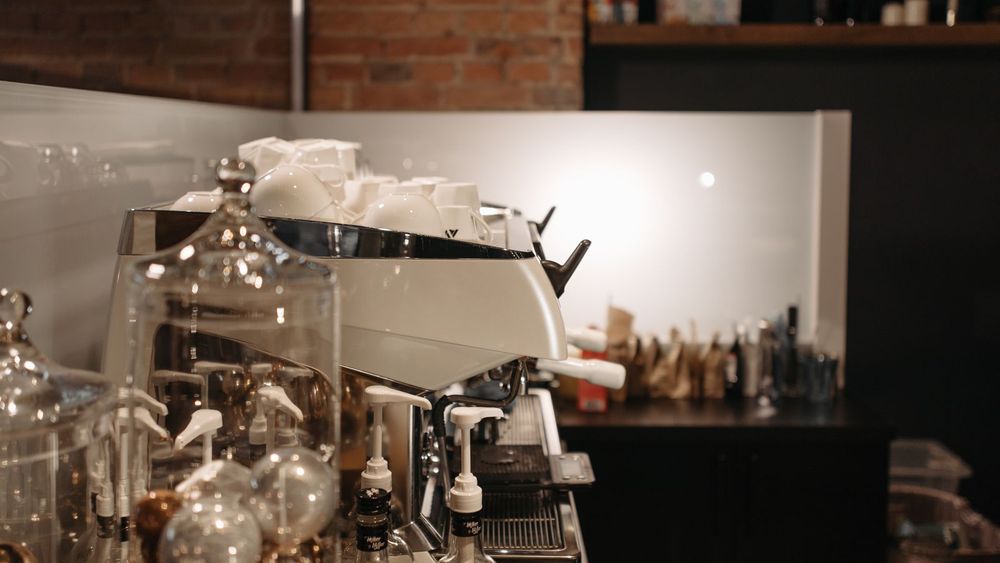
The short answer: Decide on a built-in grinder and milk frothing before you compare prices, and settle the portafilter diameter, because the design and the total cost depend on it. The 15 bar on the box is a pump figure; for the coffee bed, the historical SCAA definition, quoted in SCA’s 25 Magazine, gives 9 to 10 atmospheres (roughly 9.1 to 10.1 bar). In our catalogue the price boxes range from approx. €123.99 to approx. €1,187.29 on Amazon.de, the median is €489.00, and 8 of 17 portafilter machines have a built-in grinder.
Six questions before you compare prices
On the order of decisions: the grinder and the heating system cannot be changed after purchase, but the tamper, scale and knock box can.
- Should the grinder be built into the machine or stand separately? A built-in one saves a device on the worktop, but you can only replace it together with the machine. A separate grinder costs extra and can be replaced independently: eleven of the 14 electric grinders in our catalogue name a portafilter solution, and their price boxes range from approx. €87.99 to approx. €639.00.
- Do you need milk foam straight after the espresso? According to La Marzocco, a single boiler cannot brew and steam at the same time; a dual boiler can. If you froth milk after every espresso, that also decides the design.
- Pressurised basket or single-wall basket? The basket type determines how much work on the grind size is ahead of you.
- Which portafilter diameter applies? Tampers, baskets and the holders of grinders depend on it, and we found no uniform size.
- Does the place of use match the intended purpose? Whether an office or a guesthouse is permitted is set by each manufacturer for each model.
- What does the whole package cost? Depending on the model, a grinder, tamper, scale and knock box come on top of the machine, plus the ongoing cost of coffee.
Heating systems: catalogue, manufacturer data, open questions
Our catalogue covers 17 portafilter machines with a rewritten review and no heat-exchanger machine; the information on that class below comes solely from La Marzocco. For the two Ninja models, the heating system is not stated in any of the manufacturer documents we reviewed. According to their reviews, the other 15 heat as follows: four with a thermoblock, two with a thermocoil, three with a ThermoJet, five as single boilers and one as a dual boiler.
| Machine | Heating system | Grinder | Portafilter according to manufacturer | Price (catalogue price box) |
|---|---|---|---|---|
| De’Longhi Dedica EC685 | Thermoblock | no | no diameter stated | approx. €123.99 |
| De’Longhi Classic EM450 | Thermoblock | no | no diameter stated | approx. €127.00 |
| De’Longhi La Specialista Arte | Thermoblock | yes | no diameter stated | approx. €369.00 |
| Sage Barista Express Impress | Thermocoil | yes | 54 mm | approx. €379.00 |
| Ninja Luxe Premier | not published | yes | not published | approx. €381.43 |
| Ninja Luxe Pro | not published | yes | not published | approx. €386.85 |
| Sage Barista Pro | ThermoJet | yes | 54 mm | approx. €474.01 |
| Sage Bambino Plus | ThermoJet | no | 54 mm | approx. €479.90 |
| Lelit Anna PL41TEM | Single boiler | no | 57.35 mm (Amazon listing text), LELIT57 group | approx. €489.00 |
| Sage Barista Express | Thermocoil | yes | 54 mm | approx. €489.00 |
| Gaggia Classic Evo Pro | Single boiler | no | 58 mm | approx. €499.52 |
| De’Longhi La Specialista Touch | Thermoblock | yes | no diameter stated | approx. €549.97 |
| Lelit Victoria | Single boiler | no | LELIT58 group | approx. €799.00 |
| Rancilio Silvia | Single boiler | no | 58 mm tamper in the catalogue, no group size | approx. €829.00 |
| Gaggia Classic UP | Single boiler | no | 58 mm | approx. €950.89 |
| Sage Barista Touch | ThermoJet | yes | 54 mm | approx. €971.54 |
| Lelit Elizabeth | Dual boiler | no | LELIT58 group | approx. €1,187.29 |
The price boxes are not from the same day: for some of the machines the reviews give a date, for the others only the price box, and according to its review the Classic UP sits in the box as of July 2026, the Classic Evo Pro as of September 2026.
According to La Marzocco, a single boiler has one boiler with one heating element, from which the water for espresso and steam comes. Both at once is not possible. After the espresso, the boiler has to heat up for steam, and the water volume in it falls. Before the next espresso, the temperature has to be lowered again and the water volume raised again; according to La Marzocco, this can be sped up by flushing, that is, by running off hot water. La Marzocco writes that there is no constant temperature stability in this process; it is a manufacturer that builds dual boilers itself and dates the dual boiler system to 1970 (GS series).
The heat-exchanger machine likewise has one boiler with one heating element, but two water circuits. According to La Marzocco, the boiler temperature is constant at about 120 °C, and the fresh water runs through a tube system in the boiler to the brew group. The brew group and the steam wand can run at the same time. After a long pause the machine can overheat, so the manufacturer recommends a cooling flush before every shot.
In a dual boiler, two boilers heat separately: a large one at 120 °C for steam and a small one at 90 to 95 °C for the coffee, according to La Marzocco. For a dual boiler system with a saturated brew group, the manufacturer states a temperature stability of under 0.6 °C, especially in combination with insulated stainless steel and electronic control (PID). Whether that figure applies to a household model, the source does not say. According to our German review, the Lelit Elizabeth, the only dual boiler in our catalogue, has a brass coffee boiler of 300 ml (95 °C from the factory) and a stainless steel 316L steam boiler of 600 ml (135 °C from the factory). The Lelit shop gives a heat-up time of less than 15 minutes.
On its Austrian page, De’Longhi writes that the thermoblock heating of the Dedica Style and the Dedica Arte reaches extraction temperature in just 40 seconds. For the Dedica Maestro Plus, the manufacturer advertises an Advanced Thermoblock that regulates actively, and the page for the Classic EM450 promises a fast heat-up time and higher temperature stability.
Sage relies on two other systems. The Barista Express and Impress heat with a thermocoil and PID, and the Express holds 93 °C from the factory. For the ThermoJet of the Barista Pro, the extraction temperature should be reached after 3 seconds according to Sage; the time refers to extraction temperature, not to steam readiness. Sage also advertises up to 32 per cent less energy than with a thermoblock; the footnote on the product page bases this on internal benchmarks from November 2022.
Times to readiness are given by only some manufacturers. For the Anna, the manual gives about 3 minutes according to our German review, and the Lelit shop less than 10 minutes; the English data sheet for the Victoria speaks of a few minutes. Instead of a time, the manual for the Gaggia Classic E24 asks you to insert the portafilter, let about 150 ml of water run through and wait a few minutes until the machine, with the portafilter inserted, reaches the right temperature. According to our German review, the Silvia is ready when the orange heating light goes out.
Which one holds temperature better? The manufacturers give opposing answers. De’Longhi sees the higher temperature stability in the thermoblock, La Marzocco finds it lacking in the single boiler and the heat-exchanger machine, Gaggia justifies the brass boiler of the Evo Pro with more heat storage, and Lelit the two boilers of the Elizabeth. We found no independent measurements on household machines.
For the Lelit Anna, a single boiler with PID, our German review states, following the manual (which we did not open ourselves), a possible deviation of the boiler temperature from the set value of +/- 10/12 degrees, during heat-up, during extraction and when drawing hot water. The sources do not allow a ranking of the designs by temperature stability, so we do not give one. What is documented are the differences in workflow, that is, simultaneous or one after the other, and how long you wait for the boiler.
The 15 bar on the box and the pressure at the coffee bed
How the pressure of a vibration pump behaves is shown by the catalogue of the pump manufacturer CEME for its Ulka models (at least from 2008). Pressure is plotted against flow rate, measured with water at 20 °C. The highest pressure occurs at zero flow, that is, with a closed outlet, and falls with rising flow down to 0 bar. Read from the diagram (an approximation): the E5 model, the 15 bar class, reaches roughly 13.7 to 16.6 bar at zero flow and is still at roughly 8.5 to 12 bar at about 200 cc/min. The E4 model reaches roughly 17 to 21.5 bar at zero flow.
For the Ulka pumps, the catalogue figure is therefore the maximum pressure without flow, and the 20 bar class (E4) and the 15 bar class (E5) are separate models with their own characteristic curves. What arrives at the coffee bed is additionally determined by the resistance of the coffee bed and, on some machines, by an overpressure valve.
| Source | Pressure figure | Type of statement |
|---|---|---|
| SCAA, historical definition (SCA, 25 Magazine, issue 3) | 9 to 10 atmospheres, roughly 9.1 to 10.1 bar | Definition by a trade association, not a standard for household machines |
| Barista Guild of America espresso survey 2017 | Mean 8.5 bar, most common answer 9 bar | Self-reported by 275 baristas, 76 per cent of them from the USA |
| Sage Barista Express | 9 bar at extraction, the 15 bar pump makes it possible | Manufacturer, product page |
| Gaggia Classic UP | 9 bar when brewing, 15 bar nominal | Manufacturer, product page; for the Classic E24 only 15 bar nominal |
| Lelit Victoria | 8 to 10 bar at extraction as ideal value, pump pressure 15 bar | Manufacturer, manual |
| De’Longhi Dedica EC685 | only pump pressure 15 bar | Manufacturer, product data |
| Andueza et al. 2002 | Arabica espresso compared at 7, 9 and 11 atm | Study |
Andueza, Maeztu, Dean, de Peña, Bello and Cid (2002, Journal of Agricultural and Food Chemistry) call water pressure one of the most important influencing factors, on which few studies exist. The espresso at 9 atm showed consistent foam and a high proportion of key aromas associated with freshness and with fruity, malty and buttery notes. In the principal component analysis, the samples at 7 and 9 atm could be separated from those at 11 atm. Only the profile at 9 atm and the separation of 7 and 9 atm from 11 atm are documented; the abstract does not show any superiority of higher pressure.
We would not read the pump figure as a quality feature. We find a figure for the pressure at the basket from Sage (9 bar), from Gaggia only for the Classic UP (9 bar when brewing) and from Lelit as an ideal value (8 to 10 bar).
Temperature, dose and time: sources side by side
For almost every figure there are several recommendations. The range for water temperature runs from 88 °C at Lelit to 96.1 °C at the SCAA.
| Source | Water temperature | Type of statement |
|---|---|---|
| SCAA, historical definition | 90.5 to 96.1 °C (195 to 205 °F) | Definition by a trade association |
| Barista Guild of America espresso survey 2017 | Mean 200.3 °F, roughly 93.5 °C | Self-reported by baristas |
| La Marzocco | 90 to 95 °C as ideal value for extraction | Manufacturer of professional machines |
| Sage Barista Express | 93 °C from the factory, controlled by PID | Manufacturer, product page and manual |
| Lelit Victoria | 88 to 92 °C when brewing | Manufacturer, manual |
| Lelit Elizabeth and Lelit Anna | 95 °C boiler temperature from the factory | According to our German reviews |
| De’Longhi Dedica EC685 | three levels without a degree figure | Manufacturer, manual |
| Gaggia Classic Evo Pro | no set value in degrees, no PID mentioned | Manufacturer gives no figure; thermostat according to our German review |
| Rancilio Silvia | Thermostat, no set value in degrees | Manufacturer, product page |
The figure on the display is not always the water in the cup. De’Longhi writes that the three-level brew temperature of the Dedica refers to the water in the thermoblock and differs from the temperature of the drink in the cup, and at Lelit the 95 °C stands for the boiler temperature. The figures can be read as a range, not as a measured value at the basket, and the factory setting as a starting point (93 °C at Sage, 95 °C boiler temperature at Lelit).
| Source | Dose (double) | Drink | Time |
|---|---|---|---|
| SCAA, historical definition | 14 to 18 g | 50 to 70 ml (2 x 25 to 35 ml) | 20 to 30 s |
| Barista Guild of America espresso survey 2017 | 18 to 20 g | on average 36.5 g, ratio on average 1:2 (answers from 1:1.5 to 1:2.5) | 25 to 30 s |
| Sage Barista Express | ideal dose 18 g (product page), 16 to 19 g for two cups according to the manual | preset approx. 60 ml for two cups (manual) | 25 to 30 s extraction time, output starts after 8 to 12 s (manual) |
| Lelit Victoria | Basket for 2 doses 14 to 18 g; ideal value 7 g +/- 0.5 | Ideal value 30 ml | Ideal value 25 s |
| Gaggia Classic UP | 2 cup basket 18 g, 1 cup basket up to 11 g | no figure | no figure |
| Rancilio Silvia | Baskets 8/16 g and 14/18 g, portafilter takes filters up to 21 g | no figure | no figure |
| Smrke et al. 2024 | 20 g | 40 g | Extraction time was measured, not set |
In our assessment, the basket sets the dose: the baskets in the table range from 8 to 18 g, and the Silvia’s portafilter takes filters up to 21 g. Lelit’s ideal value (7 g for 30 ml) is in the range of a single espresso (SCAA: 7 to 9 g for 25 to 35 ml; for the two-dose basket Lelit gives 14 to 18 g). The survey, by contrast, means doubles: 93 per cent of respondents describe their espresso as a double, and most use 18 g baskets. According to this survey, the ratio 1:2 is the average, a common practice and not a standard. Smrke, Eiermann and Yeretzian worked in their 2024 study with 20 g of coffee to 40 g of drink at 9 bar. For time, the middle is 25 to 30 seconds. As a starting point, the basket of your machine and the ratio 1:2 suggest themselves, so for an 18 g basket 18 g in and 36 g out; from there you change in small steps.
Pressurised basket or single-wall basket
Gaggia supplies the Classic E24 from the factory with the pressurised filter “Crema perfetta” on the portafilter, for one or two cups, and writes that it enables espresso with crema even on first use. The manual requires it to be used only together with the Perlstrahl frother (aerating nozzle), otherwise the coffee would spray out and there would be a risk of burns. If you use the conventional baskets, you remove the pressurised filter and the frother. According to the safety booklet, only ground coffee belongs in the pressurised filter portafilter. The Classic Evo Pro costs €499.52 in our price box and still comes with the pressurised filter, plus two conventional baskets.
In the manual for the Barista Express, Sage likewise lists double-wall baskets, which are intended for pre-ground coffee; single-wall baskets there are intended for freshly ground whole beans. According to our German review, you do not need a grinder to begin with on the Dedica: according to the product data it comes with pressurised or double-wall baskets that are intended for pre-ground coffee, and it is ESE pod compatible.
Our review of the Gaggia Classic Evo Pro describes the consequence like this: the pressurised filter builds up the resistance itself and makes the start easy on grind size, while the conventional baskets require the right grind size and a clean tamp. Even with a pressurised filter, adjusting is part of it, in our assessment. On factory settings, Stiftung Warentest (Germany’s consumer testing foundation) writes in the press release on its 2021 comparison that only a few machines had brewed “the optimal espresso” with them, and coffee sommeliers therefore gave setting tips for each device.
Grinder: what is documented
The grind size determines how fast the water runs through the coffee and how much dissolves. Andueza, de Peña and Cid (2003, Journal of Agricultural and Food Chemistry) compared three grind sizes in two Robusta-heavy blends (Arabica to Robusta at 20 to 80, one with 50 per cent torrefacto), so their result cannot be transferred to specialty Arabica: in both blends, the extraction of solids, soluble substances and aroma compounds increased inversely to particle size.
Cameron and colleagues (2020, Matter) call espresso the most variation-prone of the common coffee formats. Assuming a homogeneous flow through the coffee bed, their model predicts that the yield falls monotonically with a coarser grind. In the experiment, however, they found a maximum: at very coarse and at fine settings, the yield was lower. They interpret this as uneven flow at fine settings, with poor reproducibility and wasted raw material.
Smrke, Eiermann and Yeretzian (2024, Scientific Reports) attribute a key role in espresso flow to the fines. Different grinding techniques can deliver different amounts of fines (particles under 100 micrometres) at the same mean particle size, according to the abstract of the study. The authors added fines and found that more of them lowers the permeability of the coffee bed, reduces the flow and lengthens the extraction time. The study did not compare household grinders; the set-up was one Arabica bean, one grinder, 20 g dose, 9 bar, 40 g drink, a professional machine, tamping at 20 kgF and added fines.
This fits the rule of thumb that Stiftung Warentest gives (test 12/2019). If the powder is too fine, the drink trickles into the cup too slowly, over-extraction takes place, and the espresso tastes strong and bitter. If it is too coarse, the water runs through so fast that it dissolves too few aroma compounds: the espresso tastes sour, is too pale, and the crema disappears quickly. Cameron and colleagues qualify the rule, because at very fine settings the yield falls again. We would take the rule as a first direction and cross-check it with time and drink mass. How you then adjust the grind size is covered in the guide Coffee grind size.
On the type of grinder: Stiftung Warentest examined 15 coffee grinders for test 12/2019. Blade grinders can also grind well, it says there, but finding the right grind size is laborious and the same result is hard to repeat; the grind size can only be changed through the grinding time. For a double espresso, blade grinders needed up to 70 seconds of pure grinding time, burr grinders 6 to 18 seconds. Burr grinders deliver the same grind size every day “once set correctly”, and almost all grinders delivered better powder after adjustment by a barista than after the instruction manual. In the manual for the Classic E24, Gaggia prefers a burr grinder to a blade grinder because the latter releases too much powder and grinds unevenly.
One drawback of burr grinders is the dead space: between the burrs and the outlet, a remainder of powder always stays behind, up to 3.9 g in individual grinders, according to Stiftung Warentest enough for half an espresso. The first drink then consists partly of old powder. Blade grinders have no dead space. Our assessment: a burr grinder is the more reliable choice.
And pre-ground coffee? According to the Deutscher Kaffeeverband (German Coffee Association), whole beans that are ground fresh only shortly before brewing are used, for example, for a portafilter machine or bean-to-cup machine, while pre-ground coffee is suited to the filter coffee machine. Volatile aromas are lost during grinding. On its freely readable page, Stiftung Warentest backs up what it writes with no measurement: once ground, the aroma fades within a very short time.
Lelit considers the grinder indispensable; the Victoria manual says “The grinder is a must”, and according to the manual half of the result depends on how you operate the machine. In the manual for the Classic E24, Gaggia by contrast recommends ordering finely ground coffee from roasters, even if ideally the coffee is ground only shortly before use. Grinding fresh is thus the ideal case for Lelit, Gaggia and the Deutscher Kaffeeverband, and Stiftung Warentest names the rapid aroma loss after grinding; with a pressurised filter, however, ground coffee is a route intended by the manufacturer.
Grinder built in or separate
Eight machines in the catalogue have a built-in grinder: the De’Longhi La Specialista Arte and Touch, the two Ninja Luxe models, and the Sage Barista Express, Impress, Pro and Touch. The cheapest is the Arte (approx. €369.00); its review names neither the design nor the material of the grinder. Among the machines whose review explicitly names a conical burr grinder, the Sage Barista Express Impress (approx. €379.00, 25 settings) is the cheapest according to the price boxes, with the Ninja Luxe Premier following at approx. €381.43. According to Sage, the Impress lever presses the grounds with 10 kg and turns 7 degrees while doing so; the manual gives the dose as 8 to 11 g for one cup and 16 to 19 g for two. You set grind size and extraction time yourself. According to its review, the Impress is the wrong choice for two groups: those who already tamp confidently and want to determine the puck height themselves, and those who already own a good espresso grinder and do not want to pay for a second grinder.
On the other nine machines, the grounds come from a separate grinder or from the pack. Of the 14 electric grinders in the catalogue, eleven name a portafilter solution (holder, fork or dosing cup); with the Caso Barista Crema, the Rommelsbacher EKM 200 and the Wilfa Svart Uniform+ you grind into a catch container and transfer the grounds. The eleven at a glance:
| Grinder | Burr set | Price (catalogue price box) |
|---|---|---|
| Rommelsbacher EKM 400 | Stainless steel conical burr set, 35 settings | approx. €87.99 |
| De’Longhi Dedica KG 520.M | Conical burr set, 18 settings | approx. €131.89 |
| Graef CM800 | Conical burr set, 40 grind sizes | approx. €139.99 |
| Sage Dose Control Pro | Conical burr set, 60 settings, timer 0 to 50 s | approx. €153.25 |
| Graef CM820 | Conical burr set, 40 grind sizes | approx. €157.00 |
| Baratza Encore ESP | 40 mm conical burr set, 40 steps | approx. €179.95 |
| Sage Smart Grinder Pro | Conical burr set, 60 settings | approx. €199.00 |
| Baratza Virtuoso+ | 40 mm conical burr set, 40 steps | approx. €229.95 |
| Fellow Opus | 40 mm conical burr set, 41 steps | approx. €230.00 |
| Eureka Mignon Specialità | 55 mm flat burrs, stepless | approx. €431.90 |
| Eureka Libra 16CR | 55 mm flat burrs, stepless | approx. €639.00 |
The Eureka Mignon Specialità ranks first in our grinder ranking for 2026 (an editorial rating) and has a touchscreen timer and a 300 g bean hopper. The Libra 16CR, by contrast, doses by weight: the portafilter hangs in a fork that weighs along, and the motor stops at the target weight (±0.2 g according to Eureka). According to its review, the Graef CM820 is no longer listed at Graef (as of 25 September 2026); it is still listed on Amazon. The dates of the price boxes: Baratza Encore ESP and Virtuoso+, Eureka Mignon, Fellow Opus, Graef CM820 and Sage Dose Control Pro September 2026, Eureka Libra and De’Longhi KG520.M July 2026. Hand grinders in the catalogue include, for example, the Timemore Chestnut C3 ESP Pro (approx. €91.99, 38 mm steel burr), the Timemore C5 ESP Pro (approx. €119, 42 mm burr) and the 1Zpresso J-Ultra (approx. €199, 48 mm burr). The choice is explained in the guide Hand grinder buying guide, and more on electric grinders in the guide Coffee grinder guide.
Portafilter diameter: no standard found, only manufacturer data
We found no standard for the diameter of portafilter and basket at DIN, ISO or EN or anywhere else. For the Classic E24 and the Classic UP, Gaggia gives a 58 mm stainless steel portafilter, described on the product page as “Professional”. For the Victoria and Elizabeth, Lelit speaks of the LELIT58 as a commercial group (58.55 mm according to a Lelit accessory text, as our review of the Elizabeth puts it); the Anna, by contrast, has the LELIT57 group, at 57.35 mm according to the Amazon listing text, and a 58 mm tamper is too wide for it according to our German review. For the Silvia, Rancilio gives a 58 mm tamper but no group size. At De’Longhi and Ninja, there is no diameter in the manufacturer documents we reviewed. For the Express, Impress, Pro, Bambino Plus and Touch, Sage gives 54 mm.
A size of 51 mm appears in no manufacturer statement for a catalogue machine. It appears only in accessories: with the Vicloon tamper with 51 mm (approx. €10.79, with a silicone mat for 58 mm), in the GdHaHSP accessory set and in the size table of the tamper maker Motta, which lists De’Longhi at 51 mm. The seller of the tamper writes “Please measure your coffee filter before ordering” and at the same time says the base is suitable for all types of espresso and coffee machines, which is contradictory. In manufacturer data and accessories, we thus come across 51, 54, 57 and 58 mm. 58 mm is the size that several manufacturers give for their groups described as commercial. We would measure at the basket and not go by the name of the machine. The tamper maker Motta recommends measuring the inner diameter of the basket and subtracting one millimetre; the Motta 8100/M (approx. €23.97) has a stainless steel base of 58 mm and a handle of real wood.
For a grinder that is meant to grind directly into the portafilter, too, the manual decides and not its name. According to its review, the Graef CM820 has two holders of approx. 60 and 70 mm diameter, and Graef does not assign which portafilter belongs in which holder. With the Sage Smart Grinder Pro, two portafilter holders are in the box, one for 50 to 54 mm and one for 58 mm. According to our German review, the Dose Control Pro likewise has holders for 50 to 54 and for 58 mm.
Grinders differ on the dosing cup. The Baratza Encore ESP comes with a dosing cup and a 58 mm adapter ring, with which the ground coffee can be transferred into a portafilter of 54 or 58 mm; at 54 mm the ring is removed before dosing, and for other diameters such as 51 mm the manual names neither cup nor adapter. For the Baratza Virtuoso+, the product page names the dosing cup as compatible (for 58 mm with an adapter), but does not say whether it is included. For the Fellow Opus, a supplied portafilter dosing cup makes the catch container compatible with 54 and 58 mm portafilters, according to the manual.
Steam and milk: the operating rules
For more on the technique of frothing, see the guide How to froth milk; here are the operating rules from the manufacturer documents.
For the Classic E24, Gaggia allows steam for a maximum of 60 seconds at a time, because a longer draw could empty the boiler completely. If you want to prepare another coffee straight afterwards, you lower the boiler temperature by dispensing hot water at the brew group, otherwise the coffee could taste burnt.
For the La Specialista Touch, De’Longhi leaves open whether brewing and steaming can happen at the same time; for the thermoblock models Dedica EC685, EC695 and EC785, by contrast, the manual requires a cooling pause, which applies to these models and not to all thermoblocks. On these three, both indicator lights flash after steam when the boiler has to cool down for the espresso. You then place a container under the milk frother, open the steam knob and let hot water run until the lights show the cooled boiler. For frothed milk, the manual gives an ideal value of 60 °C and a maximum of 60 seconds of steam.
For the Barista Pro and the Impress, Sage requires you to take the portafilter out of the brew head before frothing. Limescale or a blocked steam wand can turn or loosen it according to the manual of the Pro. It must not be removed during brewing, because the machine is then under pressure according to the manual.
Lelit explicitly describes brewing and steaming in parallel for the Elizabeth. With several milk drinks in a row, you plan in the prescribed pauses of the Gaggia Classic and the Dedica, and for any other model you read up in the manual.
Home or office
The Gaggia safety booklet, which is linked on the product pages of both Classic models, intends the machine only for normal household use and not for staff kitchens of shops, offices, farms or other working environments. According to our German review, the safety booklet of the La Specialista Touch excludes rooms set up as kitchens for the staff of shops, offices and other work areas, as well as agricultural tourist facilities, hotels, room rentals, motels and other accommodation businesses.
Lelit, by contrast, describes the Victoria as built for household use and unsuitable for continuous professional use. According to our German review, the manual names as places of use the household and similar areas: staff kitchens in shops, offices and other working environments, farmhouses, guests in hotels, motels and other residential environments, and bed and breakfasts. Rancilio lists the Silvia in the Home Line 2020 catalogue with the recommendation “Recommended for home and office”. In our assessment, anyone buying for a team or a guesthouse should read the safety booklet of the specific model word for word before buying. One manufacturer counts offices as household, another excludes them.
What it costs
The price band of the catalogue can be described without judgement: no machine sits between €127.00 and €369.00, and ten of the 17 lie between €369.00 and €549.97. The catalogue has no entry-level class between €150 and €250. Our scores also do not support a middle as the best choice. The mean editorial overall score is 8.05 for the two machines under €300, 8.70 for the ten between €300 and €700 and 8.96 for the five above. The scores come from data sheets and manuals, and two to ten devices per group are not statistics. We therefore claim neither a sweet spot nor a price threshold from which espresso becomes right.
How expensive the whole set-up becomes depends on the grinder. Our calculation from the catalogue values:
| Set-up | Calculation | Total | Share of the machine |
|---|---|---|---|
| Gaggia Classic Evo Pro, Baratza Encore ESP, tamper, scale, knock box | 499.52 + 179.95 + 74.95 | €754.42 | 66% |
| Gaggia Classic Evo Pro and Rommelsbacher EKM 400, without accessories (pure price calculation: the EKM holder is designed for about 60 mm according to the manual, the fit with the 58 mm portafilter remains open) | 499.52 + 87.99 | €587.51 | 85% |
| Sage Barista Express Impress, scale, knock box (grinder and tamper built in) | 379.00 + 29.99 + 20.99 | €429.98 | 88% |
| Lelit Victoria and Eureka Mignon Specialità, without accessories | 799.00 + 431.90 | €1,230.90 | 65% |
The €74.95 of accessories comes from the Motta tamper at €23.97, the Maestri House scale at €29.99 and the De’Longhi knock box DLSC084 at €20.99. The scale is part of the routine in the 2017 survey: among the 275 baristas surveyed, 82 per cent measure the yield by weight. If you swap the Motta for the Vicloon tamper (€10.79), it comes to €61.77. With the Motta tamper, the Bagail scale (€39.99, 3,000 g capacity) and the MHW box (€27.99, 1.2 litres), it comes to €91.95. You stay under €80 with a tamper, a 0.1 g scale and a knock box only with the cheap combinations. The machine’s share in our table ranges from 65 to 88 per cent; no fixed split can be derived from that.
We calculate the running costs with 18 g of coffee per espresso (Sage gives 18 g as the ideal dose, the basket of the Gaggia Classic UP holds 18 g, the survey is at 18 to 20 g). The 23 coffee beans in the catalogue cost €13.63 to €35.95 per kilogram according to the price box, the median is €18.58. That gives 24.5 cents per espresso for the cheapest variety, 33.4 cents for the median and 64.7 cents for the most expensive. At 14 g, the lower SCAA dose for the double, it is 19.1 cents for the cheapest variety.
The equipment share comes from the purchase price divided by 3,650 espressos (five years times 365 days times two a day). A €400 device comes to 11 cents per cup. With the catalogue prices it is 3.4 cents for the Dedica EC685, 13.4 cents for the Sage Barista Express, 13.7 cents for the Gaggia Classic Evo Pro, 21.9 cents for the Lelit Victoria and 32.5 cents for the Elizabeth. Two espressos of 18 g each use 65.7 kg of coffee in five years, which is €895 for the cheapest and €2,362 for the most expensive variety. 14 of the 17 machines in the catalogue cost less than this €895.
Descaling and lead
The BfR (German Federal Institute for Risk Assessment) writes (as of 7 May 2025) that portafilter espresso machines can release high amounts of lead after descaling, and advises rinsing the machine well afterwards. For test 12/2021, Stiftung Warentest found too much lead in the cup after descaling in two of seven portafilter machines examined, the Severin KA 5995 Espresa Plus at €156 and the Solis Barista Gran Gusto at €400 (2021 models, see below), verdict “poor”. The effort also differs: the descaling programme of the Solis takes 75 minutes, the Sage machine in the comparison was descaled in 17 minutes, and with Solis and Graef there was a risk of scalding during descaling.
This belongs before the purchase: what is used to descale and how long it takes. According to the product page, you descale the Gaggia Classic Evo Pro manually, with no programme, and the Classic UP likewise has none. Descaling by machine type is described in the guide Descaling and cleaning, and how hard water relates to the machine in the guide Water hardness and coffee.
Fault patterns: symptom, cause, remedy
Causes are given here only where a source names them. The details are in the sections above.
| Symptom | Cause according to source | What you change |
|---|---|---|
| The tamper does not fit in the basket | The diameter differs; for the Lelit Anna a 58 mm tamper is too wide according to our German review | Measure the inner diameter of the basket and subtract one millimetre (Motta) |
| The coffee sprays out of the basket | Pressurised filter without the Perlstrahl frother (Gaggia) | Fit the frother or switch to a conventional basket |
| The espresso tastes burnt after frothing milk | According to Gaggia, the coffee can taste like this if the boiler stays too hot after steam | Dispense hot water at the brew group |
| The extraction trickles, the espresso tastes strong and bitter | Powder too fine (Stiftung Warentest, test 12/2019) | Grind coarser, then check time and drink mass |
| The extraction runs through, the espresso tastes sour and is too pale | Powder too coarse (Stiftung Warentest, test 12/2019) | Grind finer, then check time and drink mass |
Further faults in the technology are collected in the guide Espresso machine troubleshooting.
What other published assessments say about portafilter machines
Stiftung Warentest most recently examined seven entry-level models for €156 to €455 in test 12/2021 (online 17 November 2021): De’Longhi Dedica EC785, Graef Espresso Salita, Krups Virtuoso XP442C, Sage The Bambino Plus, Severin KA 5995 Espresa Plus, Smeg ECF01BLEU and Solis Barista Gran Gusto. Four models did well; according to the press release, the overall winner is the Krups machine at €169, together with a Smeg machine at €350. We list the Sage Bambino Plus from this line-up in the catalogue. On the page for this comparison there is a note dated 3 September 2025 on an assessment by the Belgian partner Test Achats; after our review in October 2026, it lists no newer portafilter machine assessment of its own.
The ETM Testmagazin examined 17 portafilter machines in issue 12/2024 (no. 232, published on 29 November 2024), only four of them with a grinder. According to ETM Testmagazin 12/2024, in the group with a grinder (four devices) the De’Longhi La Specialista Opera EC9555.M, which is not part of our catalogue, is the overall winner with “very good” (95.8 per cent), as the aggregator testberichte.de reports it.
Our assessment: an overall score for the machine alone answers the question of the espresso in the cup only in part. Stiftung Warentest examined grinders (test 12/2019) and portafilter machines (test 12/2021) separately.
What distinguishes the machines in the catalogue
If you want to start without a grinder of your own, the catalogue offers several routes. The Dedica EC685 is 149 mm wide according to De’Longhi, by the manufacturer’s statement the narrowest espresso machine in its own range, and the Classic EM450 costs €3.01 more. Then there are the eight machines with a grinder and the Gaggia Classic Evo Pro, whose pressurised filter is intended for ground coffee.
With a grinder in the machine, the devices differ in things that can be checked before purchase. The grinder of the Barista Pro has 40 mm burrs and 30 settings, that of the Barista Express 16 settings, the La Specialista Touch a conical burr set with 15 settings and active temperature control, the Arte 8 settings and a 180 g bean hopper. The Barista Touch brings a touchscreen and automatic milk frothing with a milk temperature of 40 to 75 °C.
Among the single boilers with a separate grinder, the equipment differs: according to Gaggia, the Gaggia Classic Evo Pro has boiler and group of lead-free brass (manufacturer statement, not verified by us), the Classic UP two PID controllers and a three-stage pre-infusion, the Lelit Anna a boiler temperature that can be set from 80 to 130 °C, the Victoria a pre-infusion that can only be switched on or off, and the Silvia a thermostat instead of PID.
The Elizabeth, our only dual boiler, has a pressure gauge whose green zone runs from 8 to 12 bar according to the review.
Whether a bean-to-cup machine suits you better than a portafilter machine is covered in the guide Bean-to-cup vs espresso machine. Which accessories you need first is in the guide Barista accessories essentials, and how an extraction succeeds in the first place in the guide Espresso basics.
What cannot be documented
We have not used or measured anything ourselves for this guide. Every figure comes from the sources named or is calculated from catalogue values. What we could not document, we left out. This includes a heat-up time in minutes for the Gaggia Classic Evo Pro and Classic UP, the Rancilio Silvia and the Sage Barista Express, a difference in foam quality or control between a clip-on frother (Panarello) and a bare steam wand, a percentage share of the grinder in the result, and the claim that the steam pressure of thermoblocks only rarely suffices for microfoam. Likewise missing is a manufacturer statement on which pump is in which household machine; whether machines with 15 and with 20 bar on the box have the same pump therefore cannot be said. On the shelf life of ground coffee for espresso, we found no study with a figure in days; Anese, Manzocco and Nicoli (2006, Journal of Agricultural and Food Chemistry) studied ground, dark roasted coffee after opening, with no number of days in the abstract and not for espresso. We do not calculate a price comparison with a cappuccino in a café, because we found no reliable average price figure for Germany.
The figures of the Espresso Italiano specification (7 g, 25 ml, 25 s, 88 °C, 9 bar) we found only in secondary sources and did not use them. We did not open the manuals of the Sage Dose Control Pro, the Lelit Anna, the Rommelsbacher EKM 400 and the De’Longhi KG520.M or the 2018 Lelit manual of the Elizabeth ourselves; what is stated above from them comes from the reviews of these devices. The same goes for the information on the Graef CM820, the Baratza Virtuoso+, the Fellow Opus and the Eureka Libra 16CR. We know the ranking of ETM issue 12/2024 only through the aggregator testberichte.de; we did not read the PDF of the article.