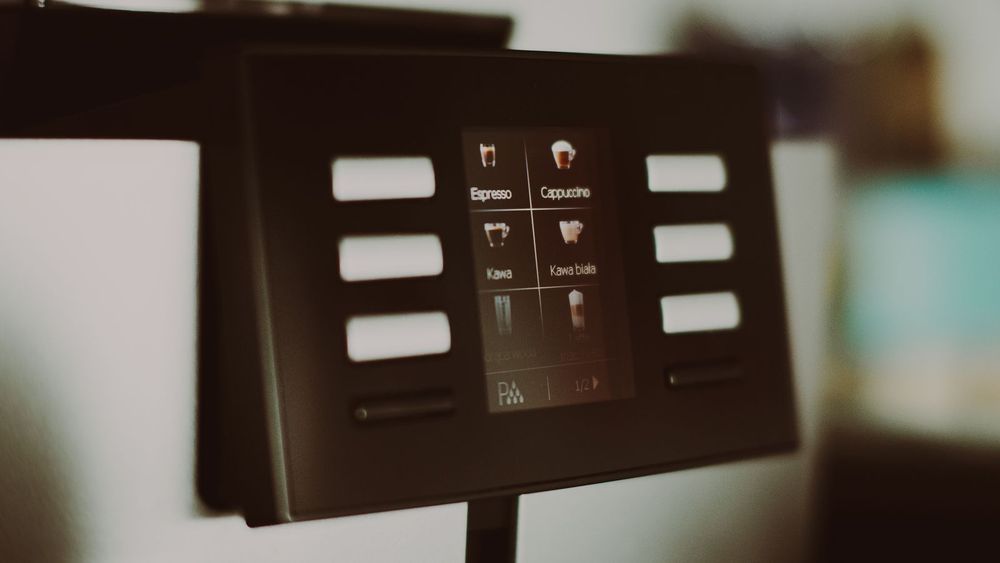
The short answer: The bean-to-cup machine grinds, doses and presses by itself; on a portafilter machine you do these steps by hand and get more adjustable variables in return. No comparison of household machines documents that one type tastes better: in 2026, Stiftung Warentest (Germany’s consumer testing foundation) found that bean-to-cup machines produce partly very different quality from the same good espresso beans. Our assessment: if you want as few steps as possible in the morning, take the bean-to-cup machine; if you want to control dose, grind and milk yourself, take the portafilter machine.
What each machine does for you
In a bean-to-cup machine, the grinder and brew group sit inside the housing. On the De’Longhi Magnifica S, the Philips LatteGo 5400 and the Nivona NICR 790 the brew group can be removed; on the Jura E6 and E8 it is built in. The machine grinds fresh for each drink, presses the grounds in the brew chamber and forces the water through. How much coffee falls into the chamber is a machine specification: according to its data sheet, the variable brew unit of the Jura E8 handles 5 to 16 g per drink, Nivona gives 7 to 11 g per cup for all its bean-to-cup machines, and the Grundig KVA 6230 gives 8 ± 2 g (Standard) and 10 ± 2 g (Intensive).
On a portafilter machine you take over these steps. You grind, or have a grinder grind, fill the grounds into the basket, distribute and tamp them, and lock in the portafilter. The portafilters measure 54 mm on Sage and 58 mm on Gaggia. From this follows our assessment: you need a tamper, dosing ring and baskets on a portafilter machine but not on a bean-to-cup machine, because there the grinder doses and the brew unit presses. We found no manufacturer source saying exactly this; it follows from the way the machines are built. Which accessories make sense first on a portafilter machine is covered in the guide on barista accessories.
That does not remove the need for adjustment. A bean-to-cup machine also has a grind setting. On the Magnifica S, according to the manual, you change it by one position at a time and see the effect after two coffees at the earliest; on the Siemens EQ600 and EQ6 plus it only takes effect from the second cup, and you judge it from the third at the earliest. The troubleshooting table in the Siemens manual assigns “coffee too sour” to a grind that is too coarse and “too bitter” to one that is too fine. “Beans in, press the button” therefore describes the factory setting. How to adjust is explained in the guides on bean-to-cup machine settings and coffee grind size.
Bar, degrees and grams: the figures quoted for espresso
There is no standard for household machines, but there are several reference values, and they do not agree. The SCA prints as a historical definition: 25 to 35 ml from 7 to 9 g of coffee (14 to 18 g for a double), water at 195 to 205 °F (90.5 to 96.1 °C), 9 to 10 atmospheres and a brew time of 20 to 30 seconds. The Deutscher Kaffeeverband (German Coffee Association) gives 7 to 9 g, 25 to 30 ml and about 25 seconds. In 2011, Illy and Navarini wrote in Food Biophysics that traditional espresso requires machines that heat water to 92 to 94 °C and force it through at 9 ± 2 bar. They give no separate values for bean-to-cup machines there. A BGA survey of baristas (2017, printed in SCA 25 Magazine, 275 participants, 76 per cent from the USA) gave on average a dose of 18 to 20 g, a ratio of 1:2, 25 to 30 seconds, 8.5 bar and about 93.5 °C. That is café practice, not a target value.
The bar figure on a data sheet measures something different. De’Longhi gives 15 bar for the Magnifica S and 19 bar for the Dinamica Plus 370.70, and Jura gives a static maximum of 15 bar for the E8. The Magnifica S manual says 1.5 MPa (15 bar); De’Longhi does not state the pressure at the coffee bed. In our assessment, the figure describes what the pump can deliver, and how much pressure reaches the coffee grounds is determined by the resistance of the coffee bed, that is the grind, the amount in the brew chamber and the tamping density. It is the same with portafilter machines: Sage advertises 15 bar and gives 9 bar at extraction; for the Gaggia Classic Evo Pro the European manufacturer gives a nominal 15 bar, and no manufacturer page says what value the pressure relief valve of the EU version is set to. The pump maker CEME/Ulka gives the catalogue pressure at zero flow. A comparison of “15 bar on a bean-to-cup machine against 9 bar on a portafilter machine” therefore equates two different quantities.
For temperature, figures for household bean-to-cup machines are rare. The Jura E8 has three temperature levels without a degree figure. In the laboratory study by Gloess and colleagues (2013, European Food Research and Technology), the semi-automatic Dalla Corte Evolution ran at 92 °C and 9 bar, and the fully automatic Schaerer Coffee Celebration at about 90 °C (boiler temperature; the extraction temperature is not defined) and 8.25 bar. Both are commercial machines. Our assessment: the ranges overlap so much that neither type can be derived from them as the better one.
The differences at a glance
The rows are placed side by side because they can be documented. Where a row is missing, the source is missing.
| Criterion | Bean-to-cup machine | Portafilter machine | Source |
|---|---|---|---|
| Steps per drink | The machine takes over grinding, dosing and pressing | You grind (or use a grinder), dose, tamp and lock in; hybrids take over part of this | our own assessment from the way the machines are built |
| Catalogue price | 18 machines, about €229 to €1,049, median about €599 | 17 machines, about €123.99 to €1,187.29, median about €489, 8 with a grinder, 9 without | our own count of the price boxes, as of September to October 2026 |
| Milk | Philips LatteGo 5400 with LatteGo container, Jura and Nivona via tube, Magnifica S by hand on the steam wand | Steam wand by hand (Sage Barista Express, Gaggia), automatic milk system on the Sage Bambino Plus | manufacturer data in our German reviews |
| Heat-up | Grundig KVA 6230: under 50 seconds according to the technical data, the other manufacturers give no time | Dedica 40 seconds (advertising claim), Sage Bambino Plus 3 seconds to extraction temperature, Lelit Victoria under 10 minutes (German shop) | manufacturer and shop data in our German reviews |
| Standby | Philips LatteGo 5400 0.2 W (EN 50564:2011, according to Philips), switches off after 30 minutes from the factory; Jura E8 switched off 0 W according to the manual | Switch-off from the factory: Dedica after 5, Gaggia Classic Evo Pro after 20, Sage and Lelit after 30 minutes; Rancilio Silvia never without an add-on | manufacturer data in our German reviews |
Time: steps instead of seconds
We do not give a number of seconds per cup, because there is no documented one. Stiftung Warentest measures the time from switching on the cold machine to the finished first cup of cappuccino and publishes the values behind a paywall. For the same machine types, our guide on capsule vs pod machines records that we have no documented times.
What can be documented are the working steps. On a bean-to-cup machine every day begins with the pre-heating and rinsing cycle: on the De’Longhi Magnifica Plus every switch-on starts with it, and you cannot cancel it. The Siemens EQ600 skips the rinsing cycle if you press a quick-selection drink for 2 seconds (quickCup). Milk costs time afterwards: the Magnifica Plus requires the CLEAN function after every milk drink, and Stiftung Warentest advises rinsing the milk system after every cappuccino or latte. According to Philips, the Philips LatteGo 5400 prepares milk drinks one at a time only.
On a portafilter machine the waiting time comes before the shot. With the Gaggia Classic Evo Pro, according to our German review you run about 150 ml of water through and let the portafilter heat for several minutes. Then come grinding, dosing, tamping and the shot, and the milk is done by hand on the steam wand. The Gaggia tolerates steaming milk for 60 seconds at a time at most and then needs cooling time. For several milk drinks in a row, according to the review, a bean-to-cup machine or a dual-boiler machine is the better choice.
Our assessment: on a portafilter machine the steps before the shot add up, on a bean-to-cup machine the rinsing afterwards. If you mostly drink espresso without milk, the bean-to-cup machine has the shorter sequence. With several cappuccinos in a row this no longer necessarily holds, because then the bean-to-cup machine rinses after every milk drink.
Taste: what comparisons show
The most recent assessment is the one by Stiftung Warentest of 17.07.2026: 36 bean-to-cup machines in the ranking, 13 of them new. Coffee sommeliers tasted espresso and cappuccino blind, first on factory settings, then with self-optimised settings. The result on the freely readable page: from the same good espresso beans, the machines produced partly very different quality. Individual grades are behind the paywall and are not included here. In 2016 the foundation had rated ten bean-to-cup machines (€375 to €970) all “good” and portafilter machines (€188 to €740) almost all the same (press release of 23.11.2016). We take this only as evidence that both types can perform well; the prices are ten years old.
For portafilter machines the comparison in test 12/2021 (the Stiftung Warentest magazine) applies: seven entry-level models for €156 to €455, four of them good. For espresso like at an Italian café, the text names a good bean, some practice and a feel for it. According to the press release of 17.11.2021, only a few machines deliver their best espresso on factory settings; the sommeliers gave setting tips for each machine. Grinders were not part of this assessment. We found no newer portafilter comparison of the foundation’s own. No source we know of documents how many weeks the learning period takes.
The only laboratory study we found comparing the types is by Gloess and colleagues (2013). With the same coffee (Antigua Guatemala) and water of 4 to 6 °dH (German degrees of hardness), they compared the fully automatic Schaerer Coffee Celebration with the semi-automatic Dalla Corte Evolution. A trained sensory panel found the highest aroma intensity and a roasty note in both espressos. The semi-automatic machine had the finest crema; the fully automatic one had a pronounced fruity note, the highest acidity and the highest bitterness in the aftertaste; for the lungo the crema result was the other way round. Commercial machines, one coffee, one laboratory: the study says nothing about household machines and shows neither a higher nor a lower ceiling for the portafilter machine.
Why the portafilter machine demands control is shown by Cameron and colleagues (Matter, 2020). They call espresso the most variation-prone of the common coffee formats. In the experiment, the extraction yield has a maximum across the grind setting and falls again at very fine settings because the water flows through unevenly. “Finer means more extraction” is therefore only true up to a point. For grinders, Stiftung Warentest describes (12/2019, editorial, without measurement in the freely readable part): too fine and the espresso trickles slowly and tastes strong and bitter; too coarse and the water runs through quickly, the espresso becomes sour and pale, and the crema disappears quickly.
How many adjustable variables a machine has is stated in the data sheets. The Jura E8 has seven grind levels, ten coffee strength levels and three brew temperature levels. The Grundig KVA 6230 pre-infuses in Standard and ECO; the speed mode does without it. The Sage Barista Express has 16 grind levels and PID, and the Lelit Victoria has a temperature adjustable in the display and a pre-infusion that can be switched on and off. A freely adjustable pressure profile is not listed as a household function by any manufacturer document in our German reviews.
Our assessment: the portafilter machine gives you more ways to influence the result, the bean-to-cup machine takes steps off your hands. Because bean-to-cup machines perform so differently from the same beans, the individual machine decides first and the type second.
Costs: purchase, beans, care
The purchase price differs less by type than by machine. Four of the 18 bean-to-cup machines in the catalogue cost under €400: Tchibo Esperto Mini, Grundig KVA 6230, Melitta Solo and De’Longhi Magnifica S. For minimalist models without a milk system, Stiftung Warentest gives roughly €280 to €630 (as of July 2026) and notes that several machines cost over €1,000. With a portafilter machine, a grinder is added for nine of the 17 catalogue models. We calculated these total prices from the price boxes:
| Setup | Total |
|---|---|
| Gaggia Classic Evo Pro (about €499.52), Baratza Encore ESP (about €179.95), tamper, scale and knock box (together €74.95) | €754.42 |
| Gaggia Classic Evo Pro with Rommelsbacher EKM 400 (about €87.99), without accessories | €587.51 |
| Sage Bambino Plus (about €479.90) with Rommelsbacher EKM 400, without accessories | €567.89 |
| Sage Barista Express Impress (about €379, grinder built in) with scale and knock box | €429.98 |
| Lelit Victoria with Eureka Mignon Specialità | €1,230.90 |
Eleven of the 14 grinders in the catalogue have a portafilter solution; they cost €87.99 to €639. “Portafilter machine plus grinder for €400 to €800” is therefore true only for some of the combinations. If you divide the price by 3,650 (five years, two cups a day, both our assumptions, excluding repairs, electricity and resale value), the purchase costs per cup are 6.3 cents for the Tchibo Esperto Mini, 16.4 cents at the catalogue median of €599 and 28.7 cents for the Jura E8. For portafilter machines it is 3.4 cents for the Dedica, 13.7 for the Gaggia and 21.9 for the Lelit Victoria, each without a grinder. With a grinder and accessories the Gaggia comes to 20.7 cents.
The coffee itself is the second item. The 23 bean reviews in the catalogue give €13.63 to €35.95 per kg, and the median is €18.58. Per drink that gives:
| Coffee per drink | cheapest variety | median | most expensive variety |
|---|---|---|---|
| 7 g | 9.5 cents | 13.0 cents | 25.2 cents |
| 11 g | 15.0 cents | 20.4 cents | 39.5 cents |
| 18 g (double) | 24.5 cents | 33.4 cents | 64.7 cents |
So the dose decides, not the machine type: a bean-to-cup drink with 11 g costs less than a portafilter double with 18 g, and a simple portafilter espresso with 7 g costs less than both. None of these figures documents a systematic cost advantage of the portafilter machine per cup. With two doubles of 18 g each per day, that is 65.7 kg of coffee in five years, which at catalogue prices per kilogram comes to €895 to €2,362 for the coffee together (our calculation), so about as much as the machine or more.
Care costs very different amounts depending on the machine. A De’Longhi example: the DLSC002 water filter costs about €7.49, and if replaced roughly every two months that is six filters and €44.94 a year; the EcoDecalk descaler (about €7.98) is enough for five uses, so about €1.60 per descaling; cleaning tablets from Coffeeano cost about €0.16 per use at 80 pieces (€12.99). On the Jura E8, the manual calls for cleaning after 180 preparations, which at two cups a day is about every 90 days; six tablets cost €9.99, so four cleanings a year cost about €6.70. Depending on the machine we arrive at roughly €5 to €60 a year for filters and agents. For water filters alone, Stiftung Warentest gives a good €40 to over €100 a year and generally considers regular descaling cheaper. A portafilter machine also needs consumables: for the Barista Express, Sage gives a filter replacement after 90 days or 40 litres, plus cleaning tablets for backflushing and descaler.
On durability, a current statistic is missing. In 2026 Stiftung Warentest advises servicing by a specialist every one to two years and does not assess service life. An open reader survey by test.de from 2008 (3,070 participants, not representative, self-reported) found that almost every second bean-to-cup user had had the machine repaired at least once, portafilter and capsule machines failed less often, and servicing cost €50 to €150. That is no use as a repair statistic for today.
Care and lead after descaling
There is no uniform cleaning rule. For bean-to-cup machines (article of 27.07.2026), Stiftung Warentest names daily tasks: empty the grounds container and drip tray, change the water in the tank, rinse the milk system and clean its individual parts by hand according to the instructions, otherwise germs form. For the brew group, many suppliers recommend rinsing about once a week; according to the article this is a manufacturer recommendation and not a rule of the foundation. Specifically: the Magnifica S requires rinsing under running water at least once a month, the Philips LatteGo 5400 weekly. The built-in brew unit of the Jura E6 and E8 is cleaned by a tablet programme of about 20 minutes, triggered after 180 preparations or 80 switch-on rinses; you take the fine-foam nozzle apart weekly.
On a portafilter machine, backflushing depends on the model. According to the manual, the Rancilio Silvia requires it daily. On the Sage Barista Express, the CLEAN-ME light calls for a backflush cycle of about 5 minutes, separate from descaling (after 90 days at hardness level 4, after 60 at level 6). The Lelit Victoria is backflushed once a month with a blind basket. For the Gaggia Classic Evo Pro, backflushing is not in the manual; there you wash the baskets daily with warm water. How the guides on descaling and water hardness proceed is covered in descaling and cleaning and water hardness and coffee.
A safety issue mainly concerns portafilter machines. The BfR (German Federal Institute for Risk Assessment, as of 07.05.2025) names excessive lead release after descaling only for portafilter espresso machines: afterwards they can release high amounts of lead, and where it comes from is not known. Acidic descalers are suspected of dissolving lead from metal components and solder joints. The investigation is small and not representative, and the differences between machines are large. The BfR advises rinsing thoroughly after descaling, repeating the manufacturer’s rinsing steps and running a water-only rinse before daily use. In 2021 Stiftung Warentest rated two of seven portafilter machines (Severin and Solis) as poor (“mangelhaft”) because they flushed too much lead into the cup after descaling.
On bean-to-cup machines the BfR makes no statement of its own and refers to the CVUA Stuttgart (a state chemical and veterinary investigation office): in 2007 increased lead release in 3 of 17 bean-to-cup machines, in 2011 none detected. In a follow-up check of 12.12.2013, one bean-to-cup machine (De’Longhi Ecam 25.457, new unit) released 490 instead of a maximum of 10 micrograms per litre after descaling, and after a second rinse nothing was detectable. That is a single machine from 2013 and cannot be transferred to current models. The foundation’s conclusion applies to both types: descale only when necessary, and rinse once more rather than once too little afterwards.
The middle way: hybrids and combinations
Between the types are portafilter machines that take over part of the work. The Ninja Luxe Café Pro (about €386.85) has a conical burr grinder with 25 levels, an integrated scale, a tamping lever and automatic milk frothing with five programmes. The Sage Barista Express Impress (about €379) has a conical burr grinder with 25 grind levels and an Impress puck system that tamps with about 10 kg of pressure; you froth the milk by hand on the steam wand. The Sage Bambino Plus (about €479.90) has an automatic milk system with a temperature sensor and the ThermoJet, but no grinder. Grind, dose and tamping remain your job there.
The Gaggia costs about €112.67 more than the Ninja and still needs a grinder: with the Rommelsbacher EKM 400 (about €87.99) the combination is about €200 above the Ninja, with the Baratza Encore ESP (about €179.95) about €290 (our calculation from the price boxes, without accessories).
If you want both sides, you can combine the bean-to-cup machine for the week with a manual addition for the weekend, for example the AeroPress Original (about €41.08). Whether the combination comes out cheaper than a single expensive machine depends on what you count as expensive; we do not document a blanket statement on that. For the cheapest entry into the portafilter world there is the De’Longhi Dedica EC685 (about €123.99).
Market situation and data gaps
The Deutscher Kaffeeverband reported on 02.04.2026 that the whole-bean segment had reached a new high of 193,800 tonnes, up 130 per cent in ten years, while ground coffee fell by about 38 per cent. Managing director Holger Preibisch said that a bean-to-cup machine now stands in every third household. The announcement names no source for this. It gives no figure for portafilter machines.
What we lack, we have not estimated: a taste comparison of a household bean-to-cup machine with a household portafilter machine, current data on repairs and service life, an overall comparison of electricity costs, and a source for the service life of grinders. Nothing can be documented either with “café level” without a definition.
Which machine suits which daily routine
Our assessment based on the facts above: the bean-to-cup machine suits you if several people want different drinks in the morning and you accept the care of the milk system. From our catalogue, for tight budgets these are the Tchibo Esperto Mini (about €229, the cheapest) and the Grundig KVA 6230 (about €229.99), plus the De’Longhi Magnifica S (about €319.90) and the Philips LatteGo 5400 (about €424.48). Above these are the Magnifica Plus (about €649.99), the Jura E6 (about €699), the Nivona NICR 790 (about €750), the Siemens EQ600 (about €779) and the Jura E8 (about €1,049). The purchase criteria are explained in the bean-to-cup machine buying guide.
The portafilter machine suits you if you want to control dose, grind and milk yourself and already own a grinder or plan to get one. The Baratza Encore ESP and the Rommelsbacher EKM 400 (the cheapest grinder with a portafilter solution in the catalogue) are examples. As machines, the Sage Barista Express (about €489 in the shops, €599.90 in the Sage shop), the Gaggia Classic Evo Pro (about €499.52), the Lelit Victoria (about €799) and the Rancilio Silvia (about €829) come into question. The Gaggia has no PID, the Silvia has a thermostat, and the Victoria shows its temperature in the display. More on this is in the espresso machine buying guide.
On budget the types overlap: four of the five portafilter setups with a grinder in our calculations (all except the Lelit Victoria with Eureka Mignon, which is above at €1,230.90) cost about €430 to €754 and therefore sit in the price range of the bean-to-cup machines from the Philips LatteGo 5400 to the Nivona NICR 790 (about €424.48 to €750).