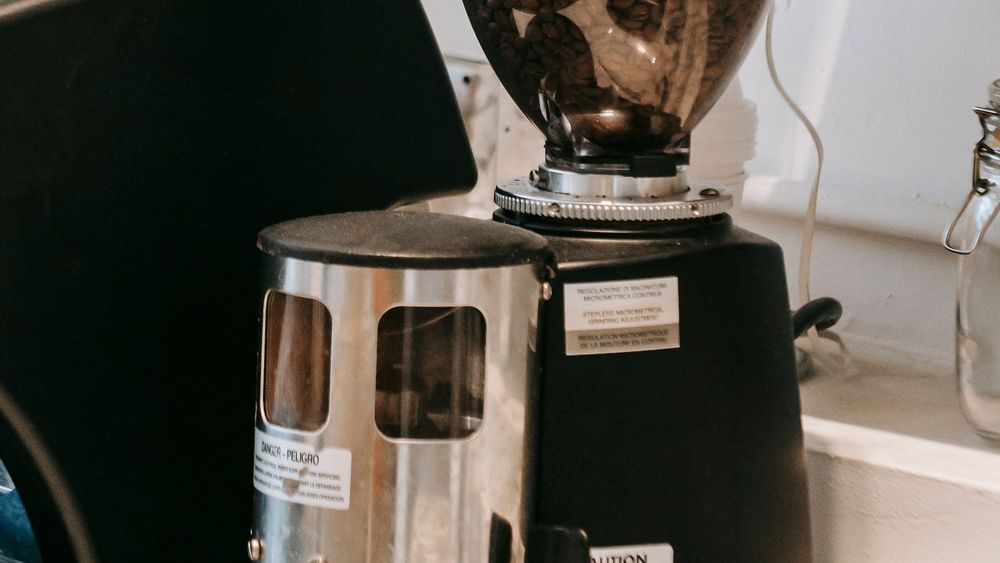
The short answer: For regular use we would take a burr grinder whose fineness can be adjusted; in its conclusion, Stiftung Warentest (Germany’s consumer testing foundation) names burr grinders as suitable for regular coffee drinkers. In 2019 it examined fifteen electric grinders (nine with burrs, six with a blade); there were good grinding results in all design groups, good models already under €50, and poor ones as well. Our assessment for espresso: we look at how many steps the manufacturer divides the espresso range into (the scales count differently for each manufacturer): Wilfa names 5 of 41 steps, Sage for the Smart Grinder Pro 30 of 60, and Eureka adjusts steplessly.
The settings, capacities, power ratings and prices in this guide come from the manufacturers and from our reviews. Differences, sums and counts are our own calculation. We did not measure anything on any grinder; where a figure comes about differently, it says so.
How to approach the choice
- Decide what you brew. In its brochure “Die Welt des Kaffees” (The World of Coffee, page 54), the Deutscher Kaffeeverband (German Coffee Association) gives finely ground coffee as preferable for espresso, a medium grind for filter coffee and a medium to coarser grind for the French press. On page 47 it writes: the finer the coffee is ground, the more aroma compounds can dissolve during brewing. The way you brew decides whether you need the fine end of the scale at all.
- Estimate the amount per run. As a guide, test.de gives 50 to 60 grams of ground coffee for one litre of coffee. This determines whether a hand grinder is an option (section “Hand or electric”).
- Decide whether the fineness has to be adjustable. A blade grinder controls it through running time, cones and burrs through an adjustment on the machine.
- Count how many steps the manufacturer assigns to espresso (table in the espresso grinder section). The machine forces the water through a firmly compacted puck, and Wilfa gives 20 seconds as the usual brewing time for espresso, 4 to 6 minutes for filter and 6 minutes for the French press. For espresso, Smrke et al. (2024) support the link between particle size and shot time; that even a small change shifts the flow time, and that a French press, which steeps for several minutes without pressure, is more forgiving, is our own inference.
- Pick the dosing: by time, by weight, by contact switch on the portafilter, or none. A time is not an amount; what follows from that is covered under the faults.
- Read the approvals and care instructions in the manual. Place of use, material to be ground and contact with water are regulated differently by every manufacturer; several examples are in the questions below.
- Work out the budget. If the espresso machine has no grinder, the grinder comes on top of the machine price.
Blade, cone, burrs: the three designs
Stiftung Warentest describes the principles in test 12/2019 (online 20.11.2019) as follows. In a blade grinder, rotating blades smash the beans, much like a blender. In a conical burr grinder, a cone with sharp steel edges rotates inside a steel ring, and the grounds trickle down along the cone into the container. In a flat burr grinder, one disc turns horizontally against a second, fixed one; the discs are slightly concave, come closer together at the edges, and centrifugal force pushes the grounds outwards. In the instructions, however, Rommelsbacher describes the burrs of the EKM 200 as flat and toothed, so the descriptions differ.
The practical difference starts with adjustment. A blade only knows on and off, and the grind depends on the grinding time: the longer, the finer. According to Warentest, you can find the right grain only by stopping the process again and again and checking the powder, and an ideal result is hard to repeat. Burr grinders usually set the fineness with a dial. According to Warentest, once set correctly they deliver the same grind every day, many even the same amount of powder; this refers to the repeatability of the setting (Graef, however, mentions readjusting after some time, see the faults).
For a double espresso, burr grinders needed 6 to 18 seconds, blade grinders up to 70 seconds of pure grinding time. The blades force you to take breaks so that the powder does not get too warm (bad for the aroma, writes Warentest), and they push the powder to the edge, so that you sometimes have to stop the grinder several times, shake it and scrape the powder off. According to Warentest, most grinders are as loud as a vacuum cleaner, blade grinders quieter on average; their powder warms up somewhat more during the chopping. They also chop nuts, grains and spices.
Warentest found grinders with a good grinding result in all groups and calls blade grinders handy and suitable for occasional use. In the Scandinavian assessment of 2024 (Råd & Rön and Tænk, report on test.de of 25.11.2024), the Bosch TSM6A013B for €20 ground fairly well; it only knows on or off, the blades are fairly loud, and it is difficult to clean. Whether it reaches espresso fineness is not stated in the summary; fineness from 1 to 0.3 millimetres of grain size was examined. ETM Testmagazin (issue 5/2025) writes that blade grinders (called Messermahlwerke by ETM) can never grind beans completely uniformly; for the French press that is still passable, but for Americano and espresso it can cause a very mixed flavour. In the same comparison, two grinders that ETM lists as propeller grinders scored “good”: the Graef CM102 (according to a retailer data sheet, a blade grinder) with 89.7 % as the value-for-money winner, and the Domo DO723K with 87.9 %.
There is no blade grinder in our catalogue; they appear there only as comparison examples in reviews. Our assessment: for espresso we would not take one, because the fineness can only be controlled through running time and ETM warns about the aroma precisely there; for occasional use, Warentest and ETM (for the French press) consider them acceptable.
Burrs or cone: what can be shown
The assumption that flat burrs grind more evenly and are therefore the better espresso grinder is not backed by any measurement in the sources we have read. Smrke et al. (2024) do not compare cones with flat burrs; they used a single grinder and added the fines afterwards. Our ranking list of electric grinders does not commit itself either. In the conversation accompanying the 2019 Warentest report, the barista Nicole Battefeld says the catering trade works mainly with flat burr grinders; flat burrs delivered even grounds, conical grinders an uneven grain with larger and smaller particles (practical assessment without measured values). In the introduction to its 2025 comparison, ETM writes that both burr types can in principle deliver completely uniform powder, even if models with modern flat burrs might grind even more gently (editorial statement).
Manufacturers give figures for speed: Eureka names 1,350 rpm at 50 Hz and 310 W for the burrs, Baratza 550 rpm idle at 70 W for the cone of the Encore ESP and the Virtuoso+, Fellow 350 rpm at 150 W for the cone of the Opus. The Wilfa has 58 mm burrs and only 80 W; a speed is missing from the manufacturer’s information, but Wilfa advertises slow grinding. “Flat burrs fast, cone slow” therefore holds for the Eureka compared with these conical grinders.
On heat and noise, two statements without measurement on household grinding stand against each other. The explainer box of SRF Kassensturz (2020; Swiss television consumer programme) writes that flat burrs generate a lot of heat through high speed and cones grind more gently. ETM, on the other hand, writes in 2025 that modern flat burr grinders can grind even more gently. The measured values that ETM collected on this (as testberichte.de summarises them; we have not seen the issue) overlap, as the table below shows: by about 1 dB for sound pressure, widely for the temperature of the grounds. With three models per design, no design effect can be shown this way. The figures come from the plus and minus lines for each grinder and are therefore a selection.
| Feature | Flat burr grinder | Conical burr grinder | Source |
|---|---|---|---|
| Construction | one disc turns against a second, fixed one; the grounds travel outwards | cone with steel edges turns inside a steel ring | Stiftung Warentest, test 12/2019 |
| Electric grinders in the catalogue | 5 grinders, indicative prices from €39.99 to €639 | 9 grinders, indicative prices from €87.99 to €230 | our price boxes, mostly as of September 2026 |
| Speed according to manufacturer | Eureka 1,350 rpm; Wilfa names 80 W and advertises slow grinding | Baratza 550 rpm, Fellow Opus 350 rpm | manufacturers, from our reviews |
| Temperature of the grounds | 24.1 to 30.6 °C (3 models) | 23.2 to 33.4 °C (3 models) | ETM Testmagazin (issue 5/2025), via testberichte.de, selection from the plus and minus lines |
| Sound pressure | 76.8 to 81.0 dB (3 models) | 80.0 to 82.4 dB (3 models) | ETM Testmagazin (issue 5/2025), via testberichte.de, selection from the plus and minus lines |
| Uniformity of the powder | according to the ETM editors, completely uniform possible in principle | as with flat burrs | ETM Testmagazin (issue 5/2025), introduction |
Cleaning, too, follows the manufacturer, not the design. Baratza lets you remove the cone of the Encore ESP with a quick-release and advises brushing off the ridges about once a month with daily use; Fellow wants the cones cleaned at least every three months, Graef the burrs at least weekly depending on use. Eureka recommends washing the bean hopper with water and neutral soap at least once a week, but brushing the burrs dry. When cleaning, no manufacturer approves water on the burrs or cones of the electric grinders; among the hand grinders, only Hario (Skerton N and Mini Slim Plus: burrs soaked; the MM-2 with its wooden body must not be immersed in water according to the instructions) and Porlex (all five parts by hand) allow it. With Comandante, lukewarm water on the burrs is allowed only after grinding spices. The intervals in detail are in the guide cleaning a coffee grinder.
Hand or electric, and when a hand grinder is enough
According to the manufacturer, seven of the ten hand grinders in our catalogue hold 15 to 30 grams per fill. For the KINGrinder K6, the manufacturer’s blog gives 30 to 35 g, and Hario lists its 24 g on some pages for beans and on others for ground coffee. Three grinders fall outside this range: in the Hario Skerton N the glass container takes up to about 100 g, but according to the instructions the hopper takes only beans for one to two cups; in the Comandante C40 the supplied Bean Jars hold 40 g each, and there is no figure for the grinding chamber in the manufacturer’s sources. For the 1Zpresso J-Ultra, the manufacturer only gives the magnetic catch container with 35 to 40 g of grounds, and does not say how many beans fit in one fill. At the 50 to 60 grams per litre of coffee that test.de gives, that means two to four fills for the other hand grinders (our own calculation: 50 g divided by 30 g and 60 g divided by 15 g, rounded up).
Because there is no comparative measurement of grind quality (more on that below), the choice depends first on the amount, and we would take a hand grinder if you grind one to two cups per run. That is a rule of thumb. Our review of the Porlex Mini II sets the threshold higher: according to the review, anyone who regularly grinds three fills or more in one go (by calculation around 60 g) is better served by an electric grinder or a hand grinder with a larger hopper. More on the individual hand grinders is in the hand grinder buying guide.
| Feature | Electric | Hand | Source |
|---|---|---|---|
| Capacity per run | bean hopper from about 75 g (Wilfa, according to the Amazon catalogue) to 450 g (Sage Smart Grinder Pro) | 15 to 30 g per fill for seven of the ten; exceptions: Skerton N (glass container up to about 100 g, hopper for one to two cups), Comandante (Bean Jars of 40 g each, no figure for the grinding chamber), J-Ultra (catch container with 35 to 40 g of grounds only) | manufacturers, from our reviews |
| Grinding time for a double espresso | 6 to 18 s for burr grinders | no manufacturer figure | Stiftung Warentest, test 12/2019 |
| Sound pressure | 76.8 to 82.4 dB (7 models) | 65.3 to 67.1 dB (1 model, Handground, not in the catalogue) | ETM Testmagazin (issue 5/2025), via testberichte.de, selection from the plus and minus lines |
| Temperature of the grounds | 23.2 to 33.4 °C (8 models) | 22.8 to 23.8 °C (1 model, Handground, not in the catalogue) | ETM Testmagazin (issue 5/2025), via testberichte.de, selection from the plus and minus lines |
| Indicative prices in the catalogue (on Amazon.de) | 14 grinders from €39.99 to €639 | 10 grinders from €31.14 to €236.90 | our price boxes, mostly as of September 2026 |
| Manufacturer’s espresso note | from €39.99 (Caso, Espresso printed on the scale) and €54.99 (Rommelsbacher EKM 200, settings 3 to 7 in the instructions) | 5 of 10, the cheapest for €91.99 | our reviews, based on manufacturer information |
| Weight | Eureka Specialità and Libra 5.6 to 6.5 kg | around 300 g (Hario Mini Slim Plus, Amazon catalogue, packaging unclear; Hario Europe names 370 g including box) to around 700 g (J-Ultra), where stated; the Q Air comes to 365 g | manufacturers, from our reviews |
On quality there is one editorial statement and one measurement on a single model; a comparison with more expensive electric grinders does not exist. In its 2020 comparison of eleven hand grinders, all with stainless steel or ceramic cones, the ETM editors wrote that solid burrs are in no way inferior to electric ones, that grinding takes a moment longer, and that the beans do not warm up to a significant degree (no measured values are on the freely readable page). In 2025 the manual Handground received 92.4 % (very good) in the ETM comparison (issue 5/2025), with little warming and very low sound pressure (values in the table). In its own FAQ, Handground names 15 settings from espresso to cold brew, but advises against regular espresso because grinding on the finest setting takes much longer. For hand grinders, what can be shown is therefore capacity, price, adjustment and the manufacturer’s approval for espresso.
How long cranking takes for one portion is not stated by any manufacturer in our catalogue. Our review of the Timemore Chestnut C3 ESP Pro says that espresso is the most strenuous grind for any hand grinder, because the torque rises with finer grounds (the editors’ assessment, without measurement), and deliberately gives no number of seconds. The manufacturer expressly intends five of the ten hand grinders for espresso: Comandante C40 (7 to 13 clicks), 1Zpresso J-Ultra, Timemore C5 ESP Pro and Chestnut C3 ESP Pro, and KINGrinder K6 (40 clicks as a starting value). The catalogue lists no hand grinder between €69.00 and €91.99.
You can take the 1Zpresso Q Air on journeys (365 g, fits in the AeroPress chamber according to the manufacturer), and with their folding handle also the Timemore Chestnut C3 and the C5 (around 530 and 640 g). The Hario Skerton N with its glass base and 173 x 96 x 210 mm, by contrast, is a kitchen appliance.
What matters in an espresso grinder
In espresso, the shot time depends on the grind. Smrke, Eiermann and Yeretzian (2024, Scientific Reports 14, 5612) examined an Arabica bean from Costa Rica at 9 bar, a 20 g dose and 40 g in the cup, with fines added afterwards: the shot time could be predicted from the median particle size and the fines fraction under 100 micrometres. The fines fraction acts practically only through the permeability of the coffee bed, and its influence on the extraction yield itself is small. Very fine is not automatically the most efficient, the authors write in the introduction: fine particles dissolve faster but are carried away more slowly at lower flow. Cameron et al. (2020, Matter 2(3), 631 to 648) found, according to the abstract, a maximum of the extraction yield: it falls at very fine as well as at very coarse settings, and the authors interpret the fine side as uneven flow through the bed.
For buying, in our assessment, what counts is therefore the number of steps the manufacturer spreads across the range in which espresso lies. The numbers apply per manufacturer and cannot be compared with each other, because every scale counts differently; of the stepped grinders in the catalogue, only Fellow gives a step size in micrometres. Smrke supports the dependence of shot time on particle size and fines fraction, Cameron concerns the extraction yield; that more steps in the espresso range mean finer increments is stated by neither study. By how many seconds one step shifts the flow time, no manufacturer quantifies. According to manufacturer information, only the two Eureka adjust steplessly (a support article calls the Rommelsbacher EKM 200 stepless, the product page says 46 settings); the other grinders with a stated number of settings have 18 to 60 steps, and where an espresso range is given, it covers between 5 and 30 of them (count from the table).
| Grinder | Adjustment | Espresso range according to manufacturer | Source |
|---|---|---|---|
| Eureka Mignon Specialità | stepless, micrometric via the lower burr | no steps | Eureka, from our review |
| Eureka Libra 16CR | stepless micrometric system | no steps | Eureka, from our review |
| Wilfa Svart Uniform+ | 41 steps | 3 to 7 (five steps), starting value 5 | Wilfa instructions (page 78), from our review |
| Fellow Opus | 41 steps plus inner ring (intermediate values in increments of 16.7 micrometres) | 1 to 2 in quarter steps (five steps) | Fellow, from our review |
| Baratza Encore ESP | 40 steps | 1 to 20; according to the manual, settings 1 to 20 change the grind only slightly | Baratza manual, from our review |
| Baratza Virtuoso+ | 40 steps | starting value 8, seven steps below it | Baratza, from our review |
| Sage Smart Grinder Pro | 60 settings | 1 to 30, starting value 12 | Sage table, from our review |
| De’Longhi Dedica KG 520.M | 18 settings | for the portafilter 1 to 6 according to the instructions | De’Longhi instructions, from our review |
| Rommelsbacher EKM 400 | 35 settings | 1 to 5 for pump espresso machines | Rommelsbacher instructions, from our review |
The Sage Dose Control Pro also has 60 settings; the Graef CM800 and CM820 have 40 settings and a fine adjustment on the upper burr, which you turn with a screwdriver. According to the product page, the Rommelsbacher EKM 200 has 46 settings, the instructions are less clear; the Caso Barista Crema has a scale printed with French Press, Filter and Espresso, but no number of settings is given. Our assessment: if you pull almost only espresso and notice that the right flow time lies between two steps, the fixed steps of most grinders will not help you; then the stepless Eureka or the inner ring of the Opus with its finer increments (16.7 micrometres) come into question.
Dosing works in four ways. By weight: the Libra 16CR has a scale in its fork (accuracy according to Eureka plus or minus 0.2 g, target weight in 0.1 g steps), the Wilfa a lid that serves as a removable 0.1 g scale, and the grinder runs the filled portion empty.
By time: the Virtuoso+ sets 0.1 to 40.0 seconds in tenths of a second, the Smart Grinder Pro stores one duration per shot count (1 to 8) and cup count (1 to 12), the Dose Control Pro has a dial from 0 to 50 seconds, the Specialità two programmable doses. Caso, Dedica and the Rommelsbacher EKM 200 choose the portion by number of cups, time-controlled. The EKM 400 chooses 1 to 12 portions with a relative portion size; whether it doses by time, its review does not say. The Opus has four fixed running times (30, 60, 90 and 120 seconds); there the time is only an upper limit, and the filled portion is ground.
By contact switch: Graef grinds as long as the portafilter presses. Not at all: the Encore ESP has a Pulse button and on/off.
Grinding directly into the portafilter is intended for ten of the 14 electric grinders. The Graef CM800 (two holders of about 60 and about 70 mm) and CM820, both Sage (holder for 50 to 54 and 58 mm), both Eureka (height-adjustable fork), the EKM 400 (removable holder) and the Dedica (accessory for standard sizes) work with a holder or fork. The Encore ESP and the Opus have a dosing cup for 54 and 58 mm. For the Virtuoso+, Baratza names the cup only as compatible. It is not intended for the Caso Barista Crema and the EKM 200 (powder container only) and for the Wilfa (no holder). For a 51 mm portafilter, the cups of the Encore ESP and the Opus are ruled out.
Why evenness alone guarantees nothing
Ground coffee does not have a uniform grain. Uman et al. (2016, Scientific Reports 6, 24483) measured four light to medium roasted Arabica samples from Guatemala, El Salvador, Tanzania and Ethiopia by laser diffraction, ground on a Mahlkönig EK 43 with a fixed setting. The particles ranged from about 0.1 to 1000 micrometres, and the distribution had two peaks. The fine particles carry most of the accessible surface, but particles one to two orders of magnitude larger also contribute, even in small amounts. At an identical setting the distribution was independent of origin and processing.
Severini et al. (2016, Journal of the Science of Food and Agriculture 96(9), 3023 to 3031) show how much the spread can matter, using espresso under café conditions. Of the three variables the barista controls (grind, amount of coffee, tamping pressure), the grind explained 87 to 96 per cent of the variance of the experimental data according to the abstract (volume and chemical variables). At a constant grind setting of 6.5, the caffeine content varied between 80.03 and 130.36 mg. The authors conclude that the spread of particle sizes per grind setting has a profound influence on quality and that standardising grinding is very important. Volume and chemical variables were measured; the three barista variables were compared with each other.
More evenness also does not automatically mean more in the cup. Angeloni et al. (2023, European Food Research and Technology 249(5), 1247 to 1256) extracted a Brazilian Arabica bean in the French press (25 g of coffee to 250 g of water at 95 °C, five minutes), ground on the EK 43. Sieved, homogeneous fractions had lower TDS and extraction yield than the unsieved, two-peaked grounds; the highest value was reached by the unsieved fine grounds (21.4 ± 0.9 % extraction yield) and a mixture of three settings. The authors conclude that a homogeneous grind is poorer in bioactive compounds and volatile aroma compounds. Limits: one bean, one grinder, French press only, chemistry only.
Smrke et al. also saw no worse sensory result with a higher fines fraction, with a single Q Grader and expressly without double-blind assessment; the optimum was at about 30 seconds and 19 to 20 per cent extraction yield, for one bean and one roast profile.
In our comparison, what counts as a buying criterion is the repeatability of the setting, not evenness as a guarantee of taste. Stiftung Warentest, ETM and the Scandinavian assessors rate the grinding result; ETM lists evenness among the performance criteria, and Tænk rates it by the amounts in the upper, middle and lower sieve. None of the studies above shows that it improves the taste.
For timing, a direction can be shown, but no number of minutes. The Deutscher Kaffeeverband writes (page 47) that grinding releases volatile aromas and a large part of the carbon monoxide and carbon dioxide; coffee is ground either immediately before preparation or at the roastery, which then sells the coffee as powder. The direction of just before brewing is first supported by the SCA literature review by Emma Sage (article on sca.coffee, dated 15.02.2012 according to the address): grinding increases porosity and surface area and thereby speeds up degassing and ageing. First oxidation products appear within 24 hours of roasting and grinding, and trained assessors detected rancidity in coffee packed in air after four months (Marin et al., 2008). That concerns packaged coffee over days to months.
Smrke et al. note that there is hardly any data on the amounts for the time scale under one minute. For the minutes after grinding, editorial statements are therefore what is available: Stiftung Warentest writes that the aroma fades within minutes, and ETM that the powder loses flavour without pause from the moment of grinding.
Dead space and single dosing
According to Stiftung Warentest (2019), a residue of powder always stays stuck in burr grinders between the burrs and the outlet, up to 3.9 grams in individual grinders. The assessors calculate that this is enough for half an espresso: the first drink the next morning consists partly of old powder and does not taste freshly ground. Warentest also writes that professionals pour away the first coffee of the day, and refers to a conversation with the barista Nicole Battefeld. There she advises always pouring away one shot when setting up the grinder, and says the dead space should not amount to more than one to two shots. According to Warentest, blade grinders have no dead space; in burr grinders it sits between the burrs and the outlet.
Single dosing is a way of operating: you only fill in the next portion. Without giving a reason, Fellow advises not storing beans in the Opus; according to the EU manual the container holds 100 g (the earlier US page named 110 g, test.de 132 g). In the Wilfa, the supply sits in the bean tin and only the next portion in the grinder; the review uses this to explain the small hopper of about 75 g (according to the Amazon catalogue). Eureka offers a Single Dose Hopper as an accessory for the Specialità, Baratza a single-dose hopper for the Encore ESP, and Graef has the EliteGrindX CM8011EU with an additional 75 g single container (Graef shop €199.99, September 2026), which Graef advertises for daily fresh amounts of beans.
No manufacturer information available to us gives a measured value showing that single dosing keeps coffee fresher or reduces dead space: Graef advertises daily fresh amounts of beans, Fellow gives no reason for its advice. The description in the Wilfa review is: what was weighed is ground, minus what stays stuck in the burrs. From the definition it follows that single dosing changes how many beans lie open in the grinder, not how much powder stays behind in the burrs. On light, test.de (2024) gives a precaution: coffee is considered light-sensitive and should lie in transparent containers only briefly; the large containers from KitchenAid (316 g) and Moccamaster (230 g) would only be of use if you use the coffee up quickly. In 2020, ETM wrote about hand grinders that you should only grind as much as you will use soon, so that no beans keep oxidising in the grinder.
Price classes in the catalogue
The indicative prices of the 14 electric grinders range from about €39.99 to €639, those of the ten hand grinders from about €31.14 to €236.90. All the electric ones are in the category coffee grinders, the hand grinders in the category hand grinders.
| Price band | Electric, indicative prices in euros | Hand, indicative prices in euros | Source |
|---|---|---|---|
| under €60 | Caso Barista Crema 39.99, Rommelsbacher EKM 200 54.99 (both flat burr) | Hario Mini Slim Plus 31.14, Skerton N 39.80, MM-2 50.98 (all ceramic) | price boxes of the reviews, mostly 09/2026; Skerton N without retrieval date |
| €60 to €160 | Rommelsbacher EKM 400 87.99, De’Longhi Dedica KG 520.M 131.89, Graef CM800 139.99, Sage Dose Control Pro 153.25, Graef CM820 157 (all cone) | 1Zpresso Q Air 69.00, Porlex Mini II 69.00, Timemore Chestnut C3 ESP Pro 91.99, KINGrinder K6 99.00, Timemore C5 ESP Pro 119 | price boxes, mostly 09/2026; Dedica and C5 ESP Pro 07/2026, Mini II without retrieval date |
| €160 to €240 | Baratza Encore ESP 179.95, Sage Smart Grinder Pro 199, Baratza Virtuoso+ 229.95, Fellow Opus 230 (all cone) | 1Zpresso J-Ultra 199, Comandante C40 MK4 236.90 | price boxes, mostly 09/2026 |
| €240 to €300 | none in the catalogue | none in the catalogue | not applicable |
| over €300 | Wilfa Svart Uniform+ 330, Eureka Mignon Specialità 431.90, Eureka Libra 16CR 639 (all flat burr) | none in the catalogue | price boxes; Wilfa and Libra earlier records (Libra unchanged since 07/2026) |
All prices are indicative figures from our price boxes on Amazon.de, mostly as of September 2026. Older or without a retrieval date are the values for the Wilfa and the Libra (unchanged since July 2026), the De’Longhi Dedica (July 2026), the Timemore C5 ESP Pro (July 2026), the Porlex Mini II and the Skerton N. On 25.09.2026, manufacturers’ shops asked more for the same grinders in some cases: Graef CM800 €189.99, Sage Smart Grinder Pro regularly €259.90, Dose Control Pro €219.90, Rommelsbacher EKM 200 €79.99 and EKM 400 €129.99, De’Longhi Dedica €235.00. For the Dedica that is a good €103 more than in our price box (own calculation), and it would then no longer fall in the €60 to €160 band.
No source sets a price threshold from which a grinder is any good. In test 12/2019, Stiftung Warentest saw good models already under €50, and poor ones as well. In the Scandinavian comparison of 2024, the Fellow Opus came first (test.de named about €200, our price box lists about €230), ahead of the KitchenAid 5KCG8433 at €150 and the Wilfa CGWS-130B at €140. ETM’s value-for-money winner in 2025 was, with the Graef CM102, a blade grinder. As an editorial judgement, our ranking list of coffee grinders included no grinder under €139.99.
What money buys in the catalogue is in the data sheets. Manufacturer espresso notes already exist for the two electric grinders under €60 (table in the section “Hand or electric”), though for the EKM 200 with pump-pressure espresso and filter machine in the same settings 3 to 4. A delimited espresso range with settings 1 to 5 for pump espresso machines and a removable portafilter holder is first shown by the Rommelsbacher EKM 400 (about €87.99).
According to the manufacturer data, the Libra’s premium of around €207 (own calculation) over the Specialità buys only dosing by weight, and the only flat burr grinder designed for single dosing from the factory is the Wilfa (for the Specialità there is a Single Dose Hopper as an accessory).
With hand grinders, finer increments belong to the more expensive ones. Manufacturers give 8 micrometres per click for the J-Ultra, 15 for the Timemore C5 ESP Pro, 16 for the K6, 23.3 for the Chestnut C3, 25 for the Q Air and on average 37 for the Mini II; Comandante and Hario do not quantify their step size.
If you buy an espresso machine without a grinder, you pay for the grinder in addition. The Sage Dose Control Pro with 60 settings costs about €153.25, the stepless Eureka Mignon Specialità about €431.90, around €279 more than the Sage (own calculation).
What independent assessments have examined
We rely on three assessments, and none is comparable with another.
| Assessor | Field and criteria | Ahead | What remains open |
|---|---|---|---|
| Stiftung Warentest, test 12/2019 | 15 electric grinders, 9 with burrs and 6 with a blade; weighting according to SRF: grinding 50 %, handling 35 %, durability 10 %, noise 5 % | Graef CM 800 good (2.1), Melitta Molino good (2.3), Cloer 7520 and Rommelsbacher EKM 300 each good (2.4); best blade grinder Severin KM 3879 satisfactory (according to SRF Kassensturz of 24.01.2020) | Grades behind the paywall (€4.90), not viewed; the result is almost seven years old |
| Råd & Rön and Tænk 2024, report on test.de (25.11.2024) | twelve electric grinders according to test.de (eleven according to the Tænk page); fineness from 1 to 0.3 mm grain size, time for 100 g, handling, cleaning, noise | Fellow Opus, KitchenAid 5KCG8433, Wilfa CGWS-130B | Original reports are paid; the Wilfa WSFBS-200B was also assessed, its placing cannot be viewed |
| ETM Testmagazin (issue 5/2025) | 13 grinders (12 electric, 1 manual); handling, performance (accuracy, evenness, speed), noise emission, material | Wilfa Svart Uniform+ very good (94.1 %), Rommelsbacher EKM 500 (94 %), Graef EliteGrindX CM8011 (93.5 %; listed at testberichte.de only as CM 8011) | Issue not viewed, ranking via testberichte.de; the Graef is not the CM800, the Fellow Opus is not in the field |
Three rankings, three leaders: a joint ranking cannot be formed from them. The Moccamaster KM5 was narrowly ahead on grinding result with the Scandinavians, but was the loudest and the hardest-to-handle grinder (test.de). At Stiftung Warentest (test 12/2019), grinding made up half of the overall grade according to SRF. According to test.de, the Opus was among the slowest: 1:40 to 3:23 minutes for 100 g, while the Wilfa CGWS-130B needed 54 seconds to 1:25.
Graef advertises the CM800 with the grade good (2.1) from issue 12/2019, which SRF supports. Of Stiftung Warentest’s own grinder comparisons we found on test.de, on 12.10.2026, only the one from 2019, plus the 2024 report on the Scandinavian assessments (search result, no guarantee of completeness). Whether today’s devices are identical in construction to those assessed at the time is open; this also applies to the Caso Design Barista Crema and the De’Longhi KG520.M, whose names correspond to grinders in our catalogue.
The ECBC (European Coffee Brewing Centre, founded in 1971 by the Norwegian Coffee Association) runs an approval programme for household grinders. According to its announcement of 23.01.2025, the criteria include: particle distribution within 5 % of the ECBC filter standard, little retention, consistent performance, a hopper for at least 60 g, and extraction to the Gold Cup standard. Approved devices may carry a quality seal. Wilfa writes that the Uniform is approved by the ECBC.
Faults and what triggers them
The espresso runs too fast or too slow. Stiftung Warentest explains it without measured values like this: powder that is too fine leads to over-extraction, the espresso becomes strong and bitter, and the drink drips too slowly into the cup. Powder that is too coarse lets the water run through so fast that too few aroma compounds dissolve; the espresso becomes sour and pale, and the crema disappears quickly. That finer powder lengthens the flow time agrees with Smrke et al.; Cameron even found a lower extraction yield at very fine settings. Change only the grind and in small steps, by one step on a stepped grinder. As a guide for the target time, Wilfa names 20 seconds for espresso, and Smrke et al. found their optimum at about 30 seconds (for one bean and one roast profile). The table by brewing method is in the guide adjusting the grind size.
After a while the setting no longer fits. In the CM800 instructions, Graef writes that the nature, moisture and freshness of the bean depend strongly on the environment, so the grind must be corrected after some time. The grounds should form small to medium balls that spread out again when they fall, without clumping strongly; oily, old and freshly roasted beans behave differently. What you change: grind a trial amount and adjust the setting until the grounds show this picture again. Related to this: the assessors of Stiftung Warentest (test 12/2019) achieved better powders on almost all grinders only after optimisation by a barista, compared with following the instructions for use.
The burrs clog. On the Encore ESP the grounds pile up in the middle of the grounds container; above the Max line, according to Baratza, the burrs can clog and be damaged in the process, and a clogged grinder is usually down to grounds above the line or oily coffee without regular cleaning. Wilfa warns that at grind settings 1 to 4 the burrs can clog, with the limit differing by bean, wear and factory setting. Wilfa advises setting coarser (around setting 25), letting the coffee run through and cleaning with a brush, but not opening the device (warranty).
The grounds clump and cling. Coffee charges electrostatically during grinding, and the charge leads to clumps. Méndez Harper et al. (2024, Matter 7(1), 266 to 283) measured this on a Mahlkönig EK 43 with 98 mm burrs, not on household grinders: fine settings and darker roasts charge more. Fine settings mean more breakage events, longer contact with the burrs and more fines. The room air only had an effect above about 60 % relative humidity; the measurements ran at about 25 to 45 %. What you can change: for the EKM 400, Rommelsbacher names an anti-static function; the manufacturers in our catalogue mostly give no measured quantity for it. None of the instructions in our catalogue recommends water on the beans; KINGrinder only describes how to do it without damage (the state of the studies is in the question above).
The dose no longer fits after a change of beans. A timer repeats a time, not a mass, and the throughput depends on the setting. For the Encore ESP, Baratza names 1.3 g/s at setting 10 and 2.2 g/s at setting 30; 18 g would be ground in just under 14 seconds at setting 10, and in a good 8 at setting 30 (own calculation). For the Virtuoso+, Baratza names 1.3 to 2.4 g/s. For Eureka there are two different ranges: the Specialità instructions give 1.4 to 1.8 g/s in the espresso range and 1.9 to 2.5 g/s in the brew range, the product page 1.8 to 2.5 and 2.5 to 3.5 g/s. ETM writes in 2025 that with cup selection the amount of beans also depends on the grind. When you change beans, weigh once and set the time again.
What manufacturers do not state
Some gaps run through the catalogue. None of the manufacturers of our 24 grinders publishes a measurement of the particle distribution (median, fines fraction, spread), and none of the 24 reviews contains one. There is likewise no manufacturer figure for retention in the burrs: for the Opus, Fellow speaks of low retention and describes a direct fall path from the bean container to the chute (manufacturer information from the Amazon bullet list, without a measured value), Wilfa refers to an ECBC assessment in which, according to the manufacturer, the residue in the burrs is examined, and the value is nowhere to be found; the ECBC announcement of 23.01.2025 also contains no limit for retention or heating. In the Virtuoso+ manual, Baratza notes that partly ground beans can remain between the ridges after switching off.
No manufacturer publishes sound levels in decibels for the 14 electric grinders. According to the data sheet, Eureka speaks of the Specialità being around 20 dB quieter than conventional grinders, without naming a reference device, Fellow promises fast and quiet grinding in the Opus instructions, and Rommelsbacher calls the burrs of the EKM 200 quiet. Decibel values exist only from third parties and for other models (ETM 2025; at Tænk the values are locked); for the Wilfa, ETM only names a relatively low sound pressure, without a number. A throughput in grams per second is stated only by Eureka and Baratza; for Sage, Graef, Fellow, Wilfa, Caso, Rommelsbacher and De’Longhi it is missing.
What can be compared is therefore number of settings, capacity, type of dosing and price. Statements about evenness, residue or loudness of a catalogue grinder go beyond manufacturer information and our reviews; independent assessments state them only for individual models (test.de 2024: the Opus grinds particularly evenly; ETM 2025: the Wilfa has a relatively low sound pressure). Whether heat during household grinding changes aroma or taste, no measurement shows us; Uman et al. (2016) only suspect that cafés reduce the burr gap over the course of the day because the grinding burrs get warmer, and did not measure the temperature of the grinder. Likewise, there is no peer-reviewed comparative study on whether ceramic or steel grinds finer or more evenly; we know of only one bachelor’s thesis (Pe 2022) with three ceramic and three steel conical grinders of unknown models, which the guide buying a hand grinder puts into context.
Which grinder in which case
The ranking lists place eight grinders each according to our rating: our ranking list of coffee grinders eight of the 14 electric ones, our ranking list of hand grinders eight of the ten manual ones.
Espresso with the finest adjustment: for the Eureka Mignon Specialità, Eureka names a 55 mm flat burr set of hardened steel, stepless adjustment, a timer for one and two cups and a portafilter fork. According to Eureka, the Eureka Libra 16CR has the same burr specifications and switches off at the target weight using a scale.
Espresso with fixed steps, from a smaller budget: the Rommelsbacher EKM 400 comes with a 220 g hopper and 200 W. On the De’Longhi Dedica KG 520.M the portafilter sits on a 350 g hopper via an accessory; anyone who wants to adjust more finely than in 18 settings will find more suitable grinders according to our review. According to Graef, the Graef CM800 is 397 mm high, which matters under a wall cabinet, and has a contact switch for the portafilter. The Graef CM820 is no longer listed by Graef (25.09.2026), and our review leans towards the CM800.
Sage offers 60 settings: the Dose Control Pro with a dial and the Smart Grinder Pro with stored times. The Baratza Encore ESP has no timer, the Virtuoso+ has one and costs €50 more according to the price boxes. The Fellow Opus has five steps in the espresso range and a 100 g container for single dosing.
Flat burrs with single dosing: the Wilfa Svart Uniform+ has 58 mm stainless steel burrs behind 41 steps, the lid serves as a scale, and a portafilter holder is missing. It leads the ranking of ETM Testmagazin (issue 5/2025); for espresso as a daily drink, our review recommends a grinder with stepless adjustment instead.
If you do not grind into the portafilter, you do not need a holder. The two cheapest electric grinders in the catalogue have only a powder container: the Caso Barista Crema and the Rommelsbacher EKM 200. For the EKM 200, support considers 15 g as a single dose rather unsuitable and names the EKM 100 blade grinder for small amounts, €32.99 in the manufacturer’s shop (25.09.2026).
By hand: the Hario Mini Slim Plus (24 g per fill), the Skerton N and the MM-2 list no espresso machine in their Hario tables (see the question on the ceramic grinder). The 1Zpresso Q Air and the Porlex Mini II cost the same; the Q Air has no espresso range in its grind reference, the Mini II has a porcelain cone and can be taken apart into five parts. For espresso by hand, the manufacturers intend the Timemore Chestnut C3 ESP Pro, the KINGrinder K6, the Timemore C5 ESP Pro, the 1Zpresso J-Ultra and the Comandante C40 MK4 (ordered by ascending price; the prices are in the table above).
We would put a scale next to every grinder with a timer: the Maestri House Mini (about €29.99) resolves to 0.1 g and weighs up to 2,000 g, the Bagail (about €39.99) likewise to 0.1 g, up to 3,000 g.