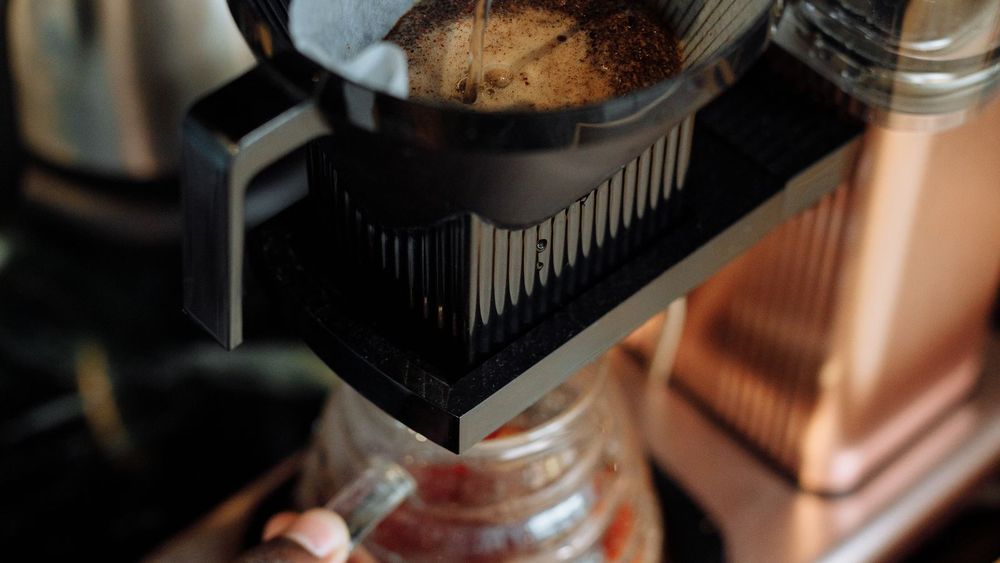
The short answer: The box shows watts, cup count and timer, while most manufacturers say nothing about brew temperature and brew time. For certified machines the SCA requires 90 to 96 degrees in the coffee bed, the ECBC asks for 4 to 6 minutes for the carafe, and the 15 machines of Stiftung Warentest (test 11/2024) needed 8 to 12. We would therefore buy by carafe, shut-off, filter size and upkeep, and start with 60 g of coffee per litre.
A drip coffee maker is a heating element, a water tank and an outlet above a paper filter. Manufacturers like to claim that two machines costing €23 and €259 should still differ in the result. For the cup, that is hard to prove, and that is what this guide is about: what has been measured, what is only a certification criterion, and what is merely printed on the box.
What is on the box and what of it counts
Wattage is the best example. It says nothing about how hot the water arrives at the filter, but it sets a lower limit for the brew time. Our calculation, using the water data from the NIST WebBook: heating 1.25 litres from 15 to 95 degrees takes about 0.116 kilowatt hours. At 1,000 watts that is at least about 7 minutes, at 1,450 watts about 4.8. Losses to the housing, the carafe and steam are not included, so the real time is longer. Anyone who wants a full carafe in six minutes needs about 1.2 kilowatts on paper (1.16 if calculated exactly).
On cup count: the cup is not standardised. According to their manuals, WMF, Severin and Braun count about 125 ml per cup, Melitta and Moccamaster give 1.25 l for ten cups (the 125 ml is our conversion), the Deutscher Kaffeeverband (German Coffee Association) uses 125 to 150 ml, and the BfR (German Federal Institute for Risk Assessment) 200 ml. What matters is therefore the carafe’s capacity in litres.
Timers are convenience. With aroma settings, the situation is more open. For test 11/2024, Stiftung Warentest examined whether aroma buttons or aroma dials make a difference. For the three settings of the KA 4810, Severin nowhere explains whether they work through water quantity, flow speed or contact time. Our assessment: as long as a setting is not explained, it is not a reason to buy.
The numbers side by side
For almost every figure there are several recommendations. The table shows who says what.
| Quantity | Figure | Source |
|---|---|---|
| Coffee per litre | 55 g/kg (1:18.2) | SCA 310-2021, reference ratio |
| Coffee per litre | 60 g/l (1:16.7) | ECBC according to Moccamaster USA; Moccamaster manual |
| Coffee per litre | around 65 g/l | Deutscher Kaffeeverband, brochure |
| Coffee per cup | 7 to 10 g per 125 to 150 ml (around 47 to 80 g/l) | Deutscher Kaffeeverband, website |
| Temperature | 90 to 96 degrees in the bed, from 33 per cent of the water added | SCA 310-2021, section 6.2 |
| Temperature | 92 to 96 degrees | Melitta |
| Temperature | 88 to 95 degrees (brochure: 88 to 96) | Deutscher Kaffeeverband |
| Brew time | 4 to 6 minutes | ECBC according to Moccamaster USA; Melitta |
| Brew time | 3 to 5 minutes | Deutscher Kaffeeverband, brochure |
| Brew time | 8 to 12 minutes measured | Stiftung Warentest, test 11/2024 |
| Keeping the carafe warm | coffee at 80 to 85 degrees for 30 minutes | SCA 310-2021, section 6.6 |
| Automatic shut-off | 40 minutes with a glass carafe, 5 minutes with a thermal carafe | Umweltbundesamt (German Environment Agency), press release 57/2014 |
The SCA figures come from a copy of the standard on coffeegeek.com that we read on 12 October 2026; the SCA original returned a 404 error that day, and the copy was no longer available on 14 October 2026. The ECBC rows come from the account given by Moccamaster USA.
On dose, we commit to a figure: 60 g per litre of water as a starting point, which is 7.5 g for a 125 ml cup and 75 g for a full 1.25-litre carafe. In its favour are the agreement of the ECBC and the Moccamaster manual and its position between the SCA reference value and the Kaffeeverband’s brochure. The SCA itself calculates 68.75 g for 1.25 litres. Cotter and colleagues found in 2021 that consumers fall into two groups in their preference for black coffee across a wide range of strengths. So there is no single correct dose. If you like it stronger or milder, move within the range.
Temperature and time: what the certificates say and what they do not
The 92 to 96 degrees are a certification criterion, not a range proven to be best. Batali, Ristenpart and Guinard examined this in 2020 in Scientific Reports: they found no data for this range in the sources they reviewed. They then brewed drip coffee at 87, 90 and 93 degrees, adjusted grind size, dose and flow time so that strength (TDS) and extraction yield stayed the same, and had 270 brews rated blind by trained panellists. No temperature effect could be shown. Of 31 attributes, only “nutty” differed, by about one point out of 100.
That is not an all-clear for cold machines. The study used one Arabica roast and one programmable machine and covered only 87 to 93 degrees. It says nothing about a machine that misses strength and extraction yield at a low temperature. What it does show: dose and extraction yield shape the sensory profile more than temperature does. Bitter, astringent and viscous increased with strength, unrelated to extraction yield; the highest acidity was at high strength and low extraction yield. The authors state that this departs from the classic Brewing Control Chart.
On brew time, the sources do not agree. The ECBC and Melitta give 4 to 6 minutes, the Kaffeeverband 3 to 5, and the SCA none at all. Stiftung Warentest measured 8 to 12 minutes across 15 machines. The 4-to-6-minute window is therefore a certification value that many machines on the market do not reach. As a buying target for an uncertified machine it is not documented, and the calculation above shows why machines around 1,000 watts cannot come anywhere near it.
In our catalogue, only Moccamaster gives both: 92 to 96 degrees and about 6 minutes for a full carafe, each as a manufacturer’s statement. WMF, Braun, Emerio, Russell Hobbs and Melitta give no figure for either temperature or duration, and Severin lists an adjustable brewing temperature without a value. That cheap machines deliver water well below 90 degrees at the filter, as is often read, is therefore neither documented nor disproved: the measurements of Stiftung Warentest are not freely accessible.
Hot plate or thermal carafe
Two facts are certain. According to the Umweltbundesamt, new drip machines with a thermal carafe must switch off five minutes after the last brewing cycle, and machines with a non-insulated container after 40 minutes at most. In our catalogue, Moccamaster, WMF, Braun, Russell Hobbs and Emerio switch off after 40 minutes, Severin after 35. The Melitta AromaFresh X can be set to 20, 40 or 60 minutes.
How quickly coffee gets worse on the plate is less clear than is often claimed. The Deutscher Kaffeeverband and Melitta advise against keeping it warm for long, otherwise the aroma evaporates and it tastes bitter, both without a measurement and without a number of minutes. Stiftung Warentest wrote in 2014 that it should not be kept warm for longer than half an hour and becomes more sour, likewise without a measurement. Batali and colleagues examined this in 2023 with trained panellists: light, medium and dark roasted drip coffee stood for between 15 minutes and 3 hours in glass carafes on the hot plate, in thermal carafes and in vacuum carafes. Acidity rose, but was perceived only in light and medium roasts, and more attributes decreased than increased. A panel of 93 industry people showed no blind preference for fresh over held coffee. The abstract says nothing about “bitter” or “burnt”.
Our assessment from this: if the coffee stands for more than half an hour, the thermal carafe is the more sensible choice, because it needs no heating that switches off after five minutes anyway. For taste, the advantage is not documented. With Moccamaster, the KBGT thermal version keeps a full carafe at 80 degrees for up to three hours, according to the manufacturer. Stiftung Warentest found good models in both designs; three machines disappointed at keeping warm: the coffee was not very hot or cooled too quickly.
Filter: size, paper, permanent
The machine determines the size. A paper filter that is too small can fold over or tear, and one that is too large does not seal properly, writes Melitta. The SCA standard does not rank a conical basket against a flat-bottomed basket either: it has a separate reference grind for each design, nothing more.
On material, one point is documented. Paper retains cafestol: Urgert and colleagues found in 1995 that filtered drip coffee contained negligible diterpenes, while a cup of French press contained 3.5 mg. For every 10 mg of cafestol per day, cholesterol rises by 5 mg/dl. This study did not look at metal filters. Whether a permanent filter makes the coffee “fuller” is not documented in peer-reviewed work; we did not find a sensory study of paper against metal in drip machines. It follows from the construction that a metal mesh lets through more oil and fines, as the Bodum review also infers. The ECBC limits the grounds in the cup to a maximum of 75 mg per 100 ml.
Limescale, water and upkeep
Limescale does not demonstrably make the coffee cooler, but it makes it slower. Melitta writes that limescale on the heating element worsens heat transfer and lengthens the brew time, and a clearly longer cycle usually points to this. The Umweltbundesamt names scaled heating elements as a cause of impeded heat transfer or appliance failure, and a layer of scale as a reason for higher electricity consumption.
The manufacturers’ intervals differ widely. In its general FAQ, Melitta gives an upper limit of 40 brewing cycles before descaling (earlier depending on hardness), Moccamaster every 100 brewing cycles or at least every 3 months, Emerio every 3 to 4 months at average hardness, and Russell Hobbs at least once a month. WMF sets fixed times by hardness range: soft every 6 months, medium every 3, hard every 6 weeks, very hard monthly. The Melitta AromaFresh X derives the date from one of four adjustable hardness levels and signals it with a CALC display. The guide Water hardness and coffee explains how hard your water is, and the methods are in Descaling and cleaning.
Taste also depends on the water. Melitta writes that very soft water emphasises acidity and very hard water softens it. Rune and colleagues found in 2026 that it is above all alkalinity that matters, not hardness as such. Stiftung Warentest did not rate aroma at all in test 11/2024, explaining that water hardness, variety, grind size, quantity and machine settings shaped the taste more than the machine did.
Typical faults
This lists only causes that a source names or that follow cleanly from the mechanism.
| Symptom | Possible cause | Source |
|---|---|---|
| Coffee seems thin | Grind too coarse, water runs through too quickly | Deutscher Kaffeeverband |
| Coffee tastes harsh | Powder too fine | Deutscher Kaffeeverband |
| Filter holder overflows | Drip stop blocked, grind too fine (espresso grind), decaffeinated coffee | Moccamaster manual according to the review |
| Brew takes longer than before | Limescale in the flow system | Melitta, WMF |
| Coffee is bitter and strong | Higher strength (TDS), so more powder per litre | Batali et al. 2020 |
| Grounds in the carafe | Filter too small or folded over | Melitta |
The acidity problem is trickier. The chart reading “sour means too coarse” is the classic one; Batali et al. 2020 place the highest acidity at high strength and low extraction yield. If your coffee is sour, look first at dose and grind size. The individual corrections are in the guide Pour-over and filter coffee, and grind sizes are explained in Coffee grind size.
What remains open
There are five points we could not clarify. We have the standard DIN EN 60661 on measurement methods only as a title, and the text of the standard costs money; whether it defines 125 ml as a cup is open. We have not read the ECBC document itself, only the account given by Moccamaster USA. The individual values from Stiftung Warentest on aroma settings, brewing temperature and keeping warm, as well as the models with aluminium in the brewing water, are behind the paywall. Whether the shape of the paper filter or basket changes extraction is not stated by any of our sources, nor is how much grounds a permanent filter lets through. And that limescale lowers the temperature at the filter is not stated in any of the sources named; only the longer brew time and the higher electricity consumption are documented.
How to go about buying
- Decide on the carafe’s capacity in litres, not the cup count. Calculate with your own mug, not with 125 ml.
- Look for the statement on brew temperature and brew time in the data sheet or manual. If it is missing, that is information, not proof of a poor machine.
- Calculate the lower limit of the brew time from heating power and carafe size, as above. If a manufacturer’s figure falls well below it, it needs explaining.
- Choose the carafe according to how you drink: if you empty it within half an hour, the glass carafe is enough, otherwise take the thermal carafe.
- Read how the machine is descaled and whether the carafe may go in the dishwasher. The manufacturers answer inconsistently.
- Check which paper filter fits, and whether a replacement for the glass carafe is available.
On price: Stiftung Warentest examined 15 machines from under €40 to €240, of which ten had glass and five thermal carafes. Six were good, including several inexpensive ones, and there were good models in both designs. Decent drip machines therefore do not start only at €100. The freely readable introduction speaks of “well filtered from €35”.
The machines in our catalogue
All prices are guide values from the reviews’ frontmatter (as of September 2026), not daily prices. The Emerio CME-122933 costs about €22.99 on Amazon.de, has 1,000 watts, a 1.25-litre glass carafe and a removable permanent filter. The Braun PurShine KF 1500 is about €29.00; the thermal carafe comes only with its sister model KF 1505. The Russell Hobbs Textures+ costs about €39.99, has 975 watts and, according to the manufacturer, a shower head whose number of holes is not stated. The WMF Stelio Aroma is about €47.00. Its capacity is contradictory: 0.65 l according to WMF, 1.25 l according to the Amazon catalogue.
With a built-in grinder there is the Severin KA 4810 for about €99.99 and the Melitta AromaFresh X for about €166.99. The Moccamaster KBG Select costs about €259.00, has 1,450 watts, a water outlet with nine holes and is the only machine in the catalogue with a temperature and time statement. For manual pour-over without electricity there are the Bodum Pour Over with stainless steel mesh and the Chemex with paper. There is no measurement of water distribution. As an assessment criterion, the ECBC requires wetting all the grounds in the first minute, which speaks for the design of the outlet but says nothing about the individual machine.