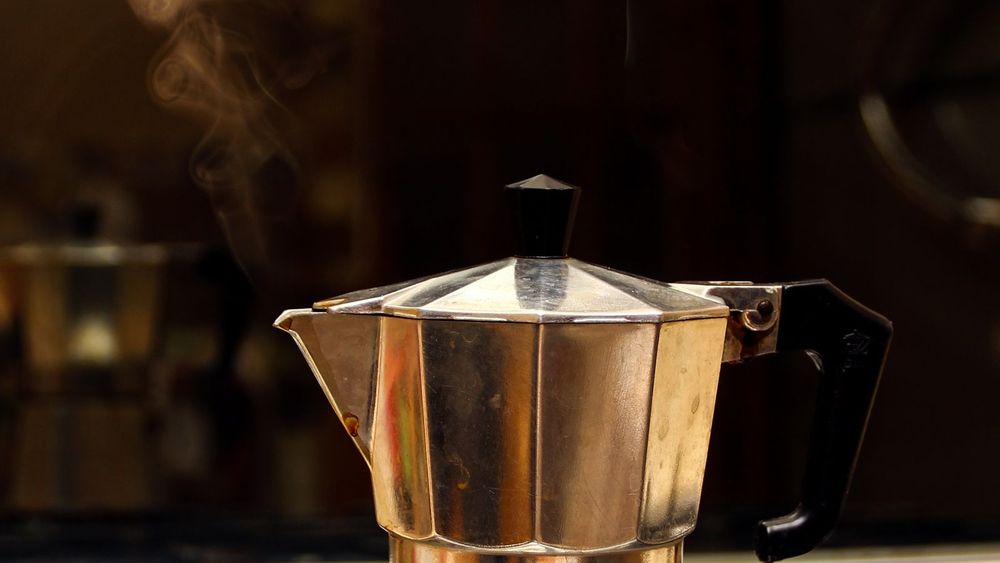
The short answer: According to the Bialetti instructions, cold water goes into the boiler up to the lower edge of the safety valve, the ground coffee goes loosely and without tamping into the funnel, and the pot goes on the hob with the lid closed (on a medium setting for electric, glass-ceramic and induction, with a limited flame on gas). You take it off the heat as soon as the upper chamber is full; other sources give the gurgling as the signal. For a 6-cup Moka Express, the instructions table gives 300 ml of water in the boiler and 270 ml of yield. On water temperature and when to take the pot off, the manufacturers contradict each other.
According to an Allensbach survey from 2014 that Stahl et al. (2017) cite, 4.23 million Germans aged 14 and over most often prepare their coffee in a moka pot. Even so, there is no uniform rule for operating it. Bialetti’s operating instructions say something different about the hob setting and about taking the pot off the heat than the product page of the same manufacturer, and several suppliers of stainless steel pots again require something of their own, such as pre-warmed water.
On disputed points we first say who prescribes what, then give our assessment, marked as such. We do not operate the pots ourselves; the information comes from manufacturer documents and studies.
How to make moka pot coffee: the steps
The order of the steps is the same in the instructions we reviewed.
- Before first use, rinse the pot thoroughly with water only and run one brew with water alone, then make coffee at least three times and throw it away. That is what Bialetti requires. The reason given, that the first three espressos are needed to bring out the aroma as well as possible, is a manufacturer statement that we cannot verify.
- Fill the base with water, at most up to the lower edge of the safety valve. The Bialetti product page warns that the coffee becomes too watery if the valve height is exceeded. How much water belongs in which pot is shown in the table in the section on size.
- Fill the funnel generously with ground coffee, level it off and never tamp it. Bialetti lists tamped coffee among the reasons why air escapes at the safety valve. Morgenheld, Barista Royal and Rommelsbacher ask for the filter basket to be filled to the rim, also without tamping. In the Morgenheld PDF, however, the section on the reducer filter says to press down slightly.
- Remove grounds from the rim and screw on the upper part, according to Bialetti firmly but without overdoing it, and without using the handle as a lever. Grounds on the rim of the boiler are listed in the Bialetti FAQ among the three causes of leaking water.
- Put the pot on the hob with the lid closed. On gas, the flame must not reach beyond the boiler. On electric and glass-ceramic hobs, according to the Bialetti instructions you never choose the highest setting but always a medium one; the instructions for Brikka, Venus and Moka Induction say the same for induction. For Brikka and Moka Induction, never use the boost function as well.
- Take it off the heat when the upper part is full or the pot clearly gurgles. Which signal applies when is explained in the next section. According to Bialetti, the pot must not be left unattended during use.
- Open the pot only once it has cooled down. Milu requires at least 20 to 30 minutes before unscrewing it. Then stir the coffee in the upper part and only then pour it, as the Bialetti instructions advise.
According to Bialetti, the pot needs heat and builds up overpressure inside; anyone who ignores the instructions risks scalding or the pot bursting. The steam jet and safety valve must not point at the user. Only touch the handle and knob, the base stays hot, and the pot must not be placed on flammable or heat-sensitive surfaces. The oven and microwave are excluded, and the pot is approved only for domestic use.
Where the manufacturers differ
Cold or pre-warmed water
Cold water is required by the Bialetti instructions (Moka Express, Venus, Brikka Induction, Moka Induction), room-temperature water by the Moka Express product page. Nevo names fresh water, and Rommelsbacher for the electric EKO 364/E cold, clear water. Groenenberg wants it pre-warmed at 70 to 80 °C, and so do Morgenheld and Barista Royal. Orbegozo allows cold, lukewarm and hot water. The reasons differ: Morgenheld pre-heats so that the pot warms up slowly and the coffee does not burn and turn bitter from heating too fast. Barista Royal gives a shorter brewing time and less burnt or bitter taste as reasons and lists cold water among the typical mistakes.
Physically, quite a lot speaks for pre-warming. King (2008, American Journal of Physics) writes in the abstract that with water at room temperature at the start, half of the coffee is extracted at water temperatures below 70 °C, well below the desired range of 90 to 95 °C. Hotter extraction results if the water is pre-warmed to about 70 °C before closing and at least 100 ml of air space remains in the boiler. We could only read the abstract. Navarini et al. give no starting temperature of the water in the text; the temperature curves in their Figures 3 and 4 start at about 23 to 26 °C. At the start of delivery the tank water there was 68.7 °C (400 W) and 70.2 °C (600 W) respectively.
Our assessment: with Bialetti pots, use cold water, as stated in every Bialetti instruction we reviewed. For pots whose manufacturer prescribes pre-warming, its specification applies, even if the base is then already hot when you screw it together. None of the sources documents a flavour advantage of one variant or the other. When comparing the two variants, change only the water temperature per run.
When the pot comes off the heat
The Bialetti instructions for Moka Express and Venus say: as soon as the upper part is full of coffee. The Moka Express product page, by contrast, gives the gurgling sound as the sign that the espresso is ready. Nevo takes the pot off the hob as soon as the distinct gurgling begins, Groenenberg names the typical hissing sounds at the end, and Milu and Morgenheld see all the coffee at the top once it hisses or bubbles respectively, and then take the pot off the heat immediately. Barista Royal writes that the pot comes off as soon as the coffee flows upward, and the residual heat pushes the rest through.
The Brikka is different: according to the instructions, the bubbling, hissing sound shows the start of crema formation, and after a few seconds the crema in the upper part is checked. If the pot stays on the heat source, the crema can dissipate and the coffee can overflow.
With an ordinary stovetop pot we would take it off the heat at the first distinct gurgling or hissing. This is supported by the Bialetti product page, Nevo, Milu, Morgenheld and Groenenberg, plus the mechanism from the next section. For the Brikka, the manufacturer’s instructions apply.
Hob setting and lid
There is no uniform setting or wattage. The sources at a glance:
| Source | Hob setting |
|---|---|
| Bialetti instructions | Gas: flame not beyond the boiler. Electric, glass-ceramic, induction: never the highest, always a medium setting |
| Bialetti product page | lowest setting |
| Orbegozo instructions | constant low heat |
| Nevo instructions | low to medium heat |
| Easyworkz manufacturer page | medium heat |
| Groenenberg product page | never the highest setting, at most half heat if the base discolours dark |
| Navarini et al. 2009 | 400 W and 600 W hob output on a 3-cup pot |
On the lid, the sources agree: the instructions from Bialetti (Moka Express, Brikka, Venus) and from Morgenheld require it closed. We found no manufacturer that prescribes an open lid. Our assessment: with Bialetti pots we would start with the medium setting from the instructions; for other manufacturers their specification applies (Orbegozo, for example, requires constant low heat). If the base discolours or the coffee tastes bitter, go down one setting.
Why the pot pushes water upward
According to the Bialetti instructions, the pot builds up overpressure inside. Navarini et al. (Applied Thermal Engineering 29, 2009, authors from illycaffè and the University of Trieste) describe it as an article of faith among users of stovetop pots that the water has to boil at 100 °C to be driven upward, and that the pressure corresponds to the vapour pressure of boiling water. They see both refuted by their measurements. In their experiment delivery began at clearly lower water temperatures, and the dry air initially trapped in the boiler made up a non-negligible part of the pressure.
The experimental setup: a Bialetti Moka Express for 3 cups with 150 g of water and 15 g of coffee, medium roast, ground coarse for stovetop pots, an electric hob at 400 W and at 600 W, 10 runs each. We read the authors’ manuscript; the final version was not accessible to us.
The text gives no pressure value, none is available from Bialetti, and Groenenberg gives 1.5 bar for this design. In the figures the pressure rose from about 1 bar to about 2 to 2.5 bar (read from the curves and rounded): to about 2.05 bar in the 400 W example run (Fig. 3), to about 2.3 bar in Fig. 6 and to about 2.5 bar in Fig. 4, in both of these runs without a stated heating power. Because the start is at 1 bar, this points to absolute pressure, so the overpressure would be a good 1 to 1.5 bar. According to Fig. 6, the measured pressure is made up of dry air and water vapour.
The process has two phases. Up to about 120 g of water emerged (of 150 g), the pot works as a closed space, which the authors call regular extraction. Then the water level reaches the end of the riser tube in the funnel, a short circuit to the surroundings forms, and the remaining water evaporates intensely, announced by a familiar rattling (the authors call it the strombolian phase). The tank water at that point is 117.2 °C (400 W) and 120.6 °C (600 W) respectively. According to the authors, hot water and steam in the coffee bed harm quality because they dissolve less soluble substances that give bitterness and astringency.
Whether taking the pot off earlier improves the flavour was not investigated by the authors; the conclusion drawn here is our own inference. We equate the rattling in the study with the gurgling and hissing the manufacturers speak of; the study itself does not make this link. On this reading, taking the pot off at the first gurgle avoids the phase the authors describe as harmful.
Is moka pot coffee the same as espresso?
No. Navarini et al. note that moka coffee is partly described as harshly bitter and often as burnt, and that it lacks the foam layer of real Italian espresso. As a benchmark they cite Petracco (2001): Italian espresso with water at 90 ± 5 °C, 9 ± 2 bar, a flow time of 30 ± 5 s and a coffee cake of 6.5 ± 1.5 g. The SCAA definition (Fasman 2018, 25 Magazine) gives 25 to 35 ml from 7 to 9 g of coffee, water at 90.5 to 96.1 °C (195 to 205 °F) at 9 to 10 atmospheres and 20 to 30 s. The magazine calls it the traditional definition. In a 2017 survey by the Barista Guild of America (275 participants, 76 per cent from the USA) the average extraction pressure was 8.5 bar, and the most frequently named value was 9 bar.
In the measurement by Navarini et al. the absolute pressure was about 1 to 2.5 bar, far below that. Then there is the time: in the 400 W example run (Fig. 3) the pressure reached its maximum after about 320 s (read from the figure), whereas an espresso takes 20 to 30 s. Navarini et al. cite extraction yields of 27.6 to 31.9 per cent for moka. They name 18 to 22 per cent as the most acceptable range (SCAA Brewing Control Chart, Lingle 2001) and note that the yield for moka is higher than for filter, espresso and French press. Whether this range is the right benchmark for stovetop pots, the source does not say.
Among the Bialetti instructions we reviewed, only that of the Brikka promises crema: one Brikka cup is 30 ml including crema, and the silicone membrane in the riser tube is meant, according to Bialetti, to provide more creaminess. By the definitions of Petracco and the SCAA, coffee from a classic stovetop pot is, in our view, not espresso.
Pot size, water amount and coffee amount
At Bialetti a cup is not a fixed amount. The table gives the values from the instructions for the Moka Express, the Moka Induction and the Brikka Induction: water in the boiler up to the valve edge and yield in the upper part. In the PDF files the tables exist only as images; we rendered and read them. The assignment of the two figures follows the symbols and matches Navarini et al. (3 cups: 150 g of water) and the US page of Bialetti (6 cups 9.1 oz, so 270 ml).
| Pot (according to Bialetti instructions) | Size | Water in the boiler | Yield in the upper part |
|---|---|---|---|
| Moka Express | 1 cup | 63 ml | 60 ml |
| Moka Express | 2 cups | 103 ml | 90 ml |
| Moka Express | 3 cups | 150 ml | 130 ml |
| Moka Express | 4 cups | 220 ml | 190 ml |
| Moka Express | 6 cups | 300 ml | 270 ml |
| Moka Express | 9 cups | 460 ml | 420 ml |
| Moka Express | 12 cups | 670 ml | 600 ml |
| Moka Express | 18 cups | 885 ml | 800 ml |
| Moka Induction | 2 cups | 130 ml | 100 ml |
| Moka Induction | 4 cups | 180 ml | 150 ml |
| Moka Induction | 6 cups | 320 ml | 280 ml |
| Brikka Induction | 4 cups | 170 ml | 160 ml (one cup 30 ml) |
If you divide the yield of the Moka Express by the number of cups, you get about 43 to 50 ml per cup from 2 cups upward (our own calculation). For the Moka Induction it is between 37.5 and 50 ml per cup, and for the Brikka it is 30 ml. Other manufacturers calculate differently: Groenenberg gives 200 ml for 4 and 300 ml for 6 cups (capacity), Morgenheld gives the same amounts as water, Florina 270 ml for 6 cups, and Bialetti for the 4-cup Venus about 170 ml according to the manufacturer. The valve edge on your own pot therefore remains decisive, not the number on the packaging. The Brikka instructions additionally require the supplied measuring cup.
On the amount of coffee: for the grounds, Bialetti names only the filled funnel, on the product page generously. Navarini et al. worked in the 3-cup pot with 15 g of coffee to 150 g of water, so 1:10. Lambda Coffee recommends 30 g for 300 ml (also 1:10), and 24 g on a second page of its own. Easyworkz recommends 16 g for 200 ml, 25 g for 300 ml (about 1:12) and 40 g for 520 ml, in each case finely ground. The brew calculator on our German site works with 1:10 for the moka pot, 1:11 for mild and 1:9 for strong. Our assessment: without a gram figure from Bialetti, the filled, untamped funnel remains the specification. You get a number by weighing the amount once and using it as a reference for the next run.
Grind size, roast and freshness
The grind size information uses different scales and cannot be compared directly:
| Source | Information |
|---|---|
| Bialetti instructions | grind size for moka pots, explicitly not finely ground coffee |
| Groenenberg, Morgenheld | 4 to 5 on a scale from 1 (fine) to 10 (coarse) |
| Barista Royal | 3 to 5 on a scale from 1 to 12, between espresso and hand filter |
| Milu | slightly coarser than for espresso, between fine espresso and hand filter |
| Nevo | medium-fine |
| Lambda Coffee | between fine and medium |
| Orbegozo | medium, not too fine (only coarse in the cleaning section of the same instructions) |
| Easyworkz | fine |
| Rommelsbacher (electric) | espresso powder, coarser if steam escapes at the valve |
| Navarini et al. 2009 | ground coarse for stovetop pots |
The sources that make any comparison at all put it between espresso and hand filter, so coarser than for the portafilter machine. Morgenheld also warns that coffee ground too fine clogs the filter and can lead to overpressure. Our assessment: we would start in the middle of this range and go coarser as soon as air or steam escapes at the valve, which the Bialetti FAQ and Rommelsbacher also state. The number only helps if your grinder has the same scale. How to adjust the grind size on your grinder is explained in the guide coffee grind size.
On roast: Groenenberg recommends a slightly lighter espresso roast. Navarini et al. worked with a medium roast (16 per cent weight loss) and did not compare roast levels. Akiyama et al. (2003, Journal of Agricultural and Food Chemistry) measured that grinding roasted beans releases volatile aroma compounds, especially nutty and smoky roasted notes, but not the loss over time or a difference in flavour. Freshly ground coffee is recommended by Milu, Barista Royal, Morgenheld, Groenenberg and Orbegozo, and Barista Royal lists pre-ground coffee as a mistake because of the loss of aroma.
Does a moka pot work on an induction hob?
Aluminium does not work. Neff (BSH) lists as unsuitable non-ferrous metals such as aluminium and copper, plus conventional, non-magnetic stainless steel. Aluminium parts in the base reduce the ferromagnetic area, and the cookware may then be recognised only inadequately or not at all. Neff advises checking with a magnet.
For the aluminium Bialetti Moka Express, Bialetti offers a plate for induction: steel, approx. €19.90 (as of October 2026), according to Bialetti for all moka pots from 1 to 9 cups and small cookware, with a thickness that is meant to ensure good heat transfer (manufacturer statement). In its FAQ, Groenenberg recommends an induction adapter, a metal plate under the pot, if the hob does not recognise it. The Bialetti Moka Induction has steel on the outside and aluminium on the inside and runs without an adapter plate. According to the instructions, the stainless steel Venus is induction-capable only in the 4, 6 and 10 cup versions, not as a 2-cup pot. For Milu’s 2-cup pot the information diverges: the instructions name every type of hob including induction across the board. In the manufacturer’s shop, one product page says the 2-cup variant may be too small for induction fields, the page of the personalised version explicitly excludes 2 cups as not suitable for induction, and the Amazon title carries the addition “2 Cup No Induktion”.
For Brikka and Moka Induction, Bialetti requires matching the boiler diameter to the technical characteristics of the hob. Groenenberg gets specific and names induction fields from 9.5 cm diameter for 4 cups and from 10.5 cm for 6 cups. When buying for induction, what counts in our view is the manufacturer’s approval for exactly this size, the magnetic base and the minimum diameter of the hob; the material alone says nothing about this.
Caring for a moka pot properly: cleaning, limescale and gasket
For aluminium pots, Bialetti requires washing after every use with lukewarm water without detergent or scouring agents. The pot is explicitly not dishwasher safe. It is stored taken apart, every part completely dry and not closed. As the reason, the Brikka instructions give staining and oxidation, and the Venus instructions likewise say not to close the pot after washing. Groenenberg lets the pot dry for about 4 to 5 hours after cleaning before it is assembled. Milu advises storing the pot dried and open. Orbegozo considers discolouration in the boiler unavoidable over time; water with vinegar can remove it.
Whether the dishwasher is allowed depends on the material and the manufacturer’s statement. For Moka Express, Brikka and Moka Induction from Bialetti it is excluded, and Florina recommends hand washing for its aluminium pot. The BfR, too, in its 2020 FAQ recommends not cleaning aluminium moka pots in the dishwasher. According to the instructions, the manufacturer approves the stainless steel pots from Nevo, Morgenheld, Groenenberg, Milu and Coffee Fox as well as the Bialetti Venus for the dishwasher but mostly recommends hand washing. Easyworkz and Barista Royal state the approval on the manufacturer’s page. The Venus instructions advise hand washing without washing-up liquid so as not to alter the taste.
What the dishwasher does to aluminium pots was measured in a laboratory study. The Hessian State Laboratory (Stahl et al., Environmental Sciences Europe 29, 2017) brewed coffee six times each with four brands, three of aluminium and one of stainless steel: 12 g of coffee, 150 ml of water, 7 minutes on a plate heated to 270 °C. Aluminium passed into the coffee, most at first use and less from the second to the fifth use; the authors speak of a passivation of the surface. After cleaning in the dishwasher, contrary to the manufacturer’s instruction, the concentration rose clearly, up to 0.795 mg/l. With correct use the authors consider the additional intake negligible.
The Moka Express instructions require regular descaling. The procedure: fill the boiler with water to just below the valve, add two teaspoons of citric acid or vinegar, assemble the pot completely and run one brew without ground coffee. The liquid is poured away, the pot is washed with running water, and then, according to the Moka Express instructions, coffee preparation continues. After descaling, the Venus instructions require repeating the steps of the first use of the product. During normal washing, move the piston in the valve along its axis so that no limescale settles.
In its 2007 opinion the BfR explains that the thin aluminium oxide film is destroyed on contact with acidic or salty foods. As examples for aluminium pots and trays, the opinion and the 2020 FAQ name apple sauce, rhubarb, tomato puree and salted herring. The FAQ assigns this warning to aluminium foil, trays and uncoated pots, not expressly to the moka pot. On the dishwasher it says that the protective layer can be removed there and re-forms during further use. Whether descaling acid attacks the layer, the FAQ does not answer; Bialetti prescribes citric acid or vinegar. For gasket and filter: only original spare parts for the model. The replacement interval and a price example are in the FAQ above; the example applies to a set that Bialetti lists for Venus, Kitty and Musa, not for the Moka Express.
Faults: air at the valve, water at the rim, bitter taste
The Bialetti instructions list four fault patterns with causes; the causes are not ordered by frequency. Information from other manufacturers is added:
| Symptom | Cause according to the source | What you change |
|---|---|---|
| Air escapes at the safety valve | Bialetti: not a moka grind, coffee pressed into the funnel, too much water in the boiler | grind coarser, fill loosely, water only up to the valve edge |
| Water leaks out | Bialetti: pot not closed tightly, gasket worn, grounds on the rim of the boiler | screw tighter, check the gasket, clean the rim |
| No coffee in the upper part | Bialetti: check that all parts are present and tightly closed and that there is no water leak | check parts, closure and tightness |
| Coffee cold or too hot | Bialetti: water level | check that the water level is at the lower edge of the valve |
| Filter clogged, overpressure | Morgenheld: coffee ground too fine | grind coarser |
| Dark discolouration on the base | Groenenberg: heat too high | half heat at most |
| Water left in the base | Nevo: normal. Venus instructions: possible, the remainder helps against colour changes on the boiler if the pot stays longer on the heat source | nothing |
For bitterness and burnt taste, the explanation by Navarini et al. is above in the section on water pressure. Manufacturer statements are added: Groenenberg requires taking the pot off the hob immediately after boiling, otherwise overpressure arises. Milu gives temperatures that are too high as the reason for burnt coffee and a bitter aftertaste and gives scorching as the reason for taking it off immediately.
On quenching: Groenenberg recommends cooling the boiler from the outside with cold water after boiling to stop the cooking process. Morgenheld holds it optionally under cold water for 3 seconds, against over-extraction or deformation. Both mean stainless steel pots. For aluminium, Florina warns that a hot product can be damaged by cold water, and requires cleaning only after cooling. Quenching does not appear at Bialetti, where the rule is: open only once cooled. For Bialetti pots and other aluminium pots we would therefore not quench, but first set the moment of taking it off earlier and then check the setting and grind size.
What the sources leave open
In the instructions we reviewed and on the Moka Express product page, Bialetti gives no fixed brewing time and no gram figure for the grounds, and the closed lid comes without a reason. For the Brikka there is no pressure measurement. We found no SCA, DIN or ISO standard specifically for moka pots. Five statements also remain undocumented: that dark roasts suit the pot better, that freshly ground coffee gives more aroma in a moka pot than long-stored coffee, that a patina in the boiler improves the taste (Bialetti does not know the word), that the induction plate heats more slowly or fits pots from other manufacturers, and that the gasket is the most common cause of steam escaping at the rim. How water hardness affects the taste from the pot, we have not researched.
Matching pots: reviews and ranking
Our reviews evaluate manufacturer information. The table sets out the pots from this guide by hob, size and material. The links lead to the pots on Amazon.de.
| Pot | Size, material | Hob according to manufacturer | Price (guide value from the review’s price box, on Amazon.de) | Score |
|---|---|---|---|---|
| Bialetti Moka Express | 6 cups, aluminium | Induction only with Bialetti steel plate | approx. €28.87 | 9.4 |
| Bialetti Moka Induction | 2 cups, steel outside, aluminium inside | Induction without adapter plate | approx. €26.14 | 8.7 |
| Bialetti Venus | 4 cups, 18/10 stainless steel | Induction only in 4, 6 and 10 cups according to the instructions | approx. €28.00 | 8.8 |
| Bialetti Brikka | Brikka Induction, 4 cups, aluminium and steel | Induction version | approx. €52.25 | 8.9 |
| Groenenberg | 4 cups (200 ml), stainless steel, with reducer filter | Induction from 9.5 cm field diameter | approx. €32.99 | 8.5 |
| Morgenheld Flow | 6 cups (300 ml), stainless steel | induction-capable | approx. €39.95 | 8.2 |
| Nevo | 6 cups (300 ml), stainless steel, reducer filter included | Induction | approx. €44.99 | 8.3 |
| Barista Royal | 6 cups (300 ml), stainless steel | all types of hob | approx. €44.99 | 8.5 |
| Easyworkz Diego | 6 cups (300 ml), stainless steel, reducer piece included | induction-capable | approx. €44.99 | 8.3 |
| Lambda Coffee | 5 to 6 cups (approx. 300 ml), stainless steel, removable wooden handle | also camping stoves according to the instructions | approx. €43.48 | 8.2 |
| Waldwerk | 300 ml, stainless steel, oak handle | all types of hob including induction | approx. €39.99 | 8.1 |
| Coffee Fox | 4 cups (200 ml), stainless steel | gas, electric, induction according to the manual | approx. €17.95 | 8.0 |
| Zanetti Star | 3 cups, boiler stainless steel, upper part aluminium | induction-capable | approx. €22.90 | 8.2 |
| Milu | 2 cups (100 ml), stainless steel | Induction for 2 cups: manufacturer’s shop says not induction-capable or may be too small, instructions say every type of hob across the board | approx. €25.45 | 7.9 |
| Florina Grande | 6 cups (270 ml), aluminium | not induction-capable | approx. €17.90 | 7.8 |
| Orbegozo KF 200 | 2 cups, aluminium | gas, electric, glass-ceramic | approx. €11.37 | 8.0 |
| Rommelsbacher EKO 364/E | 2 or 4 cups, electric, 365 W, automatic switch-off | electric | approx. €64.46 | 8.7 |
The prices were not all collected on the same day. Eleven reviews give their guide value as of September 2026. For Coffee Fox and Milu it dates from July 2026, and for the Rommelsbacher it is older than the catalogue retrieval of 7 September 2026, which showed €60.89. For Zanetti, Florina and Orbegozo the reviews give no collection date; the catalogue retrievals of 7 September 2026 showed €17.80 for Florina and €12.11 for Orbegozo.
For small amounts in a larger pot there are reducer filters, though for the Morgenheld Flow the reducer insert is only an accessory to buy separately. According to the manufacturer, Groenenberg states pot and filter insert to be aluminium-free. Before buying a replacement gasket and filter, it is worth looking at the spare parts offer: in the manufacturer’s shop for the Florina Grande there are, according to the review, no spare parts.
For espresso with a portafilter machine, types and prices are covered in our portafilter buying guide.