The short answer: Both brew with hot water and ground coffee, but the AeroPress uses a plunger to press the brew through a paper filter, while the French press pulls a metal mesh through the standing brew. According to Urgert and Katan (1997), paper holds back the diterpenes that affect cholesterol, and a metal mesh does not. For a single cup with paper, take the AeroPress; for several cups at once, take a pot.
The core of the difference is not the price or the looks, but the filter. Everything else in this guide, from the number of cups to cafestol, follows from this one design decision.
Plunger and paper against mesh: how the devices work
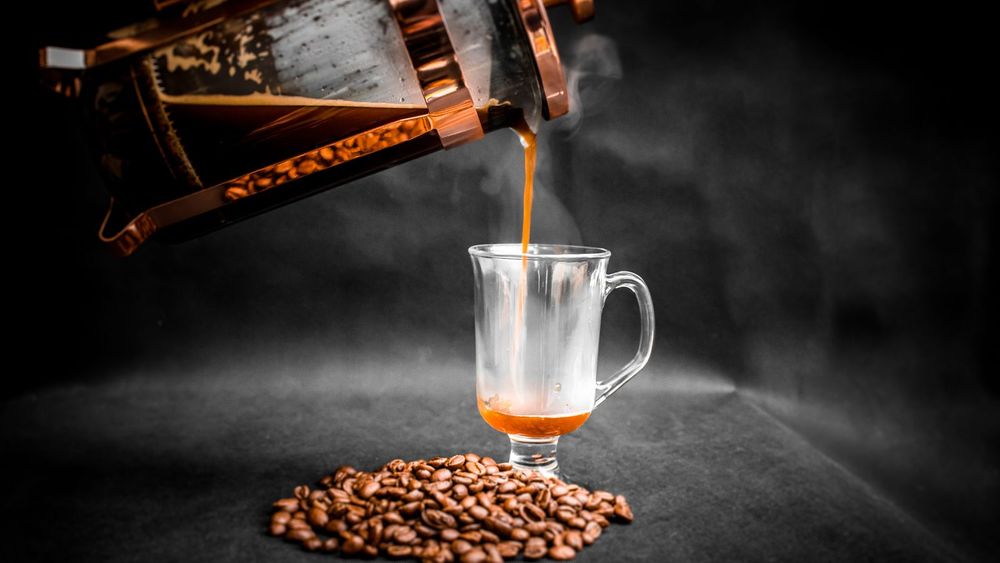
With the French press, the coffee sits in the pot with the water. After the steeping time, you push a metal mesh down through the standing brew from above and press the grounds to the bottom. The mesh has openings, and whatever fits through the openings stays in the drink. Bodum credits the stainless steel plunger of the Bodum Chambord with preventing ground beans from escaping when you pour. That does not refer to fine particles that fit through the mesh. That these end up in the last cup is our conclusion from the design of the mesh; there is no manufacturer statement on this.
AeroPress itself describes its method in three phases: infusion, rapid immersion, then air pressure with microfiltration. AeroPress places most of the extraction in the immersion phase, that is, in the steeping. According to AeroPress, the air pressure speeds up the process and lowers acidity and bitterness compared with methods with a long brew time; this is a manufacturer claim and has not been measured. According to AeroPress, the paper filter holds back grounds, fines and bitter oils. The page gives no times and no pressure values.
So the AeroPress is not pure immersion like the pot. The plunger presses the finished brew through the bed and the filter. That is the difference between a plunger with a paper filter and a mesh that is pushed through the standing brew.
The figures side by side
The table reproduces the manufacturers’ figures, each with its source. They are manufacturers’ starting values, not standards: the SCA standard 310-2021 with its 55 g per litre applies only to electric household drip coffee makers and not to hand pour-over, French press or AeroPress.
| AeroPress | French press | Source | |
|---|---|---|---|
| Grind size | medium-fine (medium for pre-ground coffee) | coarse | AeroPress FAQ and instructions; Bodum, Espro, Bialetti, Grønenberg |
| Dose | 16 to 18 g per heaped scoop | 7 to 10 g per cup (125 to 150 ml) | AeroPress FAQ; Deutscher Kaffeeverband (German Coffee Association) |
| Water | up to fill mark 4, no ml figure | ratio 1:12 to 1:18 depending on the source | AeroPress instructions; Espro Brew Guide |
| Temperature | 85 °C, 80 °C for dark roasts, boiling allowed | 88 to 96 °C depending on the source, not boiling | AeroPress instructions and FAQ; Kaffeeverband, Bodum, Espro |
| Waiting time | 60 seconds, 30 for medium-fine | at least 4 minutes (Bodum) | AeroPress instructions; Bodum combined instructions |
| Cleaning | rinsing is enough | take the filter unit apart after every use (Bodum) | AeroPress FAQ; Bodum instructions |
According to the product page, the “under two minutes” for the AeroPress is not the steeping but brewing and cleaning together. If you read “1 to 2 minutes steeping time” anywhere, that is not the manufacturer’s figure.
Grind size, water and time: where the sources disagree
On grind size, the sources largely agree. AeroPress recommends medium-fine but warns that very fine particles block the flow of water and make pressing harder. In all the grinder manufacturers’ charts we checked, the AeroPress is set finer than the French press but coarser than espresso. At Baratza, the AeroPress is at setting 12 on the Virtuoso+ and the French press at 28, and on the Encore ESP it is 22 against 32 (each on its own scale, not comparable with each other). Bodum justifies “coarse only” on safety grounds: finely ground coffee can clog the filter and build up high pressure. Espro adds that fine powder can clog the meshes. How to set this on your grinder is covered in the guide Coffee Grind Size.
Opinions differ more on temperature. AeroPress gives 85 °C for its own press and allows boiling water if your kettle has no temperature setting. The world championship recipes on aeropress.com range between 75 and 92 °C for the winners. For the French press, Bodum’s product page says about 92 to 96 °C, while the instructions only say “hot, not boiling”; the Kaffeeverband generally advises 88 to 95 °C and nothing above that. Studies suggest that temperature decides less between good and bad than people think. Liang, Chan and Ristenpart found in 2021 that for full immersion between 80 and 99 °C the yield was about 21 per cent, regardless of grind size, roast level and temperature; temperature changes the speed. Batali, Ristenpart and Guinard found in 2020 for drip filter coffee that 87, 90 and 93 °C, at the same strength and yield, barely changed the sensory profile. Neither finding applies one to one to the AeroPress or to four minutes in a pot. Our assessment: stick to the manufacturer’s line, which for the pot means hot, not boiling water, and only change the temperature when you do not like the result.
On time, the figures for the French press vary the most. The Kaffeeverband gives about two and a half to four minutes, Bodum at least four, Espro up to four and, in a blog post, three to six. Grønenberg has you pre-infuse for 30 seconds and then steep for four minutes. We would start with four minutes and move from there in small steps. On dose, Espro lists 1:15 to 1:18 and 1:12 for light roasts, and Fellow gives 1:14 for the Opus. We would begin with 1:15, about 30 g to 450 ml. This is a starting value, not a standard.
With the AeroPress, the brew ratio helps little because the manufacturer never gives millilitres, only the fill mark. Fellow calculates 25 g at 1:15 for the Opus, while the world champions use 16.5 to 35 g and often dilute afterwards. These recipes are a competition of their own and not an everyday benchmark.
Body and clarity: what is measured and what is not
Here there is one documented difference and one that is only a manufacturer claim. The first is documented.
In 1995, Urgert and colleagues measured the cafestol content of different preparations. A cup of French press contained 3.5 mg, Scandinavian boiled coffee 3.0 mg, Turkish coffee 3.9 mg and espresso 1.5 mg. In filter, instant and percolator coffee, the diterpenes were negligible. For every 10 mg of cafestol a day, serum cholesterol rises by about 5 mg/dL; with five cups of French press a day, it could rise by 8 to 10 mg/dL. This statement applies to high, long-term consumption and not to a single cup. In 1997, Urgert and Katan described how hot water dissolves the diterpenes but the paper filter holds them back. In 2025, Santanatoglia and colleagues found, in specialty coffee from Kenya prepared in eight ways (including AeroPress, Chemex, V60 and French press), that unfiltered methods have high and paper-filtered ones clearly lower concentrations of cafestol and kahweol. The individual values for the AeroPress and the French press appear only in the full text, which we have not opened; which type of filter the AeroPress had there is not stated in the abstract. A paper filter is also not the only factor: Rendón, Scholz and Bragagnolo (2017) found in filter coffee that 12.41 per cent of the cafestol stayed in the paper filter, 87.45 per cent in the spent grounds and only 0.15 per cent in the drink.
On body, the evidence is thinner. AeroPress describes the paper filter as smooth, without sediment, and the stainless steel filter as somewhat fuller in body, similar to the French press. That is the manufacturer’s own description. We did not find a comparative study of AeroPress against French press with sensory analysis. The underlying relationship is at least documented: Gloess and colleagues compared nine preparations in 2013, and total solids there were linked to texture and body. So if you leave more dissolved and suspended solids in the cup, you get more body. On yield: in 2022, Várady and colleagues found, for a fermented specialty coffee at a fine grind size, 25.91 per cent for V60, 21.69 for French press and 20.67 for AeroPress. That applies to this coffee with the authors’ recipes and says nothing about taste.
If you do not want the fines from the pot, paper is the obvious route: the AeroPress with a paper microfilter or, with the Espro pots, a paper filter between the two meshes. The Espro manual describes this, according to our review; whether paper filters are included is contradicted between the manual and the product page.
How much coffee at once?
Here the pot wins, and the AeroPress cannot be scaled up. The chamber of the Original limits what fits in one go: 10 oz is around 300 ml. For AeroPress, more volume means a different model or brewing again. Alone at the breakfast table that is no problem, but with three people it turns into a loop. A 1 l pot with a metal mesh brews for several people in one go; Bodum requires at least 2.5 cm of free space at the top.
If you rarely brew more than 300 ml at a time, you will never fill a litre pot. Then a small pot or the AeroPress straight away is enough. Only double-walled stainless steel can keep coffee warm: Grønenberg states at least one hour. For single-walled glass pots, no manufacturer we checked gives a keep-warm time.
On the go and clearing up
AeroPress draws the line itself by where it is used. According to the manufacturer, the Go is designed for work, travel and the outdoors and weighs 323 g fully packed, and the Original with scoop and stirrer around 220 g. The manufacturer gives no evidence of a weight advantage for the Go, and we cannot confirm one. The Go’s mug serves as a carrying container and fits only the Go. According to AeroPress, brewing and cleaning together take under two minutes, because the plunger wipes the chamber clean as you press, so a rinse is enough. You clean the seal now and then with washing-up liquid.
With the pot it is different. Bodum requires you to unscrew and clean the filter unit after every use. Grønenberg points out that coffee residue in the plunger can turn rancid, and Espro also lists a monthly deep clean. You rinse both meshes of the Espro pots separately after each brew. That is more work than with the AeroPress, but not a hurdle.
Which devices come into question
From our catalogue, on the paper side the AeroPress Original at about €41.08 on Amazon.de and the AeroPress Go at about €44.00 come into question (as of September 2026). The Original is made of polypropylene, and the stainless steel filter is sold separately. The Go holds 8 oz and takes the same paper filters.
On the pot side there are the Bodum Chambord with 1 l of borosilicate glass in a chrome-plated stainless steel frame (about €34.99) and the Bodum Brazil with a plastic housing (about €16.89). According to our review, the Bialetti Preziosa has no replacement glass in the shop. The Espro P3 (530 ml, about €29.75) and the Espro P5 (950 ml, about €50) have a double microfilter and take only a coarse grind. The Grønenberg stainless steel thermo pot (about €36.99) and the Ozavo Thermo are double-walled. The glass Amazon Basics pot costs about €11.54; because of its design, its metal mesh lets fine dust through, and that is our assessment. If you want the steps for each method, you will find them in the AeroPress Guide and in the French Press Guide.
Common problems: symptom, cause, change
The causes come from the manufacturers’ data; where we derive them from the design, it says so.
| Symptom | Cause | What to change |
|---|---|---|
| The AeroPress is hard to press | According to AeroPress, very fine particles block the flow of water | Grind coarser, to medium-fine, or to medium for pre-ground coffee, and do not press harder |
| Sediment in the last cup from the pot | The metal mesh lets fines through (our conclusion from the design, not a manufacturer statement) | Grind coarser, or with an Espro put a paper filter between the meshes, or switch to the AeroPress with paper |
| The plunger of the pot sticks or is hard to press | Ground too fine: Bodum cites clogging and high pressure, Espro cites clogged meshes | Grind coarse only, leave at least 2.5 cm of space at the top (Bodum) |
| Rancid aftertaste from the pot | According to Grønenberg, coffee residue in the plunger can turn rancid | Take the filter unit apart and clean it after every use (Bodum); with Espro also deep clean monthly |
| The AeroPress metal filter lets powder into the cup | According to AeroPress, the finest powder can get through the metal filter | Switch to the paper filter, or soak the metal filter regularly, as AeroPress advises |
When the AeroPress, when the pot
The decision runs in three steps. Each has a reason that you will find documented above in the text.
- How many cups do you usually brew at once? Up to two: AeroPress, because the Original holds 10 oz and, according to the manufacturer, counts as a device for 1 to 2 cups. Regularly more: pot, because more volume with the AeroPress means a different model or brewing again.
- Do you want paper or mesh as the filter? According to AeroPress, paper holds back grounds, fines and bitter oils. The mesh lets oils and fines through, which according to the manufacturer gives somewhat more body. We did not find a comparative study on body. If you want body but like paper, you can choose the stainless steel filter for the AeroPress.
- Where do you brew? On the go or at work: AeroPress, because the manufacturer designs it for that and a rinse is enough. At home with several people: pot, even if you have to take the filter unit apart after every use.
Take the AeroPress if you mostly brew alone or for two, want to make coffee on the go, or want paper in the filter. If the body with paper is too thin for you, there is the stainless steel filter, which according to AeroPress gives a somewhat fuller body.
Take the pot if more people regularly join in or volume is the priority. A 1 l pot is built for several cups, the AeroPress is not. If you want the pot with fewer fines, you put a paper filter between the meshes of an Espro.
On cholesterol: Urgert and colleagues (1995) found a possible rise in serum cholesterol of 8 to 10 mg/dL with five cups of French press a day, while in paper-filtered coffee the diterpenes were negligible. If you drink about five cups a day from the unfiltered pot and watch your cholesterol, that is a reason to prefer paper. What was measured was paper drip filter coffee; the study has no separate value for the AeroPress. For health questions, ask your doctor.