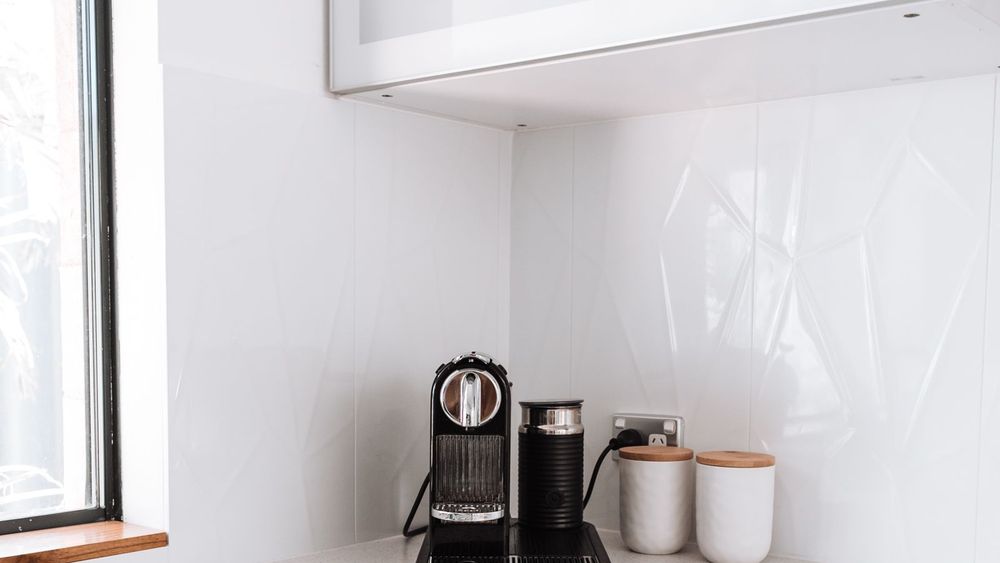
The short answer: On cost per cup, the pod comes out ahead in our examples. A Senseo Classic pod costs about €0.25 according to the pack information from Aldi Süd (14.10.2026), a Nespresso Arpeggio capsule €0.49 according to Nespresso. On machine price there is no clear winner, because the cheapest machine in our comparison is a capsule machine. Our assessment: calculate with your own pack price, because over the years the portion matters more than the machine.
Capsule or pod: how do the systems differ technically?
A pod is a paper cushion with ground coffee, a capsule a rigid container made of aluminium or plastic. How the machine turns it into coffee depends on the system, and the equation “capsule means high pressure” does not get you very far.
According to Philips, the Senseo pod machines work at 1 bar: the Original Plus states it as pump pressure, the Switch as brewing pressure. The original Nespresso machines show a completely different number. The Essenza Mini instructions give 19 bar with the symbol Pmax and speak of a pressure of up to 19 bar, De’Longhi also gives 19 bar for the CitiZ, and Tchibo gives a maximum of 15 bar for the Cafissimo Milk.
Two capsule systems control the brew via a barcode, and for both, neither the instructions nor the manufacturers’ pages give a pump pressure in bar. The Vertuo machines read the code on the capsule, pre-wet the coffee and choose the brewing parameters and coffee length themselves. Nespresso calls the process Centrifusion and describes it as patented. With Tassimo, INTELLIBREW reads the barcode of the T DISC and then regulates water quantity, temperature and brewing time; according to Bosch, this technology is also patented.
What all portion systems have in common is that the amount of coffee and the grind are fixed beforehand, for pods as for capsules. Philips prohibits loose coffee and damaged pods in the pod holder of the Senseo. Tchibo specifies for the Cafissimo never to fill in loose coffee powder or beans. So whoever fills the capsule or pod decides the quantity and grind.
What else can you adjust on the machine?
The water quantity is freely adjustable on many machines, and with it the ratio of coffee to water. On the Essenza Mini, the espresso and lungo buttons are programmable: you hold the button until the desired quantity has run through, and according to Krups the factory settings are 40 ml and 110 ml. The Vertuo Next and Vertuo Pop work with 20 to 535 ml and store the quantity per capsule type. The Tassimo My Way 2 has three levels each for intensity, drink size and temperature, and the Cafissimo Milk allows 30 to 250 ml. The Senseo Original Plus has two selector positions and one pod holder each for one and for two cups.
More water through the same portion dilutes the coffee. It gets thinner, not stronger; this is how we derive it from the fixed filling in our German Essenza review.
Not every brew turns out identical, either. In 2021, at the conference of the ASIC (Association for Science and Information on Coffee), J. R. Melrose examined various capsules in a Nespresso system and found brew times between 10 and 25 seconds.
What do 15 or 19 bar tell you about the coffee?
The bar figure is the maximum of the pump. How much pressure actually reaches the coffee is not printed on the pack, and we did not find a peer-reviewed measurement of it for capsule machines.
Melrose describes the mechanism in his 2021 poster paper. Many capsule machines, Nespresso among them, drive the water through the capsule and coffee bed with a vibration pump. The higher the back pressure, the less water such a pump delivers. The capsule and coffee bed slow the flow, and the actual pressure settles where the pump curve and the resistance meet. Because the resistance rises during the brew, this operating point moves with it. The outlet holes of the capsule matter too: with holes amounting to 10 per cent of the base area, the resistance roughly doubles according to Melrose.
The figure of 9 bar, which often appears as the pressure at the coffee grounds, comes from the portafilter machine. The historical SCAA definition, which the SCA reproduces in its 25 Magazine (Fasman, 2018), gives 9 to 10 atmospheres for espresso. In a 2017 survey by the BGA and SCA with 275 participants, the baristas gave an average extraction pressure of 8.5 bar, most often 9 bar. These are self-reports, nothing was measured. Among other things, the question was about the type of portafilter machine; capsule machines do not appear in the article.
Our assessment: a machine with 19 bar Pmax does not make stronger coffee than one with 15 bar, because the quantity and grind are in the capsule. Whether 9 bar or something else is applied to the coffee cannot be said without measurement. When buying, we look rather at heat-up time and tank size. The manufacturers give 25 to 30 seconds of heat-up time for the Essenza Mini, 25 seconds for the CitiZ and 30 seconds to operating temperature for the Vertuo Next. The Senseo Original Plus starts straight away and, according to Philips, needs under 21 seconds for one cup and under 60 seconds for two; the Senseo Switch in pod mode takes less than a minute for one or two cups.
How do you work out your real cost per cup?
Pack price divided by number of portions gives the price per cup. The rest is multiplication:
- Take the price of the pack you actually buy, not the promotional price. Tassimo shows how much promotions distort things: Morning Café XL cost €6.99 for 21 cups at the regular price in the TASSIMO shop on 24.09.2026 (33.3 cents per cup), and €5.52 on promotion (26.3 cents).
- Divide it by the number of portions. For beans, you divide 1,000 g by your portion. The Deutscher Kaffeeverband (German Coffee Association) gives 7 to 10 g of ground coffee per cup of 125 to 150 ml, the SCA standard 310-2021 calculates 55 g of coffee per kg of water for electric filter machines, and for a double espresso the historical SCAA definition gives 14 to 18 g.
- Multiply the price per cup by your cups per day.
- Multiply the result by 365. At two cups a day, that is 730 portions a year.
- Add the descaler, and for bean machines also cleaning agents.
The capsule and pod prices in the table are dated pack figures. We freely assumed the bean price of €18 per kg; use your own. You can work out how much bean you need for your cup with our brew calculator on the German site.
| Example | Pack information (source, date) | Price per portion | Coffee per portion | Price per kg of coffee | Per year at 2 portions a day |
|---|---|---|---|---|---|
| Senseo Classic, pod | 16 pods, 111 g, €3.99 (Aldi Süd, 14.10.2026) | about €0.25 | about 6.9 g | €35.95 (base price) | 730 x 0.249 = about €182 |
| Nespresso Arpeggio, capsule | €0.49 per capsule, 55 g per 10 capsules (Nespresso, 14.10.2026) | €0.49 | 5.5 g | about €89 (our own calculation) | 730 x 0.49 = €357.70 |
| Cafissimo Caffè Crema vollmundig | 10 capsules €4.29, 120 capsules €41.99 (Tchibo, 08.09.2026) | about €0.43 or €0.35 | about 7.4 g | €57.97 or €47.29 (base price) | about €313 or €255 |
| Tassimo, two coffee varieties | regular price (TASSIMO shop, 14.09.2026) | 33 to 44 cents | not stated | not stated | about €243 to €319 (German review of the My Way 2) |
| Beans, 8 g per cup | €18 per kg (assumption) | about €0.14 | 8 g | €18 | 730 x 0.144 = about €105 |
| Beans, 18 g double espresso | €18 per kg (assumption) | about €0.32 | 18 g | €18 | 730 x 0.324 = about €237 |
Converted to a kilogram of coffee, these examples come to just under €36 per kilogram for the pod, €47 to €58 per kilogram for Cafissimo and about €89 for Arpeggio. The pod is thus clearly cheaper than the capsule, but dearer than the assumed bean. Arpeggio is the only data point for Nespresso here; we did not read out other varieties.
How do capsules and pods compare with bean-to-cup machines and portafilter machines?
The difference lies in who decides what. The overview summarises the manufacturer information from our reviews:
| System | Coffee quantity and grind | Water quantity | Portions according to the manufacturer | Pressure figure |
|---|---|---|---|---|
| Nespresso Original (Essenza Mini, CitiZ) | fixed in the capsule | programmable buttons | Essenza instructions 2017: Nespresso capsules from the Nespresso Club | 19 bar (Pmax) |
| Nespresso Vertuo | fixed in the capsule | 20 to 535 ml per capsule type | Pop: Vertuo capsules only; Next: neither approval nor ban of other capsules stated | none in bar |
| Tassimo | fixed in the T DISC | via barcode, My Way 2 with three size levels | original T DISCs only | none in bar |
| Tchibo Cafissimo | fixed in the capsule | 30 to 250 ml (Milk) | original Cafissimo capsules only | max. 15 bar |
| Senseo | fixed in the pod | two selector positions | only mentions SENSEO coffee pods | 1 bar |
| Bean-to-cup machine, portafilter machine | you set it yourself | you set it yourself | any bean | depends on the machine |
We have no documented figures for the time per cup on a bean-to-cup or portafilter machine, which is why that column is missing. The trade-off is clear all the same: in a portion system the filler fixes quantity and grind, on a bean machine you do. If a cup is too thin or too bitter, in a portion system you can only change the water quantity or the variety. How to readjust on a bean machine is explained in the guide bean-to-cup machine settings.
When a bean machine pays for itself depends on three prices: machine, portion, bean. With the figures from the table above, Arpeggio is about €0.35 per cup above the assumed bean; at five cups a day that is 1,825 cups and about €631 a year. Compared with the Senseo pod, the gap is only about €0.10, which at five cups comes to about €192 a year.
How free are you in choosing capsules and pods?
With pods as with capsules, the manufacturer has a say. For the Senseo Original Plus and the Switch, Philips consistently speaks only of SENSEO coffee pods, and the Switch’s data sheet lists only these as supported pods. Philips therefore does not forbid pods of other brands, but they are not approved either.
With capsules, the range runs from explicit exclusion to silence. Tchibo permits only original Cafissimo capsules for the Cafissimo Milk. Bosch prescribes original T DISCs for Tassimo and states that T DISCs do not fit other machines. For the Vertuo Pop, Nespresso names Vertuo capsules only, and the 2017 Essenza Mini instructions speak of capsules available only through the Nespresso Club. On the CitiZ product page, by contrast, De’Longhi and Nespresso say neither that they are approved nor that they are banned.
For the Nespresso Original format there are compatible capsules from other suppliers, and Stiftung Warentest (Germany’s consumer testing foundation) examined them in test 9/2025: 17 coffee capsules and coffee balls from seven systems. Good own-brand retailer capsules for Nespresso machines were available from 17 cents per capsule, and the best came out just ahead of the original, which cost almost three times as much. According to Warentest, anyone who drinks four cups a day and switches to the cheapest good capsules saves about €500 a year.
Refillable reusable capsules turn the principle around. You then decide the grind, quantity and tamping, and with them how even the result is. For Cafissimo and Tassimo we advise against them because of the restrictions above.
How much waste do capsules and pods produce?
On waste, the pod has the legal position on its side. In Annex 1, under waste code 20 03 01, the Bioabfallverordnung (German Biowaste Ordinance) expressly counts “permeable, softening single-portion units for tea, coffee or other drinks” among separately collected biowaste (version after Art. 6 of the Act of 13.7.2026). If such units are made of biodegradable plastic, they may only be composted with the biowaste if they are certified to DIN EN 13432 and disintegrate completely after no more than six weeks of composting (sieve pass-through of at most 2 mm). Rigid capsules made of aluminium or plastic do not fall under this wording. What may go in your organic waste bin is additionally governed by your municipality’s waste bylaw.
Capsules also do not automatically end up being recycled in the recyclables system. According to Stiftung Warentest (test 9/2025), the capsules from Lavazza, Nescafé Dolce Gusto, Tassimo and Netto Marken-Discount cannot be recycled, or only partly.
On climate the picture is different, which is why we separate the two questions. Researchers at the Université du Québec à Chicoutimi compared four routes for 280 ml of coffee: classic filter coffee with 25 g of coffee, filter coffee from a capsule with 14 g, French press with 17 g and instant coffee with 12 g. Classic filter coffee had the highest CO2 footprint, mainly because of the larger amount of coffee and the electricity. At recommended quantities, instant coffee performed best. When 20 per cent too much coffee was used and the water was heated twice, the capsules came out ahead. As an order of magnitude, the authors give about 59 g CO2e for 11 g of Arabica from Brazil and about 27 g CO2e for the manufacture and landfilling of one capsule. We read their own article in The Conversation (09.01.2023); we did not find the peer-reviewed original paper.
Our assessment: on waste, the pod and the bean come ahead of the single-use capsule. On climate, what matters most is how much coffee you use per cup, and an overdosed filter coffee can do worse than a capsule.
Maintenance: what do you have to do regularly?
Descale, and do so according to your manufacturer’s specification. There is no uniform weekly schedule by water hardness; the figures differ:
| Machine | When to descale | Agent according to the manufacturer |
|---|---|---|
| Nespresso Essenza Mini | by cups of 40 ml: hard (20 °dH, German degrees of hardness) after 300, medium (10 °dH) after 600, soft (0 °dH) after 1,200; descaling kit: hard at least twice, soft at least once a year | Nespresso descaling kit (L-(+)-lactic acid), no vinegar |
| Krups FAQ (general) | with an average of 4 cups a day and hard water, every 3 months | according to the machine’s instructions |
| Senseo | every 3 months, with no grading (Versuni support) | only citric acid based descaler for SENSEO, no vinegar, no mineral acids |
| Tassimo | when the calc light comes on | Bosch descaling tablets, no agents containing phosphoric acid |
| Tchibo Cafissimo | when the yellow indicator light comes on | standard liquid descaler for coffee and espresso machines (recommended: durgol swiss espresso, 125 ml), none based on formic acid |
| Nespresso Vertuo | when the machine flashes orange | according to the instructions |
On vinegar the manufacturers agree in substance, not in their reasoning. Nespresso writes that other products such as vinegar could impair the taste of the coffee. On the product page for the Senseo Switch, Philips warns that vinegar could damage the machine and impair the taste. Tchibo justifies its own specification by saying that other agents can damage materials or be ineffective. So citric acid is not an agent for all portion systems: it is expressly required only for Senseo, while Nespresso and Bosch prescribe their own agents. The steps for each machine type are in the guide descaling and cleaning, and how hard your water is is covered in the guide water hardness and coffee.
What to do if the coffee is off or the machine plays up?
The causes in this list come from the instructions we read for our reviews, or from the mechanism described above. Descaling indicators are in the maintenance table.
- The coffee tastes thin: more water through the same portion dilutes it. Check whether you pressed the lungo rather than the espresso button, or programmed the button quantity up. On the Essenza Mini you reset the quantities by holding the lungo button for 5 seconds while the machine is switched off.
- With the Senseo, suddenly less coffee runs into the cup: according to the Switch manual, the strainer in the pod holder is then usually clogged, and you clean it with a washing-up brush. The instructions give exactly this clogging as the reason for the ban on loose ground coffee and damaged pods.
- The Tassimo does not recognise the T DISC: the troubleshooting table first names the reading window, which you clean with a soft, damp cloth, and the foil of the disc, which you smooth flat. If that does not help, Bosch refers you to the TASSIMO infoline.
- The Tassimo starts, but nothing comes out: if the tank was removed in between or the machine stood unused for a long time, Bosch requires a cleaning cycle with the Service T DISC.
- Coffee from the Vertuo Pop is lukewarm or contains grounds: for lukewarm coffee, the troubleshooting section of the instructions says to preheat the cup with hot tap water and descale if necessary; for grounds, to run the cleaning programme twice in a row.
- The Cafissimo Milk does not draw in milk: according to the troubleshooting table, you check the fit of all parts of the milk container, and if necessary take it apart and clean it again.
Which machines from our comparison are worth considering?
The prices come from our reviews (as of September 2026). They show that the order does not run along the system boundary: the cheapest machine is a capsule machine, and the cheap pod machine costs less than all the Nespresso machines.
| Machine | System | Price | From the review |
|---|---|---|---|
| Tassimo Happy | T DISC | about €34.99 | INTELLIBREW, 0.7 l tank, calc indicator |
| Senseo Original Plus | Pod | about €59.90 | 1 bar, 0.7 l tank |
| Nespresso Vertuo Next | Vertuo | about €69.90 | 1.1 l tank, barcode |
| Nespresso Vertuo Pop | Vertuo | about €75.90 | 0.56 l tank, compact |
| Nespresso Essenza Mini | Nespresso Original | about €81.38 | 0.6 l tank, no milk system |
| Tchibo Cafissimo Milk | Cafissimo | about €89.00 | integrated milk system |
| Senseo Switch | Pod and filter | about €95.99 | 1 l tank, thermal jug for up to 7 cups |
| Nespresso CitiZ with Aeroccino | Nespresso Original | about €167.89 | 1 l tank, Aeroccino included |
| Tassimo My Way 2 | T DISC | see review | 1.3 l tank, BRITA filter, 4 memory slots |
Which system suits which household?
The thresholds in this list are our assessment, calculated with the portion prices above.
- If you live alone and drink one cup a day, Arpeggio costs you 365 x 0.49 = €178.85 a year. At that sum we consider a capsule machine justifiable if the choice of varieties matters to you.
- At four cups a day the gap becomes large: €715.40 a year with Arpeggio against about €364 a year with the Senseo pod. If you want to stay with Nespresso, you can consider cheaper compatible capsules, see the Stiftung Warentest figures further up.
- For a shared flat we would look at the tank: 1.3 l for the Tassimo My Way 2, 1.1 l for the Vertuo Next, 1 l for the CitiZ and Senseo Switch, against 0.56 l for the Vertuo Pop. For an office, the instructions come first: according to its instructions, the Senseo Switch is intended for household use only, and staff kitchens and offices are expressly excluded. The instructions for the Tassimo My Way 2 mention only the private household and the home environment, so according to our German review an office does not fall under that. For the Vertuo Next and Vertuo Pop, the safety notes expressly mention offices and other work environments; for the CitiZ our review says nothing on this.
- With guests, the capsule has the advantage that everyone picks their own variety, with no open bag of beans left over.
- From about five cups a day we would run the numbers on a bean machine. Whether it pays for itself depends on whether you are coming from the capsule (about €631 gap per year in our example) or from the pod (about €192), and on the price of the machine.