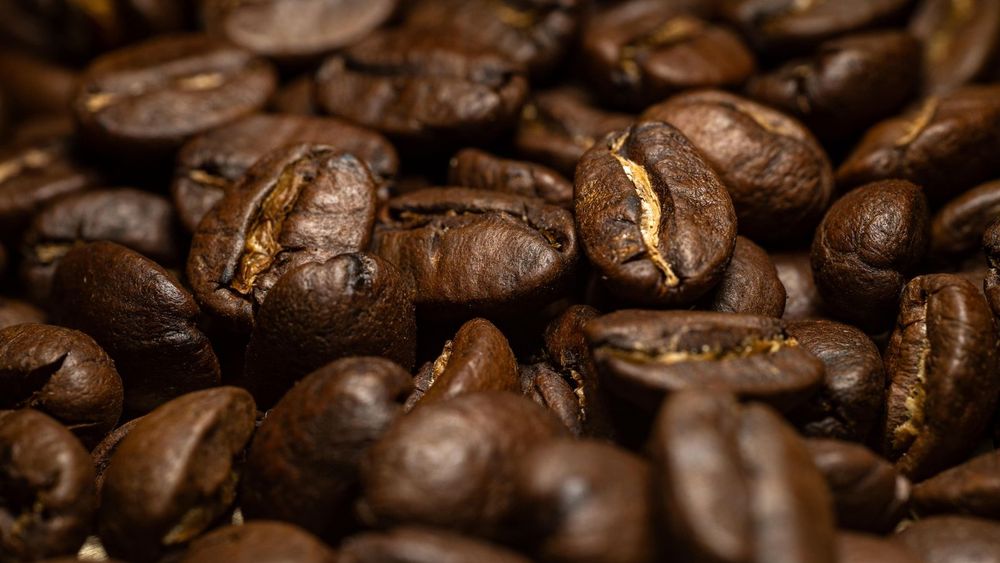
The short answer: According to the Deutscher Kaffeeverband (German Coffee Association), beans lose 11 to 20 per cent of their weight during roasting, so for 250 g of roasted coffee you weigh in roughly 281 to 313 g of green coffee. No source documents in days how long it should rest afterwards. All that is documented is that the beans degas for hours to weeks.
According to the Deutscher Kaffeeverband, roasting means that the beans are heated dry and fat-free with hot air; duration and temperature vary and contribute to the flavour. Almost all the other numbers that circulate in instructions cannot be traced back to a reliable source. This guide therefore gives only what is documented, says who states what where there is a dispute, and keeps our assessment separate from that. No roasting trials or measurements of our own are behind it.
What happens to the bean during roasting
According to Kelly and Scott (2014, conference paper, University of Waikato), green coffee typically starts with 8 to 15 per cent water. The first phase drives out most of it and sets the Maillard reactions in motion.
Then comes the first crack. Water in the cells evaporates, the steam and the roasting gases cannot escape quickly enough, and the internal pressure rises. The beans swell, according to the Deutscher Kaffeeverband they nearly double in volume, and burst audibly as they do so. For lighter roasts you stop here; for darker ones you wait for the second crack.
According to Kelly and Scott, pyrolytic reactions begin after the first crack, and at the second crack the cell walls break open and oil emerges. The authors describe this from the literature; they did not measure it.
The two cracks sound different. Using a microphone on a small roaster, Wilson (2014, Journal of the Acoustical Society of America) showed that the first crack is louder and contains more low-frequency energy, while the second crack has more cracking sounds per unit of time. This supports the idea of telling the phases apart by ear.
That leaves acidity. Anokye-Bempah and colleagues (2024, Scientific Reports) roasted profiles of the same duration but very different dynamics in a 5 kg drum roaster. Total titratable acidity, which correlates strongly with perceived acidity, rose to a maximum by the first crack and fell back to the starting value by the second crack. Total acidity was measured, not individual fruit acids. According to this study, then, roasting longer beyond the first crack breaks down acidity. Whether you like that is something no measurement can decide.
At the end it has to be quick: the association writes that the beans are cooled immediately by air or water. Otherwise they carry on roasting.
Weight loss: how much green coffee to weigh in
The weight loss during roasting is called “Einbrand” in German. The Deutscher Kaffeeverband gives it as 11 to 20 per cent, depending on the roast. The range of 15 to 20 per cent that is often read is narrower than the source.
The calculation here is our own:
| Starting point | at 11 per cent weight loss | at 20 per cent weight loss |
|---|---|---|
| 150 g green coffee gives | 134 g roasted coffee | 120 g roasted coffee |
| 454 g green coffee (1 pound) gives | 404 g | 363 g |
| 250 g roasted coffee needs | 281 g green coffee | 313 g green coffee |
The rule of thumb “250 g finished, so 300 g green coffee” therefore only hits the upper half of the range. For 250 g of roasted coffee, the amount needed differs by up to 32 g depending on the roast level.
Roast levels: what can be documented
The Deutscher Kaffeeverband assigns three levels. A light roast (blonde, mild, cinnamon roast) is suitable for filter preparation, a medium roast for filter or café crème, and a dark roast is ideal for espresso. It says nothing there about the AeroPress, bean-to-cup machines, moka pots or milk drinks. Anyone who reads that anywhere as a rule is not reading a documented one.
What “light” and “dark” mean in measurement terms is set by Agtron values, and the definitions contradict each other:
| Level | USDA (procurement specification, 2004) | Coffee Review |
|---|---|---|
| Light | Agtron 80 to 90 | above 80 |
| Medium-Light | not listed in our source | 70 to 80 |
| Medium | 50 to 60 | 60 to 70 |
| Medium-Dark | 40 to 50 (called “moderately dark” there) | 50 to 60 |
| Dark | 30 to 40 | 40 to 50 |
The same Agtron range of 50 to 60 is called medium by the USDA and medium-dark by Coffee Review. The USDA standard (Commercial Item Description A-A-20213B) is a US procurement specification, not a European standard. According to our guide to coffee beans, the SCA standard for roast level is still in development. You probably do not have an Agtron meter at home, and Kelly and Scott state that colour alone is not repeatable enough to indicate the roast state.
Crack temperatures: a range, not a fixed number
At what temperature do the cracks begin? The figures differ, and that is partly down to where the temperature is measured:
- Wilson (2014) is reported as giving around 200 degrees internal bean temperature for the first crack and around 230 degrees for the second crack. We only know these figures from a summary by Improbable Research; we could not open the full text.
- Vosloo (2017, master’s thesis, North-West University) gives around 175 to 180 degrees for the first crack and more than 200 degrees for the second crack, determined in a model with roasting trials.
- Kelly and Scott write that the measured temperature depends on the roaster and the sensor position and cannot simply be transferred from one roaster to another.
Our assessment: a single temperature figure is no good as an anchor as long as you do not know where its thermometer measured. Listen for the cracks, as Wilson’s measurement makes them distinguishable, and also note the time.
Frying pan, hot air, drum: what the manufacturers write
For the frying pan there is no manufacturer statement, and we also found no source that ranks the methods by quantity, times, evenness or temperature. Manuals are available for two home roasters:
| Detail | Behmor 1600 Plus | Fresh Beans SR700 |
|---|---|---|
| Quantity | at most 1 pound (454 g), beginners start with ¼ pound | measuring cup of 43 cc, filled four times (172 cc), the manual does not give grams |
| Roasting time | roughly 8.5 to 25.5 minutes depending on quantity and profile | not stated in our source |
| Cooling | cooling cycle starts automatically, a fan blows the silverskin (chaff) into the collection tray | cooling mode of 1 to 3 minutes |
| Placement | not outdoors, not in garages either; well ventilated, 46 cm clearance at the exhaust openings | not outdoors, not on or next to the hob |
The manufacturer’s times apply to that roaster and say nothing about the frying pan or other hot-air machines.
We do not judge which route is more even or more laborious, because without a source that would be only an assertion. Our catalogue contains neither home roasters nor green coffee, so there is no editorial recommendation for a machine either.
Step by step: a process with reasons
The steps are our suggestion, derived from the sources above. Times are deliberately left out.
- Weigh the green coffee before roasting. You need the weight to work out your own weight loss. Among the scales in our catalogue, the Bagail and the Maestri House have a 0.1 g step. Hot beans do not belong on the platform.
- Start small. Behmor advises beginners to use a quarter pound, so roughly 113 g. For the frying pan there is no manufacturer figure; our assessment is the same caution.
- Ventilate and stay with it. Behmor requires a well-ventilated environment and prescribes “never unattended”; the SR700 manual forbids opening the lid during roasting.
- In the frying pan, keep the beans moving constantly. This is an assessment, not a source: it gets hot where the bean touches the surface.
- Listen for the cracks. The first crack decides whether you stop for a light roast. Darker means carrying on into the second crack, and that is exactly where Behmor warns against a duration of more than 10 seconds.
- Take notes. Kelly and Scott found no event in the course of the batch that marks the ideal stopping point between the two cracks. It is a decision that you make repeatable with time and notes.
- Cool immediately. With air: beans into a metal sieve, a fan in front of it. This is our suggestion for the air cooling that the association mentions. Expect a hot sieve and a hot pan; that is our assessment and not a source statement on temperature.
- Let it rest and weigh again.
Degassing: why freshly roasted is not ideal straight away
After roasting the beans keep degassing, according to the Deutscher Kaffeeverband for hours, in part for up to two months. According to Smrke and colleagues (2018, Journal of Agricultural and Food Chemistry) the gases are mainly CO2 and weigh 1 to 2 per cent of the freshly roasted coffee; the authors refer to earlier literature here. For 250 g of roasted coffee that is 2.5 to 5 g (our own calculation).
How much and for how long depends on the roast level. Smrke measured arabica whole beans at 35 degrees over at least 400 hours:
| Roast level | Weight loss through degassing |
|---|---|
| light | 2.5 to 2.8 mg/g |
| medium | 4.7 to 6.6 mg/g |
| dark | 8.5 to 11.9 mg/g |
The darker, and the shorter the roasting time at the same roast level, the more gas and the faster. A light-roasted sample was still degassing after 800 hours, at 2 µg per g and hour. 800 hours is a good 33 days. The values come from a laboratory vessel at 35 degrees, not from a kitchen at 20 degrees, and the roasting times of the samples were between 4 and 12 minutes.
Why does the gas matter? CO2 is regarded as an indicator of freshness, influences the extraction process, plays a part in the crema and can change the sensory profile. Smrke calls it a little-studied molecule. The common explanation that filter coffee therefore foams up and espresso channels is not in the abstract or the introduction.
Something follows from Smrke’s valve measurement for storage: in a pack with a one-way valve no significant overpressure builds up, because the gas escapes. A tightly sealed container without a valve holding fresh beans, on the other hand, can build up pressure. That is a deduction from the mechanism; it was not measured in the study. The Kaffeeverband writes that for immediate packaging an aroma valve is used, from which gases escape without oxygen reaching the beans.
And the resting time? Blogs give figures such as 24 to 72 hours for filter and 7 to 14 days for espresso. We found no source for that, and the association names no days either. Our assessment: freshly roasted coffee behaves differently from stored coffee, and how long you wait is a question of roast level and brewing method that you are best placed to settle yourself. To do so, brew several days in a row using the same recipe, keeping the amount of coffee and water constant, and note when you like the coffee.
Storage: green coffee and roasted coffee
Green coffee does not keep for a year or longer as a general rule. Gallego and colleagues (2025, International Journal of Food Science) stored arabica for 365 days in eight kinds of packaging at four locations. At the location with constant temperature and humidity (Alto de Letras), the total SCA score was maintained all year in four plastic packagings (PE-EVOH, PE-PAV, PE-double, PP-PVC), but not in the natural-fibre packaging Fique. In Santa Marta, warmer and more humid, the score was impaired after 60 days, in the cold room after 240 days, and in Chinchiná it fell over the whole period. Shelf life depends on packaging and climate.
The Deutscher Kaffeeverband describes roasted coffee like this: light, warmth, oxygen and foreign odours have a negative effect on the aroma. With an opened pack, a change can be tasted after four weeks at the latest. A light-proof, airtight container is recommended for the opened pack. This refers to bought packs that have been opened, not freshly roasted beans in the first days, for which the degassing above applies.
Safety: heat, smoke and acrylamide
The manuals are clear. Behmor: never operate unattended, because coffee beans can ignite like any food. Not outdoors, not in garages either, not with an extension cable, no green coffee with a lot of chaff. SR700: not outdoors, not on or next to a hob or burner, for household use only, do not touch hot surfaces.
This contradicts the widespread advice to move roasting outdoors. For these two machines it is wrong, and for the frying pan there is neither permission nor prohibition. We therefore give no blanket recommendation: what the manual of the machine in question says applies. Behmor also requires a correctly inserted chaff tray.
With acrylamide, it shows how little can be deduced from rules of thumb. The BfR (German Federal Institute for Risk Assessment) writes that since acrylamide is formed during roasting, coffee is also affected. It forms from about 120 degrees and rises sharply from about 170 to 180 degrees. According to the BfR there is no health-based guideline value because of its genotoxic and carcinogenic properties. The BfR’s rule of thumb, the more browned, the more acrylamide, applies to baked goods and potato products.
For coffee it is the other way round. Engelhardt, Bahar and Delker (2023, Beverage Plant Research) roasted robusta from Vietnam and arabica from Brazil with tangential, drum and hot-air roasting in three profiles each. Acrylamide was highest in light roasts and fell with longer roasting time. Furan and methylfurans were low in light roasts and highest in dark ones. Lowering both at the same time succeeded neither through the profile nor through pretreatment. These were industrial roasters, not home machines, and the levels in the drink also depend on preparation. Whether this carries over to the frying pan or hot air is an assumption.
We found no measurements on home-roasted coffee. So the studies allow neither an all-clear nor a warning.
Problems: what you observe and what may be behind it
Causes are given only where a source supports them. What we derive from the mechanism or estimate is labelled as such in the row.
| Observation | possible cause | what you change |
|---|---|---|
| Beans smoke heavily | With the Behmor 1600 Plus, heavy smoke is the signal to cool immediately. | Cool. For other machines, their manual applies. |
| Beans catch fire | Too long in the second crack: Behmor prescribes never roasting more than 10 seconds into it, after that the beans could ignite. | Switch off, pull the plug, keep the door closed, no water (Behmor manual). Stop earlier next time (deduction). |
| Roasted coffee weighs less than calculated | The weight loss is 11 to 20 per cent depending on the roast (Kaffeeverband). | Note the weight before and after roasting and plan with your own figure. |
| The coffee tastes different freshly roasted than after a few days | Degassing: according to Smrke and colleagues, CO2 can influence the sensory profile, and a light-roasted sample was still degassing after 800 hours at 35 degrees. How this shows in the taste is not documented. | Brew several days in a row using the same recipe and take notes (deduction). |
| You find too little acidity | Total titratable acidity fell back to the starting value between first and second crack in a 5 kg drum roaster (Anokye-Bempah 2024). | Stop closer to the first crack (deduction; transferring it to home roasters is an assumption). |
| The cracks are hard to tell apart | Wilson heard the first crack louder and lower in frequency, and in the second crack more cracking sounds fall per unit of time. He measured on a small roaster. | Write down the time while listening. Temperature figures do not help if the measuring point and roaster do not match (Kelly and Scott). |
| Uneven, too light or too dark | For the frying pan and hot air, no cause is documented. | Our assessment: smaller quantity, keep the beans moving, note every batch with its time. According to Kelly and Scott, colour alone is not repeatable enough. |
Roast it yourself or buy it ready roasted?
We cannot document a statement about price. You can do the sums yourself: roasted coffee costs 1.12 to 1.25 times the green coffee price per kilo, because the weight loss has to be paid for as well. With an assumed green coffee price of €10 per kilo (worked example, not a market price) that comes to €11.24 to €12.50. On top of that come your machine and your time.
If you would rather buy it ready roasted, our guide to grind size helps with grinding after the resting time. The Kaffeeverband explains why grinding shortly before brewing makes sense: it breaks open the cells, releases volatile aromas and a large part of the carbon monoxide and carbon dioxide, and the finer the grind, the more aroma compounds dissolve during brewing.
What we cannot document
Gathered together so that the gaps are not scattered through the text:
- Temperature ranges in degrees per roast level, in no source of the hierarchy.
- Resting times in days for filter and espresso.
- Quantity, times and evenness when roasting in the frying pan.
- A price comparison between green coffee and roasted coffee.
- Measurements of acrylamide, furan or smoke gases in home roasting.
- Roasting time and gram quantity of the Fresh Roast SR800, as well as manuals for Gene Café and Kaldi.
- Statements by the Deutscher Kaffeeverband on the shelf life of green coffee and on home roasting.
The sources are current as of 14 October 2026. We took the Agtron values from Coffee Review from the fact file for our guide to coffee beans (Coffee Review, Roast Definitions, checked there on 5 and 6 October 2026).