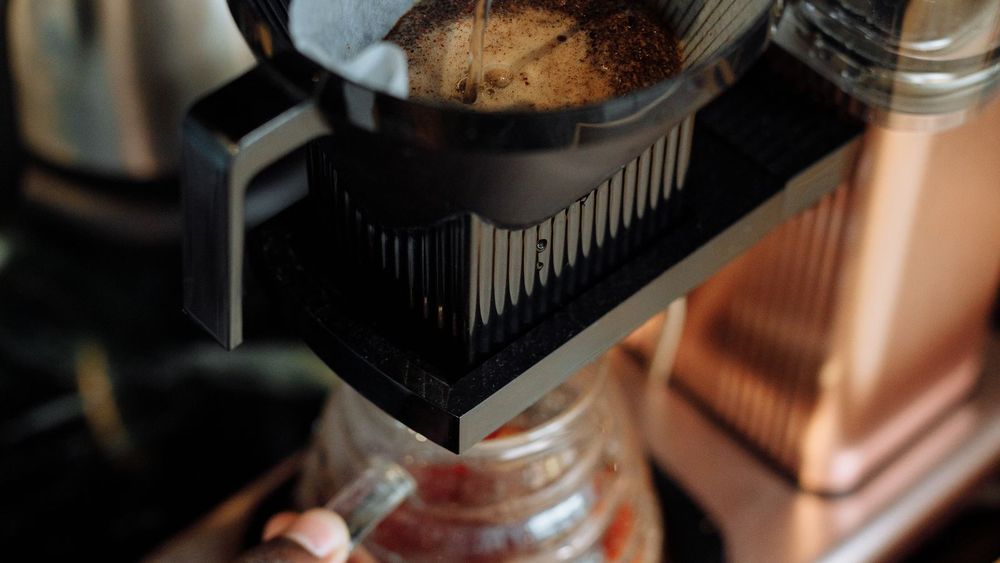
The short answer: Brew hot straight onto ice. The AeroPress recipes for iced coffee work with 1:15 to 1:16 total water, ice included, and an ice share of 33 to 47 percent. Our assessment for getting started: 40 percent ice, 60 percent hot water.
Iced coffee is a broad term. The Duden (German dictionary) defines it as “coffee with ice cream and cream”, without quantities and without saying whether the coffee comes from a filter or an espresso machine. In 2016 the Deutscher Kaffeeverband (German Coffee Association) presented six recipes from around the world: café con hielo (fresh, sweetened espresso over ice cubes), mazagran (sweetened filter coffee with ice cubes and a splash of alcohol), affogato, cà phê sữa đá, cherry bomb with cold brew, tonic water and cherry syrup, and one more. A German-style recipe with vanilla ice cream and cream was not among them.
This guide covers what is brewed hot and chilled afterwards. Coffee extracted cold is covered in the guide Cold brew at home. The line is drawn by Claassen et al. (2021): there is no definition of cold brew, and the authors suggest calling only cold-extracted coffee by that name. Hot-extracted coffee should never be called cold brew. So flash brew and Japanese iced coffee are not cold brew.
Flash brew with a pour-over dripper: the method
The principle: part of the water is already in the jug as ice, and the rest runs hot through the coffee bed. The brew is therefore more concentrated than normal filter coffee and is diluted and chilled when it hits the ice. The steps are our suggestion, derived from the information from AeroPress and Hario; the pouring amounts come from us. Example with 30 g of coffee at 1:15, so 450 g of total water:
- Insert a paper filter and rinse it with hot water over the sink. If the rinse water runs into the jug first, ice melts there before you have even started brewing.
- Put the jug on the scale, weigh in about 180 g of ice and tare to zero. The ice is part of the recipe quantity, which is why it is weighed and not estimated.
- Put 30 g of coffee in the filter and shake the bed flat so that the water runs through evenly.
- Pre-wet with about 60 g of hot water until all the grounds are wet, and wait until the foaming subsides.
- Keep pouring in two to three portions up to 270 g of hot water, in circles, without flooding the edge.
- Swirl the jug until the ice has melted and pour into a glass. If ice is left over, it may stay in the glass.
Every manufacturer names times differently. Hario UK gives about 2.5 minutes for the hot V60, and the AeroPress recipes come to two to four minutes including steeping and pressing. We therefore do not prescribe a time of our own. More important than the clock is that, once the water has run through, the amount of water in the jug is the amount you weighed in.
Why the ice counts towards the water
Coffee grounds hold back water. Guinard et al. (2023) assume in the Journal of Food Science an absorption ratio of about 2.1 g of water per gram of coffee, a model value that varies with grind size and roast. With 30 g of coffee, about 63 g stays in the wet grounds, and of 450 g of total water, 387 g end up in the glass once the ice has melted completely. The amounts in the table further down are calculated with this formula.
That the ice counts towards the water quantity follows from the heat. A rough calculation of ours, only approximate: 207 g of hot water at 94 °C (that is what the jug reaches with 270 g of infusion) carry about 81 kJ of heat, calculated with the specific heat of water, 4.184 J per gram and kelvin (NIST Chemistry WebBook). Melting 180 g of ice takes about 60 kJ if you use the textbook value of about 334 J/g for the enthalpy of fusion; we did not open a primary source for it. The remainder warms the 387 g to at most about 13 °C.
Losses at the dripper, jug and air are not taken into account, so in reality some ice is more likely to be left over. With 33 percent ice the calculation would give about 27 °C, and with 47 percent the ice does not melt completely. The calculation shows why shares of around 40 percent are plausible.
On aroma, the manufacturers claim more than can be documented. Hario writes of the V60 Iced Coffee Maker that the ice chills the coffee instantly, even with hot water. In the Iced Flash Brew recipe, AeroPress says it extracts a lot from the coffee while preserving aroma compounds. Both are product descriptions. We found no study that compares flash chilling with slow cooling, neither at Europe PMC nor at PubMed (search on 14 October 2026).
A simpler reason why cold coffee can smell flatter is provided by aroma release. Steen et al. (2017) examined in Food Chemistry six serving temperatures from 31 to 62 °C for one type of coffee and found that the release of volatile aroma compounds increases sharply above 40 °C. Iced coffee, at around 5 to 15 °C, lies below that range and was not studied, nor was the perception of smell in the cold. It is plausible that the trend continues downwards: less aroma released, even without anything having been lost beforehand. That is an extrapolation of ours.
The numbers and who names them
There is no standard for iced coffee. The SCA standard 310-2021 applies to electric household filter machines and explicitly excludes manual pour-over, French press, espresso and capsule machines; iced coffee does not appear in it. Its numbers serve as a point of comparison, not as a specification. The original PDF could no longer be retrieved on 12 October 2026; we read a Wayback copy.
| Variable | Source and figure | Our starting point |
|---|---|---|
| Ice share of total water | AeroPress Inc.: 47 percent (20 g coffee, 170 g hot, 150 g ice), 40 percent (16 g, 150 ml, 100 g) and 33 percent (20 g, 200 g, 100 g); Hario UK: 300 g ice in the ice chamber of the V60 Ice Coffee Maker, no percentage | 40 percent |
| Total ratio including ice | AeroPress recipes by our calculation 1:15.0 to 1:16.0; Hario UK hot V60 1:16.7 (15 g to 250 ml); Kalita according to our German review 1:16 (20 g to 320 g); SCA 310-2021 for filter machines 55 g/kg, that is 1:18.2; Deutscher Kaffeeverband 7 to 10 g per 125 to 150 ml, so 1:12.5 to 1:21 | 1:15 |
| Water temperature | AeroPress 88 to 96 °C (cooler for dark roasts, hotter for light), 94 °C and 99 °C; Hario UK 92 to 96 °C in the brew guide, 92 to 94 °C in the blog; Deutscher Kaffeeverband 88 to 95 °C, not above; SCA 90 to 96 °C for machines | 93 °C |
| Grind size | AeroPress: medium-fine in two recipes, fine in the recipe with 16 g; Hario UK hot V60: medium to fine; grinder charts (example Sage): filter medium to medium-coarse, without iced coffee | medium-fine |
On the ice share: the calculation from the three AeroPress recipes shows that 40 percent is not a law but the middle between 33 and 47 percent. The energy balance above gives complete melting at 40 percent, but not at 47 percent. If you work with less ice and a somewhat stronger brew, you stay within the manufacturer’s range.
On temperature: only AeroPress gives an ice-specific figure. Batali et al. (2020) found in Scientific Reports that, with strength and extraction yield held constant, 87, 90 or 93 °C did not noticeably change the profile of filter coffee. The study concerned drip coffee served at 65 °C, not iced coffee. So temperature is not a hard requirement as long as strength and extraction yield are right, and 93 °C lies within all the ranges mentioned. Medium-fine for the grind size is our assessment based on the AeroPress and Hario information.
Worked example in the AeroPress pattern
The table works with 1:15 and 40 percent ice. It is a worked example of ours. The glass amount is total water minus 2.1 times the coffee, calculated in grams; the density of coffee is simplified to about 1 g/ml.
| Coffee | Total water | Ice | Hot water | In the glass, approx. |
|---|---|---|---|---|
| 15 g | 225 g | 90 g | 135 g | 194 g |
| 20 g | 300 g | 120 g | 180 g | 258 g |
| 30 g | 450 g | 180 g | 270 g | 387 g |
| 40 g | 600 g | 240 g | 360 g | 516 g |
For other ratios, work it out the same way: you subtract the ice from the total water yourself.
Two AeroPress recipes show how far the variants lie apart. In the “Japanese Inspired Iced Coffee”, 16 g of coffee steep with 150 ml of water at 94 °C for two minutes, then it is pressed for 30 seconds and the carafe is swirled until the ice has melted. In the “Iced AeroPress Flash Brew”, the coffee is first pressed onto 100 g of ice in the carafe, preferably one large cube; the chilled coffee then goes onto fresh ice in the glass. The manufacturer’s reasoning is that the pre-chilled coffee melts the new ice slowly. This has not been measured; it is a manufacturer’s statement.
The ice chamber route and machines with an ice programme
With the V60 Ice Coffee Maker (Fretta), Hario takes a different approach: 300 g of ice go into the ice chamber of the dripper around the outlet, the paper filter is wetted beforehand, then the water is poured in circles, according to Hario with the same method as for the V60. The product page gives no ratio of coffee to water. According to our German review, the Hario V60 Starter Set is a plastic dripper without an ice chamber; the ice device is a different product and is not in our catalogue.
Making flash brew with the AeroPress departs from the standard recipe. According to the manufacturer’s recipe (as stated in our German review of the AeroPress Original), it is 85 °C (80 °C for dark roasts), a medium-fine grind and 60 seconds steeping, and with a truly medium-fine grind you may press after just 30 seconds; the ice recipes are at 88 to 99 °C. According to our German review, the AeroPress Go explicitly lists iced coffee as a use; it does not deliver milk foam. The Kalita Wave 185, which Kalita calculates at 20 g to 320 g of water, also comes into question as a dripper for flash brew. Its suitability for this is our assessment.
Bean-to-cup machines chill nothing; the glass supplies the ice. The Philips LatteGo 5500 has eight iced variants among 20 coffee specialities; Philips advises brewing over ice cubes, with the glass two thirds full of ice, at aroma strength 3. According to our German review, the product page says the brewing system is calibrated so that iced coffees taste like hot drinks; that is a manufacturer’s statement. The Philips LatteGo 5400 has no iced drinks on its list, and our German review points to the 5500 series for iced coffee at the press of a button.
Among the De’Longhi machines, the Magnifica Plus offers two cold coffees (Cold Coffee and Cold Americano), selectable as Iced or Extra iced; the machine suggests the number of ice cubes. The Dinamica Plus 380.95 has an iced coffee among the 12 coffee and water recipes of its 24 drinks. The Rivelia comes with Cold Coffee, Cold Espresso and Cold Americano without accessories. On the La Specialista Touch EC9455, the cold brew programme uses cold or room-temperature water with a longer infusion and runs in under five minutes; according to the instructions, three ice cubes go into the glass for a single, five for a double.
The Ninja Luxe Premier and the Luxe Pro brew filter coffee classic, strong, over ice and as cold brew. According to the instructions, the temperature selection does not apply with “Over Ice”, cold brew and cold press. The Premier has seven sizes from 175 to 530 ml.
Espresso over ice, iced latte and espresso tonic
Espresso over ice appears as café con hielo among the Kaffeeverband’s six recipes from 2016. We stay with the manufacturer recipes we found. An iced americano is espresso with cold water over ice.
Nespresso UK describes the iced latte for the Original machine with 40 ml of Barista Creations Freddo Intenso, 90 ml of cold-frothed semi-skimmed milk and four ice cubes, and for Vertuo with 80 ml of Ice Leggero, 80 ml of milk and four ice cubes. With the Nespresso Aeroccino 4, the iced cappuccino consists of 40 ml of coffee and 60 ml of cold foam, the iced latte macchiato of 40 ml of coffee and 120 ml of cold foam with three large ice cubes; for the iced cappuccino, our German review gives no number of ice cubes. The Aeroccino 4 does not froth more than 120 ml of milk. Increasing the amount of milk to taste for a larger iced latte is our assessment.
There is a pointer on fat. Mahmud et al. (2021) had 231 people rate nine iced coffee drinks made from instant coffee and cream: liking rose with fat and coffee concentration up to a point and fell after that, and three groups with different preferences formed. This cannot be transferred to flash brew. On milk, the Kaffeeverband says it can mask unwanted acids or bitter compounds, and that with too much milk the fine flavour is lost.
For espresso tonic, a health note applies. The Bundesinstitut für Risikobewertung (BfR, German Federal Institute for Risk Assessment) describes tonic and bitter lemon drinks as containing quinine. In Germany, according to the BfR’s 2005 statement, non-alcoholic soft drinks may contain at most 85 mg of quinine per litre; we have not checked against the current legal provision whether the value still applies today. According to the BfR, pregnant women should avoid it as a precaution. The BfR also advises avoiding it with tinnitus, optic nerve damage, certain forms of haemolytic anaemia and quinine hypersensitivity, and with heart rhythm disorders or anticoagulant medication only after consulting a doctor. No specialist source we found documents quantities or the order of pouring, so we do not give any.
There are dedicated devices for cold milk foam on iced coffee. The WMF Stelio Induktion froths cold after two presses, according to WMF especially for frappé, cocktails, iced coffee or desserts. The Severin SM 3586 has a cold programme, and the WMF Lono Silk needs 150 to 350 ml of milk for cold and hot foam alike. With the Philips Senseo Milk Twister, cold foam is made by pressing for three seconds; Philips lists iced coffee as a recipe in the data sheet.
What cannot be documented
For this guide we did not find the following. The Deutscher Kaffeeverband gives no quantities for espresso or filter coffee over ice. For the iced americano and the espresso tonic there is no manufacturer recipe with quantities. A study on roast level and iced coffee is missing, as is a measurement of whether a different ice share at the same total water shifts strength or extraction yield. No source claims that flash brew needs a finer grind, and there is no ice recipe from Kalita. Where these gaps matter, the assessment is given in the relevant section.
Troubleshooting
Watery: The cause is usually more water than planned, for example ice that only goes into the finished drink after brewing or that was not weighed in. Weigh the ice and subtract it from the total water. A large cube has less surface than crushed ice and therefore melts more slowly; in the Iced Flash Brew, AeroPress relies on a single large cube.
Weak despite the right amount: Then it comes down to the strength of the brew. According to Batali et al. (2020), brew strength and extraction yield determine the profile. More coffee for the same amount of water raises the strength, so 1:15 instead of 1:16.
Sour and thin: The directional rule is in the guide Coffee grind size: grind finer. That is not a law, because according to Guinard et al. (2023) acidity can also occur at high brew strength and low extraction yield.
Bitter and dry: Grind coarser. Change only one variable per run, otherwise you do not know which one worked. Temperature is the weaker lever for this, see above.
Flat in smell: This can additionally be due to lower aroma release in the cold (Steen et al. 2017, who studied only 31 to 62 °C), not to the preparation alone. Keeping warm is a different case: Batali et al. (2023) found rising acidity when light and medium roasts were kept warm for up to three hours and suspect the loss of volatile aroma compounds. The Kaffeeverband writes that freshly brewed coffee should be drunk soon, otherwise it tastes bitter. Both concern keeping warm, not cooling on ice.
Which bean suits
There are partial findings on roast level: titratable acidity reaches its maximum in roasting at first crack and falls to the starting value by second crack (Anokye-Bempah et al. 2024); acidity and bitterness respond to brew strength and extraction yield at each roast level (Frost et al. 2020). So acidity can be changed not only through a different bean. In the ice recipe, AeroPress advises the cooler temperature for dark roasts and the higher one for light roasts, within 88 to 96 °C.
Our assessment: if you are making flash brew for the first time, take a bean you know as filter coffee and change only the ice. Then any deviation in the glass can be traced back to the preparation.