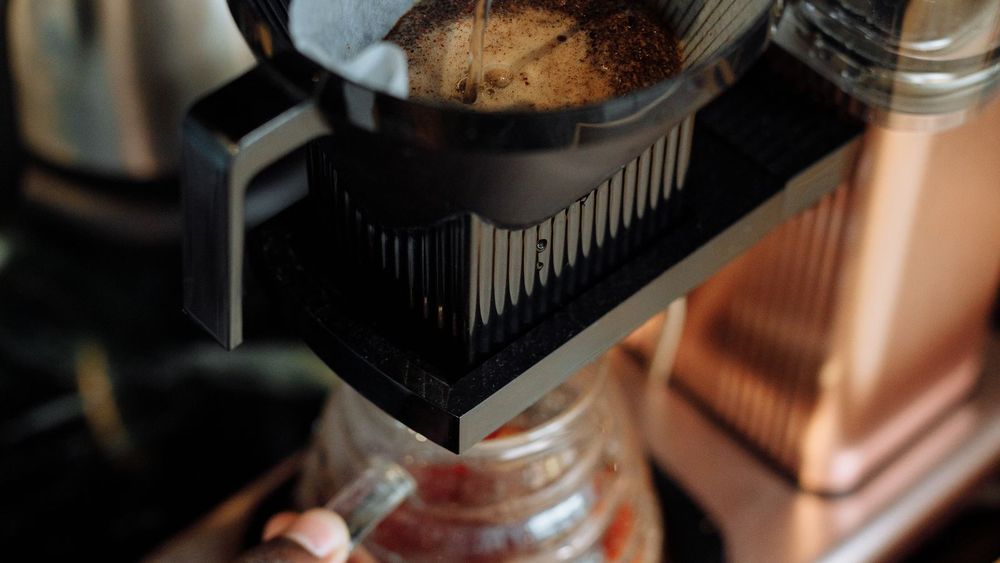
The short answer: Which dripper you choose changes the cup less than ratio, time and grind size: according to Santanatoglia et al. (2023), these are the variables that most strongly influence the content of compounds in the cup. Between V60, Kalita Wave, Chemex and Melitta there is no sensory comparison with the same recipe. Our assessment for getting started: the V60 Starter Set, because it is the cheapest dripper in our catalogue.
The designs at a glance
The table reproduces what the manufacturers themselves write. Where a cell says “no information”, the manufacturer has published nothing on it, and we have added nothing.
| Filter | Design according to the manufacturer | Grind according to the manufacturer | Time according to the manufacturer | Paper |
|---|---|---|---|---|
| Hario V60 | Cone with a 60 degree opening angle, spiral ribs, one large hole | medium-fine (Hario UK, expert guide) | around 2.5 minutes (Hario UK), within 3 minutes (Hario Global) | V60 paper 01, 02, 03 |
| Chemex | Carafe and filter in one, air channel in the spout | medium-coarse | no information | own bonded filters |
| Kalita Wave | Flat bottom with three holes, wave filter with 20 waves | medium-coarse, like sea salt | 2 to 3 minutes draw-down, after a 30 to 45 second bloom | Wave filters 155 and 185 |
| Melitta pour-over dripper | two outlets, ribs, plastic or porcelain | no information | no information | filter bags 102, 1x4, 1x6 |
| Hario Switch | V60 cone with a valve, immersion and drip-through | medium (manual), to be adjusted yourself | around 2 minutes steeping, then the lever | V60 paper 02 |
| Reusable filter (Hario Double Mesh, Bodum Pour Over) | stainless steel mesh instead of paper | Bodum: medium grind | Bodum: about 4 minutes | none |
Four of these designs have no moving parts: V60, Wave, Chemex and the Melitta dripper. The exception is the Switch. It sits on a silicone base, the switch is made of PCT resin, there is a stainless steel ball inside, and according to our German review, taking it apart and rinsing the parts individually is part of the daily routine. If you do not want that, pick one of the other four. Hario gives 200 ml as the finished quantity per brew.
What the draw-down depends on
Santanatoglia et al. (2023, Antioxidants) compared eight filter coffee preparations with three coffee types. They name the amount of water, the extraction time and the particle size as the most important parameters, and say that the recipes are key factors, not the device alone. They measured acrylamide, chlorogenic acids, caffeine and antioxidants, not flavour values. In line with this, Chemex, Hario and Kalita attribute the draw-down to the grind size in their FAQs and recipes.
The design still plays a part. Moroney et al. (2019, PLoS ONE) calculated for a cone-shaped coffee bed with a 60 degree opening angle: the flow there departs clearly from one-dimensional flow, and local extraction varies strongly. This is a simulation, calculated for the cone and not measured. It compares no brands and no flat bed, so it only supports the statement that the geometry of the bed affects evenness.
What the manufacturers say about their own designs is manufacturer information without measurement. Hario describes the cone as a shape that allows a thicker layer of coffee and guides the water to the centre. The spiral ribs keep the paper away from the wall, the one large hole does not slow the water, and the extraction comes close to that of a cloth filter. Kalita writes that the base of the wave zone is flat, so water poured in from one side also wets the grounds evenly. With the Kalita three-hole design, the liquid does not stay long in the filter and wave zone, so fewer off-flavours are dissolved.
The counter-example belongs here too: with the 102 and 103 drippers, Kalita offers straight cones with three holes. “A cone means one large hole” is therefore not a rule. Our assessment: the manufacturers’ arguments are plausible, but a comparison with the same recipe is missing.
Brew ratio, temperature and time
For almost every figure there are several recommendations, and they partly contradict each other even within one manufacturer. We calculated the ratios in the table ourselves from the gram and millilitre amounts in the sources.
| Source | Ratio | Temperature | Time |
|---|---|---|---|
| Hario UK, V60 02 | 15 g to 250 ml, so 1:16.7 (60 g/l) | 92 to 96 degrees | around 2.5 minutes |
| Hario Global | bloom with twice, three pours with four times the coffee amount, calculated 1:14 | not recorded | within 3 minutes |
| Kalita USA | 20 g to 320 g, 1:16; recommended range 1:16 to 1:18 | 195 to 205 Fahrenheit (around 90.6 to 96.1 degrees Celsius) | 2 to 3 minutes after the bloom |
| Chemex | one heaped tablespoon per 5 oz cup (according to our German review), no grams | no information | no information |
| Deutscher Kaffeeverband (German Coffee Association) | 7 to 10 g per 125 to 150 ml, around 47 to 80 g/l | 88 to 95 degrees, not boiling | not recorded |
| SCA 310-2021 | 55 g per kg of water (1:18.2), machines only | 90 to 96 degrees in the bed | no brew time specified |
Two things stand out. Hario Global and Hario UK are far apart at 1:14 and 1:16.7, and the Global page gives no overall ratio; it only follows from the pours. The SCA standard 310-2021, in turn, expressly applies to electric household filter machines and not to manual pour-over. Its 55 g per kg are certification conditions for machines, not a recipe recommendation for the dripper.
On temperature, Batali et al. (2020, Scientific Reports) show something unexpected: at 87, 90 and 93 degrees the sensory profile did not change noticeably as long as TDS and extraction yield stayed the same. That was a drip machine with one Arabica and trained panellists, not manual pour-over. Temperature therefore mainly acts through how much dissolves.
Our assessment: we would start with 15 g of coffee to 250 g of water (60 g/l) and with water between 92 and 95 degrees, because that is the range where Hario UK, Kalita and the Kaffeeverband overlap. A time window of 2 to 3 minutes works, as at Hario and Kalita. After that, you change one variable per brew. For comparison with a machine: Moccamaster calculates 75 g to 1.25 l for the full pot, also 60 g/l (Moccamaster KBG Select).
V60 or Chemex: what the paper changes
Chemex advertises its bonded filters with “20-30% thicker paper than most of the competition”. It does not say which measure is meant, thickness or basis weight, or which competitors, so the figure counts only as a Chemex claim. The manufacturer credits the paper with removing fats, bitterness, acidity and sediment.
The scientific literature paints a more precise picture. Urgert and Katan (1997, Annual Review of Nutrition) explain that cholesterol-raising diterpenes are dissolved by hot water but retained by the paper filter. Rendón et al. (2017, Food Research International) measured this: of the cafestol in roasted coffee, 12.41 percent stayed in the paper filter, 87.45 percent in the spent grounds and 0.15 percent in the drink. The statement “the paper holds back the fats” is therefore simplified; the main store is the spent grounds. Rendón et al. (2018) found high fat permeability in papers of different origin, and higher values in filters with micro-perforation. Paper porosity and particle size determined the result; the study does not name brands.
Whether a V60 cup tastes “fuller” and a Chemex cup “cleaner” is not documented by any study we found. Anyone who reads that is reading experience or manufacturer description. Chemex does not say that the Chemex slows the draw-down either: the FAQ attributes slow draining to grounds that are too fine and clog the paper, or to a spout sealed by the paper. That is why three layers of paper belong on the spout side. During brewing the spout serves as an air channel, and the layers stop the paper from falling into it.
The Chemex Karaffe 6 Tassen (6-cup carafe) is made of borosilicate glass and holds 30 oz, which converts to around 887 ml. As a dose, Chemex gives one heaped tablespoon per 5 oz cup, but neither temperature nor time.
Which is more forgiving: V60 or Kalita Wave?
Kalita describes the Wave as even and suitable for beginners, even when pouring from one side. That is a manufacturer position. We found no independent study on pouring errors or on how suitable a flat bed is for beginners, and Moroney et al. (2019) says nothing about the flat bed.
Our German review of the Kalita Wave 185 takes a different angle. It lists the Wave not as a starter device but as a second purchase: the dripper is supplied on its own, a server, scale and kettle are extra, and according to Kalita only Wave filters 185 fit. A trapezoid or cone filter from the supermarket shelf does not sit there. The stainless steel Wave 185 has a guide price of about €49.14 and a score of 8.4.
The Hario V60 Starter Set costs about €24.87 and has a score of 8.6. On pouring, Hario says: pouring quickly gives a milder taste, pouring slowly a stronger one. But with the V60 too, grind size is an adjustment screw; Hario advises a finer grind if the coffee is too weak, and a coarser one if it drips too slowly. Our assessment: if you want to start small, the V60 Starter Set is the cheaper route. If you already have a scale and kettle and consider even wetting important, you can stay with the Kalita Wave 185. Hario gives no dishwasher approval for the Starter Set, so we advise hand washing.
Grind size when you change filters
The manufacturers are not in line here. Hario UK gives medium-fine for the V60, Kalita medium-coarse like sea salt, Chemex medium-coarse. Grinder makers classify it similarly: the Baratza Virtuoso+ (scale 1 to 40) gives setting 15 for the V60, 18 for the filter machine and 20 for the Chemex; the Encore ESP gives 25, 28 and 30. On the Comandante C40, pour-over sits between 18 and 35 clicks, depending on dose and brewer; the Fellow Opus gives 5 to 9 for pour-over, the Wilfa Uniform 14 to 28. For Baratza, this supports “Chemex somewhat coarser than V60”. There is no standard: DIN 10765 and ISO 23134 are measurement procedures, not grind size steps. Which setting on your grinder is meant is covered in our guide on setting the grind size.
Here is how to proceed when you switch:
- Fix the recipe. Same bean, same amount, same water, only the filter changes.
- Time it, from the first pour to the last drop. Reference values exist only for V60 and Kalita; for Chemex and Melitta you have to build your own reference.
- Change one variable per brew, and change the grind size first.
- Apply the manufacturers’ rules of thumb. Chemex: if the coffee runs through too fast, the grind was too coarse; if the filter floods, it was too fine. Hario: weak means finer, slow means coarser.
- Note two lines: grind setting and time. After three to four cups you have the recipe for the new filter.
Filter paper: sizes, folding, rinsing
The sizes are not interchangeable. Hario assigns the VCF-01 paper one to two cups, the VCF-02 one to four (not two to four) and the VCF-03 one to six, each in White and Natural and made in Japan. Kalita offers the Wave filter 155 for one to two people and the 185 for two to four. Chemex offers pre-folded circles and squares as well as unfolded circles (FP-1) and half-moons (FP-2, FP-2N).
Melitta has taken the original 1x2 filter bag out of its range. There is the 100 for a single portion, the 102 for up to two cups, the 1x4 for around four and the 1x6 for up to six cups. The 102 is slightly taller and has a narrower angle, but fits holders made for the earlier 1x2. There is also a Pour-Over line in 1x2 and 1x4: on 14 October 2026 the Melitta shop listed it at 40 pieces each for €4.39 and €4.69. Melitta advises folding over the bottom and side seams (about 15 mm and 7 mm for the 102), inserting the filter and pressing it lightly against the wall.
Rinsing is disputed. Hario UK and Hario Global recommend it: it takes away the paper smell and warms the dripper and cup. Kalita adds that it stabilises the brewing temperature. Chemex calls pre-rinsing “not a required step”; those who do it can rinse away fibres and warm the carafe, and must pour out the water before brewing. None of them gives a measurement of the paper taste. Our assessment: rinsing costs a few seconds and warms the device, so we make it a habit without selling it as a duty.
Material and reusable filters
Kalita USA offers the Wave in glass, stainless steel and ceramic, with ceramic only in the 185. On plastic, Kalita writes that it is inexpensive, durable, dishwasher safe and needs less preheating than glass or stainless steel.
The reusable filter replaces the paper with metal mesh. The Hario Double Mesh Metal Dripper comes as the DMD-01 for one to two cups and the DMD-02 for one to four cups, made entirely of stainless steel. According to Hario, the oils run through the fine mesh, which gives a “rich flavour”. For the AeroPress, AeroPress Inc. describes paper as the way to a “fairly clear flavor and a light body” and stainless steel as a heavier, thicker texture, similar to French press.
The Bodum Pour Over 1 l has a permanent filter of stainless steel mesh, a polypropylene frame (up to 120 degrees according to the instructions), a medium grind and, according to Bodum, about four minutes of draw-down. So the coffee touches plastic there. The mesh lets more coffee oil and fines through than paper does; that is an inference from the design.
A taste comparison does exist, though. Santanatoglia et al. (2023, Foods) compared V60 and AeroPress (paper) with Pure Brew and French press (metal). The paper samples had more caramel- and flower-related compounds, the metal samples more fruity and roasted ones. But the grind sizes were 945 µm (V60), 800 µm (AeroPress), 1290 µm (French press) and 1030 µm (Pure Brew), and the recipes differed. The effect cannot be attributed to the filter alone. Across eight preparations, Santanatoglia et al. (2025) found clearly less cafestol and kahweol in paper-filtered methods than in unfiltered ones.
Typical problems
| Symptom | Manufacturer’s advice | Source |
|---|---|---|
| Coffee too weak | grind finer | Hario UK |
| Water drips through too slowly | grind coarser | Hario UK |
| Chemex filters too fast | grind less coarse | Chemex FAQ |
| Chemex filters slowly, filter floods | grind coarser, check paper layers at the spout | Chemex FAQ |
| tastes bitter | coarser next time | Kalita USA |
| tastes sour | slightly finer | Kalita USA |
This is the manufacturers’ rule of thumb, and it matches the classic assignment of the Brewing Control Chart: acidity at low extraction yield, bitterness at high. Batali et al. (2020) found something different. Bitter, astringent and viscous increased with TDS, with no significant relationship to extraction yield. Sour, citrus and berry increased with TDS and decreased with rising extraction yield. The authors note that this departs from the classic chart, which places bitterness at high extraction yield. Here too: one drip machine, one Arabica.
Our assessment: the manufacturers’ rules are good as a starting point for an experiment, but not as a diagnosis. Change the grind size by one step, look at the time, then change nothing more. On the role of pouring speed, Hario says only this: quick is milder, slow is stronger.
Which device suits you
The prices are the guide prices from our price box on Amazon.de, and the scores are those of our German reviews.
| Device | Guide price | Score | What else you need |
|---|---|---|---|
| Hario V60 Starter Set | about €24.87 | 8.6 | Scale, grinder, kettle |
| Kalita Wave 185 | about €49.14 | 8.4 | Server, scale, kettle, Wave filters 185 |
| Chemex Karaffe 6 Tassen | about €56.67 | 8.9 | Bonded filters, scale, kettle |
| Hario Start Stop Dripper Set | about €54.46 | 8.7 | Scale, kettle |
| Bodum Pour Over 1 l | about €58.38 | 7.6 | Scale, kettle |
The Start Stop Dripper Set is the Switch: 300 ml server, 40 sheets of V60 paper 02 in the box, contact time via the lever instead of via the grind size. It costs more than double the V60 Starter Set. According to the manual the product is dishwasher safe; we advise taking out the ball first and rinsing by hand, so the small part does not get lost.
For one cup, the V60 01 and the Wave 155 are intended; for a pot for two to four people, the Wave 185, the Chemex or the V60 02. If you do not want to keep buying paper and use a reusable filter, look at the Bodum, but accept the plastic parts on the frame. We deliberately leave the Melitta pour-over dripper out of the table: it is not in our catalogue, and there is no review.
If you are looking for a machine for the filter recipe, read our guide on preparing filter coffee.
What the manufacturers do not state
For the Origami Dripper we found no manufacturer page, only retailers and a blog from outside the field; that is why it is not in the table. Chemex gives no temperature, no brew time and no lower limit for small amounts. For the claim about acidity and the bonded paper we found no evidence. Melitta gives no time, no grind size, no dose for the pour-over dripper and nothing on bleaching. For the Switch, the manual gives only a medium grind and around 2 minutes of steeping, but no temperature in degrees for the brewing water.
Studies are missing too. We found none that compares V60, Kalita, Chemex and Melitta sensorially with the same recipe, none on the error tolerance of a flat bed against a cone, none with measured values for the paper thickness of these brands (Rendón et al. 2018 give 50.46 to 67.48 g/m² for papers without brand information), none on the heat retention of ceramic, plastic, glass and stainless steel, and no cafestol measurement for a metal filter in pour-over. Stiftung Warentest (Germany’s consumer testing foundation) examined filter coffee machines in October 2024, not pour-over drippers.