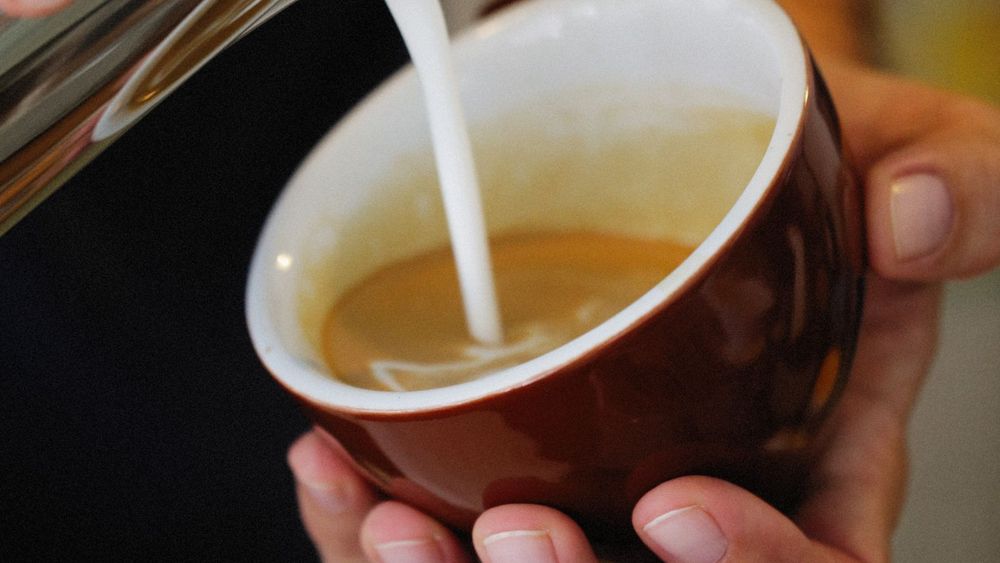
The short answer: All of these drinks start with espresso and differ in the amount of milk, the foam and the order of pouring. We found no standard for them. For the cappuccino, the competition rules of the World Barista Championship (2013) set 150 to 180 ml total volume, and the milk lies between 60 ml (Nespresso) and 100 ml (INEI, Lelit, De’Longhi), depending on the source. We would start with 100 ml.
Which espresso is the base
A recipe that says “an espresso” can mean two very different quantities. This has to be settled before any milk figure makes sense.
The single espresso of the classic definitions is small. The historic definition of the Specialty Coffee Association of America (SCAA), now published by the SCA, gives 7 to 9 g of coffee, 25 to 35 ml of drink and a brewing time of 20 to 30 seconds, and 14 to 18 g for a double. The Deutscher Kaffeeverband also works with about seven to nine grams of ground coffee per cup. In the WBC rules of 2013, the espresso is 30 ml with a tolerance of 5 ml. The Disciplinare of the Comitato Italiano Caffè (2018) for the traditional Italian espresso requires 7 to 9 g of coffee, 13 to 26 g in the cup and 20 to 27 seconds.
The well-known rule of thumb of 18 g of ground coffee, 36 g of espresso and 25 to 30 seconds describes something else. It is the average of a survey by the Barista Guild of America among 275 baristas, published in the SCA’s 25 Magazine: a dose of 18 to 20 g, 36.5 g of drink, on average a ratio of 1:2. 93 percent of respondents called their espresso a double, and 76 percent of the answers came from the USA. Sage separates it in the same way in the instructions for the Barista Express: 8 to 11 g for one cup of about 30 ml, 16 to 19 g for two cups of about 60 ml.
Our assessment: where we write “an espresso” here, we mean the single one of 25 to 40 ml, because the manufacturers’ milk recipes are calculated with it. If you pull a double as standard at home, the coffee share of every recipe below doubles. Our German-language brew calculator converts the dose and yield for your shot.
On pressure, the sources are close to each other but not on one figure. The SCAA gives 9 to 10 atmospheres, the WBC rules 2013 give 8.5 to 9.5 bar, the Disciplinare gives at least 8 bar, and Illy and Navarini (2011, Food Biophysics) give 9 bar with a tolerance of 2 bar. The 15 or 20 bar on data sheets refer to the pump. Jura states “static max. 15 bar” for the E8, that is, without flow, and Sage writes that the Barista Express extracts at 9 bar, made possible by a 15-bar pump. We therefore do not regard a higher pump figure as a reason to buy. According to the catalogue of the pump manufacturer CEME (Ulka), the rated pressure applies at zero flow and drops as soon as water flows.
Cappuccino, latte macchiato and caffè latte
The cappuccino is the only drink here for which we found an association definition and a competition rule. The WBC rules of 2013 require a harmonious balance of milk and espresso, built from a single espresso, textured milk and foam, together 150 to 180 ml. The Istituto Nazionale Espresso Italiano (INEI), an association of roasters and machine makers, describes its certified cappuccino with 25 ml of espresso and 100 ml of steam-frothed milk. The INEI wants the foam dense, with very fine or no visible bubbles.
The milk quantity is where the figures diverge. Nespresso describes the cappuccino as roughly one third each of espresso, hot milk and foam, and in the recipe for Original capsules uses 25 ml (ristretto) or 40 ml of coffee and 60 ml of semi-skimmed milk. In the instructions for the Victoria, Lelit uses 100 ml of milk at 5 °C, one part espresso and two equal parts milk and foam. For the Dedica, De’Longhi assumes about 100 g of milk per cappuccino, whose volume rises to two to three times when frothed. The cappuccino button of the Tchibo Cafissimo Milk dispenses about 90 ml of milk foam as factory setting, followed by about 40 ml of espresso.
Our assessment: 60 to 100 ml of milk covers all of these sources. We would start with about 100 ml, because three of the four sources are there, and drop to 60 ml for small cups.
The latte macchiato reverses the ratio. According to Nespresso, it is made when the coffee goes into the milk and not the other way round. The original recipe has 150 ml of frothed semi-skimmed milk in the glass, with 40 ml of espresso on top. The recipe table in the Aeroccino 4 instructions manages with 40 ml of coffee on 120 ml of dense milk foam. A Vertuo recipe from Nespresso with 50 ml of milk and 230 ml of coffee follows a completely different logic. What is documented is 120 to 150 ml of milk per espresso. If you want to fill a large glass, you can use more, but you then leave the manufacturers’ recipes behind.
Manufacturers make the caffè latte without foam. In the instructions for the Dinamica Plus ECAM370.70, De’Longhi assigns it to the setting NO FOAM (KEIN SCHAUM), together with hot milk. Nespresso prepares it with the Aeroccino 4 using the button that only heats the milk, and takes 2 x 40 ml of coffee with a generous amount of hot milk. On the De’Longhi Dinamica Plus 380.95, the level for milky coffee and café au lait is called DELICATE (ZART).
Flat white, cortado and espresso macchiato
For these three, our research found neither a standard nor an association definition, only manufacturer recipes and the settings of bean-to-cup machines.
For the flat white, Nespresso UK uses two capsules of 25 ml each (ristretto size) and slowly pours in 60 ml of heated, frothed milk. According to Nespresso, the drink comes from Australia or New Zealand and is slightly smaller and stronger than a latte, though the manufacturer provides no evidence for the origin. For the ECAM370.70, De’Longhi assigns the flat white to the setting VERY LITTLE FOAM (SEHR WENIG SCHAUM), and for the ECAM380.95 to the level CREAMY (CREMIG), both times less foam than for the cappuccino.
Nespresso brews the cortado with 40 ml of coffee, adds 20 ml of hot milk and puts two spoonfuls of milk foam on top. The recipe page provides no definition. On the ECAM380.95, De’Longhi sorts it into the level CREAMY, together with latte macchiato and flat white.
According to Nespresso, the espresso macchiato is an espresso “stained” with a little firm milk foam on the crema (stained in the English original). The recipe: 40 ml of espresso, froth 20 ml of milk, one spoonful of it on the crema. On both Dinamica models, De’Longhi puts it in the level with the most foam, like the cappuccino.
Our assessment from these recipes: among the larger milk drinks, the flat white has the highest coffee share, 50 ml of coffee to 60 ml of milk at Nespresso. The cortado and espresso macchiato are smaller and even more coffee-forward, both with 40 ml of coffee to 20 ml of milk.
The recipes in one table
| Drink | Coffee | Milk | Foam | Source |
|---|---|---|---|---|
| Cappuccino | 1 single espresso, 25 to 40 ml | 60 to 100 ml, total 150 to 180 ml | plenty, level with the most foam | WBC 2013, INEI, Nespresso, Lelit, De’Longhi |
| Latte macchiato | 40 ml, after the milk | 120 to 150 ml | less than for the cappuccino | Nespresso, Aeroccino 4 instructions, De’Longhi |
| Caffè latte | 2 x 40 ml | generous, only heated | none | Aeroccino 4 instructions, De’Longhi ECAM370.70 |
| Flat white | 2 ristretti of 25 ml each | 60 ml | less than for the cappuccino | Nespresso UK, De’Longhi |
| Cortado | 40 ml | 20 ml hot | two spoonfuls | Nespresso, De’Longhi ECAM380.95 |
| Espresso macchiato | 40 ml | 20 ml to froth | one spoonful | Nespresso, De’Longhi |
The table collects manufacturer recipes and one competition rule, it is not a standard. Nespresso appears in almost every row because we found quantities for all six drinks from no other manufacturer. A source does not always say whether it measures the milk before or after frothing; the Aeroccino 4 gives foam quantities in its table.
Why the latte macchiato forms layers
From bottom to top: dense hot milk, espresso, foam. That is how Nespresso describes the glass. The reason is density. Foam is full of air and the lightest, so the espresso falls through it. It does not sink beneath the warm milk, though. Xue and others (2017, Nature Communications) describe pouring as a process that pushes a liquid of lower density (espresso) into a surrounding of higher density (milk). Buoyancy works against this, the mixture of espresso and milk stays on top, and without stirring, pure milk can remain beneath it.
The order follows from the density, and here all sources agree: milk first. Nespresso states it in the recipe, Melitta describes it for the Melitta CI Touch, and Philips for the LatteGo machines. In the instructions for the Jura E8 (2025), Jura goes further: first the milk foam flows into the glass, then comes a short pause in which warm milk and foam separate, and only then does the espresso run.
Less is known about pouring speed than many recipes assume. We found the advice to let the espresso run slowly over the back of a spoon in no source. The only study we found on this examined something finer than the three layers. Xue and others observed horizontal bands of differing espresso concentration, which can form in the mixture as it cools to room temperature (22 °C) and last at least ten minutes, sometimes hours. In the model experiment with dyed water injected into a salt solution by a needle, these bands formed only above a critical injection speed. Injected slowly, the mixture stayed unlayered. At the same time, the faster the jet, the deeper it penetrated, and the thicker the mixing zone became. Nothing follows from this for the coarse three-part division in the glass, and we cannot derive a recommendation on pouring speed from it. In the authors’ photo experiment, 30 ml of espresso at 50 °C ran into 150 ml of milk at the same temperature.
Cappuccino: coffee first or milk first?
Here the manufacturers contradict each other. Nespresso brews the coffee first and puts the foam on it, and Melitta does the same with the CI Touch according to its own description (Italian Preparation Process). On their portafilter machines, Lelit and De’Longhi describe the same sequence, with the foam going onto the coffee. According to its operating chapter, the Tchibo Cafissimo Milk dispenses the milk foam first and then the espresso as factory setting, and Philips also reverses it with the LatteGo machines. For cappuccino, flat white and latte macchiato, milk runs first and then coffee there, for caffè latte and café au lait coffee runs first. That is also how it is stated in our German review of the Philips LatteGo 5400.
Our assessment: if you pour by hand, take the espresso first. Four of the six sources do it that way, and only that way can you let the foam run into the crema. How to pour patterns is described in our guide Latte Art for Beginners.
Which drink is stronger?
Caffeine depends on the coffee, not the milk. A cappuccino and a latte macchiato made with the same espresso contain the same amount of caffeine; the latte macchiato just spreads it over more milk, according to Nespresso over 150 instead of 60 ml. A flat white with two ristretti and a caffè latte with 2 x 40 ml contain two portions of coffee.
How strongly a drink acts can only be inferred without measurement: the less milk goes onto the same espresso, the more clearly the coffee comes through. If you want more coffee in the glass, you need less milk or a second shot, not a different drink.
An espresso is only equal on paper, though. EFSA (2015) assumes approximately 80 mg of caffeine for a 60 ml espresso and stresses that content and portion size vary between and within countries. A study by Crozier and others (2012, Food & Function) shows how far: in 20 espressos bought in Glasgow, the caffeine content differed by a factor of 6, the highest value was 322 mg in a single espresso, and three more were over 200 mg. The authors suspect the main reason is the amount of coffee used, and besides that the bean blend, the roast and the grind. They note that cafés make larger drinks such as latte and cappuccino by diluting a single or double espresso.
Caffè crema is not a milk drink
On drinks menus, caffè crema often stands next to the cappuccino. It contains no milk. It is a longer-brewed coffee from a portafilter machine, bean-to-cup machine or capsule machine. We found no standard or association definition; manufacturers describe it by quantity and grind.
The Sage Barista Touch stores café crema in three sizes, 120, 150 and 180 ml, and for this, according to the display, calls for the single-cup basket and a coarse grind setting. For the Tchibo Esperto mini, the factory settings are about 125 ml of caffè crema and about 180 ml in the XL variant, compared with about 40 ml of espresso, and Tchibo advises grind setting 2 instead of grind setting 1 for caffè crema. The Cafissimo Milk also brews caffè crema at about 125 ml and espresso at about 40 ml as factory settings, both with a short pre-brew.
This is how we read the grind tips from Sage and Tchibo: if several times as much water is to run through the ground coffee, it has to be coarser, otherwise the extraction takes too long.
Milk: foam, fat and temperature
Foam forms because milk proteins build a film around the air bubbles. Fat does not help with this, it interferes. Huppertz (2010, International Journal of Dairy Technology) and Kamath and others (2008, International Dairy Journal) describe fat as a factor that impairs the formation and stability of milk foam. Illy and Navarini (2011) call lipids antifoaming agents and say that skimmed milk gives a lighter, airier foam than whole milk. In line with this, in the Dinamica Plus instructions De’Longhi recommends whole or partly skimmed milk at about 5 °C for a richer, more even foam. The creaminess and taste of whole milk are a different question, which foam research does not answer.
For the two main drinks, manufacturers provide different types of foam but name them differently. The Nespresso Aeroccino 4 has a button for airy foam (cappuccino) and one for dense foam (latte macchiato). The De’Longhi Dinamica Plus 370.70 uses VERY MUCH FOAM (SEHR VIEL SCHAUM) for the cappuccino and VERY LITTLE FOAM (SEHR WENIG SCHAUM) for the latte macchiato. All this documents is that both drinks get their own setting. Whether the latte macchiato foam is meant to be firmer or drier cannot be read from it.
There is no uniform temperature limit. De’Longhi gives 60 °C as the ideal value for the Dedica, Sage 60 to 65 °C, Lelit at most 65 °C. According to its instructions, the Philips Milk Twister heats to a fixed approximately 74 °C, for the LatteGo machines Philips points in a footnote to 70 to 82 °C, and the Sage Creatista Plus lets you set 56 to 76 °C in 11 steps. According to Sage UK and Subminimal, overheated milk loses sweetness. The cooked taste is determined by temperature and time together (Zhang and others 2025, Foods). Why we would still stop at about 65 °C is derived in the guide How to Froth Milk.
On plant-based drinks there is a study by Tarasov and others (2025, Food Systems). They frothed ten barista drinks made from soy, oat, almond, hazelnut, coconut and blends against a barista cow’s milk. With steam at 65 °C, according to the authors all were usable alternatives, with mechanical stirring they were not. The products came from Russian manufacturers. Sage UK warns that soy can curdle when overheated. We found no source that attributes a particular heat sensitivity to oat.
Common faults and what to change
The latte macchiato has no layers. Check the order first: if the espresso goes into the glass first, the dense milk beneath it is missing. Pour the milk first and give it a moment, as Jura does with the pause before the espresso.
The cappuccino seems thin and milky. With a single espresso of 25 ml and 100 ml of milk, there is four times as much milk as coffee. Move towards 60 ml of milk or use a double.
The foam collapses quickly or hardly gets firm. With whole milk this is to be expected according to foam research, lower-fat milk froths more easily. If you froth a plant-based drink with a whisk device, according to Tarasov and others the cause lies more in the method than in the drink, as steam performed better there.
The milk tastes cooked. Then it was too hot or kept warm too long. Stop at 60 to 65 °C, the range given by De’Longhi, Sage and Lelit, and measure with a thermometer in the jug. This is not possible with the Milk Twister, which according to its instructions heats to a fixed approximately 74 °C.
The flat white looks like a cappuccino. Then it has too much foam. On the Dinamica Plus ECAM370.70, choose VERY LITTLE FOAM instead of VERY MUCH FOAM, and on the ECAM380.95 CREAMY instead of DENSE (DICHT). On the Creatista Plus, you set the foam height in eight steps between 2 and 30 mm; Sage does not say which step belongs to the flat white.
The coffee from the stovetop pot has no crema. This is not an operating error. According to our German review of the Bialetti Moka Express, a stovetop pot works with a fraction of the roughly 9 bar of a portafilter machine and, by design, does not build up a crema layer. For this, Bialetti uses a membrane in the Brikka.
Without a portafilter machine: bean-to-cup, capsule, frother
A portafilter machine is convenient for these drinks, but not a requirement. The Deutscher Kaffeeverband explicitly names bean-to-cup machines as appliances that prepare cappuccino, milky coffee and latte macchiato. Which drinks a bean-to-cup machine knows is determined by the manufacturer. The Jura E8 shows cappuccino, cortado, flat white, latte macchiato and espresso macchiato on its home screen. For the De’Longhi Rivelia, the product page lists eight hot milk drinks, including cortado and flat white, and an extra shot for cappuccino and flat white, among others. The Siemens EQ6 plus additionally lists Kleiner Brauner and milky coffee in its drinks list. We found no quantity table for the milk drinks in any of the De’Longhi instructions we read.
The Nespresso recipes from the table are written for capsules and the manufacturer’s own frothers, so with a capsule machine and Aeroccino you can recreate them directly.
With a stovetop pot you get strong coffee, but not an espresso in the sense of the definitions above, more on this in our guide Moka Pot Guide. For the foam, a frother is added to this. Bodum sells its own jugs for this based on the plunger principle. With the Chambord milk frother (0.08 l), according to Bodum you pump for 30 to 45 seconds until the volume doubles, with the Latteo (0.25 l) 60 to 90 times. For the coffee French press, we found no manufacturer instructions for frothing milk.
What we corrected in October 2026
Older versions of this guide gave figures and explanations for which we found no source in the fresh research. Some of them are still quoted on other pages, so they are collected here:
- Cappuccino: 60 to 70 ml of milk. This covers only the Nespresso recipe; what is documented is 60 to 100 ml.
- Latte macchiato: 200 to 250 ml of milk in a glass of 250 to 300 ml. What is documented is 120 to 150 ml per espresso.
- Flat white: 110 to 130 ml of milk in a cup of 150 to 160 ml, and the name coming from the foam lying flat. What is documented at Nespresso UK is 60 ml of milk on two ristretti.
- Caffè latte with a thin layer of foam and cortado with hardly any foam. De’Longhi and Nespresso both describe them differently, see above.
- The espresso sinking into the milk. It stays above it because it is lighter than the warm milk.
- Overheated milk turning sweetish, and the latte macchiato foam being meant to be firmer and drier. Sage UK and Subminimal name a loss of sweetness; on firmness we found nothing.
- The coffee French press as a milk frother. We found no manufacturer instructions for it.