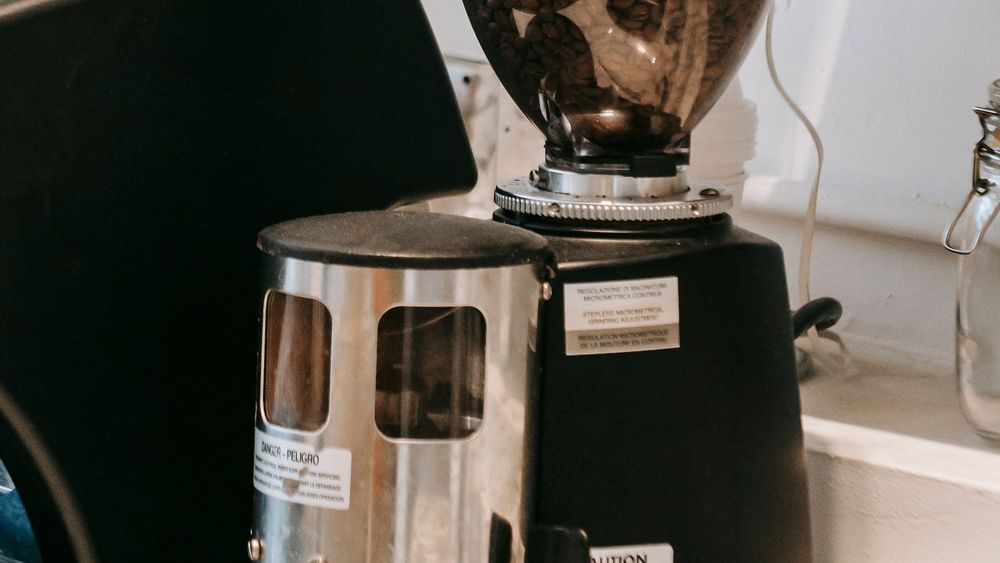
The short answer: There is no single setting or texture that applies to every grinder: manufacturers classify the same preparation differently, and we know of no standard for grind size settings. What is described is the direction: smaller particles dissolve faster (Uman et al., 2016, as a basic assumption of the study), but in espresso finer grounds slow the flow (Smrke et al., 2024). Start with the value from your grinder’s manual, change only the grind size, in small steps, and measure the time; as a target range for espresso, Sage gives 25 to 30 seconds.
How to set the grind size
The order we recommend: set the dose first, then turn the grind size, then measure the time, while water temperature and water quantity stay unchanged. In the manuals of the CM800 and the CM820, Graef likewise advises keeping the dose and the tamping pressure constant and adjusting only the grind size. If you change two variables at once, you will not know afterwards which one had an effect.
- Look up the starting value in your grinder’s manual. Setting numbers cannot be carried over from one grinder to another (table below), and Wilfa points out that each grinder deviates slightly in calibration. The values are still good as a start, but no more than that: in the lab, Stiftung Warentest (Germany’s consumer testing foundation) had 15 electric grinders grind for espresso, filter coffee and French press, once following the instructions and once with settings optimised by a barista (test 12/2019). Following the instructions mostly gave only mediocre results; almost all grinders produced better grounds when optimised.
- Fix the dose, the water quantity and the tamping pressure. Scales with a timer make dose, drink weight and brew time measurable. The Maestri House Mini has a resolution of 0.1 grams, a timer up to 9:59 and an auto timer that starts with the flow of liquid and stops when no more coffee runs on the espresso machine. The Bagail also displays in 0.1 gram steps, but only guarantees an accuracy from 0.3 grams, and it suits espresso only if it fits under the portafilter.
- If you have no starting value, start rather coarse and go finer in small steps until the flow is right. This is our precautionary rule, and its reason lies at the fine end: Bodum warns that finely ground coffee can clog the filter of the French press and build up high pressure. At grind settings 1 to 4, Wilfa mentions possible clogging of the burrs, and KINGrinder advises against using the K6 at the zero point or below 15 clicks.
- Adjust the grinder the way the manufacturer intends. With Baratza, the burrs must be running or completely empty; with the Rommelsbacher EKM 400, with a full hopper, only while the burrs are running. Eureka advises working step by step, because a full turn with the motor stopped can jam the grinder. Hand grinders are different: Comandante adjusts when empty, and Hario advises grinding with a few beans and readjusting as you go.
- After each adjustment, first grind a small amount. For the EKM 400, Rommelsbacher points out that a small quantity of beans has to be ground before the result of the new setting becomes visible, and Eureka recommends grinding some coffee at most every two steps. Our conclusion: powder from the old setting is still in the burrs (more on this in the section on dead space). In the interview with Stiftung Warentest, barista Nicole Battefeld advises always throwing away one shot when adjusting.
- Brew or pull the trial shot, measure the time, and only then change something. If the shot runs through too fast, go finer; if it runs too slowly, go coarser (this is what Sage and De’Longhi write).
- Note the setting for each bean. For darker roasts, Baratza (in the note on the espresso value of the Encore ESP) and Fellow give a higher number, and Severin writes: lighter finer, darker coarser; none of these sources explains a mechanism. In the manual of the Dose Control Pro, Sage notes that grinding time and grind size can vary with the type, age and roast of the beans.
Why finer does not simply mean more
The Deutscher Kaffeeverband (German Coffee Association) writes on its knowledge page that the grind size largely determines the taste, and that the finer the grind, the more aroma compounds can dissolve. Grinding breaks open the cells of the bean. Uman et al. (2016, Scientific Reports 6, 24483) assume that small particles extract faster than large ones because of their accessible surface, and measured grounds from a Mahlkönig EK 43 by laser diffraction: the particles ranged from about 0.1 to 1000 micrometres, and the distribution was bimodal. The fine fractions carry most of the surface, but coarse particles contribute even in small amounts.
In espresso, pressure comes into play as well. Smrke, Eiermann and Yeretzian (2024, Scientific Reports 14, 5612) summarise the state of the literature like this: finer grounds produce a larger pressure drop across the coffee bed at 9 bar and thereby lengthen the brew time, and grounds that are too fine could trigger uneven extraction with a lower yield. In their own experiment (one Arabica bean from Costa Rica, a grinder with added fines, 20 g dose, 40 g in the drink), the brew time could be predicted from the median particle size and the fraction below 100 micrometres. Typically, about 20 per cent of the coffee substance dissolves in espresso. Shots of under 10 and of 15 seconds, colloquially turbo espresso, already reached 17 to 18 per cent, and the maximum came from about 40 seconds. A single experienced taster (one bean, one roast profile) saw the optimum at about 30 seconds and 19 to 20 per cent yield, and noticed no penalty in the sensory scores with more fines.
According to these sources, “the finer, the more” is described only for the speed of dissolving, not for the yield. Cameron et al. (2020, Matter 2(3), 631 to 648) found a maximum in espresso: the yield falls with very fine as well as very coarse settings. With even flow through the bed, their model would have predicted a yield that falls steadily with coarser grinding. The authors interpret the measurement as uneven flow at fine settings, with poor reproducibility and wasted raw coffee.
Target values: what SCA and UC Davis give
For household filter machines there is a standard that specifies figures. SCA Standard 310-2021 for electric household filter machines uses 55 g of coffee per kilogram of water, gives a brew strength of 1.15 to 1.55 per cent TDS at this ratio, and requires 90 to 96 °C in the coffee bed, measured from 33 per cent of the water added. The instructions must include a grind size recommendation. Hand filters, French press, espresso machines and capsule machines are excluded. The reference grounds of the certification are not a recommendation for your grinder: for machines with a conical basket, less than 12 per cent of the particles above 850 micrometres applies, at least 68 per cent between 425 and 850, and at most 20 per cent below. For flat-bottom baskets the limits are 1,168 and 589 micrometres (under 17 per cent above, at least 65 per cent in between, at most 18 per cent below).
The classic Brewing Control Chart (Lockhart 1957, in Lingle’s SCA handbook, 2011) marks as the ideal zone about 1.15 to 1.35 per cent brew strength and 18 to 22 per cent yield. We read the values from Figure 1 in Guinard et al. (2023, Journal of Food Science 88(5), 2168 to 2177); they are not in the running text. The classic box therefore coincides with the lower part of the SCA range, and the upper SCA limit of 1.55 per cent lies above it. Guinard et al. consider the chart too coarse: it knows only a few attributes, mixes description and judgement, and leaves out the variety of aromas. Their new charts for filter coffee are based on three UC Davis studies with a total of 32,076 sensory measurements and 3,186 liking ratings. The respondents, mostly young adults in Northern California, formed two groups: 57 per cent liked low strength with low to medium yield best, 43 per cent two separate regions, namely low yield at medium to high strength and high yield at medium strength.
Grind size by preparation: what manufacturers state
Standards describe measuring methods, not settings: DIN 10765 (air jet sieving, edition 2016-07) and ISO 23134:2022-07 specify how to measure the particle size of ground roasted coffee. We take this from the title and scope; the standard texts are paid. The table reproduces what manufacturers write, and the last column sets our starting point.
| Preparation | Grind size according to manufacturer | Time according to source | Our starting point |
|---|---|---|---|
| Espresso (portafilter) | Sage: setting 1 to 30 of 60 (Smart Grinder Pro), 1 to 25 (Dose Control Pro); Rommelsbacher EKM 400: setting 1 to 5 of 35, extra fine; Fellow Opus: setting 1 to 2 of 11 | Sage: 25 to 30 s, flow after 8 to 12 s; Wilfa: usually 20 s; Mount Hagen: 25 s | The grinder’s starting value, then adjust by time |
| Turkish coffee (ibrik) | Comandante: 3 to 8 clicks (espresso 7 to 13); KINGrinder: 20 clicks (espresso 40) | no information in these sources | finer than your espresso value |
| Moka pot | Bialetti: moka grind, not finely ground coffee; Mount Hagen: fine, between espresso and French press; Comandante: 14 to 20 clicks; Groenenberg: 4 to 5 on a scale from 1 (very fine) to 10 (very coarse) | Bialetti: no information | between espresso and filter, fill loosely |
| AeroPress | AeroPress Inc.: medium fine; Fellow Opus: setting 2 to 5; Baratza: between espresso and V60 | AeroPress Inc.: 30 s steeping at medium fine, 60 s at medium | medium fine, steeping time per the manufacturer’s recipe |
| Hario V60 | Hario UK: medium fine; Hario Skerton N: fine to medium (paper filter) | Hario UK: about 2.5 min; Hario Japan: within 3 min | medium fine |
| Kalita | Kalita USA: medium coarse, compared with sea salt in the recipe | Kalita USA: 2 to 3 min | medium coarse |
| Chemex | Chemex: medium coarse | Chemex FAQ: no information | medium coarse |
| Filter machine | Hario: medium fine to medium; WMF: medium fine; Moccamaster: filter grind; Sage: coffee machine medium, filter coffee medium coarse; Rommelsbacher EKM 400: medium, setting 13 to 22 | Wilfa: 4 to 6 min; Moccamaster: 6 min for a full pot; SCA 310-2021: no brew time specified | medium fine to medium |
| French press | Bodum and Espro: coarse; Hario: medium to coarse; Fellow Opus: setting 8 to 10 | Bodum: at least 4 min; Espro: 4 min; Wilfa: 6 min | coarse |
| Cold brew | Fellow Opus: setting 10 to 11 of 11 | Studies: usual recipes 8 to 24 h (Fuller and Rao 2017), 14 and 22 h in the experiment (Cordoba et al. 2019) | coarse |
The information differs most for filter coffee. Baratza places the filter machine between V60 and Chemex (Virtuoso+: V60 15, machine 18, Chemex 20), Wilfa sets filter at 22 to 32, coarser than pour over at 14 to 28, and Rommelsbacher reverses this in the manual of the EKM 200: hand filter coarse (8 to 9), filter coffee machine fine (3 to 4). The statements consistently suggest that Chemex and Kalita are ground coarser than the V60. The Chemex should be ground medium coarse according to its FAQ, Kalita’s recipe for the Kalita Wave 185 calls for 20 g to 320 g of water and medium coarse like medium coarse sea salt, and Hario UK for the V60 15 g to 250 ml and medium fine. No fixed order between machine and hand filter follows from this; Hario (medium fine to medium) and WMF (medium fine) put the machine close to our starting point.
The times, too, are manufacturer statements and not a standard. According to Hario UK the V60 takes about 2.5 minutes, according to Hario Japan at most 3, Kalita gives 2 to 3, Bodum about 4 for pour over: with hand filters, the time depends on the brewer according to these statements and lies between 2 and 4 minutes. With a machine it depends on the appliance; Wilfa assumes 4 to 6 minutes for filter machines, Moccamaster 6 minutes for a full pot.
For the moka pot, the sources agree on the direction and not on the fineness. Almost all place it between espresso and filter, Comandante with 14 to 20 clicks against 7 to 13 for espresso and 18 to 35 for hand filter. In the manual of the Moka Express, however, Bialetti writes that you should not use finely ground coffee, while Rommelsbacher lists moka pots and stovetop pots in the EKM 400 under fine (setting 6 to 12, together with boiler espresso machines). The EKM 200 manual says extra fine (setting 1 to 2) for “manual moka preparation”; it does not say whether a pot or Turkish coffee is meant. Groenenberg rules out portafilter grounds: grounds that are too fine put too much resistance in the way of the low steam pressure, and then nothing arrives at the top. According to our German review of the Bialetti, this is described as a filter cake that steam pressure can hardly pass. Bialetti, Mount Hagen and Groenenberg all advise not tamping the grounds.
AeroPress Inc. recommends medium fine, 30 seconds of steeping at medium fine and 60 at a medium grind; very fine particles would block the flow of water and make pressing harder. The under 2 minutes on the product page describe the whole process of brewing and cleaning. Baratza (Virtuoso+ 12 of 40, Encore ESP 22) and Fellow (2 to 5) place the AeroPress between espresso and filter, and KINGrinder gives the same value for AeroPress and moka (65 clicks). The manufacturer’s recipe for the AeroPress Original calls for 85 °C and about 3 seconds of stirring.
Sage sets the target range for espresso at 25 to 30 seconds; over 35 seconds counts there as over-extracted, under 20 as under-extracted. More on preparing espresso is in the guide Espresso Basics. The manual of the Gaggia Classic Evo Pro lists less than 20 seconds as a fault in its troubleshooting table, Wilfa gives 20 seconds as usual, Mount Hagen 25 seconds for 7 g to 30 ml. The taster in Smrke et al. (see above), at about 30 seconds, was in the same range.
Coarse is the consensus for French press. The manual of the Bodum Chambord requires only coarsely ground coffee and at least 4 minutes of steeping, Espro also gives 4, Wilfa 6 minutes as the usual time.
For cold brew there are manufacturer statements and at least two studies with differing findings. Fellow puts cold brew on the coarsest settings, while Hario gives fine to medium fine in the manuals of its ceramic grinders: for the Skerton N in the cold brew row, for the MM-2 for the cold drip device, for the Mini Slim Plus (fine and semi-fine) for the cold extraction device (English: water dripper). Whether the Skerton row means dripping or immersion, the manual does not say. Fuller and Rao (2017, Scientific Reports 7, 17979) brewed dark and medium roasted beans, ground medium and coarse, cold and hot. Only caffeine and 3-chlorogenic acid were measured, no aromas and no taste, and according to the authors the grain size was not well controlled. The difference between medium and coarse had no significant influence on either compound; both reached equilibrium after 6 to 7 hours, while typical recipes run 8 to 24 hours.
Cordoba et al. (2019, Scientific Reports 9, 8440) come to a different finding. They brewed two Colombian specialty coffees (Huila and Nariño, medium roast) at 20 °C by immersion, 60 g to 700 g of water, with a medium grind (501 to 700 micrometres) and a coarse grind (701 to 900 micrometres) and 14 or 22 hours of steeping. The grind had the greatest influence on the physicochemical values: coarse with 22 hours gave the highest values for dissolved solids (TDS), yield, phenols and titratable acidity. The abstract also counts the pH among the highest values, but in the results section and in Table 1 it is lower with the coarse grind: for both coffees the pH was lower with the coarse grind than with the medium one (Nariño 4.81 to 4.82 against 4.86 to 4.90, Huila 4.84 to 4.88 against 4.92), so the coffee was more acidic. A panel of three trained tasters gave the highest sensory scores for both coffees to coarse with 14 hours.
Texture comparisons: mnemonics without a standard
Every source uses different words for the same setting, which is why our table has no texture per row. Hario measures grain size in sugar. In the manuals of the Skerton N and the Mini Slim+, fine is like caster sugar and coarse like granulated sugar, with semi-fine and medium in between. The Skerton N table assigns fine to medium to the V60 with paper filter, medium fine to medium to the filter coffee machine, and medium to coarse to the French press. Kalita compares the pour over with sea salt: in the recipe box as medium coarse like sea salt, in step 3 of the instructions as medium like sea salt. The FAQ sheet for Hario hand grinders gives millimetres: fine 0.5 to 0.8, medium fine 0.5 to 1.0, medium 1.0 to 1.5, coarse 1.0 to 2.0. The ranges overlap, with fine lying entirely within medium fine and medium entirely within coarse.
Starting values and step sizes of the grinders
The same number means something different on each grinder. For espresso, Baratza recommends setting 8 on the Virtuoso+ and 15 on the Encore ESP, although both have a scale from 1 to 40. Sage divides the espresso range differently on two grinders with 60 settings: up to 30 on the Smart Grinder Pro, up to 25 on the Dose Control Pro. On the Encore ESP, according to Baratza, settings 1 to 20 change the grind size only slightly and 21 to 40 more strongly, so a step is not the same size everywhere there.
| Grinder | Scale | Starting values according to manufacturer |
|---|---|---|
| Baratza Virtuoso+ | 1 very fine to 40 very coarse | Espresso 8, AeroPress 12, V60 15, filter machine 18, Chemex 20, French press 28 |
| Baratza Encore ESP | 1 to 40 | Espresso 15, AeroPress 22, V60 25, filter machine 28, Chemex 30, French press 32 |
| Sage Smart Grinder Pro | 60 settings | Espresso 1 to 30 (start 12), coffee machine 31 to 45, filter coffee 46 to 54, French press 55 to 60 |
| Sage Dose Control Pro | 60 settings | Espresso 1 to 25 (start 15), coffee machine 26 to 34, filter coffee 35 to 45, French press 46 to 55 |
| Wilfa Svart Uniform Plus | 41 click stops | Espresso 3 to 7 (start 5), AeroPress 14 to 26, pour over 14 to 28, filter 22 to 32, French press 30 to 38 |
| Fellow Opus | Outer ring 1 to 11 in quarter steps, 41 click stops | Espresso 1 to 2, AeroPress 2 to 5, pour over 5 to 9, French press 8 to 10, cold brew 10 to 11 |
| Rommelsbacher EKM 400 | 35 settings | 1 to 5 extra fine (pump pressure espresso), 6 to 12 fine (boiler, moka pot, moka), 13 to 22 medium (filter), 23 to 35 coarse (French press) |
| Comandante C40 MK4 | Clicks from the zero point | Espresso 7 to 13, stovetop pot 14 to 20, hand filter 18 to 35, French press 25 to 35 |
| KINGrinder K6 | Clicks from the zero point | Turkish 20, espresso 40, moka and AeroPress 65, pour over 100, French press 120 |
| 1Zpresso Q Air | Numbers, 30 clicks per revolution | AeroPress, moka pot and filter machine 12 to 20, siphon and pour over 18 to 32, French press 26 to 38; espresso missing |
The size of a step varies as well. According to manufacturer statements it is 8 micrometres per click on the 1Zpresso J-Ultra, 15 on the Timemore C5 ESP Pro, 16 on the K6, 23.3 on the ESP dial of the Timemore Chestnut C3 ESP Pro, 25 on the Q Air, on average 37 on the Porlex Mini II and 50 per outer ring setting on the Opus; for the C40, Comandante gives no figure. That is more than a factor of 6. We therefore recommend going by effect and not by the number of clicks: first one step, then measure the time, and with fine increments (8 to 16 micrometres), several steps in a row if needed.
Fault patterns: symptom, cause, change
The causes in the table reproduce the sources named.
| Symptom | Cause according to source | What you change |
|---|---|---|
| Espresso runs through too fast, tastes sour, looks pale, the crema disappears quickly | Grounds too coarse: the water runs through and dissolves too few aroma compounds (Stiftung Warentest, test 12/2019). Sage: under 20 s is under-extracted | grind finer |
| Espresso drips, shot over 35 s, strong and bitter | Grounds too fine: over-extraction (Stiftung Warentest), over 35 s is over-extracted at Sage too. In the manual of the PL41TEM, Lelit names dose and tamping pressure as well as grind size | grind coarser, check dose and pressure |
| Filter coffee runs through quickly and is thin | Hario UK: coffee too weak, grind finer. Severin: grind size too coarse or too little grounds | grind finer or use more grounds |
| Water drips too slowly, the filter overflows | Hario UK: grind coarser. WMF: with a grind that is too fine, the filter can overflow. Moccamaster: espresso grind is too fine | grind coarser |
| French press or AeroPress is hard to press | Bodum: fine grounds can clog the filter. AeroPress Inc.: very fine particles block the flow of water | grind coarser |
| Moka pot brings hardly anything to the top | Groenenberg: grounds too fine against the low steam pressure. Bialetti: never press into the funnel | grind coarser, fill loosely |
| The grinder stalls | Wilfa: grind setting 1 to 4 can clog the burrs. Eureka: a full turn with the motor stopped can jam it | do not grind on the finest settings, adjust only while the burrs are running |
| After changing beans the time is off | the setting no longer suits the new bean (step 7) | find the setting again in small steps |
The rule of thumb “sour means too coarse, bitter means too fine” has support, but not everywhere in the same wording. Sour and bitter are named explicitly by Fellow, by Melitta in the manual of the AromaFresh X, by Kalita USA in its recipe and by Stiftung Warentest (for espresso). For the Arte, De’Longhi goes by too slow and too fast, Hario UK by too weak and too slow dripping. We take sour and bitter as a pointer to the direction of the first step and check the time afterwards; further causes of bitterness and acidity are covered in the guide Coffee Tastes Bitter or Sour. The rule does not hold as a law: for filter coffee, Guinard et al. link acidity, citrus and red fruit to high brew strength at low yield, and bitterness, astringency and roast notes to high strength at high yield. According to this account, a thin coffee without a sour note is a different fault pattern from a strong, sour one. In espresso, short shots can reach high yields (Smrke et al.).
Fresh grinding and dead space
That volatile compounds are lost during grinding is documented. The Kaffeeverband writes that breaking open the cells releases volatile aromas and a large part of the gas in the beans, so losses of weight, substance and aroma are unavoidable. Akiyama et al. (2003, Journal of Agricultural and Food Chemistry 51, 1961 to 1969) collected what was released when grinding 150 g of medium roasted Arabica from Ethiopia: many nutty and smoky, roasty notes.
How fast this happens is less clear. Marin et al. (2008, Food Technology and Biotechnology 46(4), 442 to 447) stored a medium roasted Arabica-Robusta blend, ground Turkish fine, in packages for up to 12 months. The sensory acceptance limit (3.0 of 5) was at least one year under nitrogen, 5 months under air and 3 months in a punctured package; this applies to packaged coffee over months. For the minutes after grinding, only statements are available: Stiftung Warentest writes in its comparison of coffee grinders (test 12/2019) that the aroma evaporates within a very short time after grinding, and the subheading says minutes. In the interview, Battefeld says that coffee powder reacts measurably with oxygen and humidity within the first three minutes after the packaging is opened. Smrke et al. note that there is little information for the time scale below one minute.
The Kaffeeverband names whole beans ground only shortly before brewing, for example for a portafilter machine or bean-to-cup machine, and considers pre-ground coffee suitable for the filter coffee machine.
According to Stiftung Warentest, with burr grinders a residue of powder always stays behind between the burrs and the outlet, in individual grinders up to 3.9 grams. That is enough for half an espresso, the first drink partly consists of old powder, and professionals throw away the first coffee of the day.
How uniform does the ground coffee need to be?
Uniformity is regarded as helpful for flow and repeatability; we have no measurement of this link. The supports for it are manufacturer advice, a model interpretation, a statement on the day-to-day stability of the grind size, and an expert statement: AeroPress Inc. advises a good grinder because it grinds particles of equal size. Cameron et al. interpret the lower yield at fine settings as uneven flow through the coffee bed, which concerns the flow through the bed and not the distribution of particle sizes. In its conclusion, Stiftung Warentest certifies that burr grinders deliver the same grind size every day after being set; that is the stability of the setting and not a statement about the particles. Battefeld says that with very uneven grounds the water finds itself small roads. The link is supported indirectly by Smrke et al.: in espresso, a higher fraction of fines lowers the permeability of the coffee bed and lengthens the brew time (one bean, one grinder, one taster).
A comparison of twelve electric grinders by the consumer organisations Råd & Rön (Sweden) and Tænk (Denmark), reported by test.de on 25.11.2024, examined at fineness levels from 1 to 0.3 millimetres of grain size how evenly the grains trickle into the collecting container, and also the grinding time for 100 g, handling, cleaning and noise. The winner of the comparison was the Fellow Opus ahead of the KitchenAid 5KCG8433 and the Wilfa CGWS-130B; for the grinding result, test.de saw the Moccamaster KM5 narrowly ahead.
Quite a lot speaks against it or leaves it open. Smrke et al. saw no penalty in the sensory scores with more fines and interpret the fines mainly as a change in the permeability of the bed. Uman et al. leave open whether there is an ideal distribution. Comandante writes that fines and boulders, that is, fine dust and coarse chunks, are unavoidable when grinding, even with this burr set, because coffee always breaks unevenly. Our assessment: uniformity is a plausible argument for reproducible settings and only indirectly documented; for better taste, it is not documented.
Which grinder suits which grind size
For espresso, what counts is how many settings lie in the fine range. On the Fellow Opus, five click stops on the outer ring remain for espresso; on the Baratza Virtuoso+, only seven click stops below the starting value of 8, in our assessment little room to manoeuvre. Stepless grinders such as the Eureka Mignon Specialità 55 adjust the lower burr micrometrically and dose by time, while the Eureka Libra 16CR grinds by weight, adjustable in tenth-of-a-gram steps. Hand grinders count clicks. In Hario’s table for the Hario Skerton N there are seven preparations, and espresso is not among them; the Comandante C40 MK4 has no numbered scale, you feel for the zero point yourself, and the J-Ultra is designed for espresso.
For machines with their own grinder, the manufacturer’s settings apply; for bean-to-cup machines there is our guide on setting up a bean-to-cup machine. The Sage Barista Express has 16 grind settings and recommends setting 8 as the starting point, the Barista Express Impress has 25 settings and an extraction guide with the times from the table above. The filter machine with grinder Severin KA 4810 has a dial without numbers, so a setting cannot be noted down as a number there. The De’Longhi La Specialista Arte has 8 or 15 grind settings depending on the generation; on the EC915X, the grind setting is 5 from the factory according to the manual, 3 to 6 suit most coffees, and settings 1 and 2 are intended for special, lightly roasted coffee or when the grinding tools are worn.
What we could not document
We read SCA Standard 310-2021 in a copy on coffeegeek.com. The original on sca.coffee was not retrievable, and we read Standard 320 for household grinders only via an archive copy; we do not take target distributions for the grind size from it. What we do take from the standard is covered in our guide on cleaning a coffee grinder. We have not seen Lingle’s Coffee Brewing Handbook (2011); the ideal zone comes from Guinard et al. Of Cameron et al. (2020) we know only the abstract, and of DIN 10765 and ISO 23134 only the title and scope. Micrometre ranges per preparation, for example for espresso, we found only in blogs and do not adopt them. We have found no measured values for aroma loss in the minutes after grinding, nor a study that compares pre-ground coffee under packaging conditions with freshly ground. Whether coarse grounds improve cold brew in taste is shown only by Cordoba et al., with three tasters and two coffees. The manufacturer statements on Severin, Melitta, WMF, Moccamaster, Eureka, De’Longhi, Mount Hagen, Groenenberg, Gaggia, Graef, KINGrinder, 1Zpresso, Porlex, Timemore, Comandante, Lelit and Rommelsbacher come from manuals and manufacturer pages that we evaluated for our reviews.