The short answer: Our assessment of the buying order is: scale first, then a distribution tool, then a tamper of the right diameter, and after that knock box, mat and milk jug. According to our price boxes on Amazon.de, the first four parts cost between €87.76 and €121.90 (as of September 2026). For the recipe, the Barista Guild of America survey with the SCA averages 1:2, for example 20 g of coffee to 40 g in the cup. Before you buy a tamper, baskets or a dosing ring, measure the basket of your portafilter.
The order in which buying makes sense
The ranking below is our assessment. We know of no study that weighs the benefit of these parts against each other, and we have not used any of them ourselves. Two observations support it. Almost all the recipes we have read give the dose in grams (SCA survey, Cameron et al., Smrke et al., Sage, Hario, Kalita), so the scale comes first. In addition, two studies see no meaningful influence of tamping pressure (section Tamping pressure), while several papers point to uneven flow through the puck; that is why we put distributing the grounds before the tamper. Our German review of the Motta tamper reaches the same conclusion: if you only have budget for one part, buy the distribution tool first.
The grinder comes before all the parts in the table. Cameron et al. (2020, Matter) see the grinder and the water pressure as the main sources of scatter in reproducibility, and according to Smrke et al. (2024, Scientific Reports) the fines fraction plays a key role for the flow rate. If you do not yet have a grinder whose grind size can be set fine enough (for looking after the grinder, see the guide Cleaning a Coffee Grinder), plan to spend your money there first.
| Rank | Part | Examples from our catalogue (price box, as of September 2026) | What it is for |
|---|---|---|---|
| 1 | Scale | Maestri House approx. €29.99, Bagail approx. €39.99 | Dose and beverage weight in grams, both with a timer |
| 2 | Distribution tool (WDT) | Normcore WDT tool approx. €25.99, Subminimal Flick approx. €29.95 | according to the manufacturer, breaks up clumps in the grounds |
| 3 | Tamper | Vicloon 51 mm approx. €10.79 (with 58 mm silicone mat), Motta 8100/M approx. €23.97 | compresses the grounds in the basket, the diameter must match the basket |
| 4 | Knock box | De’Longhi DLSC084 approx. €20.99, MHW-3BOMBER approx. €27.99 | receives the puck |
| 5 | Tamping mat | scarlet espresso approx. €14.99 | surface for the portafilter when tamping |
| 6 | Milk jug | NewGF 350 ml approx. €11.04, De’Longhi DLSC060 approx. €16.99 | frothing milk by hand |
All prices in this text are catalogue prices from our price boxes, as of September 2026. The first four parts add up to €87.76 with the cheapest option for each (Maestri 29.99 plus Normcore 25.99 plus Vicloon 10.79 plus De’Longhi DLSC084 20.99). With the most expensive option for each (Bagail 39.99 plus Subminimal 29.95 plus Motta 23.97 plus MHW 27.99) it comes to €121.90. Of the sixteen possible combinations, five stay under €100 (€87.76 to €98.72), and all five include the Vicloon tamper; the most expensive combination with Vicloon costs €108.72. With the Motta tamper it is at least €100.94. Tamper and WDT tool alone cost €36.78 (Vicloon plus Normcore) to €53.92 (Motta plus Subminimal) together.
The routine from dose to shot
- Dose. Put the portafilter on the scale, tare, grind the dose straight into it and note it to 0.1 g. The reason comes from the model by Cameron et al.: the dose determines the bed depth, and one gram of deviation at 18 g is more than five per cent.
- Distribute. Normcore and Subminimal describe their needle tools like this: break up clumps and distribute the grounds evenly. With the De’Longhi Arte, you tap lightly against the dosing funnel so that the coffee distributes evenly.
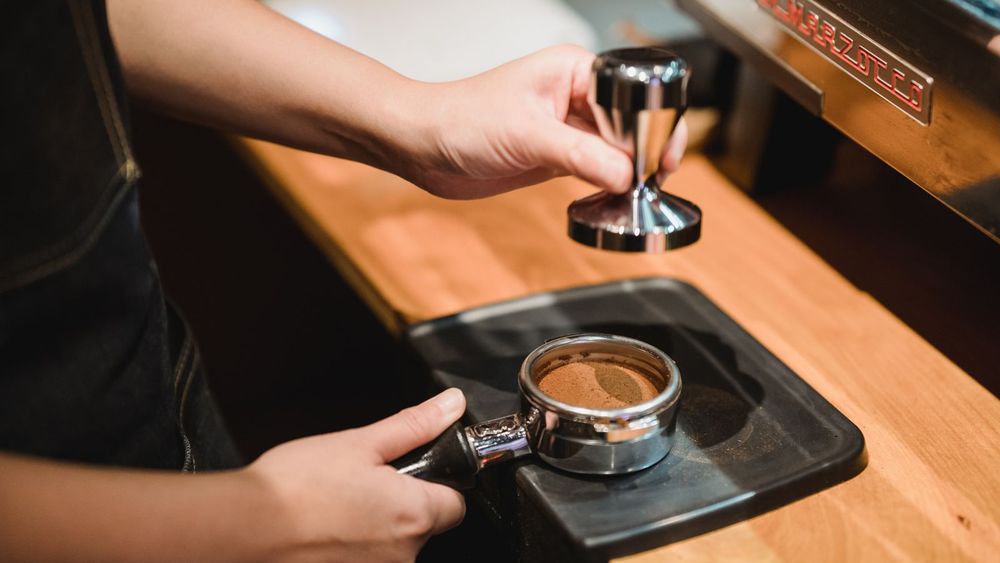
- Tamp. Put the portafilter on the mat if you have one, set the tamper on top and press down with about the same force as for every shot (our recommendation, so that one variable fluctuates less; it is not documented). According to the manufacturer, the studded surface of the scarlet mat is meant to stop the portafilter slipping while tamping. How much force the manufacturers specify is in the section Tamping pressure. With the Sage Barista Express, after tamping you remove the dosing funnel and trim the puck to the right height with the dosing blade (Razor); as a guide, the top edge of the tamper cap should then be flush with the basket rim.
- Measure the shot. Put the cup on the scale, let the time run, and stop at the target weight. Decide beforehand where your time starts, at the switch or at the first drop, otherwise two shots are not comparable.
- Change one variable. Change only the grind size per shot (instructions in the guide Coffee Grind Size) or only the dose; the recipe behind it is in the guide Espresso Basics. The reason is simple: with two changes you do not know which one worked. Sage gives over 35 seconds as over-extracted (grind too fine) and up to about 20 seconds as under-extracted (too coarse).
Why the precision scale is the first part in the table
Without a scale, every change to the recipe stays vague. You then do not know whether the next shot ran differently because you ground finer or because one gram more was in the basket. We condense an espresso recipe to three variables: dose, beverage weight and time. Beyond that, Cameron et al. list grind size, water pressure and temperature as control variables, and the Barista Guild survey additionally asks about temperature, pressure and pre-infusion. The scale supplies two of the three core numbers. The time comes from the clock; both scales in the catalogue have a timer (the Bagail’s is automatic according to the manufacturer).
The term yield has two meanings. Cameron et al. and Lee et al. (2023, Physics of Fluids) mean by extraction yield the mass fraction of the ground coffee that has dissolved. Cameron et al. determined it from the concentration of the beverage (refractometer) and the weighed beverage mass; with a scale alone you do not get this yield. Among baristas, on the other hand, yield often simply means the beverage weight (this is also how the Barista Guild survey asks, Fasman 2018). In this text, yield means the dissolved fraction and beverage weight means what the scale shows.
At an 18 g dose, 1 g of deviation is 5.6 per cent, 0.1 g is 0.56 per cent, and at a 36 g beverage, 1 g is still 2.8 per cent (our calculation). Cameron et al. worked with 20.0(5) g of coffee and 40.0(5) g of beverage, weighed on an espresso scale (Acaia Lunar) and discarded shots whose beverage weight deviated by more than 1 g. A tolerance of 0.5 g leaves no room for scale error with a scale reading in whole grams, because rounding to whole grams alone gives up to plus or minus 0.5 g; with 0.1 g steps there is room left.
A scale’s display increment is not its accuracy. The manual of the Maestri scale gives 0.1 g as the accuracy value; the manufacturer’s FAQ for the sister model Tikko S2G (K112A) describes a fluctuation of plus or minus 0.1 g as normal (according to our German review). The Bagail also displays in 0.1 g steps up to 3,000 g, but only guarantees accurate readings in the range from 0.3 to 3,000 g. The 0.3 g is the lower limit of this range; an 18 g dose is far above it.
The Maestri scale measures 105 x 105 mm at 19 mm height and carries up to 2,000 g (ample for espresso, tight for a full filter jug). According to the instructions, its automatic timer starts with the flow of liquid and ends at 9:59. The manual does not call the scale waterproof, forbids washing it with water and requires a dry charging port, while the product page advertises water resistance. The Bagail scale measures 16.5 x 13 cm at 2.5 to 3.5 cm height depending on the source, and therefore does not fit under every portafilter spout. Bagail warns against placing hot objects directly on the scale and requires the silicone mat to be put on before weighing, otherwise damage to the device may result.
Which recipe applies?
None of the numbers below is a law. Seven sources side by side, and they are far apart.
| Source | Dose | Beverage weight | Time | Type of statement |
|---|---|---|---|---|
| SCAA definition, historical (Fasman 2018, SCA) | 7 to 9 g, for a double 14 to 18 g | 25 to 35 ml, for a double times two | 20 to 30 s | Definition, called heritage by the SCA itself |
| Barista Guild of America and SCA survey 2017 | 66 per cent on average 18 to 20 g | on average 36.5 g, ratio on average 1:2 (range 1:1.5 to 1:2.5) | 51 per cent on average 25 to 30 s | Self-reported |
| Sage Barista Express (SES875) | 16 to 19 g for 2 cups, 8 to 11 g for 1 cup | not given in the extraction instructions, presets are approx. 30 ml (1 cup) and approx. 60 ml (2 cups) | 25 to 30 s, flow after 8 to 12 s | Manufacturer’s instructions |
| Lelit Victoria (PL91T) | 7 g (plus or minus 0.5) | 30 ml, about 1:4 by volume | 25 s | Manufacturer’s figure for the ideal espresso (manual p. 19; 7 g for one cup, 14 g for two according to p. 15) |
| Cameron et al. 2020 | 20.0 g | 40.0 g | Measured variable | Measurements in a café, 6 bar |
| Smrke et al. 2024 | 20 g | 40 g | Measured variable | Experiment with Victoria Arduino Black Eagle, 9 bar |
| Méndez Harper et al. 2024 | 18.0 g | 45.0 g (1:2.5) | Measured variable | Experiment with Victoria Arduino Black Eagle, 7 bar |
The historical SCAA definition and Lelit work with 7 to 9 g and 7 g respectively for a single cup (the SCAA gives 14 to 18 g for the double, Lelit 14 g for two cups), whereas the survey works with doubles: there 66 per cent are on average between 18 and 20 g, and most use 18 g baskets. Of the respondents who did not know the basket size in grams, over three quarters used double baskets. At 16 to 19 g for two cups, Sage is close to the survey, and the three studies use 18 to 20 g for 40 to 45 g. So 1:2 is the average of a survey and a ratio that two of the three studies also use. Cameron et al. even suggest reducing the coffee mass per shot by up to 25 per cent. The dose is therefore itself a subject of research.
1:2 suggests itself as a starting point, so for an 18 g basket, 18 g to 36 g. The dose is better guided by the basket than by a table, and 36 g is close to the survey average (36.5 g).
On time, the middle lies at 25 to 30 seconds: the SCAA definition gives 20 to 30, the survey 25 to 30 for 51 per cent, Sage 25 to 30, Lelit 25. Not every source says when it starts counting. The Sage manual leaves open whether its 25 to 30 seconds include the lead time of 8 to 12 seconds until the first flow, while the Maestri timer starts with the flow of liquid. A time value without a starting point cannot be compared. Smrke et al. describe turbo espressos at 10 to 20 instead of 25 to 30 seconds and found that shots under 10 and at 15 seconds reached 17 to 18 per cent yield, over 80 per cent of the observed maximum. According to a single taster, the optimum for their bean lay at about 30 seconds and 19 to 20 per cent yield. The authors stress that green coffee and roast profile determine where the optimum lies.
The water figures also diverge. The SCAA definition gives 90.5 to 96.1 °C at 9 to 10 atm. In the survey, the water temperature averages 200.3 °F (about 93.5 °C), the pressure averages 8.5 bar (most often 9 bar), and 52 per cent work with pre-infusion. For the ideal espresso, Lelit gives 88 to 92 °C and 8 to 10 bar. Cameron et al. brewed at 92 °C and had to lower the pressure from 9 to 6 bar because the puck clogged at fine settings; Méndez Harper et al. brewed at 94 °C and 7 bar.
Why uneven grounds disturb the shot
Cameron et al. compared a model with measurements from the café. With even flow through the puck, the model predicts an extraction yield that falls steadily as the grind gets coarser. The authors measured instead a maximum and lower yields at both very fine and very coarse settings. From this they conclude that flow becomes uneven at fine settings, with poor reproducibility and wasted coffee. As a possible cause, the caption of Figure 4 names aggregates and/or uneven bed density due to too many fines.
Lee et al. (2023) describe in their two-path model how something like this escalates. Where more water flows, more is dissolved, the permeability rises, and even more flows. Small differences in the packing thus grow over time, and at a fine grind all the soluble coffee is dissolved in one path. The authors note that the mean yield may not be a good guide to taste, and they expect a bitter taste from the over-extracted portions.
Méndez Harper et al. (2024, Matter and iScience) show where clumps can come from: during grinding, coffee particles become electrostatically charged and form aggregates, which according to the authors are a problem for reproducible espresso. The charging depends on moisture: beans with less than about 2 per cent residual moisture charge negatively, darker (drier) roasts more strongly and negatively, lighter ones positively.
From these building blocks we put together a picture that remains a hypothesis: clumps and uneven density favour preferred paths for the water, and these paths reinforce each other over the course of the shot.
Do you need a WDT tool if you tamp cleanly?
Manufacturers describe distributing and tamping as two working steps. Normcore gives the purpose of its WDT tool as breaking up clumps, loosening compacted grounds and distributing the coffee more evenly before tamping. Less channelling is supposed to follow. Subminimal describes the purpose of the Flick similarly: break up clumps and distribute the grounds evenly before the tamper compresses them.
Other manufacturers go other ways. For the La Specialista Arte, De’Longhi has you tap lightly against the dosing funnel before pressing so that the ground coffee distributes evenly.
The Normcore tool has needles of 50 mm length and, according to Normcore, 0.25 mm thickness (the Amazon title says 0.23 mm), and according to Amazon nine prongs. By the conclusion of our German review it is not tied to any basket size, because the body measures 28 mm. The needles are the only wear part. The Subminimal Flick measures 110 x 18 mm, has 42 mm long needles of 0.5 mm thickness as supplied, two sets of 0.35 mm are included, and the needles retract into the aluminium tube. The manufacturer’s blog lists 54 and 58 mm, and 51 and 53 mm are missing. As care, Subminimal only describes clearing the needle channels dry.
Our assessment: a WDT tool is a plausible but not a documented step. For our German Normcore review nobody took measurements, and we have not found a peer-reviewed measurement on distribution tools. We do not accept non-peer-reviewed comparisons such as the one by Decent Espresso (2020, needles of different thickness) as evidence. We would stir the grounds until no clumps are visible any more. Anyone who instead proceeds as De’Longhi does is following the manual of their machine.
Tamping pressure: manufacturers, survey and studies
The manufacturers’ figures range from a number to none at all. In the Barista Express manual, Sage gives 10 to 15 kg when tamping for a balanced extraction, which is about 98 to 147 N. For the Dedica, De’Longhi instructs to distribute the powder evenly and press it lightly with the tamper; the Arte manual only says to press the coffee with the tamper. In neither place is there a force. In the Barista Guild survey, most gave 20 to 30 pounds, about 9.1 to 13.6 kg. The studies also tamp differently: Cameron et al. standardised on 98 N (about 10 kgf), Smrke et al. used 20 kgF, Méndez Harper et al. 196 N (about 20 kgf).
Two studies show whether the pressure changes anything. Cameron et al. tried a range of tamping pressures and saw no meaningful change in shot time or extraction yield. They noticed differences in taste but did not quantify them. The conditions: Mahlkönig EK 43 grinder, 20 g basket, 92 °C, 6 bar instead of 9 bar, San Remo Opera machine. Kuhn et al. (2017, Journal of Food Engineering) measured caffeine and trigonelline with time resolution in a commercial espresso machine, with varied particle size and varied tamping pressure. Two compounds were measured, not taste. Smaller particles delivered more, and according to the abstract, tamping pressure had no detectable effect.
Against this stand two manufacturer statements, both without a measured value. The Dedica manual from De’Longhi (section 4.1) calls pressing very important for a good espresso: if pressed too firmly, the coffee runs out slowly and is strong; if too lightly, it runs out too fast and is weak. Then there is the troubleshooting for the Lelit Anna (PL41TEM): if the pressure gauge shows over 14 bar and no coffee comes, Lelit names four causes: grounds too fine, too much coffee, pressing too hard, and a shower screen that needs cleaning.
We would not measure the pressure but keep it about the same for each shot and stay within the range your manufacturer gives. Neither of the two studies examined distribution tools or a tamper set on crooked; whether a tamper set level brings anything is therefore open and remains an assessment without evidence.
Which tamper diameter fits your machine?
Motta gives a rule: measure the inside diameter of the basket and subtract 1 mm. The measurement refers to the basket, not to the portafilter from the outside. The manufacturer’s size table has the columns 41, 49, 51, 53, 54, 57, 58 and 58.5 mm. Of the roughly 52 rows in the picture (brands, model ranges and competitors’ baskets), by our count about 34 are in the 58 mm column, give or take one or two rows. Catering brands predominate, but Krups, De’Longhi, Lelit, Gaggia, ECM, Rocket and La Pavoni also appear in the table.
| Size | Assignment by source | Note |
|---|---|---|
| 41 mm | Krups | Motta table |
| 49 mm | La Pavoni Europiccola | Motta table |
| 51 mm | De’Longhi | Motta table, De’Longhi itself leaves the diameter open for the Dedica and Arte |
| 53 mm | several groups | Motta table |
| 54 mm | Dalla Corte and San Marco (Motta), Sage Barista Express (manual) and Bambino Plus (our German review) | accessories in the 58 mm size do not fit according to our German reviews |
| 57 mm | Lelit (Motta), Lelit Anna with 57.35 mm | a 58 mm tamper is too wide according to the review |
| 58 mm | Gaggia (manufacturer’s site), Rancilio, La Marzocco, ECM, Rocket, Bezzera, Faema (Motta) | Lelit Elizabeth measures 58.55 mm according to Lelit |
If you are about to buy a machine, the guide Espresso Machine Buying Guide has more on the differences between machines. The Motta table assigns a size to brands and baskets, the Lelit models deviate from it, and Sage is missing from it entirely.
The manufacturer does not give a reason why Motta subtracts a millimetre; we suspect it is so that the tamper does not get stuck in the basket. That a clearly too small tamper does not reach a strip of grounds at the edge follows from geometry; what this strip does is not documented. In the manual of the La Specialista Arte, De’Longhi writes about coffee residues at the edges of the basket after pressing that they do not impair extraction in any way. The manual says nothing about a ring next to a tamper that is too small. The area determines how much pressure a force produces: a 51 mm base has about 20.4 cm², a 58 mm base about 26.4 cm². With the same force, about 29 per cent more pressure bears on the grounds in the 51 mm basket (the calculation comes from the Vicloon review, and we recalculated it).
What is in the box is inconsistent. Plastic is documented for the Gaggia Classic E24 (accessories according to the manufacturer’s site), the Lelit Anna, Elizabeth and Victoria (manuals) and the Sage Bambino (accessory list). The Gaggia Classic UP, by contrast, comes with a stainless steel tamper with a removable plastic handle, and the 2020 Rancilio Silvia catalogue lists a tamper made of black wood with a flat stainless steel base as part of the equipment. With the De’Longhi Dedica, a tamper is only included with some models according to the accessory list, and the Sage Barista Express has an integrated, removable 54 mm tamper.
Problem patterns: too fast, too slow, sour, bitter
The shot runs too fast. Sage’s limits are in step 5 of the routine; the flow should start after 8 to 12 seconds. The Gaggia Classic Evo Pro lists a run of under 20 seconds in its fault table as a malfunction (too fast). That fast is not an error for every coffee is shown by Smrke et al. with their turbo espressos. The first step: grind finer, then check dose and beverage weight.
The shot runs too slowly or not at all. More fines (particles under 100 micrometres) lower the permeability of the coffee bed and lengthen the shot time (Smrke et al.), and in Cameron et al. the puck clogged at 9 bar and fine settings. Then you grind coarser. The dose acts in addition: our estimate from above (Darcy’s law, not measured) is about 1.6 seconds for 1 g more on 18 g and 28 seconds.
Sour or bitter. The rule of thumb is: sour means under-extracted, so grind finer; bitter means over-extracted, so grind coarser. It appears in the Sage manual (page 13), at Kalita (bitter: grind coarser next time, sour: somewhat finer), at Melitta, Fellow and in test 12/2019 of Stiftung Warentest (Germany’s consumer testing foundation) (grounds too fine: bitter, too coarse: sour). It is not uniform. The same Sage manual describes under-extracted espresso on page 12 as bitter or harsh, thin and watery. The De’Longhi Arte manual mentions neither sour nor bitter. Guinard et al. (2023, Journal of Food Science) summarised three UC Davis studies with 32,076 sensory ratings for filter coffee: acidity, citrus and red fruit appeared at high brew strength and low yield, bitterness and roast notes at high brew strength and high yield. That applies to filter coffee, not to espresso. We treat the rule as a first direction and use time and beverage weight as a cross-check.
Sour and bitter at the same time. Lee et al. expect bitterness from over-extracted portions. Cameron et al. write that uneven flow should be accompanied by a perceived mixture of under- and over-extracted flavours, and that consumers might describe the same espresso as bitter and sour. One part of the puck is then extracted more strongly, another more weakly. First you change what you can control: re-weigh dose and beverage weight and distribute the grounds more evenly, and only after that the grind size.
The shots vary from day to day. The guide Espresso Machine Troubleshooting collects further problem patterns around the portafilter machine; before you change anything about the tamper, re-weigh dose and beverage weight.
Comfort at the workspace and milk foam
Knock box and mat are about comfort. They work neither on the grounds nor on the shot, they keep the kitchen tidy. The distribution tool, by contrast, intervenes in the grounds before the shot, whereas a knock box does not improve an espresso. Scale, distribution tool and tamper therefore come before them in our order.
The De’Longhi knock box costs approx. €20.99 (€25.00 in the De’Longhi shop). The catalogue dimensions of 14.8 x 10.8 x 14.1 cm are outer dimensions, including the protruding knob of the bang bar. According to the manufacturer it is dishwasher safe, while our German review advises wiping the base by hand. The MHW box costs approx. €27.99 and holds 1.2 litres according to the brand shop, up to 15 pucks according to the seller. The body is ABS, the knock bar is metal and removable, and the box has no lid. It measures about 13 x 13 x 10 cm and weighs 435 g. How to knock out the puck is prescribed by Dualit for its own knock box: turn the portafilter over and knock it against the bang bar until the puck comes out. The basket should touch the bar, not the handle, because otherwise the basket can come loose from the portafilter.
The scarlet mat costs approx. €14.99 and is made of natural rubber according to the manufacturer. Size M measures approx. 300 x 150 x 10 mm. According to our German review, the mat affects extraction at most indirectly. The mat that comes with the Vicloon tamper, on the other hand, is made of food-grade silicone according to the seller.
With the milk jug, the capacity decides first; how you then pour the foam into the cup is explained in the guide Latte Art for Beginners. Sage UK and Lelit give the same rule: fill cold milk to at most half of the jug so that it has room to grow. For the Dedica, De’Longhi states that the milk volume increases to two to three times. Lelit calculates 100 ml of milk at about 5 °C for one cappuccino. A jug with a nominal volume of 350 ml therefore takes at most 175 ml of milk under the half-full rule, enough for one cup. The NewGF jug has a nominal volume of 350 ml, a scale from 150 to 350 ml in 50 ml steps according to the photo, and is made of 304 stainless steel, coated black on the outside. The latte art pen is included, and hand washing is recommended. The De’Longhi jug (approx. €16.99, €24.99 in the De’Longhi shop) also holds 350 ml, is made of stainless steel and, according to our German review, is sized for one cappuccino per filling; for two cups, the half-full filling is not enough on paper. According to the US and NZ sites it is dishwasher suitable.
For the Barista Express, Sage gives 60 to 65 °C and Lelit at most 65 °C; for the Dedica, De’Longhi gives 60 °C as the ideal value. These are manufacturer figures, not measured values. Sage UK justifies them by the denaturation of the proteins at about 70 °C; Lelit claims that milk does not foam above 65 °C, without giving a measured value. Zhang et al. (2025, Foods) heated raw milk in a water bath for 10 or 30 minutes at 60, 75 or 100 °C and had a panel rate the cooked flavour. Raw, it scored 2.83 points, 60 °C after 10 minutes 2.75 (not different from raw), 60 °C after 30 minutes 4.25 and 75 °C after 10 minutes 4.17. The authors attribute it to denatured whey protein. Nothing was measured at 65 °C or for the duration of a steaming process (De’Longhi for the Dedica and Gaggia for the Classic give at most 60 seconds of steam), so the study does not document a threshold at 65 °C. Our assessment: we would stop the milk at about 65 °C because Sage and Lelit draw their limit there, as does the guide How to Froth Milk.
Sage describes the hand check on the jug inconsistently: hot to the touch, pleasantly warm, too hot to hold, warm but not too hot to hold. More reliable than the hand check are a milk thermometer, which Lelit and Sage mention, or a jug with a colour strip: the indicator strip on the Sage jug shows the temperature by changing colour according to the manual.
Backflushing, blind basket and the 3-way valve
A blind basket is a basket without holes. It is part of backflushing, a cleaning of the group head: cleaning powder into the blind basket, insert the portafilter, pump water, pause, repeat. Sage UK recommends backflushing with cleaning solution if the machine has a three-way valve, and says that it loosens coffee oils in the group head.
What the valve does is described by La Marzocco in a blog of 14.07.2025: after the shot it relieves the pressure in the group head by directing the water from the top of the coffee into the drip tray. The portafilter can then be removed immediately and safely. On machines without a 3-way valve you have to wait a moment or accept the kickback. Keeping the valve clean, including through regular backflushing, is important for performance. Gaggia ascribes the same function to the solenoid valve of the Classic E24: it relieves the pressure in the portafilter immediately after the shot, the water runs into the drip tray through the open valve, and it dries the puck.
The condition of backflushing only with a three-way valve is named, among the sources of this text, by Sage UK alone. A 3-way valve does not appear on the Urnex product page or data sheet, and no manufacturer source gives a reason for the condition. Our deduction from the descriptions by La Marzocco and Gaggia: a blind basket has no holes through which the water can drain downwards. The pressure in the group must therefore escape another way, and on portafilter machines the 3-way valve is that way. If it is missing, backflushing lacks the pressure relief. Whether your machine has such a valve and provides for backflushing is decided by the manual of your machine.
| Machine | Valve | Backflushing according to the manufacturer |
|---|---|---|
| Gaggia Classic UP | solenoid valve according to the equipment list, blind basket in the box | monthly |
| Lelit Anna | 3-way solenoid valve | at least weekly or after 100 shots |
| Lelit Victoria | 3-way solenoid valve | monthly with blind basket |
| Rancilio Silvia | solenoid valve on the group head | manual requires backflushing with a blind filter disc |
| Sage UK (blog) | for machines with a three-way valve | heading Monthly cleaning routine, text weekly |
Urnex Cafiza costs approx. €12.55 for 566 g. The manufacturer describes the backflush like this: blind basket into the portafilter, up to 1/2 teaspoon (3 g) of powder in, insert the portafilter, 10 seconds of brewing, 10 seconds of pause, five times. Then remove the portafilter, let water run over the group, repeat the round without powder, then prepare an espresso and pour it away. As a second use, Urnex names the soaking bath (6 g per litre, 30 minutes).
What you can skip or buy later
Calibrated tampers limit the pressure to a fixed value, for example Sage’s specification. In our assessment they belong at the end of the shopping list (for the effect of pressure see the section Tamping pressure), and in the overall budget the accessories come after the grinder and before a machine upgrade.
The GdHaHSP set (approx. €19.99) contains a WDT tool with 8 needles of 0.3 mm, a magnetic aluminium dosing ring and a puck screen, for 51 mm portafilters only. In the catalogue, the dosing ring is only represented in this set. It extends the basket wall and, according to our German review, has nothing to do with extraction. The seller’s claim that the puck screen eliminates channelling is treated by the review as an advertising claim.
Precision baskets (IMS, VST) are supposed to deliver a more even flow. For this we found only retailer and manufacturer statements. Our catalogue lists no precision basket as individually bought accessories; IMS baskets are in the box with the machines Lelit Victoria and Lelit Elizabeth according to the reviews. With dual-wall baskets, the reviews of the GdHaHSP set and the Vicloon tamper consider WDT, screen and a new tamper less relevant because the insert regulates the pressure (manufacturer’s logic, not measured). De’Longhi supplies the Dedica with pressurised or dual-wall baskets.
What do you need of this without a portafilter machine?
Without a portafilter machine, part of the list falls away. The scale stays where the recipe is given in grams, for example with the pour-over. For the pour-over, Hario UK’s V60 Expert Guide lists among the equipment, among other things, Hario V60 Drip Scales and a Buono kettle. The recipe doses 15 g of medium-fine ground coffee to 250 ml of water at about 92 to 96 °C. You stop pouring when the scale shows 250 g; the preparation should take about 2.5 minutes. If the coffee is too weak, Hario advises grinding finer; if the water drips too slowly, coarser. Kalita USA recommends 20 g of coffee for 1 to 2 cups and 320 g of water, of which 60 g for the bloom (30 to 45 seconds pause), at 195 to 205 °F (about 90.6 to 96.1 °C), a ratio between 1:16 and 1:18 and 2 to 3 minutes of brew time. The water should be heated with a gooseneck kettle for precise pouring, but it is not required.
How the pour-over works step by step is explained in the guide Pour-Over Filter Coffee. In our assessment you need the scale immediately, because both recipes end in grams. Also a grinder whose grind size can be adjusted, because Hario’s tips aim at that. The kettle with a thin spout is a recommendation and can wait. The Hario V60 Starter Set (approx. €24.87) does not include scale, grinder or kettle; the spoon in the set holds 12 g. With the Kalita Wave 185 (approx. €49.14), scale and kettle come on top of the dripper.
For the French press, Bodum doses in spoons, not in grams. For the Bodum Brazil (approx. €16.89), a scale is therefore optional in our assessment.
How a bean-to-cup machine and a portafilter machine differ is explained in the guide Bean-to-Cup vs Espresso Machine. Tamper, WDT tool, dosing ring and baskets are needed on the portafilter machine and not on the bean-to-cup machine, because there the grinder doses and a brew unit in the machine presses the grounds (our classification from the design; we have not found a manufacturer source for it). A milk jug for hand-frothed milk and cleaning agents as specified by the manufacturer remain useful.
Which parts of our catalogue fit which basket size
At 51 mm, the Vicloon tamper (304 stainless steel according to the seller, who advises measuring the basket before ordering) and the GdHaHSP set fit. For 58 mm there is the Motta 8100/M with a flat stainless steel base and wooden handle, without calibration; by Motta’s rule it belongs to a basket of about 59 mm. For the Subminimal Flick, the manufacturer’s blog gives 54 and 58 mm; for the Normcore tool, the size question does not arise according to our German review because of the 28 mm body. In 54 and 57 mm our catalogue has no tamper; Sage includes its own 54 mm tamper with the Barista Express.
If a part fits in diameter, that does not mean it is approved by the manufacturer. According to our German review, the manual of the Sage Bambino Plus requires using only the supplied accessories and warns that accessories not sold or recommended by Sage could cause fires, electric shocks or injuries. For the Classic UP, Gaggia links a safety booklet that, according to our German review, is written for the brand’s bean-to-cup machines; according to it, accessories from other manufacturers are to be avoided.
Our site also has an overview of all parts and a ranking of them. Neither says anything about how much better an espresso becomes with any one part: the ratings assess the products editorially and measure nothing in the drink.
What cannot be documented
Every number in this guide comes from the sources named or is calculated from them. Some things that appear in accessory lists and blogs we did not find in any usable source and therefore left out: a manufacturer’s statement on how long to stir with the WDT tool, a source on the inertia of kitchen scales, evidence that knocking on the edge of a bin wears out the basket or handle, a manufacturer source for supplied tampers being too light or too tight in diameter, and a measurement of a ring of unpressed coffee at the basket rim through which the water flows preferentially.
Likewise missing are market data on the choice of accessories per basket size and on the prevalence of 58 mm in household machines, a comparison of whether accessories for a few dozen euros bring more than the next more expensive machine model, an independent measurement of precision baskets, and a measurement linking the hand feel on the jug with the milk temperature. The Sage UK blog leaves open which Sage models have a three-way valve.
The parameters of the Istituto Nazionale Espresso Italiano for a certified espresso (7 g, 25 ml, 25 s, 88 °C, 9 bar) are not in the 2022 archive copies, only the cappuccino and a sensory description. We found the numbers only in secondary sources and did not use them.
We read several sources only in part or not afresh. For Cameron et al., the full text was not retrievable at Cell Press; the accepted manuscript was read. For Kuhn et al. (2017), only the abstract was freely accessible, so we do not know the pressures compared. The SCA standard 350-2021 for espresso machines with recipe specifications is reserved for members, and we did not see it. From earlier research for other guides, we took over without reopening: the classification of the study by Guinard et al. (only the abstract was read afresh), the sour-bitter rule at Kalita, Melitta, Fellow and Stiftung Warentest, the fault table of the Gaggia Classic Evo Pro and the hand checks of the Sage models SES876, SES878 and SES500.