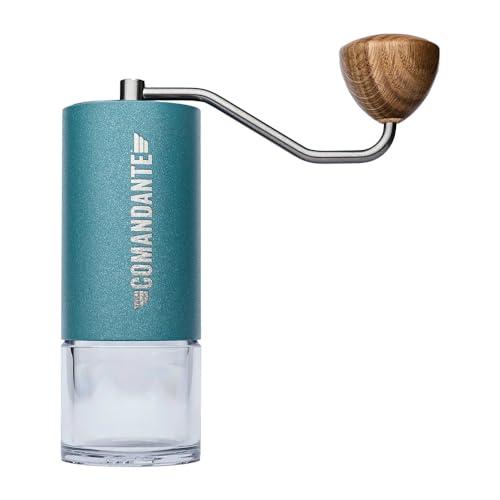
Around €237 on Amazon.de, and a manufacturer’s recommended retail price of €269.00 for the Alpine Lagoon colour reviewed here: the Comandante C40 MK4 Nitro Blade is the most expensive hand grinder in our category, and the gap is large. The three alternatives in the table further down are priced at €91.99 to €199.00. The MK4 has been on the market since autumn 2021, and the Amazon.de catalogue gives 1 September 2021 as the release date. It replaced the MK3, which according to the company chronicle was built for five years; as improvements Comandante names workflow, weight and durability as well as the polymer bean jar.
According to the manufacturer, grinders and burr sets are made and assembled on the outskirts of Munich, the company headquarters is in Bavaria, and the Amazon.de catalogue lists BB Coffee Company GmbH as the manufacturer. It began in 2005 with the roastery Supremo, the Comandante brand was registered in 2012, and grinder production started in 2013. Comandante describes itself as a small, family-run project.
What the C40 is made of
The body is a stainless steel body, according to the manual finished either with real wood laminate or with powder coating. Alpine Lagoon carries no wood veneer, so following the manual’s logic the second finish remains for this variant. Comandante describes the turquoise itself as a tribute to the Bavarian alpine lakes. As materials the manufacturer lists stainless steel, glass, polymers and real wood, expressly no aluminium: the manual carries the seal food safe, aluminium free, BPA free, checked according to the manufacturer by recognised inspection bodies.
The colour changes nothing about the grinding technology, but it does change the price. Black costs €259.00 in the manufacturer’s shop, Alpine Lagoon is €10.00 more, and the wood veneer editions lie between €299.00 and €322.80.
The manufacturer calls the polymer QTP, a long-chain polymer matrix with quartz nanoparticles, food safe and waterproof. Comandante writes that this material makes the MK4 somewhat lighter and more dimensionally stable than the MK3.
A stainless steel shaft runs through the middle, guided by two stainless steel ball bearings. Both bearings are sealed and so protected against coffee dust. Why that is more than a materials detail on a hand grinder: the cone has to run concentrically in the burr ring. If the shaft wanders under load, the gap between cone and ring changes, and with it the size of the particles that come out at the bottom.
Comandante does not state the net weight or height, and the figures from the catalogues describe the packaging: the variant record in the manufacturer’s shop gives 1124 grams, the Amazon.de catalogue 2.425 pounds as well as 9.7 x 6.5 x 1.1 inches. That this cannot be the grinder you can work out in one step: 1.1 inches is about 2.8 centimetres.
The crank carries a knob made of solid oak, made in the Black Forest. It sits on the crank as an exchangeable click-on knob; Comandante gives the standard as 44 millimetres in diameter, and the larger Big Joe variant as 55 millimetres. A magnet in the crank holds the connection to the shaft. That the crank has some play is intentional according to the manufacturer’s FAQ and has no influence on the grind result.
In detail: the Nitro Rex burr
No Comandante source gives a diameter for the burr set, neither the product page nor the home page, the FAQ or the German instruction manual. Retailer pages say 39 millimetres in some places and 40 in others, and we adopt neither figure. The geometry is documented: Comandante calls the cone the world’s first heptagonal one for specialty coffee, so seven-sided in its basic form. For the burr steel the manufacturer names over 17 per cent chromium as well as vanadium and molybdenum in balanced proportions. As aims of the alloy Comandante gives corrosion resistance, hardness and wear resistance, and the manual describes the martensitic crystal structure as exceptionally fine.
The difference from a flat burr set lies in how the force is applied. A cone pulls the bean in and breaks it down step by step on the way down, while two parallel discs grind it in a narrow gap and need rotational speed to do so. Rotational speed is the scarce quantity on a hand crank, which is why hand grinders have cones.
Nitro Blade is not a nitriding process. Comandante describes its own alloy with a high nitrogen content, whose burr sets are hardened and tempered after the tooth geometry is cut. Micro blades are also ground onto the 15 entry teeth, which the manual describes as extra sharp. From the alloy the manufacturer derives its claim that the burr set should last a lifetime.
On the start year the manufacturer contradicts itself on its own website: the company chronicle gives 2016 for the C40 MK3 with the same burr set, while the founder’s letter on the product page dates the same grinder to 2015. We write both years because both come from Comandante.
The cone is deliberately mounted so that it can move, which the manufacturer calls a floating cone. If it centres itself slightly when running empty, that is according to the manufacturer’s FAQ not a defect but a design with a performance advantage. Comandante is equally clear that fines and boulders, meaning very fine and very coarse particles, cannot be avoided with roasted coffee, because the bean grew organically and is brittle. How wide this distribution is, is the quantity that matters in grinding: particles that are too fine release their substances faster than the rest of the dose, particles that are too coarse more slowly, and both end up in the same cup. The manual describes the grinding range as running from powder-fine coffee for a mocca to granular coffee grounds for filter or French press.
Grind size: counting clicks rather than reading a scale
The grind adjuster sits under the burr set and has a triple detent. The C40 has no numbered scale; Comandante describes the setting solely through counted clicks: the grinder is set to 24 at the factory, and the further you open it from the zero point, the coarser the grounds become.
You have to find the zero point yourself by feel, and the manufacturer’s FAQ defines it by the crank, which in this detent position no longer falls through on its own. If you want to work your way systematically towards a setting, you will find the method in the guide Setting the grind size. For espresso Comandante gives 7 to 13 clicks, for pour-over 18 to 35 depending on dose and dripper; the ranges for ibrik, stovetop moka pot and French press are further down in the FAQ.
How many micrometres a single click moves is stated in no manufacturer source for either shaft, and the figures you read on this, 30 for the standard shaft and 15 for Red Clix, come from retailers. Why anyone asks at all comes down to brewing. Espresso passes through the grounds under pressure and in a short time, so even a small change in particle size shifts the flow time noticeably. Pour-over and French press work with gravity and long contact time, and the same step hardly matters there.
In the Amazon.de catalogue the manufacturer advertises that the adjustment allows fine gradations even within one brewing method. If the standard stepping is still too coarse for you for espresso, you can retrofit the Red Clix RX35 Drivetrain Set, €42.00 in the manufacturer’s shop. It adds an extra step between two standard clicks, so 5 standard clicks become 10. According to the manufacturer the red scale may run exclusively with the RX35 shaft, and standard parts in between are ruled out. The standard shaft is the series specification.
Does the grinder justify the premium of €237?
If repairability and production in Germany are worth something to you: yes. If you expect a measurably better grind distribution: no. According to its FAQ, Comandante develops and checks its burr sets in its own laboratory at the company headquarters, but publishes not a single value from it, and we have not measured anything ourselves.
What carries the price is therefore not the grind result but the time afterwards. In its FAQ Comandante offers its own repair service and justifies it with the aim of building durable and repairable grinders and reducing their environmental impact over the years. Our assessment: what you pay for here is material and the supply of spare parts.
On lifespan it stays with the claim Comandante makes for the burr set; the founder’s letter in the manual extends it to the whole grinder and speaks of two to three generations. We pass that on as a statement of intent, just as it stands.
What Comandante does not state
Besides the burr diameter, the net weight and the micrometres per click, the manufacturer sources lack: the capacity of the grinding chamber and the maximum amount of beans per grind, the total number of click steps over the whole adjustment range, grinding time and crank revolutions for a dose, the torque at fine espresso settings, the noise level, the unit-to-unit variation in the series, the service life of the burr set in kilograms of coffee, and the origin of the steel beyond the description of an alpine region. The material of the grind adjuster and the bean jar lids is also not given anywhere in detail.
Two of these gaps have consequences when buying. A complete replacement burr set, called Burr Set in the shop, is not carried by the spare parts shop, and whether it can be obtained individually is something only support can clarify. On the warranty, no period in years is stated anywhere: in the event of damage the manufacturer’s FAQ refers you to the retailer or directly to Comandante, and in the Amazon.de catalogue the word manufacturer’s warranty appears without a time period. If you need a binding period, clarify it with the seller before buying.
What else comes into question
| Model | The difference | Price | Our rating | Choose this if |
|---|---|---|---|---|
| Comandante C40 MK4 (this one) | Own spare parts shop with 49 items, a replacement burr set is not listed there | approx. €237 | 9.4 | production in Germany and replacement parts are worth the premium to you |
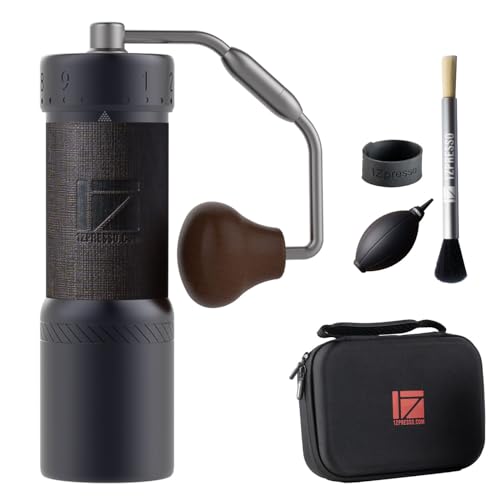
| 1Zpresso J-Ultra | Numerical external adjustment, the grind size is readable rather than counted | approx. €199 | 9.1 | you often switch between espresso and filter |
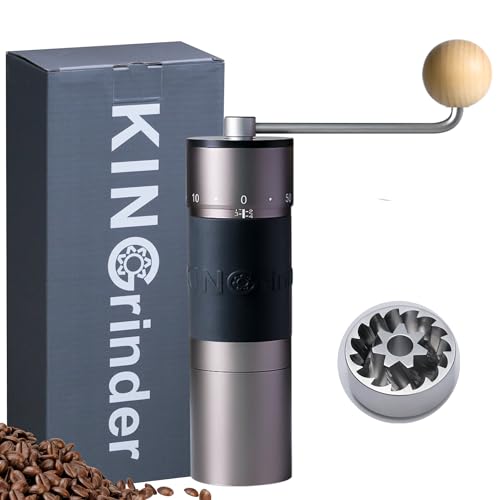
| KINGrinder K6 | 240 clicks of 16 micrometres each from the factory, on the C40 the finer stepping costs €42.00 extra | approx. €99 | 8.8 | your budget is around €100 |
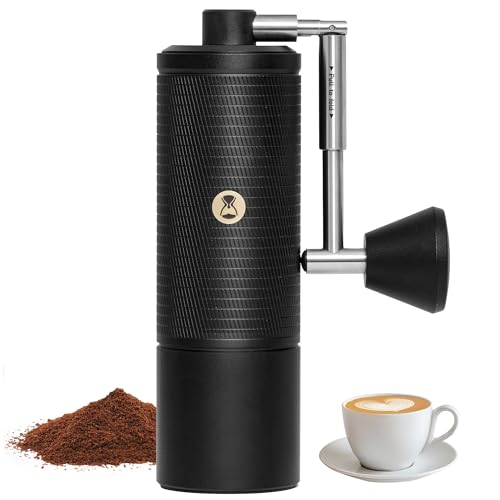
| Timemore Chestnut C3 ESP Pro | 20 g capacity according to Timemore instead of two bean jars of 40 g each | approx. €92 | 8.7 | you grind one to two cups a day |
The table sets prices as of September 2026 and our editorial rating side by side, and does no more than that. We have no measured values on the grind distribution of the four grinders, so there is no column for it.
When the C40 fits and when another grinder is better
Both bean jars supplied hold 40 grams of coffee each, one of brown glass, one of polymer, and that is enough for two cups in a row. If you regularly grind more at once, refill or buy the Polymer Bean Jar Large for €12.90 as well.
For pour-over and French press alone you stay in the coarse part of the adjustment range, and you never need the fine espresso steps there. A Timemore Chestnut C3 ESP Pro for €91.99 also covers these two brewing methods, and the premium of around €145 is then hard to justify. Conversely, if you make espresso every day, sooner or later you will think about the Red Clix.
On budget, count on €236.90 on Amazon.de or €269.00 recommended retail price, plus €42.00 for the Red Clix depending on your standards. The KINGrinder K6 costs €99.00, also covers espresso through to filter coffee and comes with 240 clicks of 16 micrometres each from the factory. A difference of around €138 is a question you answer for yourself. Which designs exist otherwise and what they mean for brewing is covered in our hand grinder buying guide.
Four cups for the family is work on a hand grinder, and fine espresso settings more than coarse ones: the narrower the gap between cone and burr ring, the higher the torque at the crank. For that case an electric grinder is the more obvious answer; if you are still wavering between hand and motor, sort it out in the coffee finder.
Scope of delivery, spare parts and care
According to the product page, the scope of delivery includes the crank with oak knob, a transparent polymer bean jar, a dark glass bean jar with lid, a Comandante wrist band in size small and a mat made of merino wool felt. Both containers are taste neutral and food safe and can be cleaned with hot water, and the manufacturer describes the polymer glass as practically unbreakable.
The C40 needs no consumables, neither filters nor descaler. Only wear parts cost money, and many of them are listed individually in the manufacturer’s shop, although a complete burr set is not. On 6 September 2026 the spare parts shop lists 49 items, including the complete drivetrain: the spring for €3.20, the disc set for €4.95, the ball bearing set of two for €6.00 and the stainless steel centre shaft for €8.30. Shaft and bearings together cost €14.30, and you order both individually without sending in the grinder.
For accessories it is worth looking at compatibility. According to the manufacturer the bean jars fit all C40 Mk3 and Mk4 as well as the C60 Baracuda.
Neither soaking nor dishwasher: Comandante writes in its FAQ that otherwise the wood veneer and ball bearing cartridges suffer in the long run. The manual gives a dry brush as the method, once a week with heavy use, once a month with light use.
Between individual grinds Comandante expressly considers cleaning unnecessary. The dry brush without harsh cleaning agents is what is prescribed, and raw rice, which you often read recommended after dark roasted beans, is not covered by this instruction. How to get a grinder properly clean and which residues cause trouble at all is covered in the guide Cleaning a coffee grinder.
The wood needs its own care. From the factory it is treated with a hard wax oil which, according to the manufacturer, complies with DIN 53160 and the European standard EN 71.3, and once a year the surface wants new wax according to the manual. If a natural wood knob eventually squeaks on the crank, mineral or olive oil helps according to the manufacturer’s FAQ.
To take it apart, you unscrew the three-pronged grind adjuster completely, after which the cone, spring, discs and shaft can be removed. The three fixing screws around the burr ring stay untouched. Comandante puts it unmistakably: loosening them can damage the C40 and cost you the warranty, because the burr ring was centred at the factory and anchored with special screws.
Who is it for?
The C40 is the grinder for people who buy once and afterwards repair instead of replace. In our hand grinder comparison it leads with 9.4 and therefore carries the badge Comparison winner 2026; of the ten hand grinders there, eight also appear side by side in the best-of list Hand grinders 2026.
Two groups should not buy it. If you switch between several recipes without counting along, you lose your reference point at every change: without a readable number, every switch costs an entry in the notebook, whereas the 1Zpresso J-Ultra for around €199 brings a numerical external adjustment. And anyone who wants to leave it standing open in a household with small children is reaching for the wrong device: the manual calls the burr teeth extremely sharp and expressly warns against letting children handle the grinder.