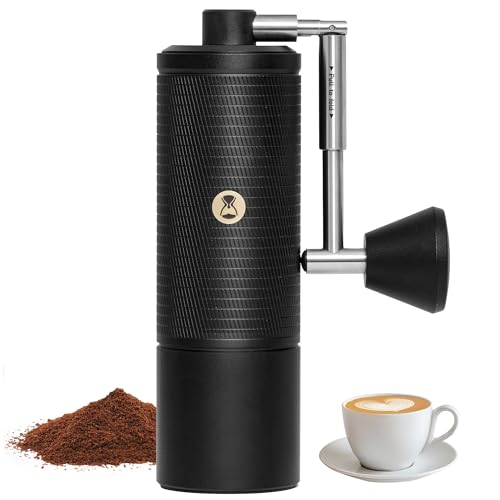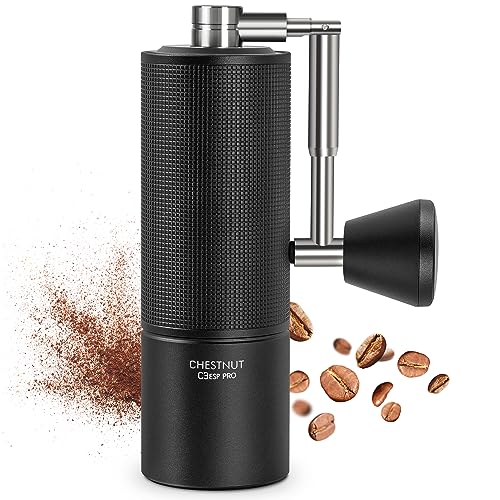
The Timemore Chestnut C3 ESP Pro is a hand grinder with a 38-millimetre stainless steel conical burr, built for espresso through to French press according to the Amazon catalogue title. On 7 September 2026 it stood there at approx. €91.99. The ESP in the name denotes a different adjustment dial, and half of the buying decision within the series hangs on that.
A note on the sources first, because it affects the whole text. On timemore.com this model no longer has a product page of its own; the manufacturer’s hand grinder range there lists the S3, the Nano 3, the C2S, the C3s/C3 series and the C5 series. The overview page for the C3 series still lists the C3 ESP Pro by name in its technical data, though, and most of the manufacturer’s statements here come from there. The rest comes from the Amazon catalogue entry and from timemoreeu.com. Where a statement appears in only one of these places, we say so.
The burr: S2C660, 38 millimetres of stainless steel
Timemore calls the conical set S2C660 and gives its diameter as 38 millimetres, material stainless steel. The European Timemore store puts the hardness at 55 to 58 HRC.
HRC is the Rockwell hardness, a measure of resistance to permanent indentation. The higher the value, the longer a cutting edge keeps its geometry, and the more brittle the steel becomes at the same time. For a burr that is driven by hand, the first half of that sentence matters most: the edge should keep its shape while bean after bean passes through the gap. Brittleness only becomes an issue where a foreign object gets between the blades, a small stone from the harvest, for instance.
The second statement on manufacturing is more concrete. Timemore describes the conical set as CNC-milled and justifies this with high concentricity and uniform particle size. Concentricity here means that the cone sits as exactly as possible in the centre of the ring. Where it does not, the gap wanders over one revolution, and one setting effectively becomes two.
The diameter places the grinder within our category. The larger Timemore C5 ESP Pro works with 42 millimetres, the KINGrinder K6 with 48 according to our data sheet. A larger cone pushes more bean through the same gap per revolution, which is why this figure sits near the top of every data sheet.
Is a 38 mm hand grinder enough for espresso?
For espresso it is enough, if you are willing to count clicks. Timemore builds the ESP variants for exactly this: 0.0233 millimetres of adjustment per click, 30 clicks per revolution. The Classic Dial of the non-ESP models jumps by 0.0833 millimetres at 12 clicks per revolution, around three and a half times as far. That division is ours, both figures are the manufacturer’s. The European Timemore store turns it into a selling point: the indexing is finer and the adjustment disc more precise, and that makes the grinder better suited to espresso.
Why the step size matters especially for espresso: the shot runs through a fixed bed of coffee under pump pressure in a little under half a minute. Particle size determines the flow resistance there, and even a small change shifts the flow time by several seconds. If you work your way towards a recipe using the method from our guide to setting the grind size, you need steps small enough to take a shot that ran too fast back by exactly one step. Pour-over and French press work with gravity and a long contact time, and the same adjustment hardly matters there.
One discrepancy belongs here. Timemore speaks of 30 clicks per revolution, the European Timemore store of roughly 36 steps. The two statements measure different things, one the travel per revolution, the other apparently the usable range. In either case you can only calculate in clicks, and a click is the unit you think in first thing in the morning anyway.
None of this says anything about the ground coffee itself. Timemore publishes no particle distribution figures for the C3 ESP Pro anywhere, and we have measured nothing. The brand’s only statement on consistency applies to a different pair: 5 per cent more consistent than the C3s and a 19 per cent larger burr, both calculated for the 42-millimetre generation of the C5. Anyone who wants to infer something about this grinder from that is inferring via two corners.
Body, handle and stability
147 by 52 millimetres, 530 grams. Both values come from the Amazon catalogue text, not from a Timemore page; timemoreeu.com at least confirms the 52 millimetres and describes it as a compact body. The catalogue data sheet lists the weight a second time, there as 1.1684 pounds, which converts to the same roughly 530 grams. The 52 is the diameter and not a second edge length: the catalogue photo shows a round cylinder with a crank mounted across it.
On the housing the sources agree. Timemore names aluminium alloy for body and crank arm, the catalogue text speaks of an integrated all-metal housing, timemoreeu.com of a one-piece, enlarged all-metal body. One-piece means here: no bolted intermediate segment halfway up where something could twist while you crank. The catalogue text draws the same line through to the shaft and describes the central shaft and components as firmly integrated, strong and durable. In the catalogue photo, the upper half of the cylinder carries a fine dot pattern, exactly where the hand grips while grinding; the catalogue text calls it a non-slip design pattern.
There is a silicone base underneath. Timemore expressly lists it for the C3 Max, the C3 Pro and the C3 ESP Pro, and the catalogue calls it a silicone pad and describes it as slip-proof and tip-proof. The catch cup screws on; Timemore calls it a threaded catch cup and justifies the thread with secure, residue-free grinding. The manufacturer files the handle under Pull-to-Fold and keeps it for the Pro models, justified by travel and storage; the catalogue text calls it solid, patented and foldable and stresses that it takes up less space and is suitable for outdoor use.
On the aluminium, the catalogue text makes an argument worth putting in context: the alloy helps with heat dissipation during grinding and so prevents the beans from overheating. That is manufacturer text without a measured value. Little heat arises in hand grinding anyway, because the rotation speed stays low.
How much coffee fits in one pass?
Two figures, both from the manufacturer. The series page says 20 grams for the C3 ESP Pro, and the German catalogue text says the grinder can process 20 to 25 grams of beans at once. We work with the 20 grams because that is the figure on the manufacturer’s page, and treat the 25 grams as the upper limit.
For espresso that is enough as long as you stay with one shot. 18 grams for a double fit comfortably; two doubles in a row would be 36 grams and are far above it. For filter coffee it gets tighter than it sounds: two cups of 200 millilitres each need 24 grams together at 60 grams per litre, and if you work with a different ratio, you can work out yours in the brew calculator. That is more than the manufacturer’s figure allows, and stays just under the upper limit from the catalogue. If you brew a whole pot, you fill it twice.
It gets tight fastest at the coarsest end of the scale. Timemore lists the range of use as espresso through pour over to French press, and French press stands for the largest amount per pass: a lot of water, a long contact time, and correspondingly a lot of coffee.
Care and spare parts
At timemoreeu.com and in the Amazon catalogue text, the same terse sentence appears on care: take it apart to clean, and clean with a brush. There the information ends. Nothing is said about water or the dishwasher, and with a housing of aluminium alloy that is no side issue. Whether aluminium tarnishes in the dishwasher cannot be documented from manufacturer or authority statements, according to our guide. We would therefore stay with the brush until the manufacturer approves otherwise. What actually builds up in a grinder and how often taking it apart is worthwhile is covered in our guide to cleaning coffee grinders.
Spare parts are the weakest link. The part affected is the burr set, of all things, the component in a hand grinder that takes the wear: neither timemore.com nor timemoreeu.com lists a replacement S2C660 burr or individual parts of the C3 series, as of 7 September 2026. In practice this means the grinder is bought as a whole and replaced as a whole.
What Timemore leaves open
Gathered here rather than spread across the text, so that it stands complete once: for the C3 ESP Pro, Timemore does not name the steel grade of the burr, gives no information on whether the dual-supported central shaft uses ball or plain bearings, no total number of detents across the full adjustment range, no starting click values for each brewing method, no handle or crank length, no country of manufacture, no operating noise, no material for the catch cup, no note on how it behaves with oily dark roasts and no colour other than black. A PDF manual is another one: the manufacturer’s download centre lists the S3, the Chestnut Nano, the Chestnut X and the C3 Pro, and this model is not among them. And one point is on us: we have no comparable particle distribution measurements for any of the four grinders in this text.
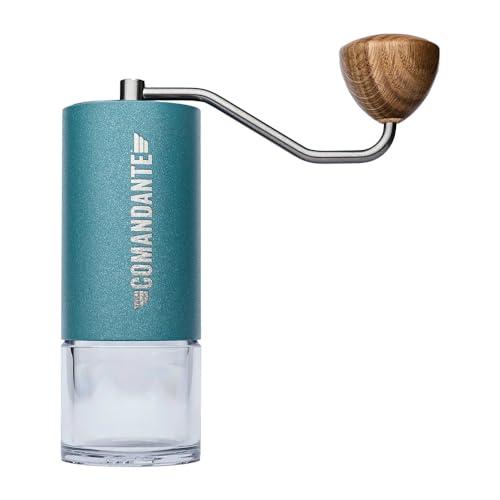
Two of these have consequences when buying. Without a statement on the bearing type, the shaft guidance cannot be compared with grinders that, like the Comandante C40 MK4, specify sealed stainless steel ball bearings. And without starting click values for each brewing method, you do not take over a number from a set of instructions but work your way there yourself with every new bean.
What else is worth considering?
| Model | The difference | Price | Our rating | Choose this one if |
|---|---|---|---|---|
| Timemore Chestnut C3 ESP Pro (this one) | 38 mm conical set S2C660, 20 g capacity, 0.0233 mm per click | approx. €92 | 8.7 | you first want to find out whether hand grinding suits your mornings |
| Timemore C5 ESP Pro | 42 mm conical set, 30 g grinding chamber, 0.015 mm per click | approx. €119 | 8.9 | you regularly grind for two people at once |
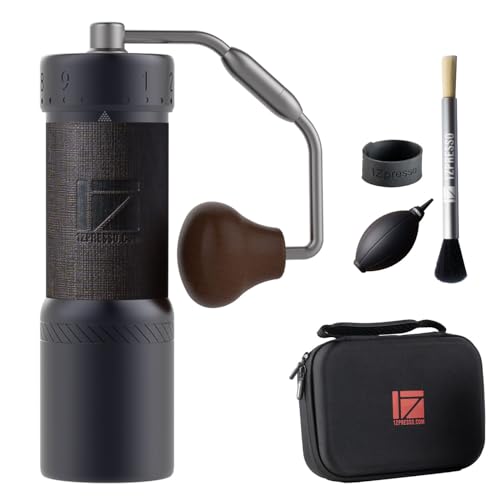
| KINGrinder K6 | externally readable scale according to our data sheet instead of counting from the stop | approx. €99 | 8.8 | you often switch back and forth between espresso and filter |
| Comandante C40 MK4 | spare parts shop with 49 items, made in Germany | approx. €237 | 9.4 | hand grinding will remain your main method for good |
The prices come from the data sheets of our own reviews, as of September 2026, and the rating is our editorial assessment, not a measurement result.
When this grinder fits and when another does
How often is espresso on the menu? That is the question the ESP variant hangs on, and it comes before the four points that our hand grinder buying guide goes through one by one: burr material, shaft bearing, adjustment mechanism and chamber volume. If you make almost only pour-over and French press, the coarser Classic Dial of the other C3 models gives you the simpler tool, and you find your setting faster because fewer steps lie between too coarse and too fine.
The second point is bookkeeping. A setting that cannot be read off has to be written down: a number in your phone, a strip of tape on the body, a card next to the bean tin. As long as there is only one coffee in the house, that costs nothing. As soon as two run in parallel, a light one for filter and a dark one for espresso, every switch becomes a calculation, and a miscount costs you a shot.
The third point is the design itself. One pass covers a double espresso or just under two filter cups, and a hand grinder has no motor: every further portion is a further pass with the crank. Anyone who grinds for more than two cups at once is therefore working against the design. This preliminary decision between hand and electric is sorted by the coffee finder in a few questions, and anyone who ends up with an electric grinder there does not need any of the four rows in the table above.
Then the budget, as a gap rather than a list. The K6 costs around seven euros more, the C5 ESP Pro around 27, the Comandante C40 MK4 around 145. At a purchase price of just under 100 euros, the seven euros are no argument in themselves; the question from the paragraph before decides that. The 27 euros buy a larger chamber and pay off as soon as two portions in a row are regularly needed. The 145 euros mainly buy the ability to buy replacements, and that only pays off if you already know today that you will stick with it.
Who it is built for, and who it is not
The names in the series can be deciphered, and that helps when buying: ESP stands for the espresso dial, Pro for the Pull-to-Fold handle. Timemore lists six variants in its capacity table: the C3, the C3 Pro, the C3 ESP, the C3 ESP Pro, the C3 S and the C3 S Pro. Anyone who needs both ends up with this one. Anyone who wants only the folding handle or only the fine indexing finds the better-suited model alongside it. One line on the series page expressly applies to the C3s and not to this model: burr set, body and components entirely of metal. Anyone sorting the six variants should therefore read the overview page model by model.
In the Amazon catalogue the grinder exists in a single version, C3 Esp Pro in black, model and part number C3 ESP PRO -Black, filed under household goods. What the brand wants to stand for, Timemore writes on its own company page: the designs are based on professionalism, aesthetics, usability and honesty, and the aim is to help people in a fast world find a slower ritual with coffee. As a description of the device it carries surprisingly far.
It is wrong for anyone who wants to repair a device over ten years rather than replace it: for them the Comandante C40 MK4 with its spare parts shop is the more consistent purchase, even though it costs roughly two and a half times as much. For everyone else, at 8.7 it is our beginner pick in the hand grinders category, but not the cheapest way in: ceramic grinders start there at around €31, the 1Zpresso Q Air with a steel cone at €69. What the additional 92 euros buy is the fine end of the scale, and where that end sits in the whole field is sorted by the best-of list hand grinders 2026.