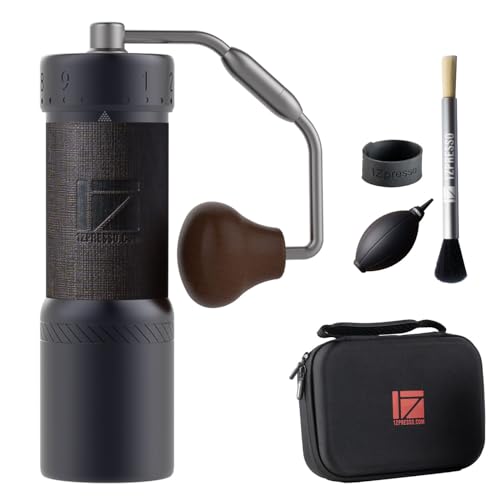
The 1Zpresso J-Ultra costs around €199 on Amazon.de, as of September 2026. In the catalogue it is listed as the J-Ultra Manual Coffee Grinder in Eisen Grau (iron grey); the manufacturer calls the same colour Iron Gray. What is sold is a hand grinder with a clear focus: a coated conical burr 48 millimetres in diameter, an adjustment ring on the outside of the body, and 8 microns of travel per click. Designed for espresso, 1Zpresso writes, and by its own account the 8 microns are the finest step among all models of the brand.
What is inside the grinder
As materials, the product page lists wood, polycarbonate, silicone, stainless steel and aluminium alloy, without saying which part is made of what. Two of them can at least be assigned via the spare parts page: a wooden knob and a PC lid appear there as separate positions, PC standing for polycarbonate.
The body is rounded and has curved edges, which according to the manufacturer makes it more pleasant to hold. The handle folds in. 1Zpresso gives transport and space-saving storage as the reason; the Amazon listing adds that the folded handle prevents the grinder from tipping over.
The dimensions are given as 19 x 18.5 x 5.5 centimetres on the product page; the Amazon catalogue converts the same values to inches. For the weight, the product page and the Amazon catalogue agree on around 700 grams, while the comparison table of the J series on the same website says 670.
The catch cup hangs magnetically under the burr set and comes off with one twist. 35 to 40 grams of grounds fit into it, as the product page says; the Amazon title shortens the range to 40 grams. For the usual 18 to 20 grams of a double espresso that is generous, and for three filter coffees in a row you empty it in between. A hand grinder is dosed portion by portion anyway: you weigh the beans for one brew, grind them and take the cup off at the bottom. For the workflow, therefore, how quickly the cup comes off matters more than how much fits in.
In the box, besides the grinder, there is a cleaning brush, a blower and a carrying bag from 1Zpresso. Brush and blower are not a pointless extra here: the manufacturer advertises that the grinder can be taken apart without a screwdriver, and that is exactly what you need both for.
In detail: eight microns per click
The adjustment ring sits on the outside of the housing. One full turn has 100 clicks and ten labelled numbers, so ten clicks per number, and a single click moves the burr by 0.008 millimetres. One turn is therefore 0.8 millimetres, and over the five turns that the English manual gives as the total travel, that adds up to 4 millimetres.
Espresso is pushed through a tightly packed bed of ground coffee under pressure in about half a minute. There, the particle size determines the resistance, and even a small change shifts the flow time noticeably. Pour-over and French press work with gravity and a long contact time, and the same step changes almost nothing there. Manufacturers therefore build fine click spacing for espresso and not for the jug.
What the brand builds this spacing for, it says itself: the sweet spot of espresso should be easier to find with it, and the product page credits the coated burr with raising sweetness and accuracy.
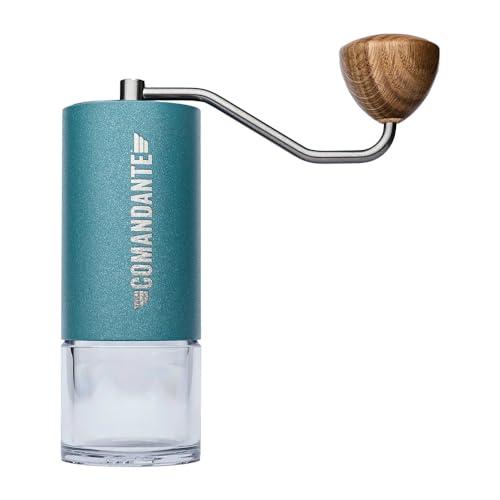
The second point is readability. You read off a number and count the clicks behind it. Grinders without a scale force you to count from a zero point you have found by feel and to keep the setting in a notebook; the Comandante C40 MK4 works exactly this way. If you grind espresso in the morning and pour-over in the afternoon, you save yourself this intermediate step, and how to approach a setting systematically is described in our guide Coffee grind size. You still have to try it out; the scale only spares you the work of finding it again.
The burr set is a cone 48 millimetres in diameter, which 1Zpresso lists as coated and calls advanced coating in its advertising. A cone pulls the bean in and crushes it in stages on its way down. That is the reason why hand grinders almost always contain cones: flat burr sets work through rotational speed, and speed is exactly the quantity a hand crank does not deliver.
1Zpresso advertises the diameter as a speedy 48mm design and describes the run as particularly smooth. The mechanics behind it are simple: the larger the cone, the more ground coffee is produced per turn, and the fewer crank turns the same dose costs.
Is the J-Ultra also the right grinder for filter coffee?
Sensible, yes; necessary, no. The Amazon listing narrows the intended use even more than the product page, saying the coated conical burr was developed specifically for espresso, and at the same time stretches it into the ultra-fine range for Turkish coffee. For pour-over and French press you pay for a click spacing that you never use to its limit there.
The mention of Turkish coffee describes the fine end of the scale. Turkish coffee is boiled together with the powder, the grounds stay in the cup and therefore have to be even finer than for espresso. About the coarse end, where the jug sits, this range says nothing.
What remains for filter coffee is the rest of the grinder, that is, the 48 mm burr set and the magnetic cup. However, which click values 1Zpresso suggests for V60, French press or moka cannot be read from the manufacturer’s pages, as the official Grind Setting Reference Chart is only available there as an image. You can also get a conical burr set and a catch cup for less: two models are in the table, and on burr diameter the two can be compared: the Timemore C5 ESP Pro works with 42 millimetres according to Timemore, the KINGrinder K6 with 48 like the J-Ultra, a figure that KINGrinder, however, only gives in its comparison article on the smaller K5.
What 1Zpresso does not state
The most striking gap concerns the component that matters. For the burr, no manufacturer page says more than coated, neither a material nor a coating material. How the housing is manufactured also remains open; the word CNC appears nowhere. For the shaft bearing, the manual and the spare parts list do list an upper bearing and an upper and a lower bearing cap, but whether balls run in them is not stated anywhere. How long a grinding session takes is likewise not quantified: neither seconds nor crank turns per dose, and we have not measured anything ourselves. Also without a figure are the capacity of the bean hopper, the length of the handle, the effort required at a fine espresso setting, the country of manufacture, the year of release and a list price in euros, as the manufacturer’s shop quotes in US dollars.
There is also a contradiction in the manual itself. In one place it gives five full turns as the adjustment range, in another four and a half from the zero point. That is 500 against 450 click steps and 4 against 3.6 millimetres of travel at the burr. In practice this means: count your own travel from the zero point instead of relying on the total.
What else comes into question
| Model | The difference | Price | Our rating | Choose this one if |
|---|---|---|---|---|
| 1Zpresso J-Ultra (this one) | Readable scale, 10 numbers and 100 clicks per turn at 8 microns each | approx. €199 | 9.1 | you grind espresso and want to note down your setting |
| Comandante C40 MK4 | 49 spare part positions in the manufacturer’s shop, but no number scale on the ring | approx. €237 | 9.4 | you want to keep and repair the grinder for decades |
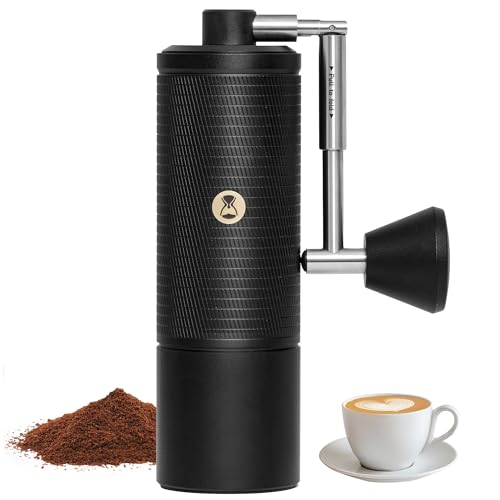
| Timemore C5 ESP Pro | Smaller burr set, 42 mm according to our data sheet against 48 mm | approx. €119 | 8.9 | your budget ends at around €120 |
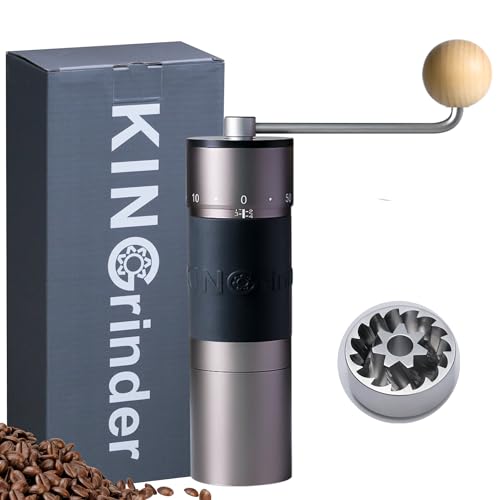
| KINGrinder K6 | Around €100 cheaper, 16 microns per click against 8 according to KINGrinder | approx. €99 | 8.8 | it will be your first serious hand grinder |
What the table offers is prices as of September 2026 and our editorial rating side by side. We have no measured values for particle distribution for any of the four grinders, which is why a column for it is missing.
When the J-Ultra fits and when another grinder does
Espresso every day, plus the wish to write down a setting you have found and to find it again after the next change of beans: this grinder is built for that. Anyone who sets the grind once and then leaves it for two years pays for a scale they never touch.
On quantity, the catch cup sets the limit. It holds 35 to 40 grams, and for a jug one usually reckons with around 60 grams of coffee per litre of water, which the brew calculator breaks down for your jug size. A jug for four people is therefore ground in two batches, and you turn the crank yourself. If you are still undecided between hand and motor, the finder sorts that out; if you grind for four people every morning, an electric grinder gets you finished sooner.
On budget, €199 stands against €99 for the KINGrinder K6 and €119 for the Timemore C5 ESP Pro; which designs exist besides these is sorted out by our hand grinder buying guide. What the extra money buys is in the table above. Whether it pays off depends on a single question: how often you turn the ring. Someone who buys a bean, uses it up and buys the same one again rarely turns it. Someone who tries a different roaster every two weeks sets up anew with every bag, and then a readable scale pays for itself in saved failed attempts.
For travel, the equipment speaks in its favour: folding handle and bag are included. Even so, with its 19 centimetres of length, the J-Ultra does not fit into a jacket pocket.
Cleaning, spare parts and what running it costs
The grinder needs no consumables, neither filters nor descaler. Washing is ruled out as well: the manual forbids cleaning the J-Ultra with water and allows water or alcohol only for wiping. What remains are the brush and the blower from the box, plus a complete strip-down once a month, which the manufacturer’s FAQ advises; which residues really cause trouble in the process is explained in the guide Cleaning a coffee grinder. Running it therefore costs no money, only time.
1Zpresso puts the service life of the burr set at 100 to 200 kilograms of beans. Converted to a household: anyone who grinds two double espressos of 18 grams each every day gets through a good 13 kilograms a year, and so reaches seven to fifteen years. The range comes from the manufacturer; the conversion is ours.
The sore point comes after that. The burr set itself is not on the spare parts page of the J-Ultra, and the manufacturer’s FAQ describes a replacement service as still in development. As long as that stays so, the life of the grinder ends with that of the burr, and for a device costing €199 that is a statement. It is not a unique feature of the brand, though: for Comandante too, according to our data sheet on the C40 MK4, no complete burr set is in the spare parts shop. The difference lies in everything around it that wears, and there Comandante lists 49 individually orderable positions.
For material and workmanship defects, 1Zpresso gives a one-year limited warranty on all its own grinders, according to the product page and FAQ. It does not cover the service life from the calculation above.
Who is it suited to?
Ten hand grinders sit side by side in our hand grinder overview, and ahead of the J-Ultra there is only the Comandante C40 MK4. Eight of the ten are also in the best hand grinders 2026 list; the two Hario models Mini Slim Plus and MM-2 appear only in the overview.
Two groups are better off with something else. Anyone who makes only pour-over or French press will find at 1Zpresso itself a line for exactly that: in the manufacturer’s model guide, the Q series is listed under Pour-over Grinders, and from it comes the 1Zpresso Q Air for around €69, whose adjustment wheel moves 0.025 millimetres per click. JX-Pro and JE-Plus do step at 12.5 microns per click, which is also coarser than the J-Ultra, but 1Zpresso itself lists the JE-Plus as an espresso grinder.
The second group buys for twenty years. Why this calculation is uncertain for the J-Ultra is explained above under spare parts; anyone who wants to take it on anyway should plan the burr as a wear part.
According to the Amazon listing, the J-Ultra comes factory-calibrated out of the box; everything else you do with the numbers on the ring.