In the manufacturer’s shop the Q Air costs US$69.00 before tax; prices there are given in dollars only. In the Amazon.de catalogue it was €69.00 on 7 September 2026. Officially it is called the Q Air Manual Coffee Grinder and is the lightest of the three grinders in the Q series, 20 per cent lighter than the Q according to 1Zpresso. What it is built for, the manufacturer states on its own product page: for pour over.
What is inside the Q Air
The product page lists 420 stainless steel, 304 stainless steel, polycarbonate and wood as materials, but does not assign any material to a component. For the body, a second manufacturer page helps. In the Q series comparison table, the Q2 S and Q are each listed with aluminium, while the Q Air is listed with Plastic. The Amazon title says the same, with a plastic body. So only the two sister models, the Q2 S and Q, have aluminium.
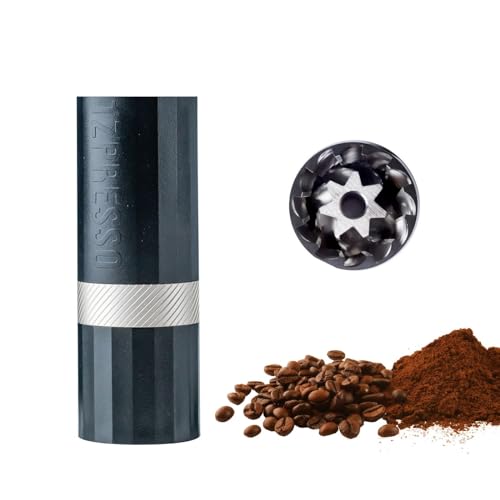
The product page gives 14.5 x 15 x 4.6 centimetres, and the Amazon catalogue converts the same values into inches. This is an overall envelope dimension, and nothing says which edge belongs to what. In the product photo the body is a slim cylinder with a shiny metallic ribbed ring in the lower third, so round, not angular. It cannot be more than 4.6 centimetres in diameter, and we do not calculate a volume from an envelope dimension.
On weight, the product page contradicts itself. The specification list says 365 grams, the promotional line on the same page says 370. The Amazon catalogue lists 0.8047 pounds, which converts to around 365 grams and so supports the specification.
The burr set is a seven-sided stainless steel burr. 1Zpresso calls it the New Heptagonal Burr, expressly claims it for the Q and Q Air, and credits it with making grinding easier than before. In the product image it lies separately next to the grinder, a star profile around a central bore. The central shaft sits in two bearings; the product page speaks of a double bearing and a three-axis construction and gives this as the reason for a stable and even grinding process.
The handle does not fold. The same model table gives the Q Air an X for this where the Q2 S and Q get an O. For colours, the specification lists blue, grey and violet, and the shop’s selection list adds Black, so four; the unit listed on Amazon is called Q Air Black.
In detail: 30 clicks and 25 micrometres
The adjustment is internal. 1Zpresso assigns the Q series to the classic internal adjustment design: the adjustment dial sits inside on the shaft, not as a ring on the outside of the body. The Q Air therefore has no scale you can read from the outside. The numbers run along on the adjustment dial itself and are read at a marker that the German manual simply calls a dot.
The figures are in the manufacturer’s official adjustment table: 10 numbers and 30 clicks per turn, three clicks per number, 0.025 millimetres of burr travel per click. The German manual counts the full turn as 0.75 millimetres, which works out with thirty times 0.025.
25 micrometres per click is a little over three times the 8 micrometres that 1Zpresso gives for the J-Ultra. For pour over it is still a fine division, and the reason lies in the brewing. In a pour-over dripper water runs through a loose bed by gravity, the contact time is long, and a single click changes little. Espresso forces water under pressure through a tightly packed puck in around half a minute, and there the same click shifts the flow time noticeably. Manufacturers build fine steps for the portafilter machine, not for the pot.
A manufacturer warning belongs here: according to the manufacturer’s FAQ you should not turn the handle during the first clicks from the zero point, because that can damage the burr set. When adjusting, you therefore count first and grind afterwards.
Which grind settings 1Zpresso gives for which brewing method
The Q Grind Setting Reference of 23 April 2026 is an image chart with three bars. AeroPress, moka pot and drip machine sit at number 12 to 20, siphon and pour over at 18 to 32, French press at 26 to 38. Because one turn covers ten numbers and thirty clicks, these are 36 to 60, 54 to 96 and 78 to 114 clicks from the zero point. The numbers come from the manufacturer, the conversion into clicks is ours.
Between two whole numbers there are three clicks, and the chart points this out specifically: these intermediate steps are the fine tuning. To change from the AeroPress to the French press you therefore turn, depending on the starting value, one and a half to two full turns, and for tuning within one brewing method single clicks. How to approach a setting systematically is covered in the guide Grind size; the ratio of coffee to water is scaled to your pot size by the brew calculator.
1Zpresso lists one further use separately: the Q series also works with the in-house Y3 Coffee Maker.
Is the Q Air suitable for espresso?
According to the manufacturer’s documents, no. The grind setting reference of the Q series lists AeroPress, moka pot, drip machine, siphon, pour over and French press, but no espresso range. In its own model advice, the Q series is listed under Pour-over Grinders, and for espresso 1Zpresso points to the JE-Plus and J-Ultra.
That the moka pot is on the list is not a release for the portafilter machine. In the stovetop pot only a fraction of the pressure builds up that a portafilter machine works with, and the grounds are correspondingly coarser. The chart shows this in the division itself: the moka pot shares its bar with the drip machine.
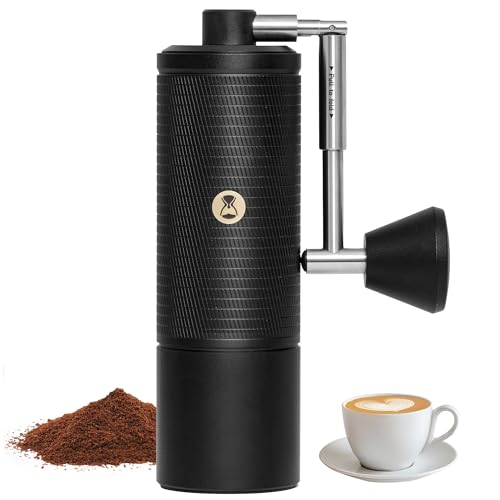
If you want one grinder for both, you will find it one price class higher. Timemore gives 0.0233 millimetres per click for the Chestnut C3 ESP Pro and advertises it in the Amazon title for espresso through to French press; it costs approx. €92 instead of €69. Within the 1Zpresso range the J-Ultra would be the answer, and it is at approx. €199.
What 1Zpresso does not state
Bundled so that it is all in one place: 1Zpresso does not give the burr diameter for the Q Air on any of its own pages, the series is described only as small burr size, and third-party sources contradict each other between 38 and 40 millimetres, which is why no figure appears here. For the burr there is also no documented hardening process or coating; the only documented items are the materials, 420 and 304 stainless steel. Whether balls run in the two bearings or whether they are plain bearings, the manufacturer does not say anywhere.
Also without information remain the volume of the catch container, the maximum amount of grounds in it, the grinding time per fill, the effort at the handle, the running noise, measured values for particle distribution and the total number of click steps from stop to stop; we have not measured any of this. When buying, two more pieces of information are missing: whether the black variant Q Air Black is identical in construction to the three colours named in the specification, and what the grinder is meant to cost in euros, because the manufacturer’s shop works in dollars. According to the product page it ships from Taiwan, which does not yet name a country of manufacture. And no datasheet as a PDF exists: the Q manual is available only as a web page, the grind setting reference only as an image file.
What else comes into question
| Model | The difference | Price | Our score | Pick this if |
|---|---|---|---|---|
| 1Zpresso Q Air (this one) | Stainless steel burr, 30 clicks per turn at 0.025 mm each, 365 g | approx. €69 | 8.5 | you want a pour-over grinder for your luggage |
| Porlex Mini II | Ceramic burr, 16 clicks per turn and 18 steps according to Porlex | approx. €69 | 8.3 | you want to be able to wash the parts with water after camping |
| Timemore Chestnut C3 ESP Pro | 0.0233 mm per click, for espresso through to French press according to the Amazon title | approx. €92 | 8.7 | you also want to use the same grinder on a portafilter machine |
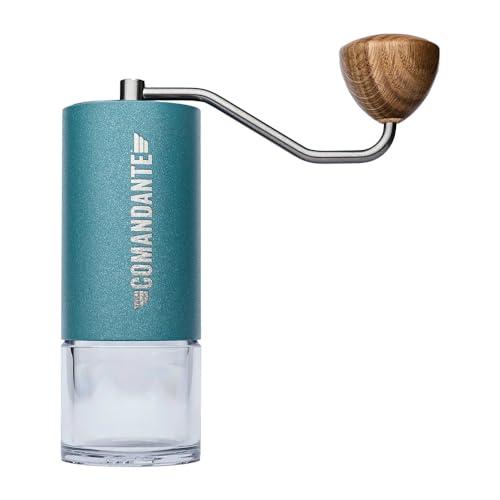
| Comandante C40 MK4 | 49 spare part items in the manufacturer’s shop | approx. €237 | 9.4 | you want to repair the grinder over the years instead of replacing it |
Prices apply as of September 2026; the score is our editorial rating based on build quality, performance, handling and value for money. We have no comparable measured values for grind distribution for any of the four grinders, which is why the table has no column for it.
When the Q Air fits and when another grinder does
The first question is the brewing method, and it decides almost on its own. For everything except the portafilter machine, 1Zpresso gives its own starting settings; the numbers are further up. The price does not change that.
Next comes quantity. The hopper holds 15 to 20 grams, and the German manual gives about 20 grams maximum. For a large cup or an AeroPress, one fill is enough. For a one-litre French press, our brew calculator uses a default ratio of 1:15, so around 67 grams of coffee and thus four to five fills in a row, each of which you crank through yourself. From three fills in a row we would recommend an electric grinder.
Third point: luggage. As storage space both 1Zpresso and the Amazon listing name the AeroPress chamber; weight and edge lengths are given further up. Neither source says anything about the French press as a hiding place; if you plan on that, measure your own pot first. Because the handle cannot be folded, the grinder also takes up its full length in the rucksack.
That leaves patience when setting. Without a scale on the body you count clicks from a point you find yourself, and note down the result if you want to find it again. If you would rather read the number from the outside, you need a model with external adjustment: at 1Zpresso that is the J-Ultra mentioned above with 100 clicks and 10 numbers per turn.
On budget, €69 stands against €92 for the Timemore and €237 for the Comandante. What these premiums buy is in the table above; which other designs exist is sorted by our hand grinder buying guide. And if you are still undecided between hand and motor, you can settle it in four questions in the coffee finder.
Cleaning, durability and what running it costs
The manual’s wording is unambiguous: this product must not be washed or soaked for cleaning. Five precautions follow below it, namely these: do not clean and wash the burr set with water; use no solvents other than water and alcohol for wiping; keep the grinder dry, which extends its life; follow the instructions when assembling and put the components in the correct position; and keep the grinder away from children for safety reasons. The ban applies across the whole product, with no exception for individual parts. The dishwasher is therefore out.
For in between, the manual describes a short way: unscrew the burr set, holding the catch container with one hand and loosening the body clockwise with the other. Then clear the thread of coffee grounds and screw the body back on anticlockwise. The instructions point out the grounds in the thread specifically before moving on to screwing together.
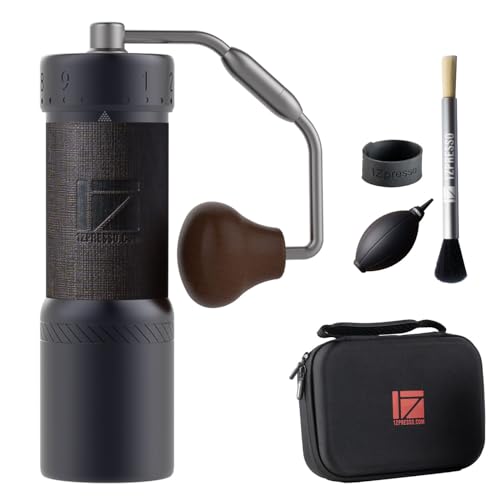
Deep cleaning needs no tools, which according to the manual applies to all 1Zpresso grinders. You fit the handle, hold it still and loosen the adjustment disc anticlockwise. The adjustment disc, inner burr, spring and lower bearing cover are then exposed. If you take off the handle, the central shaft comes out of the hopper. Cleaning is done with a brush and air blower. For reassembly the manual gives the order: lower bearing cover with the convex side towards the bearing, then spring, burr and adjustment disc, and finally tighten the adjustment disc clockwise to the stop while holding the handle firmly. The manufacturer’s FAQ recommends this complete clean once a month, which preserves grind quality and service life. What actually builds up in a grinder is explained in the guide Cleaning a coffee grinder.
Three assemblies are off limits here, and the manual lists them expressly: the sharpening ring unit including the outer sharpening ring, the screws and the bearings fixed to the hopper.
The grinder needs no consumables, neither filters nor descaler. It costs you time, not money. 1Zpresso puts the service life of the burr set at 100 to 200 kilograms of beans, and the Amazon listing repeats the range. If you grind one 20 gram fill a day, you get through a good seven kilograms a year and so reach just under fourteen to a good twenty-seven years; if you grind three times a day, just under five to a good nine. The 100 to 200 kilograms is the manufacturer’s figure, the rest is a rule of three.
After that it gets thin. The manufacturer’s shop does not carry a replacement burr, and the manufacturer’s FAQ describes an exchange service as still in development. For a grinder at €69 that weighs less than for one at €200, but it remains the difference to the Comandante C40 MK4, which has 49 spare part items in its own shop, although it too has no complete replacement burr set.
Who is it for?
Ten hand grinders sit side by side in our hand grinder overview, and the Q Air is in sixth place there with 8.5. Eight of them are also in the best hand grinders 2026 list. 1Zpresso itself expressly recommends the Q series to beginners.
One group still gets this wrong: anyone looking for a grinder that they can hold under the tap after camping. The manual rules out washing and soaking. Cleaning is done with a brush and air blower, and wiping, according to the manual, only with water or alcohol. For the same money the Porlex Mini II stands alongside, and that one may go near water: in its instructions Porlex recommends washing the ceramic burr with a small brush and the other parts with a soft sponge, then letting them dry well. The same instructions expressly forbid the dishwasher and microwave.
In its own shop the Q Air stood at 4.87 out of 5 points from 15 ratings on 8 September 2026. Fifteen votes are a thin basis, and the page that sells the device collected them.