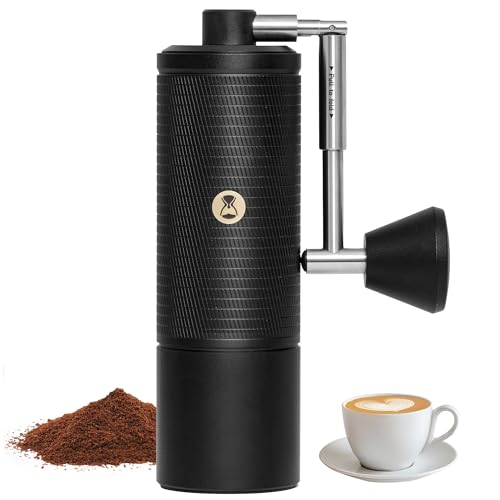
The Timemore C5 ESP Pro is a hand grinder with a 42 millimetre conical burr set, built for espresso, and sells in German retail for approx. €119; this figure comes from our own price list of July 2026, and we have no current Amazon catalogue entry for this ASIN. In the manufacturer’s shop it is listed at US$115.00.
Timemore is a Chinese specialty coffee equipment brand, and it names Matt Winton, the winner of the World Brewers Cup 2021, as its technical adviser. As guiding principles for its designs, the company page lists four terms: professionalism, aesthetics, usability and honesty. In our category, the C5 ESP Pro is the step up from the Chestnut C3 ESP Pro: the same design, a larger burr set, more capacity, for roughly €27 extra.
The burr set: 42 millimetres, seven cutting edges
Timemore calls the burr set S2C-042-III and gives it a diameter of 42 millimetres and seven cutting edges. The manufacturer files the geometry under All Purpose, so it is not tailored to a single brewing method. The C3 series uses a different burr set, the S2C660 with 38 millimetres in stainless steel. On the material of the C5, the manufacturer gets vaguer: the table lists stainless steel and aluminium as the grinder’s materials, but Timemore does not assign which part is made of which.
Timemore puts four figures front and centre for the jump to the C5: 19 per cent more burr set, a 16.23 per cent longer grinding path and 5 per cent more consistency, each of these three compared with the C3s, plus 260 per cent more grind steps in the ratio C5 ESP Pro to C3 ESP. What the 19 per cent refers to is not stated. For the diameter, Timemore gives 38 millimetres for the C3 and 42 for the C5, which is 10.5 per cent more. That calculation is ours, based on Timemore’s two diameters.
Timemore gives the 5 per cent consistency without a measuring method, so we pass it on as it stands: a statement by the manufacturer about its own product.
Our assessment of the burr set: the increase is real and has a plausible consequence, namely fewer turns for the same dose, because more bean passes through the gap with each turn. Timemore gives no figure for how much fewer.
Dimensions, weight, body
The barrel measures 53 millimetres in diameter at a height of 172 millimetres, the unfolded handle sticks out 167 millimetres, and according to Timemore the weight is around 640 grams. Timemore describes the body as a unibody, meaning one piece rather than bolted segments; there is a silicone base at the bottom and a widened filling opening at the top, which Timemore calls the XL Inlet and which is meant to make filling easier without a funnel. According to the brand, the ESP variant comes in exactly one finish, Etched Black.
The figure on which the travel question hangs is the height. Timemore advertises the C5 as compact and travel-friendly, and measured against a 42 mm burr set that holds true. Next to the little sister it looks different: for the C3 ESP Pro, the Amazon catalogue lists 147 by 52 millimetres and 530 grams. That leaves 25 millimetres more height and 110 grams more weight at practically the same diameter. A cylinder of 53 millimetres fits in any kitchen drawer and most side pockets. Whether 640 grams should go in the rucksack is a decision nobody can take off your hands.
In detail: what 0.015 millimetres per click means
The ESP variant differs from the C5 Pro in the adjustment dial. Timemore offers two dials for the series, a standard dial and an espresso dial, and the manufacturer credits both with a more distinct click feel and finer steps. For the espresso dial, Timemore gives 0.015 millimetres of adjustment travel per click, plus 50 clicks per revolution and three revolutions for the whole range.
The same product page contains a contradiction worth knowing about. The promotional block at the top speaks of 50 settings per revolution, while the tech specs table below it speaks of 10 macro steps per revolution with 50 clicks across the whole travel. Both come from Timemore, and both are on one page. The value per click is not in dispute, and we use it as our reference.
Why click density matters for espresso and hardly for pour-over: espresso passes through the coffee grounds under pressure and in a short time, so even a small change in particle size shifts the flow time noticeably. French press and pour-over work with gravity and a long contact time, where the same step hardly makes a difference. Fine stepping is therefore not an end in itself, but the precondition for correcting deliberately after a shot that ran too fast, instead of guessing.
For context, here is the little sister’s figure: for the espresso dial of the C3 series, the data sheet gives 0.0233 millimetres per click at 30 clicks per revolution. One click on the C5 ESP Pro therefore moves about a third less. What finer stepping does not deliver is any statement about how tightly the particles cluster around their mean. That depends on the burr set and on how the shaft is guided. Timemore publishes no measurements on this for either model, and nobody here has measured it.
How much coffee fits in one pass?
According to Timemore, one fill is enough for two full cups. The manufacturer does not say what cup size it assumes, and the calculation hangs on exactly that. Documented are 30 grams of capacity in the grinding chamber and 25 grams in the catch cup, so the narrower point is the cup. For filter coffee the claim works out: two cups of 200 millilitres each at 60 grams per litre need 24 grams together, which the cup can just about hold. A whole litre, at around 60 grams, is far outside that. For espresso the manufacturer’s claim does not hold. At 18 grams per shot you get one double plus a partial remainder; two doubles in a row would be 36 grams and exceed both the 25 gram cup and the 30 gram chamber.
The catch cup is the most visible change from the C3. For the whole C3 series, Timemore lists 20 grams in the data sheet without saying whether that means the chamber or the cup; the Amazon catalogue text for the C3 ESP Pro speaks of 20 to 25 grams of beans per pass. For the C5, both values are listed separately, 30 grams for the chamber and 25 grams for the cup, and the manufacturer expressly justifies the new cup with larger quantities.
If you want to know the requirement for a particular recipe beforehand, you can work it out in the Brew Calculator. Our assessment: the buying threshold is not the sentence about two full cups, but the calculation before it. One pass covers a double espresso or two medium filter cups. For a household that needs four cups in the morning, even the C5 ESP Pro is still the wrong design. You then grind twice, and the cranking effort doubles with it.
What Timemore does not state
The product page is unusually detailed for a hand grinder, but in places it still stops short. Left open are: where the grind adjustment sits (for the C3 series the description expressly mentions an internal dial, for the C5 only a redesigned one), how the shaft is mounted (dual bearings are documented only for the C3 series), whether and how the burr can be removed without tools, what material the burr set itself is made of, how long a dose takes and how much force an espresso-fine setting costs, how loud the grinder is when cranking, how large the packed dimensions are with the handle folded, in which country it is manufactured and when the series came onto the market at all. Nothing is stated either about the dishwasher, about caring for the silicone base, or about whether the catch cup and handle are interchangeable with C3 parts.
Three of these gaps have consequences when buying. Without a statement on the bearings, there is no saying whether the C5 inherited the C3’s dual bearings, and that is exactly what carries the load at fine settings. Without a spare parts programme, a worn burr set is the end of the grinder; no spare parts section for the C5 series can be found on timemore.com. And the Amazon page behind the ASIN in our data sheet currently returns no catalogue data. Dimensions and material details for the C5 in this text therefore come from timemore.com, the euro prices are retailer prices from our database, and the C3 ESP Pro dimensions come from the Amazon catalogue.
For the same reason we hold back on availability. On the retrieval date, 6 September 2026, the product page showed a sold-out notice for every variant along with an announcement of restocking, while the structured data of the same page reported stock. That is a snapshot of the US shop and says nothing about what a German retailer has on the shelf right now. We therefore do not give a stock figure for this model at all.
What else is worth considering?
| Model | The difference | Price | Our rating | Choose this if |
|---|---|---|---|---|
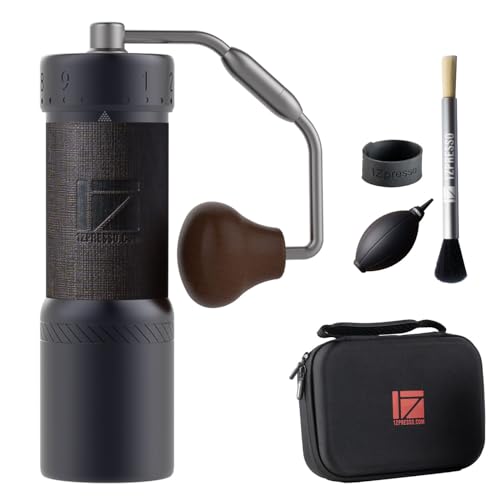
| Timemore C5 ESP Pro (this one) | 42 mm burr set, 0.015 mm per click, 30 g grinding chamber | approx. €119 | 8.9 | you grind by hand but do not want to guess between two clicks for espresso |
| Timemore Chestnut C3 ESP Pro | 38 mm burr set, 20 g capacity, 0.0233 mm per click | approx. €92 | 8.7 | you almost always grind just for yourself and often pack the grinder away |
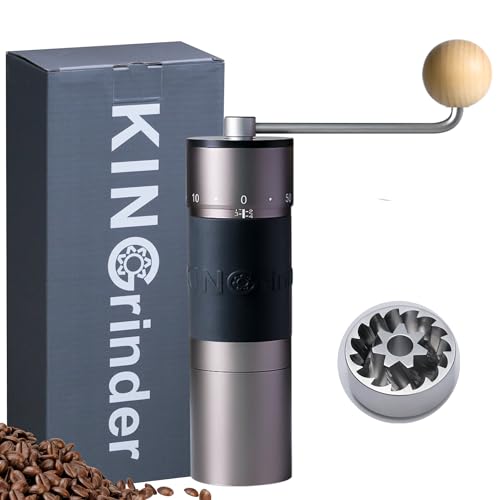
| KINGrinder K6 | according to KINGrinder 0.016 mm per click and 60 clicks per revolution, so 240 clicks over four revolutions | approx. €99 | 8.8 | your budget ends at around 100 euros |
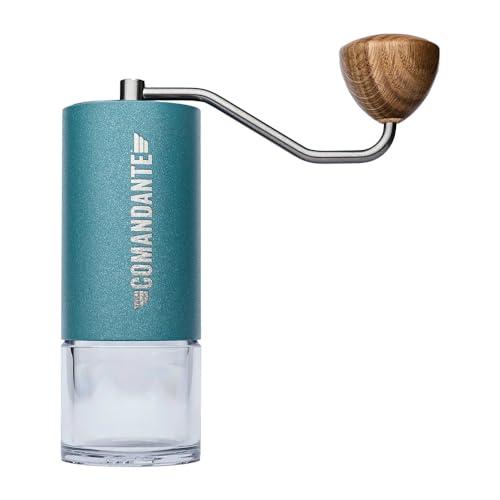
| Comandante C40 MK4 | spare parts shop with 49 items, made in Germany | approx. €237 | 9.4 | you want to repair the grinder over the years rather than replace it |
The table sets our guide prices and our editorial rating side by side, and does no more than that. We have no measurements of the particle distribution of the four grinders, so there is no column for it.
When this grinder fits and when another one does
Four points decide it, and the price is only one of them.
First, the quantity, worked out above: 25 grams in the cup, so a double espresso or two filter cups per pass. If you regularly grind for three or four people, you are working against the design, whatever the model: a hand grinder has no motor, and the finer the grind, the higher the torque at the crank, because the gap between the cone and the ring stands narrower. In that case an electric grinder is the more obvious answer. If you are still undecided between hand and motor, you can sort that out in the Coffee Finder.
Then the budget. €119.00 is the entry cost, and there are no consumables, neither filters nor descaler. The KINGrinder K6 at €99.00 is twenty euros lower. The smaller C3 ESP Pro stood in the Amazon catalogue at €91.99 on 7 September 2026, so about €27 below the C5. That price jumps around, though: a day earlier the same catalogue listed €115.00. For the difference you get four millimetres more burr diameter, the 25 gram cup and the finer espresso dial. What else to look for in a hand grinder is covered in our hand grinder buying guide, and the difference between conical and flat burrs in the grinder guide.
Third, the question of where the grinder goes after grinding. If you leave it standing out, 172 millimetres of height is no issue. If you put it away in a drawer every day, you fold the handle against the barrel. Timemore gives no packed dimension for the folded state; the barrel itself measures 53 millimetres in diameter at this 172 millimetre height and so fits in almost any drawer.
And fourth, the willingness to work out a setting for yourself. Here you get a dial with very small steps and no table telling you where espresso begins. If you want to set a number in the morning and get going, you are better served by a grinder with a readable scale.
Who is it for?
Timemore itself divides the C5 series by brewing method: the manufacturer describes the ESP variant with its finer steps as the grinder for dialling in espresso, and recommends the standard C5 Pro with the coarser dial for pour-over and the occasional espresso. The C3 series remains in the manufacturer’s shop alongside it, with its own product page and its own data sheet, so the C5 has not replaced it. Our assessment: the split matches what 0.015 versus 0.031 millimetres per click means in practice.
For you, that means: if espresso is your main brewing method, the C5 ESP Pro is the fitting choice in its price class in our hand grinder comparison, with 8.9 just behind the more expensive models in the category. Where it stands across the whole field, you can see in the best-of list Hand Grinders 2026.