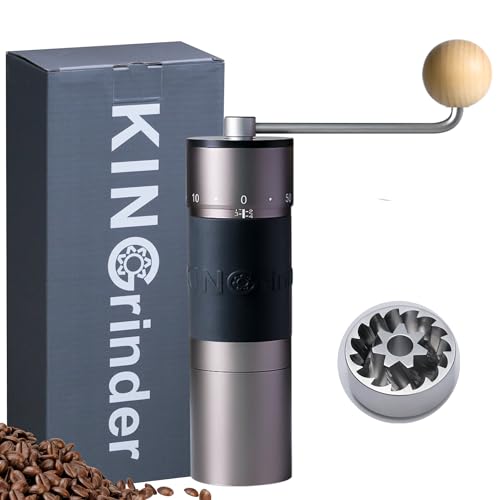
The KINGrinder K6 is a hand grinder with a seven-edged stainless steel burr cone and an aluminium body, priced at approx. €99 on Amazon.de in German retail (as of September 2026). The full name on the manufacturer’s site is K6 Straight Handle Manual Coffee Grinder, and the Amazon catalogue gives the model number K6-Straight Handle. “Straight” refers to the crank: it sticks out straight instead of folding against the body like those of the two Timemore grinders further down in the table.
KINGrinder’s own shop prices in British pounds and showed £99.00 for the K6 in early September 2026, with all variants there marked as sold out. This figure has nothing to do with our €99: the guide price above is a German retailer price from our own list. For Germany the brand points to its Amazon store anyway.
Burr set, body, bearings
The burr set is made of stainless steel, the body of aluminium. This is how KINGrinder divides the materials on the product page, and the distinction is worth remembering: the stainless steel is in the cutting edges, not in the housing.
The cone is ground with seven edges, so it has seven cutting edges. That is not a unique selling point in this class: Timemore also states seven edges for the 42 millimetre burr of the C5 ESP Pro, and Comandante describes the cone of the C40 MK4 as heptagonal, which means the same thing. KINGrinder puts its diameter at 48 millimetres, though not on the K6 page but in the comparison article on the smaller K5, which gets the same burr cone. That puts the K6 well up in this price class: the Timemore C5 ESP Pro works with 42 millimetres, the Chestnut C3 ESP Pro with 38. Our assessment: a larger cone pulls more bean through the gap per turn, so you crank for less time for the same dose.
For the shaft, the manufacturer’s Amazon text states a dual bearing design, and the manual describes, at assembly, a stainless steel bearing with an upper bearing cover, plus a spring and a lower bearing cover on the centre shaft. The word ball bearing appears in neither source, so the type of bearing remains open. What two bearing points above and below bring: they keep the cone on track at a tight gap, where a single bearing allows lateral play. That is design logic; nobody has measured it on this unit.
Dimensions and weight are in the Amazon catalogue: 6.69 by 2.17 by 2.05 inches, which converts to roughly 17.0 centimetres in height and a good five centimetres across, plus 1.3889 pounds, i.e. around 630 grams. The body is round, as the product photo already shows, so the two slightly different cross dimensions in the catalogue do not make a square footprint. The crank is not included in these figures: it sits on top of the shaft and, according to the manual, is fitted before grinding. In the comparison article on the K4, KINGrinder speaks of over 600 grams, which fits the catalogue value. The variant listed with us is iron grey.
In detail: 16 micrometres per click
The adjustment ring sits on the outside of the body, and the scale and turn counter can be read from outside. You do not have to remove the catch cup to adjust, which KINGrinder specifically points out. Counter-clockwise gives a coarser grind, clockwise a finer one.
Each click moves the grinding gap by 16 micrometres, which is the product page’s figure. One full turn of the ring counts 60 clicks, one number on the scale stands for ten of them, and the ring runs over four turns, which the German manual makes visible as turn counter 1 to 4 on the side of the grinder. The manufacturer’s Amazon text says the same in one sentence: 60 clicks per turn, up to 4 turns. Multiplied, its two figures give 240 steps across the whole adjustment range.
How far this takes you is shown by the grind size table on KINGrinder’s home page, which counts in clicks for the K6: Extra Fine 15 to 25, Fine 25 to 60, Medium-Fine 60 to 90, Medium 90 to 120, Coarse 150. The coarsest value stated there is 30 clicks above the manual’s recommendation for the French press, so there is travel left in the ring towards the top. At the bottom, KINGrinder draws the line itself: the Extra Fine column starts at 15 clicks, and below that the crank should not run empty according to the manual.
What 16 micrometres means in practice is shown by the distance between two recommendations in the manual. Between espresso at 40 clicks and French press at 120 lie 80 clicks, which by the manufacturer’s figure is 1.28 millimetres of difference in the grinding gap.
Why fineness matters more for espresso than for pour-over: under pump pressure, even a small shift in particle size changes the resistance in the coffee bed and with it the flow time. In the French press the clock determines the contact time and not the resistance, so five clicks one way or the other hardly matter there.
Zero point, turn counter, starting settings
Before you grind for the first time, you set the zero point. To do this, turn the adjustment ring clockwise until it stops at position 0 at the last stop; according to the manual you expressly do not need to tighten it hard. From there you count counter-clockwise towards coarser, and the turn counters on the side show you which of the four turns you are in.
The manual gives five starting settings, each in clicks from the zero point: Turkish coffee 20, espresso 40, moka pot and AeroPress 65, pour-over 100, French press 120. KINGrinder adds that this table is for reference only and that adjustments to personal taste are intended. How to work your way systematically from one of these values, instead of changing everything after every brew, is covered in the guide on adjusting grind size. The manufacturer’s caveat is more honest than a fixed assignment, because the right grind depends on the bean, roast level, age of the coffee and brew method.
How much coffee fits in one load?
For a double espresso or a large filter cup. KINGrinder gives 25 to 30 grams for the bean hopper on the product page and 30 to 35 grams in its own blog. We work with the smaller figure because it is on the product page.
Two manufacturer statements for the same component, shifted five grams against each other: you should know this if you choose the grinder by capacity. Calculated with 25 grams, everyday use looks like this. A double espresso needs around 18 grams, and a filter cup of 300 millilitres at 60 grams per litre likewise 18. One load covers both. A one-litre pot needs 60 grams, which is three fills and three rounds of cranking. If you grind for three or four people, you are working against the design. The exact amount your recipe calls for can be worked out in the brew calculator.
Cleaning: no water, full strip down every 30 days
Water has no place in this grinder. The manual forbids cleaning with it and provides for a brush or blower; a cleaning brush is included.
Once a month the manufacturer wants more. It recommends a complete disassembly with cleaning at an interval of no more than 30 days, and the manual describes the way step by step: turn the adjustment ring three to four turns counter-clockwise, push the grinding unit up, remove the retaining ring with the other hand, then take out the upper bearing cover and the stainless steel bearing. Tools are neither needed nor permitted. The outer burr stays where it is, and KINGrinder expressly prohibits taking things apart by force.
If you work with the RDT method, that is, dampening the beans with a touch of water before grinding to counter static, then according to the manufacturer’s instructions you spray not into the grinder but into a separate container and only then add the beans. KINGrinder provides a video on exactly this, as well as on the zero point and on disassembly, and the K6 manual is available as a PDF in eight languages, German included.
What KINGrinder does not state
The product page is kept short, and the manual is practical rather than rich in data. Open points: steel grade, hardness and any coating of the burr set; its own dimensions, since height, diameter and crank length are missing from both the product page and the manual; material and volume of the catch cup; the grind size range in micrometres, that is the finest and coarsest achievable value; retention, which is the amount of powder left in the burrs after grinding; grinding time, effort and noise; the country of manufacture; the year the brand was founded and the market launch of the K6; the colour variants, since the product page shows no colour list while Amazon lists iron grey; suitability for the dishwasher, as the only rule there is the ban on water; and the warranty terms in full, including the question of who provides them for Germany. As far as you are concerned, the statutory warranty of your retailer applies here in Germany anyway.
Three of these gaps have consequences when buying. Without a figure for retention, you do not know beforehand how much grounds stay behind when switching between espresso and filter and distort the next dose; if you dose single servings, tap the grinder out to be safe. Without the catch cup volume, it remains open whether a full load of beans will fit as powder at all or whether you are better off grinding straight into a bowl on the scale. And without a statement on grinding time, the very point that counts every day with a hand grinder stays open: how long you crank for 18 grams.
What else is worth considering?
| Model | The difference | Price | Our rating | Choose this if |
|---|---|---|---|---|
| KINGrinder K6 (this one) | 48 mm cone, 16 micrometres per click, straight crank | approx. €99 | 8.8 | you want a larger cone than in the two Timemore grinders and can do without their folding handle |
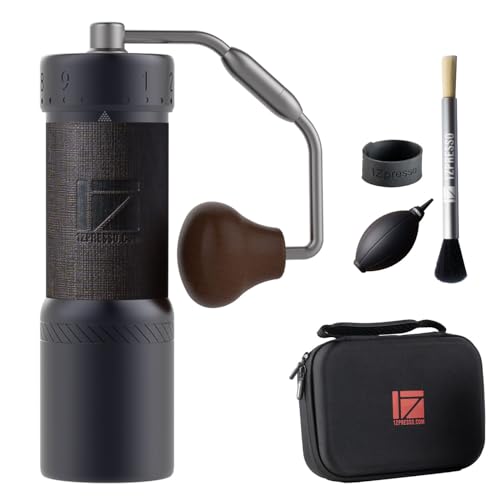
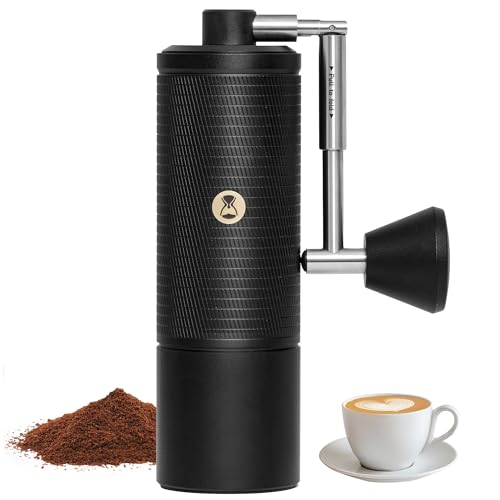
| Timemore Chestnut C3 ESP Pro | 38 mm cone, handle folds against the body | approx. €92 | 8.7 | you mostly grind one cup and often pack the grinder away |
| Timemore C5 ESP Pro | 0.015 mm per click, three turns, folding handle | approx. €119 | 8.9 | you grind almost only espresso and can budget €20 more |
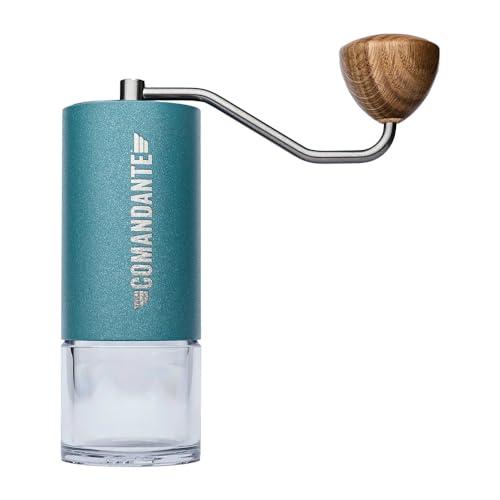
| Comandante C40 MK4 | 49 spare part items in the manufacturer’s shop | approx. €237 | 9.4 | you want to repair the grinder over years rather than replace it |
How evenly the four grinders actually grind is not something the table says: neither any of the three manufacturers nor we publish comparable measurements. It puts four prices as of September 2026 side by side.
When the K6 fits and when another grinder does
Five points decide this, and price is only one of them.
The quantity is stated above: a double espresso or a filter cup per load. For a household where four cups hit the table in the morning, a hand grinder is the wrong design whatever the model.
The K6 covers brew methods broadly, from 20 clicks for Turkish fine to 120 for the French press. If you grind only espresso, you do not need this span and, with the Timemore C5 ESP Pro for €20 more, you get a shorter adjustment travel over three instead of four turns, plus a handle that folds against the body.
The scale helps with adjusting. On the K6 you set the zero point by hand at the stop, then read the setting off the outside: one number on the scale stands for ten clicks, and the turn counter shows which of the four turns you are in. You only have to count the clicks between two numbers, and if you want to find a setting again, note the turn, number and clicks.
Then storage space and transport: around 17 centimetres in height, a good five centimetres in diameter, around 630 grams, a straight crank without a folding mechanism. The Timemore Chestnut C3 ESP Pro is the more compact choice here and costs around seven euros less.
Budget last, and that includes more than the purchase price. What else you measure a hand grinder by and where the limits of the design lie is covered in our hand grinder buying guide. With the K6 it is €99 up front, and after that there are no consumables, neither filters nor descaler. What remains is wear on the burrs, and how fast it comes depends on quantity, roast and on nothing but coffee getting into the hopper.
Who is it suitable for?
KINGrinder describes the K6 as a versatile grinder and gives lightly roasted beans as an example, where the fruity acidity comes through. Light roasts usually end up in the pour-over, and the scale fits that: of the manual’s five starting settings, pour-over at 100 clicks sits well up, only the French press at 120 lies above it, and downwards there are 85 clicks of room to correct before the limit of 15 clicks that KINGrinder draws in the manual and the grind size table. Espresso at 40 clicks, by contrast, sits close to the zero point.
In the hand grinders category the K6 stands with us at 8.8 points and the value pick badge, and how that compares with the rest of the field you can see in the list of best hand grinders 2026. This rating is our editorial assessment and follows from the manufacturer’s figures at this price, not from a measurement.
The K6 is the wrong grinder for two groups. The first buys by data sheet. If you want to know before buying how much powder stays in the burrs, how long a dose takes and what steel the cone is made of, you are better off with a manufacturer that publishes such values. The second wants to still be able to repair the grinder in ten years. Comandante keeps 49 spare part items in its own shop for this, whereas with KINGrinder the route is a contact form; the roughly €138 premium for the Comandante C40 MK4 buys exactly this difference.