Officially, Porlex calls this grinder the Kaffeemühle II Mini, and on the manufacturer’s English-language site it is the PORLEX MINI COFFEE GRINDER II. In Japan it is listed at 9,130 yen including tax in the manufacturer’s price list, while here the guide price is approx. €69 according to our price box on Amazon.de. We cannot give a retrieval date for it, because our Amazon export contains no record for the ASIN B082L26FLX: no catalogue text, no dimensions, no price date. Every statement about the device therefore comes from the manufacturer itself: from the product page, from the manual as a PDF, from the page of the Professional series and from the Japanese price list.
Five parts, pushed together instead of screwed
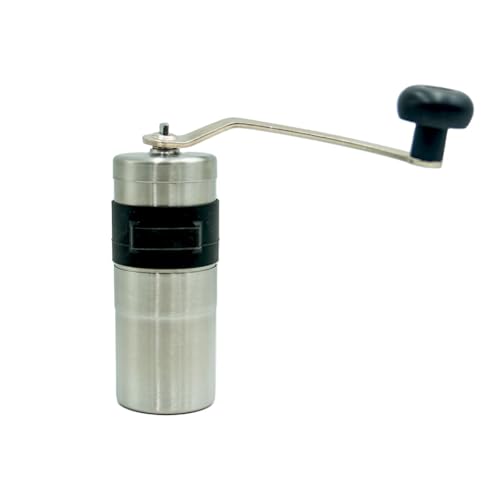
In the product photo the body is a slim, round cylinder. At the top sits a cranked handle with a black knob, and a black band runs around the middle. Judging by the photo, that is the handle holder that Porlex includes with the Mini II.
Lid, body and catch container fit into each other rather than screwing together. Porlex draws two conclusions from this itself and writes both on the product page: because no thread pulls the parts together, the fit is tighter on one unit and looser on another, and the parts are pulled off and put on with a slight twist and slowly.
For cleaning, the grinder comes apart into five parts, which the manual lists individually: body, outer cone, inner cone, inner cone base and adjustment screw. The spring inside the body stays where it is, and the manual has a separate sentence for that. When reassembling, exactly one thing can go wrong: the outer cone has three grooves, the body has three lugs, and they must engage. If the cone sits beside them, it turns along idly when you crank and gets damaged. The shaft, by contrast, turns along on purpose, because according to Porlex the handle then runs more easily.
On the material, the manufacturer says exactly one thing, and it concerns the burr set. The cone is made of porcelain, absorbs no water and can therefore be washed. Porlex rules out rust and a metallic smell for it, and according to the manufacturer it should hardly wear. In the photo the body gleams like metal. Which metal it is remains open.
In detail: 37 micrometres per click
The grind size is adjusted by an adjustment screw, and it clicks. Porlex puts this click mechanism at 16 clicks per turn and an average of 37 micrometres per click, and the manufacturer describes the screw itself as shaped to be easy to grip. The third figure appears on the page of the Professional series, where the manufacturer classes the Coffee Mill II at 18 steps. According to Porlex’s own account, it developed the burr set to work efficiently regardless of roast level and desired grind size.
One full turn moves the cones apart by around 0.59 millimetres, the 18 steps together by just under 0.67 millimetres. The whole range from fine to coarse is therefore one and one eighth turns long. We treat notch, click and step as the same thing here, because Porlex bases all three on the same 37 micrometres. The starting figures come from the manufacturer, the multiplication from us.
You do not have to guess the zero point. The manual describes it as the state in which the shaft can only just still be turned with a finger. From there it gets finer clockwise and coarser anticlockwise, and as you turn, the screw clicks into place audibly and tangibly according to the manual. If you want to find a setting again, count how many clicks you have turned back from zero. A note on your phone takes the place of the scale that other grinders carry on the outside of the housing.
Why the step size matters at all depends on the brewing method, not the grinder. In a pour-over, gravity pulls the water through a loose bed over several minutes, so one click more or less hardly shifts the flow time. In a portafilter, a pump pushes the water through a firmly pressed puck in 25 to 30 seconds, and the same click can change the shot by seconds. Manufacturers therefore build fine click mechanisms for espresso grinders. The guide Coffee grind size describes how to work your way systematically towards a setting.
Is the Mini II suitable for espresso?
The manufacturer says nothing about it. Espresso appears in one single place at Porlex, and that place belongs to the Mini Professional: only it can be screwed in up to 9 clicks below zero, and the manufacturer recommends exactly this range for fine grind sizes such as espresso.
The Professional page sets the figures of both models side by side, and the gap is clear: 36 clicks per turn instead of 16, an average of 28 micrometres per click instead of 37, 60 steps instead of 18. The adjustment travel of the Professional thus comes to around 1.68 millimetres, two and a half times as far as on the Mini II. Bean size also separates the two: up to about 10.5 millimetres in diameter there, up to about 9 millimetres here. On the Japanese price list the Mini Professional costs 12,100 yen against 9,130 yen, a difference of 2,970 yen.
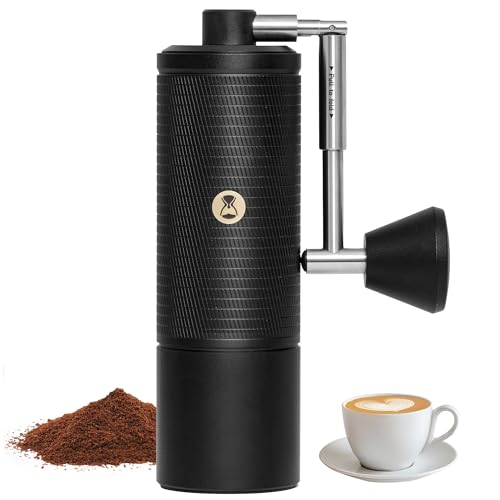
If you want a grinder that serves both pour-over and portafilter, you end up one class higher in our catalogue: Timemore puts the Chestnut C3 ESP Pro at 0.0233 millimetres per click, names espresso expressly as an intended brewing method, and it costs approx. €92, around €23 more than the Porlex.
Twenty grams, two cups
Porlex puts the fill quantity at around 20 grams of beans and converts it on the product page to about two portions, and in the manual to about two cups of coffee. The beans may not be thicker than about 9 millimetres, which is the limit the manufacturer sets for the Coffee Mill II.
The procedure is set out step by step in the leaflet. Take off the lid, add the desired amount, put the lid on. You hold the handle horizontally, press it down lightly and grind slowly clockwise. The powder falls into the catch container, which you pull off and empty directly over the filter. Without the container the body stands upright on the table, and the manufacturer advises setting it on a small plate then, because powder can still fall from the burr set.
Our Brew Calculator works out what 20 grams means in everyday use. Four cups of filter coffee at 125 millilitres each need around 31 grams of coffee at standard strength, so two fills in a row. A French press with one litre comes to around 67 grams and so to four. For a single AeroPress cup, just under 9 grams is enough, which leaves plenty of room in the hopper.
Washing, drying, and what is forbidden
You brush the ceramic cone. As a tool the manual suggests a small brush, for example a toothbrush. For the other parts Porlex recommends washing them under water with a soft sponge, and then comes a sentence that is easy to overlook: after washing, let everything dry well before the grinder is used again.
There is a separate rule for the handle. It must not lie in water for long, otherwise it rusts, and after washing it is wiped dry.
The manual expressly prohibits five things, which stand together there as a list: abrasive cleaners and metal scourers, because both scratch the parts, boiling for disinfection, the dishwasher and the microwave. What remains is washing by hand, and with five individual parts that is not a five-second job. That everything can be taken apart at all is a selling point at Porlex: the manufacturer advertises that all parts down to the ceramic cone can be taken off and washed, so that no powder from the previous fill gets mixed in. What builds up in a grinder over the months is explained in the guide Cleaning a coffee grinder.
What Porlex does not state
Gathered together so that it stands there complete once. The height, diameter and weight of the grinder appear on no page of porlex.co.jp and in no manufacturer PDF. Because the dimensions are missing, we also do not calculate a capacity for the catch container, and a packed size for the rucksack cannot be determined in advance. Also left open are the materials of all parts outside the burr set, the diameter of the cone, possible colour variants, a model or article number and the contents of the packaging beyond the handle holder.
On operation, the second half is missing. Porlex quantifies grinding time per fill, effort at the handle and running noise nowhere, nor are there measured values for particle distribution or the share of fines, and how much drop, cold or moisture the grinder tolerates is not stated in any document. We have not measured any of this. Two further pieces of information are also missing when you buy: Porlex publishes a warranty commitment nowhere, and the manufacturer likewise lists no German distributor, importer or German recommended price anywhere.
What else comes into question
| Model | The difference | Price | Our rating | Choose this one if |
|---|---|---|---|---|
| Porlex Mini II (this one) | Ceramic cone, quantified click mechanism with 18 steps | approx. €69 | 8.3 | a quantified click mechanism matters more to you than steel in the burr set |
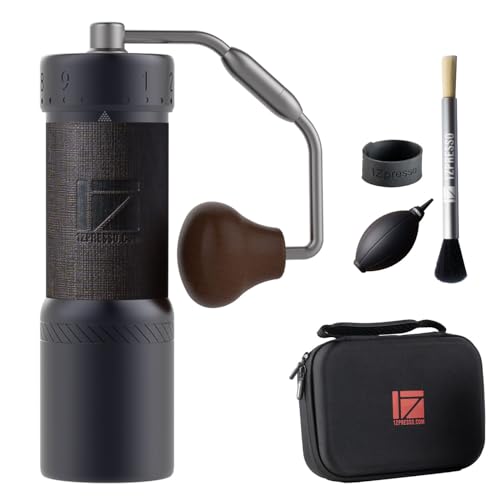
| 1Zpresso Q Air | Stainless steel cone, internal adjustment, 365 g | approx. €69 | 8.5 | you watch every gram in your luggage |
| Hario Mini Slim Plus | also a ceramic cone, according to Hario 24 grams per fill, container made of methacrylate resin | approx. €31 | 7.6 | the grinder should stay under €35 |
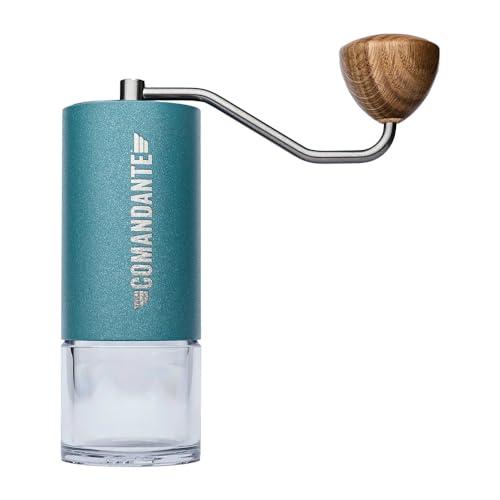
| Comandante C40 MK4 | Cone made of Nitro-Rex special steel, 49 spare part items at the manufacturer | approx. €237 | 9.4 | you grind several cups every day at home |
The price column shows the guide prices from our four price boxes in September 2026, for the Porlex without a catalogue retrieval date for the reason given above. The rating is our editorial classification by build quality, performance, handling and value for money. We have not measured how evenly the four grinders actually grind, and we have no comparable measured values either; the table is therefore not suitable for that.
When the Mini II suits you and when another grinder does
Five questions decide it, and the first is quantity. One fill covers two cups, and for the large pot you crank several times in a row, refilling and taking off the lid each time. From three fills in a row we would recommend an electric grinder or a hand grinder with a larger hopper.
The second is repeatability. The click mechanism is quantified, but you still count in your head: the manual works from zero and from the number of clicks you turn back from there. If you switch back and forth between pour-over and French press, you count every time and write the number down. If that is too fiddly for you, look for a grinder with a scale ring on the housing.
The third is bean size, and it only becomes noticeable when you shop. Whether your variety stays under the 9 millimetre limit you can see in the bag. If you regularly buy conspicuously large beans, you are better off with the Mini Professional.
The fourth is the cleaning ritual. Washing five parts by hand and then drying them completely is the procedure the manufacturer prescribes, and it cannot be shortened. If you want a grinder that goes into the dishwasher basket after the camping weekend, this is the wrong one.
And then the money. €69 stands against approx. €31 for the Hario Mini Slim Plus and approx. €237 for the Comandante C40 MK4. The roughly €38 gap downwards buys you the quantified click mechanism, the jump upwards costs around €168, and the Comandante thus costs more than three times as much as the Porlex. Which designs exist otherwise and how you tell them apart is sorted out by our Hand grinder buying guide; if you are still torn between hand and motor, you can settle it in a few questions in the Coffee Finder.
Manufacturer, ranking, spare parts
Ten hand grinders sit side by side in our hand grinder overview, and the Mini II is there in seventh place with 8.3. How we sort the eight best rated of them is set out in the Best hand grinders 2026 list. The grinder has no running costs; there are no filters or descaler to buy.
According to the manufacturer, Porlex builds the burr sets itself. The company has been developing household products in Japan since 1978, the ceramic cones are made in-house, and production takes place in its own factory in Kirishima in Kagoshima Prefecture. We have not checked how competitors in this price class manufacture. On the same product page Porlex lists a special prize from the 2020 Kyushu regional invention awards, the Minister of Education, Culture, Sports, Science and Technology Prize.
One group is still left short here: everyone who wants to reorder wear parts with part numbers through European retail. Porlex supplies individual parts, and the route to them runs through the manufacturer’s contact form, whose office is in Minoo in Osaka Prefecture. What a single part costs and how long it takes to come from Japan you only find out there on request. For individually orderable wear parts you are therefore better off looking at the Comandante C40 MK4: its manufacturer’s shop lists 49 spare part items, although a replacement burr set is not on the list there either.