Among the ten grinders in our hand grinders category, the Hario Mini Slim Plus has the lowest price at approx. €31.14 on Amazon.de according to the price box, and it is also the one we rate lowest. From the manufacturer it costs more: in the Hario Europe shop it stood at €39.90 on 15 September 2026, and at Hario USA at 40 US dollars. The Amazon catalogue showed €28.69 on 7 September and gives 15 February 2019 as the release date.
On its global grinder list, Hario shows two models with the name Mini-Slim, the Plus and the PRO. This one is called Ceramic Coffee Mill Mini-Slim + by the manufacturer, carries the item number MSS-1DTB and comes in a single colour, Transparent Black. In the Amazon catalogue it appears with the same part number as “Hario Mini Mühle Slim Plus Schwarz” (Hario Mini Slim Plus mill, black). Hario Europe also lists the Bloom Series variant MSS-1DTB-BLM, the same grinder in more environmentally friendly packaging, for €44.90; according to the shop data it was shown as unavailable there on 15 September 2026.
Hario Europe describes it as light, easy to grip and designed for travel, Hario USA as a grinder for travel and home. The Amazon text calls it a “Japanese hand grinder”. The company is Japanese: the instructions name HARIO CO., LTD., based in Chuo-ku, Tokyo, as the manufacturer, a firm that started with laboratory glass in 1921 and came to coffee in 1948. The Mini Slim Plus itself comes from China, according to Hario.
Components and materials
Ceramic is used in two places, the outer and the inner burr. Shaft, thread, spring and handle are made of stainless steel. For the burr adjustment nut, a pin, the washer and the cover of the hopper shaft, Hario uses nylon, and polypropylene for the hopper, grip and cap. The ground coffee container and its cover are made of methacrylate resin, the plastic that acrylic glass is also made from. Glass itself appears nowhere in the materials list of the instructions. For a grinder that is meant to go in your bag, that is an advantage, because acrylic glass copes far better with a knock against a table edge than glass does.
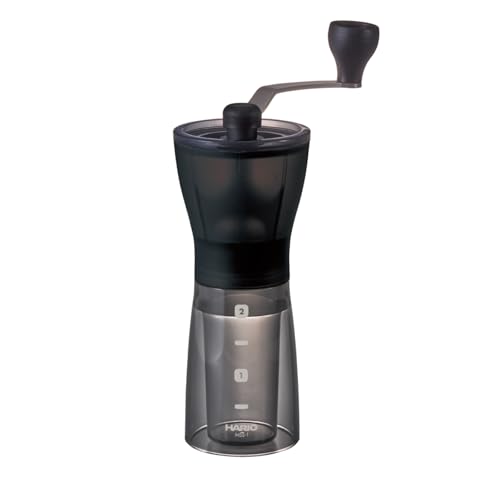
In the product photo the body is round and slim, narrowed in the middle, with the translucent container starting below it. The handle arm sticks out far beyond the edge at the side. For the packed size it therefore matters that the handle can be removed, according to the Amazon text.
Hario gives 150 by 72 by 220 millimetres, and Hario Europe states the same figures explicitly as the box size and adds around 370 grams including the box. The Amazon catalogue works out at 18.3 by 11.2 by 7.9 centimetres and 300 grams, without saying whether the packaging was weighed too. For travel planning the box size is the more reliable figure, because the grinder fits into that cuboid as supplied.
The MSS-1DTB instructions are a PDF that Hario Europe and Hario USA both link to. Over two pages it covers eight language sections, including German, French, Spanish, Portuguese and Korean, and puts four features first: a slim grinder that stores compactly, ceramic burrs, burrs that can be taken apart for cleaning, and a marking from which you read off the amount of ground coffee.
In detail: ceramic cones instead of blades
In a blade grinder, a rotating blade smashes the beans. How fine the powder becomes depends on how long the blade runs, and coarse chunks sit next to dust. A conical burr set works with a gap. The inner cone turns inside the outer ring, a whole bean fits in at the top, it gets narrower towards the bottom, and only what passes the narrowest point falls out. The grind size depends on this gap width; the duration of cranking does not change it.
Hario USA describes the Mini Slim Plus along exactly this line: the ceramic cones cut the beans instead of breaking them up like a blade grinder, transfer less heat and deliver a more even grind that is easy to adjust and to set for the next use. Hario Europe promises a better coffee because of the lower frictional heat. We consider the heat argument weak for a hand grinder. The burrs only turn as fast as your hand cranks, and that is far from the speed of an electric motor.
The instructions credit ceramic burrs with having no metallic smell, not rusting and having sharp, durable cutting edges. The downside is in the precautions. The ceramic burrs should not be struck with hard objects, and the grinder should not be dropped, because the burrs could otherwise chip or break. Ceramic is hard but brittle; a steel cone is tougher and takes a knock better.
Setting the grind size: nut, clicks and sugar grains
The burr adjustment nut is responsible. The handle stays on, you hold it in the middle and turn the nut, to the right (clockwise) for a finer grind, to the left for a coarser one.
No setting is fully closed. If you turn the nut too far clockwise, the ceramic parts grind against each other according to the precautions, and the burrs can be damaged. After the explanation above, that is the point where the gap disappears.
How many detents the adjustment range has is not stated in the MSS-1DTB instructions. Clicks appear in an FAQ sheet that Hario published for the predecessor, the Coffee Mill Ceramic Slim MSS-1: a click can be heard when turning the nut, and one click corresponds to one adjustment step. Counting runs anticlockwise and starts from the fully closed nut, which Hario’s grind size FAQ sheet also defines as zero. The table row for the MSS-1B sets 5 clicks for fine, 10 for medium-fine, 15 for medium and 20 for coarse.
We consider it likely that the Plus clicks in the same way. Hario Europe sells the adjustment nut N-MSS-1 as a spare part for the Mini Slim and the Plus alike, and the FAQ sheet and instructions prescribe the same installation position: the side with eight small bumps around the centre faces the burrs.
Which grind size is for what is shown by a table in the instructions, and it measures in sugar. Fine is as big as caster sugar, coarse like granulated sugar, medium-fine and medium lie in between. Paper filter and drip coffee maker get medium-fine to medium, the paperless filter medium, cloth filter and French press medium to coarse, the siphon medium-fine to coarse. Fine appears in a single row, for the cold extraction device (called “Water dripper” in the English section), and there next to medium-fine. Beneath the table Hario writes that the recommended grind size depends on the brewer, whose instructions contain further details.
Espresso is not one of the seven rows. Suitability for it cannot be read from Hario’s own documents, yet the Amazon catalogue text calls the grind adjustment “suitable for espresso to brewed coffee”.
If you lay the sugar table next to the click sheet, you arrive at 10 to 15 clicks for paper filter and 15 to 20 for the French press. This assignment is our own calculation from two manufacturer sources that belong to two model generations, and it equates the “halbfein” (medium-fine) of the instructions with the “mittelfein” (medium-fine) of the FAQ sheet. The two sheets do not use the same words. In millimetres, the FAQ sheet puts medium-fine at about 0.5 to 1.0 mm, medium at 1.0 to 1.5 mm and coarse at 1.0 to 2.0 mm.
Is one fill enough for two cups?
Yes, but more is not intended. The instructions assume 10 to 12 grams of coffee per cup and say you should put beans for one or two cups into the hopper. Hario gives 24 grams as the capacity. For the third cup you grind a second time.
What the 24 grams refer to is stated differently in the sources. The global product page means coffee beans, Hario Europe and Hario USA mean ground coffee, the Amazon text the maximum capacity of the ground coffee container. Grinding changes the weight practically not at all, so as the limit of one portion the figure works in every reading.
You read the amount off the container. According to the instructions, one line on the scale corresponds to roughly 12 grams and so to one cup, but only as a guideline, because the weight, variety and roast of the beans shift the amount. In the product photo, two marks carry the numerals 1 and 2, with an unnumbered line in between and one below. What the two extra lines stand for, Hario does not say.
Right at the upper limit, the German instructions have a gap. You are not to grind more beans than up to a marking, because the burrs could otherwise be damaged, but where the symbol of the marking should be, the German and the English section leave a blank. In the Portuguese section a 2 in a box stands at the same place. We therefore read the limit as the upper mark, that is, two cups.
When grinding, you hold the grinder firmly, crank clockwise and keep the hopper cover closed. The handle must never run backwards; this is stated twice, under use and in the warnings, both times with reference to damage to the burrs. If the handle is stiff, you do not keep turning by force, since according to the precautions this can damage various parts of the grinder. In the same list, Hario has put the sentence not to reach into the burrs while cranking. Which amount of water goes with your dose is worked out by the brew calculator.
Cleaning, wear and spare parts
To wash it, the burr set comes out. You unscrew the adjustment nut anticlockwise, again with the handle on, and can then remove the inner and outer burrs. Because the burrs can be coated with coffee oil, you soak them in a solution with mild detergent, rinse them well afterwards and let them dry completely. When taking it apart, take care not to lose any parts.
Besides the direction of the handle and dealing with children, the warnings rule out three things: the dishwasher, household bleach and oil for maintenance. Anyone who has so far oiled shaft and handle should leave that alone with this grinder.
The instructions plan for wear. The burrs can become dull after longer use, and if the grinding speed drops noticeably, the grinder is to be replaced. Hario Europe nevertheless sells spare parts individually: the spare parts category for the Mini Slim Plus comprises 13 items, and one of them, the pentagonal handle H-MSS-1, belongs to the older MSS-1TB.
As of 15 September 2026, the inner burr BI-MSS-1-EX costs €6.50 there, the outer burr BO-MSS-1-EX €8.50. The adjustment nut N-MSS-1 is listed at €4.50, the hexagonal shaft SH-MSS-1-EX at €6.50, the handle H-MSS-1DTB at €12.50. For the upper hopper HP-MSS-1DTB the shop asks €8.50, for its cover FH-MSS-1DTB €6.50 and for the lower container BT-MSS-1DTB €12.50. Washer, pin, hopper shaft cover and spring lie between €3.00 and €3.50. According to the shop data, the container and spring were out of stock that day.
A hand grinder needs no filter or descaler; costs only arise when something wears out or gets lost. If the ceramic goes dull, both burr parts together cost €15 in the shop, just under half of the amount from our price box, and we would try this swap before a new grinder.
What Hario does not state
For the burrs, the diameter and type of ceramic remain open, as do the number of clicks over the whole adjustment range, the step size in micrometres and a service life in kilograms or years. For the statements about frictional heat and even grounds, Hario provides no measured values. No bearing appears in the materials list. Whether the shaft runs in a ball bearing or a simple guide therefore remains open, and why that matters for the grind is explained by our hand grinder buying guide.
Grinding time, grinding output in grams per minute, effort at the handle and noise level are left unquantified in use. On the device itself, net weight and dimensions without the box are missing, as are the temperature resistance of container and hopper and any limits on roast level or bean size.
What is in the box besides the grinder and instructions, such as a brush or a pouch, is not listed anywhere; that the instructions are included in German is stated in the Amazon text. Hario names no manufacturer’s warranty either in the instructions or on the product pages, and the terms and conditions of Hario Europe contain none either. This concerns a voluntary commitment by the manufacturer; the seller’s statutory warranty rights remain unaffected. The market launch is also open. The PDF of the instructions was created on 18 December 2017, a good year before the Amazon date.
What else is worth considering?
| Model | The difference | Price | Our rating | Choose this one if |
|---|---|---|---|---|
| Hario Mini Slim Plus (this one) | 24 g per fill according to Hario, container made of methacrylate resin | approx. €31.14 | 7.6 | you rarely need more than two cups at a time and want to spend around €30 |
| Hario Skerton N | up to 100 g in one go according to Hario, glass container | approx. €39.80 | 7.9 | you grind at home and never need to pack the grinder in a bag |
| Porlex Mini II | 37 µm per detent on average according to Porlex | approx. €69 | 8.3 | you want to know how far one adjustment step opens the burrs |
| Comandante C40 MK4 | 7 to 13 clicks for espresso according to Comandante | approx. €236.90 | 9.4 | you grind daily and can spend over €200 on the grinder |
The prices come from our price boxes, the ratings are editorial assessments based on manufacturer data and price. How evenly the four grinders grind cannot be read from the table, because we have not used any of them ourselves.
When the Mini Slim Plus is enough and when it is not
Most depends on quantity. If you need three or four cups in the morning, you empty the container of the Mini Slim Plus after the second and refill the hopper, every day. For that there is the Hario Skerton N in our catalogue, which according to Hario grinds up to 100 grams in one go before you have to empty the glass container underneath. According to the instructions, though, you fill the hopper there too only for one to two cups and top up. In our price box it costs just under €9 more.
For brewing, Hario’s table draws the line, as described above under grind size. Anyone who makes espresso regularly we would point towards a different grinder: Comandante explicitly gives 7 to 13 clicks for it for the C40 MK4, which is around €206 dearer than this one.
Anyone who wants to find the grind size again in numbers pays around €38 more, a good double: for the Porlex Mini II, Porlex gives 16 clicks per turn and the step size in micrometres as well.
On the move, the plastic container is the argument for the Mini Slim Plus. In our assessment it still does not belong in a loose side pocket, because the breakage warning for the ceramic burrs is too clear.
Who is it suitable for?
Hario USA calls the Mini Slim Plus a good grinder for beginners. We follow that as long as getting started means grinding filter coffee in small amounts. Getting started does, however, come with a warning in the instructions: children must not use the product, the grinder should not be used near them and should be stored out of their reach.
It is the wrong choice for someone who often removes the burrs and then wants to be straight back at their setting. For removal the adjustment nut comes off completely, the grind size is lost afterwards, and if the Plus clicks like the MSS-1, you count again from the closed zero point. Anyone who notes down their click count gets back faster.