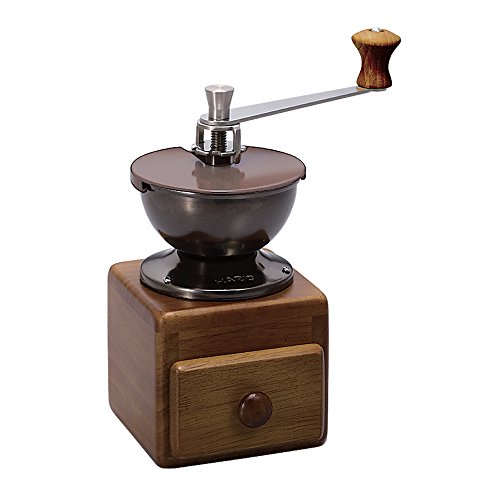
Hario lists this grinder as the Small Coffee Grinder, Hario USA as the Small Ceramic Coffee Mill. MM-2 is the model code, and it appears as the print mark MM-2 1503 on the cover of the instruction manual. In the product photo, a steel bowl for the beans sits on a wooden box with a small drawer, with a crank with a wooden knob above it. No glass is used, unlike the Hario Skerton N: the manufacturer’s material details list wood, steel, stainless steel, ceramic and two plastics.
What Hario sells under the number MM-2
The manufacturer now lists the range as the MMR-2. At Hario, this number appears under the product address for the MM series, the matching manual is version 2301, and the separately findable MM-2 manual is version 1503. Apart from the grind size table, the two agree; more on that in the section on espresso. We therefore treat the MM-2 and MMR-2 as the same Small Coffee Grinder and quote the MM-2 manual, unless version 2301 is expressly mentioned.
It is made in China, which Hario states on the product page itself. The company is based in Tokyo in the Chuo-ku district and, according to its English company chronicle, began in October 1921 as Hiromu Sibata Works making laboratory glass. Our price box lists the MM-2 at approx. €50.98 on Amazon.de.
Construction: wooden body with drawer, ceramic cone
The manual spreads the material details over two pages, the material overview and the page on grind size adjustment, and they are brief. The burr is ceramic. The hopper into which the beans go is iron or steel, as are the crank, the adjusting nut for the grind size and the stopper. The locking screw and the axle are stainless steel. The body and the crank knob are natural wood. The lid is polypropylene, as are the burr’s washers, and the burr seat is nylon.
The path of the coffee is just as simple: beans go into the hopper at the top, and the grounds fall down into the container. A Hario FAQ sheet shows it this way, and its drawing is explicitly labelled Small Coffee Grinder (MM-2). In this model the container is the drawer in the wooden body; Hario USA mentions wooden accents on the body, handle and drawer.
The lid is meant to stop beans from jumping out during grinding, and according to the manual you can crank without taking it off the hopper.
The manufacturer’s page gives the dimensions as 160 millimetres wide, 100 millimetres deep, 185 millimetres high and a diameter of 79 millimetres, without saying which component the diameter refers to. The 160 millimetres is an overall dimension: in the product photo the crank runs across the bean bowl and projects sideways beyond the wooden box. The footprint of the body is correspondingly smaller. Hario puts the weight at approx. 600 grams, including the individual carton.
According to the manufacturer, the grinder holds 24 grams. The global product page says Coffee Beans 24g, and the Japanese Hario shop says 24 grams of coffee powder. Whether beans or grounds are meant therefore remains open, so we read the number as a reference value.
In detail: adjusting nut and ceramic burr
The MM-2 has no dial that you turn during operation. The manual describes five steps: unscrew the locking screw anticlockwise and remove it, remove the crank and stopper, turn the adjusting nut to the grind size you want, fix the nut with the stopper, then refit the crank and locking screw. Turning clockwise makes the result finer, anticlockwise makes it coarser.
The adjustment is still clicked, though. A second Hario FAQ sheet describes the type as an adjusting nut that is turned and fixed with the stopper, and it counts in clicks: from the fully tightened nut, which counts as 0, 4 clicks are fine, 7 medium-fine, 9 medium and 11 coarse. After taking it apart you can find a setting again by the number of clicks, and for filter coffee this division is enough in our view. How grind size affects brewing is explained in our guide to setting your grind size.
What the steps mean in particle size is given by Hario on the same sheet: fine around 0.5 to 0.8 millimetres, medium-fine around 0.5 to 1.0, medium around 1.0 to 1.5, coarse around 1.0 to 2.0 millimetres. The ranges overlap heavily. Fine lies entirely within medium-fine, and medium entirely within coarse.
To the right the adjustment has a limit, which Hario names in the warnings (given in full below under care): if the nut is tightened too far, the ceramic cone touches its counterpart. For setting up, Hario advises grinding with a small quantity of beans and adjusting as you go. When grinding, you hold the body firmly with one hand and turn the crank slowly clockwise. The Amazon catalogue text, by contrast, speaks of an adjusting wheel, as you know it from the Skerton grinder.
Why ceramic at all? In the manual Hario lists three properties: no metallic smell, no rust, even and durable performance. Then there is frictional heat: hardly any heat arises between burr and bean, which prevents oxidation. The global product page adds that the ceramic burr peels the bean rather than smashing it as an impact grinder does. Hario USA promises a more even grind that can be set and fixed for reuse.
Is the MM-2 suitable for espresso?
By the documents, no, and the documents are thin: the brewing table in the manual lists seven methods, an espresso machine is not among them, and Hario makes no explicit statement for or against espresso anywhere.
The rows are paper filter (V60), paperless filter, Nel drip, siphon, cold drip device, drip coffee maker and French press. In the MM-2 version 1503, V60 and drip coffee maker are at medium-fine and medium, the paperless filter only at medium, Nel drip and French press at medium and coarse, and the siphon at medium-fine, medium and coarse. Fine appears there only for the cold drip device, together with medium-fine. The MMR-2 version 2301 additionally gives fine for the V60, but likewise no espresso machine.
Against this stands a sentence from the Amazon catalogue: coffee can be ground with it from espresso-fine to powder-fine, the latter for example for the Karlsbad pot. That goes beyond the manufacturer’s table, which we use as the basis here. Our assessment: if you want to run an espresso machine with a portafilter, you should not buy this grinder. If you make pour-over, you are right in the middle of Hario’s own recommendation, and the brew calculator works out the ratio of coffee to water for any number of cups.
Hario itself qualifies the table: depending on the brewing device, the suitable grind size may differ, in which case the device’s own manual applies. And the beans should be fresh.
Care and warnings in the manual
Under Handling Precautions, Hario lists five notes marked with a warning triangle and six more. All eleven are given here in the order of the manual, translated in sense:
- Always turn the crank clockwise, never let it spin freely or turn it backwards, otherwise the burr is damaged.
- Children must not use the product; it should not be used next to a small child and should be kept out of the reach of children.
- No dishwasher and no household bleach (the English version says: do not use next to household bleach).
- Do not immerse the product in water, and do not use it in direct sun, in damp places or where water drops land on it. All of this can lead to corrosion, rust or cracks in the wood.
- Do not use oil for care.
- If the adjusting nut is turned too far to the right, the ceramic burr touches its counterpart, which can lead to a malfunction.
- If bean splinters or other parts get into steps or gaps in the hopper, the beans do not slide down and the crank turns empty. Tap the device lightly now and then while grinding.
- With long use the burr wears and becomes duller. If the amount of beans that can be ground drops noticeably, it is time to replace the product.
- Do not grind anything other than coffee beans, otherwise the burr can break.
- When turning the crank, do not reach into the burr with your fingers, as this is dangerous.
- Handle the ceramic burr carefully: knocks against hard surfaces or a fall can make it break or chip.
For where you put it, the fourth point has the most consequences. In our reading, this rules out the spot directly next to the sink or kettle, where drops and steam reach, as well as a windowsill in the sun. The damage that Hario lists hits metal and wood: rust and corrosion the steel parts, cracks the wooden body. The last point fits the material: ceramic is hard and brittle and does not give way under a knock.
What Hario does not state
Hario documents the grinder with a six-page manual, two FAQ sheets, an FAQ page and brief product pages, and much of what matters when comparing grinders is in none of them. For the burr, the cone diameter and the type of ceramic are missing. On performance there is neither a grinding time nor a figure in grams per minute, and for the effort at the crank there is no number anywhere. The FAQ sheet does not reveal the total number of clicks, it only names the reference points above. On particle distribution, that is, how narrowly the grind sizes are spread, there are only the rough millimetre ranges.
Also open: the capacity of the drawer, the net weight without carton, the type of wood, the scope of delivery beyond the grinder, warranty period and warranty terms, the noise level when grinding, the year of market launch and the question of whether the burr can be removed completely for deep cleaning.
What else is worth considering?
| Model | The difference | Price | Our rating | Choose this one if |
|---|---|---|---|---|
| Hario MM-2 (this one) | Wooden body with drawer, 24 g according to Hario | approx. €50.98 | 7.8 | you grind two portions at most at a time and pour-over or French press is how you brew |
| Hario Skerton N | Glass catch container, up to 100 g of beans at a time according to Hario | approx. €39.80 | 7.9 | you often grind more than two portions at once |
| Timemore Chestnut C3 ESP Pro | Steel burr S2C660, 0.0233 mm per click according to Timemore | approx. €91.99 | 8.7 | you have a portafilter machine at home or are planning one |
| Comandante C40 MK4 | the manufacturer’s own spare parts shop with 49 items (as of 06.09.2026) | approx. €236.90 | 9.4 | you grind daily and want to buy spare parts from the manufacturer |
The prices are the reference values from our price boxes, and the rating is our editorial assessment. The table says nothing about grind quality or the effort at the crank.
When this grinder suits and when another does
First, quantity. Taking Hario’s 24 grams as a reference value and the 10 to 12 grams per cup from the manual, one filling is enough for two cups, and if you need more you refill several times. For larger quantities at once the Hario Skerton N is the obvious switch, and according to our price boxes it costs around €11 less. You will find the other models in our overview of hand grinders.
The second question is the brewing method. If Hario’s table covers it, the grinder fits. If you want espresso, by the documents it does not fit, and then the way leads to a steel burr with fine click steps, such as the Timemore Chestnut C3 ESP Pro for around €41 more. If you are looking for a grinder for which the manufacturer itself sells spare parts, you are more likely to end up with the Comandante C40 MK4, which at approx. €236.90 is, however, in a different price class.
Third: how often do you change the grind size? Every change means locking screw off, crank off, stopper off, turn the nut, put everything back together. If you set it once and stay with it, that is little work. If you regularly switch between French press (medium or coarse according to the table) and cold drip (fine or medium-fine), you go through the procedure every time, and then we would advise a grinder whose grind size can be adjusted without taking it apart.
That leaves care, and with a wooden body it is inconvenient: the grinder does not belong next to the sink. If you want to clean parts with water, you should choose a model whose manufacturer expressly allows it. For the Skerton N, Hario approves the glass parts for the dishwasher and writes that the burr part can be taken apart for washing.