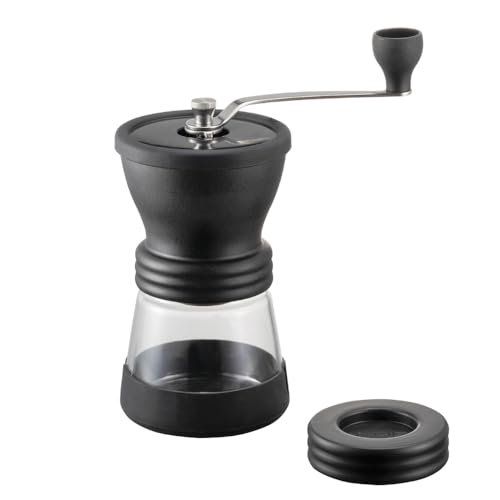
The manufacturer calls this device the Ceramic Coffee Mill Skerton N, model number MSCSN-2-B. A ceramic burr sits between a plastic hopper and a glass container, and it is cranked by hand. The instructions give China as the country of manufacture. The grinder is sold by a company that started in October 1921 as a glassworks in the Kanda Sudacho district of Tokyo. Hario today describes its business as the development, production and sale of heat-resistant glass and household goods, and the container under this grinder is exactly that.
On price, three figures stand side by side. Our price box lists approx. €39.80 on Amazon.de. The Amazon catalogue recorded a value of €43.74 on 7 September 2026. In the official Hario Europe shop the same device costs €51.50, and in Japan the manufacturer gives a recommended retail price of 4,180 yen including tax. Which figure you pay depends on the retailer; the price gaps further down are calculated with the value from our price box. You can check that the same device is meant everywhere using the EAN 4977642708358, which Hario Europe lists for the item.
What is different about the N compared with its predecessor is stated by Hario Europe in a single half-sentence, and the manufacturer documents no further changes: a redesigned lower glass container for better stability.
What the Skerton N is made of
The second page of the instruction manual has a materials diagram, and it is the most precise parts list available for this grinder. Lid, hopper and crank knob are polypropylene. The powder container at the bottom is made of heat-resistant glass, designed for a temperature difference of 120 degrees Celsius. Crank, fixing screw, stopper and the grind adjustment nut are stainless steel. The burr is ceramic. The non-slip cover and hopper lid are silicone rubber.
Hario gives the dimensions as 173 by 96 by 210 millimetres, plus a diameter of 90 millimetres. The 173 millimetres of width do not belong to the body: the glass cylinder stays at those 90 millimetres, the crank reaches far beyond it on one side, and that is exactly how it looks in the product photo. The footprint is therefore round and just under ten centimetres wide. You need extra room for the arc of the crank, plus clearance above, otherwise your hand hits the wall cabinet.
On weight, the sources contradict each other. Hario’s global product page lists around 600 grams including the individual carton, Hario Europe states around 650 grams including the carton, and the Amazon catalogue converts 1.1574 pounds, so around 525 grams. Two of the three figures explicitly include the packaging. For a grinder you hold on to while cranking anyway, though, the difference between 525 and 650 grams hardly matters.
In detail: ceramic instead of steel
Ceramic transfers less heat than steel and delivers an even ground particle size. That is what the European product page says, and it is the manufacturer’s only statement on grind quality. The instructions list two further properties: no metallic smell, and ceramic cannot rust.
The flip side is materials science. Ceramic is hard and brittle at the same time, and that is exactly why the precautions come back to the same point several times: the burr must not be struck by hard material, and the device must not be dropped. By the logic of the materials, a steel burr is more likely to survive a fall onto the worktop than a ceramic one. On the other hand, ceramic and stainless steel are both unaffected by water, which is why the product features contain the sentence that the device is fully washable, with burr parts made of ceramic and metal parts made of stainless steel.
Wear happens all the same. Hario Europe does not list a single replacement burr, and the instructions match: the burr gets dull over time, and if the amount that can be ground in one go drops noticeably, the whole grinder is to be replaced. The criterion is therefore your own observation. Our assessment: for a device around €40 that is a reasonable logic, for a grinder at €200 it would not be.
Setting the grind size: stopper, adjustment nut and two guide values
Adjustment is made below the burr, and the instructions count in clicks. The stopper, a small stainless steel part, sits in a recess of the adjustment nut. When it moves on by one recess, that is one click. Clockwise makes the grounds finer, anticlockwise coarser.
Hario gives exactly two guide values: four clicks from the stop give a fine grind, seven clicks a medium-fine one. The rest the instructions leave to trial and error. Their first step for grinding is to run a small amount of beans through and adjust the grain size accordingly; while cranking, the grinder should be held firmly.
To get at the stopper and adjustment nut, you unscrew the fixing screw anticlockwise and take off the crank and stopper. For complete disassembly, the adjustment nut and washer also come off, and then the burr can be pulled out downwards. So if you switch back and forth between French press and pour-over, you make this move every single time. How to approach a setting systematically, rather than changing everything after every brew, is covered in the guide to setting the grind size.
Which brewing method is the grinder built for?
For filter coffee in all its variations. Espresso does not appear in the grind size table of the instructions; it lists seven other methods: paper filter, dripper without paper, cloth filter, French press, siphon, cold brew and filter coffee machine.
In detail, Hario recommends fine to medium for the V60 with a paper filter, medium-fine to medium for cloth filter, siphon and filter coffee machine, and medium to coarse for the dripper without paper and the French press. For cold brew the manufacturer advises fine to medium-fine, and that is the only line that does not go beyond medium-fine, even though the long contact time otherwise argues for coarse grounds. We report the line as it stands in the PDF. Hario itself attaches a caveat to the table: the recommended grain size can vary depending on the brewer.
For quantity there are two numbers and one rule. Ten to twelve grams of coffee per cup, only as many beans in the hopper as are needed for one to two cups, and you refill only when the previous beans are running low. Too many beans in the hopper make the crank heavy according to the instructions, and individual beans can fall out.
The 100 grams that Hario advertises for this model therefore concern the glass container and not the hopper: that many beans can be processed in one go before the bottom has to be emptied. According to the dosing recommendation above, that works out as eight to ten cups, ground in several hopper fillings. Which amount of water suits your dose, you can work out in the brew calculator.
Cleaning: what the instructions prescribe
For the glass, Hario names one agent and four prohibitions. Cleaning is done with a soft sponge and a neutral detergent. Unsuitable are abrasive cleaners, scouring pads, nylon scrubbing brushes and steel brushes, and this list is complete. For heavy soiling the manufacturer permits diluted household bleach and then requires thorough rinsing with water.
One warning is easily overlooked: you must not clean the inside of the glass with a twisting motion, the way you would wring out a towel. The reason given is breakage and unexpected injuries. Likewise a metal spoon must not strike or scrape against the inside of the glass.
The burr comes out for washing. The instructions provide for taking it apart, soaking it in diluted neutral cleaner, rinsing thoroughly and letting it dry completely, and they warn against losing parts in the process. They draw one explicit limit: the inner grinding disc and the shaft stay together. What else belongs to grinder care is covered in our guide to cleaning a coffee grinder. Hario rules out oil as a care product; the wording is not to apply oil for maintenance, and anyone who has so far oiled a grinder because that often helps with mechanical devices is wrong here.
What Hario does not state
The product page is kept brief, the instructions are practical rather than rich in data. For the burr itself, four details remain open: the diameter in millimetres, the total number of clicks, the micron value per click and the particle distribution in numbers, since all that is documented is the wording about an even ground particle size. For operation, grinding time, turns per portion, noise level, the number of beans per crank pass and the hopper capacity in grams are missing, since the 100 grams belong to the glass container. Also open are the service life of the burr in kilograms or years, suitability for espresso, dishwasher suitability of the plastic and silicone parts, a scope of delivery as a list, since the components appear only in the materials diagram, and the detailed differences between the Skerton N, Skerton Plus and Skerton Pro. A warranty is not stated anywhere either; the instructions have no warranty section at all. As far as you are concerned, in Germany the statutory warranty rights against your retailer apply in any case.
You will notice three of these gaps when buying. The grinding time for 20 grams is the number that counts every day with a hand grinder, and you only learn it on your own arm. How often you have to refill for a whole pot shows at the first grind, because the hopper volume is described only as a rule for one to two cups. And when the replacement that the manufacturer provides for a dull burr is due is decided by your observation of the amount ground.
What are the alternatives?
| Model | The difference | Price | Our score | Choose this one if |
|---|---|---|---|---|
| Hario Skerton N (this one) | Ceramic burr, 100 g glass container, adjustment in clicks | approx. €39.80 | 7.9 | you grind filter coffee at home and the grinder stays where it is |
| Hario Mini Slim Plus | Container made of methacrylate resin instead of glass, 24 g of beans according to Hario | approx. €31 | 7.6 | one cup is usually enough and the grinder should come along |
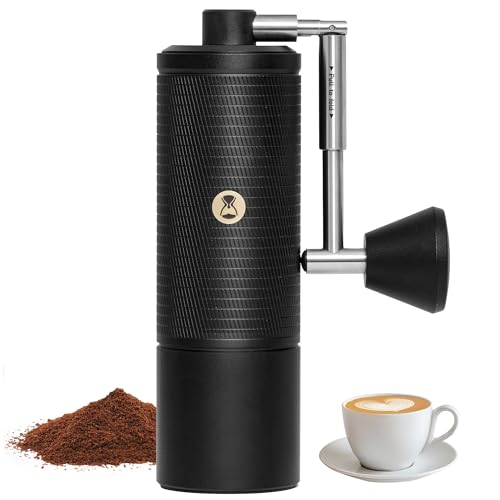
| Timemore Chestnut C3 ESP Pro | 38 mm steel conical burr with defined clicks | approx. €92 | 8.7 | espresso or a moka pot is regularly on the plan |
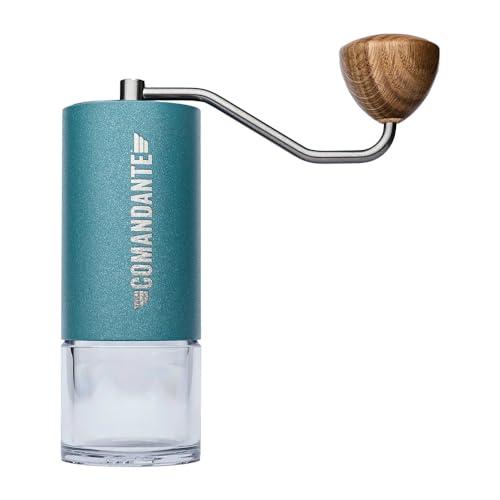
| Comandante C40 MK4 | Burr made of special steel, manufactured in Germany | approx. €237 | 9.4 | the hand grinder is to be your main tool for years |
The table sets four prices as of September 2026 side by side, plus our editorial scores. It does not say how evenly the four grinders actually grind: none of the three manufacturers publishes comparable measurements on this, and we have none.
When the Skerton N fits and when another grinder does
Five points decide this, and price comes last.
First, the brewing method. Everything that runs through a filter is covered by the Skerton N according to the manufacturer’s table. Anyone who regularly makes espresso or uses a moka pot, on the other hand, is buying past the design: the Timemore Chestnut C3 ESP Pro works with a 38 mm steel conical burr and defined clicks and costs around €52 more.
Then the amount in the morning. Beans for one to two cups belong in the hopper, then you refill. For two people that is a routine, for four it becomes an exercise, and a different model changes nothing about it, because the design sets the limit.
The third point is transport. At 210 millimetres tall and with a glass base, the Skerton N is a kitchen device. The Hario Mini Slim Plus is described by Hario in its instructions as a slim grinder that stores compactly. Its container is made not of glass but of methacrylate resin, and as capacity the global Hario page gives 24 grams of beans, just under a quarter of the amount that fits in the glass of the Skerton N. Hario Europe gives the dimensions 150 by 72 by 220 millimetres as carton dimensions, so they do not allow a size comparison with the Skerton N. In price the Mini Slim Plus is around €9 lower.
The fourth is patience. For every new grind size the fixing screw has to come out and the crank off; with a fixed setting that happens exactly once.
That leaves the budget, and that includes more than the purchase price. A hand grinder has no consumables, neither filter cartridge nor descaler. What remains is the ceramic, and because the manufacturer provides for replacing the whole device when it goes dull, the purchase price is also the price of the next round. With the Comandante C40 MK4, around €197 more expensive, there is likewise no complete replacement burr in the spare parts shop, and whether one is available separately is something only support can clarify there; 49 items can be ordered individually, from crank and knob to axle and bearings.
Who is it for?
The Skerton N suits a household where one to two pots of filter coffee are made every day and someone wants to grind the beans fresh for them without spending more than €40 on the grinder. In the hand grinders category it stands with 7.9 points and the Editors’ pick, and how it relates to the rest of the field is shown by the best-of list hand grinders 2026. The 7.9 reflects the manufacturer’s figures above and the price; nobody here has ground with it for this number.
The grinder is wrong for two groups. The first has small children in the kitchen. The instruction manual excludes use by children, requires storage out of their reach and even prohibits use in their vicinity. On top of that comes the glass container, which Hario describes as fragile and which may not be used at all if it has cracks, breaks or heavy scratches; and reaching into the rotating burr is forbidden by the same page. If something does break, the instructions require the shards to be handled carefully.
The second group buys by data sheet and compares grinders by burr diameter, service life and grinding time. For this model Hario publishes a materials list, dimensions and weight, a capacity and a table with seven brewing methods, and there the data sheet ends. We recommend a manufacturer that goes further to this group; in our table that starts at around €52 extra.