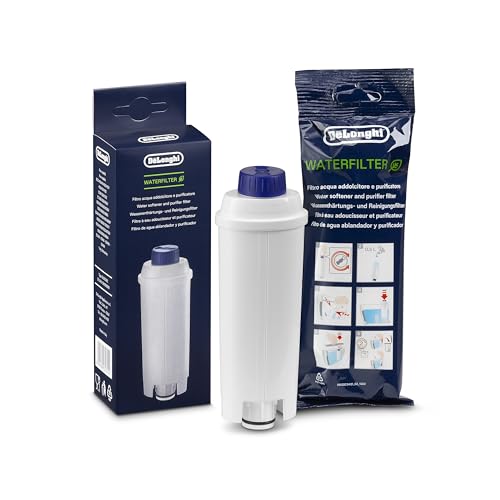
The DLSC002 is a filter cartridge for the water tank of a De’Longhi bean-to-cup machine. It sits there in a dedicated coupling and treats the water before the pump draws it in. In its online shop De’Longhi sells it as a “water filter, softener and cleaner DLSC002”; the Amazon catalogue gives 12 February 2019 as the release date.
Our reference price is approx. €7.49 on Amazon.de (as of September 2026), which is how the Amazon catalogue listed it on 7 September. We have not handled the filter and have not used one. What follows comes from the manufacturer’s German and US product pages, from three De’Longhi help pages for Germany and Austria, from the Amazon catalogue data and from the product photo.
What is inside the cartridge
The German product page names two filter materials: ion-exchange resins and activated carbon. It also describes the filter as sterile. Two things are promised: that it filters and softens the water “to reduce limescale formation”, and that it neutralises unpleasant odours, chlorine and other impurities. The Amazon listing puts it more briefly: the filter reduces limescale deposits and, with regular use, extends the life of the machine.
The product photo shows a white cartridge with a blue cap, tapering downwards to a narrower spout. The dimensions are not in the visible text of the manufacturer’s page but in the product data of its source code, at 60 x 46 x 181 millimetres. These are presumably overall dimensions from the cap to the spout.
For the question of whether the filter fits your tank, the height is of little help anyway. According to the US page it is pushed directly into the intended coupling in the water tank, so what matters is whether your tank has that coupling. The same source-code data give a packaged weight of 0.124 kilograms, packaging dimensions of 18.3 x 6.2 x 4.8 without a unit (by order of magnitude, centimetres) and Italy as the country of origin. On top of the filter sits a date disc; more on that under installation.
In detail: what resin and carbon do to the water
Hard water contains a lot of dissolved calcium and magnesium. Part of it is bound to hydrogen carbonate, which is the carbonate hardness, and this part precipitates as limescale when heated. In a bean-to-cup machine that happens where the water gets hot, that is in the thermoblock or boiler and in the pipes and valves behind it.
An ion exchanger consists of small synthetic resin beads with charged sites on the surface. As water flows through, the beads hold on to calcium and magnesium and release other ions in exchange. In cartridges for coffee machines these are usually hydrogen ions, which react with the hydrogen carbonate to form water and carbon dioxide. The carbonate hardness drops before the water reaches the heater. Exchangers of this type mainly remove the carbonate hardness; the rest of the hardness largely passes through.
Each of these charged sites can only be occupied once. Once the resin is saturated, the water flows on untreated, and you cannot tell by looking at the cartridge. How quickly that happens depends on two variables: the amount of water passing through and the hardness it brings with it. Water twice as hard exhausts the same resin about twice as fast. Any purely time-based figure for such a filter is therefore an assumption about consumption and water.
The activated carbon works differently. Its porous surface is very large, it binds organic substances that smell and breaks down free chlorine. It changes nothing about hardness. For protecting the machine, then, the resin is responsible, and the carbon for what De’Longhi summarises as odours and impurities.
How De’Longhi says to insert the filter
None of the three descriptions De’Longhi has published involves screwing anything in. The most detailed one is on the Austrian help page and has five steps:
- Turn the date disc until the next two months of use are displayed.
- Run tap water into the filter opening until it has been coming out of the side openings for over a minute.
- Place the filter in the water tank and submerge it completely for about 10 seconds, tilting it so that the air bubbles can escape.
- Insert the filter in its place and press it down.
- Close the tank with its lid and put it back into the machine.
After that, according to the same page, the filter still has to be set in the machine’s programme settings.
The German help page adds two things. Beforehand you check the water hardness with the hardness strip, and to activate the filter you fill it with at least 500 millilitres of water. The US page sums it all up in one sentence: pre-fill and push straight into the coupling in the water tank.
Allow more than a minute. The flushing in step 2 alone takes that long, and the ten seconds in the tank come on top.
Which De’Longhi machines take the filter?
Which ranges fit depends on whom you ask. The Amazon listing and De’Longhi’s US page give two different lists, both with all ECAM models, and the German product page speaks only generally of De’Longhi coffee machines.
The Amazon listing enumerates: all coffee machines of the ECAM, ETAM and EPAM series, plus ESAM 66.., 67.. and 69.., the machines of the BCO 41. and 42. series, and the EC6.., EC7.., EC8.. and EC9… series. The US page has a different list. It names ESAM6900, BCO430, BCO432, COM530 and COM532, as well as all models of the ECAM and EXAM ranges, Dedica and La Specialista.
Laid side by side: only Amazon lists ETAM, EPAM and the EC6.. to EC9.. series; only the US page lists EXAM, the COM models and the range names Dedica and La Specialista. The lists are not entirely separate, though: the espresso machines of these two ranges in our catalogue carry EC type numbers, namely the Dedica EC685, the La Specialista Arte EC9155 and the La Specialista Touch EC9455. By type number they therefore also fall under the Amazon series EC6.. and EC9… The manual of the Dedica EC685 mentions a De’Longhi water filter with the EAN 8004399327252, which is the EAN of the DLSC002. For the La Specialista Arte, the manufacturer page’s data field allows a water filter, but its manual describes softballs for the tank instead of a filter. For ESAM, Amazon names the 66, 67 and 69 series, while the US page names only the model ESAM6900. For the BCO combination machines, Amazon gives the 41 and 42 series, the US page the models 430 and 432. A German list cannot be found on delonghi.com, and the old product pages for Germany and Austria lead nowhere. The US list in turn applies to the range sold there.
This becomes concrete with three machines from our catalogue. The Magnifica S carries the type designation ECAM 22.110 and so is on both lists, as is the Dinamica Plus ECAM 370.70. The Rivelia has the full type EXAM440.55.B. Only the US page lists the EXAM range; it is missing from the German Amazon listing. If you own a Rivelia, check its manual before buying.
Replacement, idle periods and what a year costs
For service life there are four formulations from the same company. The running text of the German product page says the filter can be used “for up to 2 months”. The feature list on the same page says “replace after 2 months at the earliest”, which means the opposite. The Austrian help page gives about two months with normal use, and the Amazon listing recommends replacing it every two months, “depending on water quality”. Three of the four places treat the two months as a guide or upper limit. We therefore consider the “at the earliest” an error in the feature list and would replace it after two months at the latest, sooner with very hard water.
When the machine stands idle, a different deadline applies. If it stays unused with the filter inserted, the shelf life is at most 3 weeks according to the Austrian help page. De’Longhi does not say why. Our reading: the cartridge then holds water at room temperature for weeks, from which the activated carbon has removed the chlorine, and that is the situation in which germs can multiply.
The calculation for a year is quick. With a change every two months you need six filters; at the reference price of approx. €7.49 that comes to €44.94. In De’Longhi’s online shop the price was above this reference price when we checked on 25 September 2026. The descaler comes on top, see the next section.
Filter and descaler: how the two go together
For the Magnifica Evo, De’Longhi gives a clear order in a help page: “If present, remove the water filter before descaling the appliance.” After descaling it goes back into the tank. The same text recommends three things together, namely to use the De’Longhi WaterFilter, to carry out the water hardness check and to use the in-house descaling solution EcoDecalk. In this list the filter is a building block alongside the descaler, not a substitute for it.
De’Longhi’s German shop now sells EcoDecalk under the name Decalk Care (DLSC500). The bottle holds 500 ml and is enough for five descaling runs of 100 ml each; more in the review of the EcoDecalk. How descaling and rinse programmes work in bean-to-cup machines in general is covered in the guide Descaling and Cleaning.
What the manufacturer does not state
The gaps collected here so they are not scattered through the text. A capacity in litres or cups is missing; De’Longhi works only with the time span. How much the filter lowers hardness, whether in degrees of German hardness or in per cent, is nowhere on the German page, nor is a figure for chlorine reduction. Which resin is used remains open, and what is meant by sterile is not explained on the product page either. None of the pages says anything about the material of the housing. The weight of the filter itself is not clear: the source-code data of the German page give 0.1, those of the US page 0.27, both without a unit, and Amazon gives 0.25 pounds with item dimensions of 1 x 1 x 1 inch, which are evidently placeholders.
Also missing are a warranty period specifically for the filter, a German compatibility list and a data sheet or manual as a PDF. Whether every compatible machine reports the due replacement on its display is not clear from the help pages, which only say that the filter has to be set in the menu. We did not find a year of market launch, and the release date entered in the Amazon catalogue is no proof of one.
What else comes into question?
With the filter itself you have no choice: the machine determines which system fits. The real trade-off lies elsewhere: do you slow limescale with a filter and descale as well, or do you only descale? And with what?
| Model | The difference | Price | Our rating | Choose this if |
|---|---|---|---|---|
| De’Longhi DLSC002 (this one) | Cartridge in the tank with ion exchanger and activated carbon, slows new limescale | approx. €7.49 | 8.6 | your De’Longhi has a filter coupling in the tank and your water is hard |
| De’Longhi EcoDecalk | Lactic-acid-based descaler, 100 ml per descaling, dissolves existing limescale | approx. €7.98 | 8.7 | your machine requires descaling, with or without a filter |
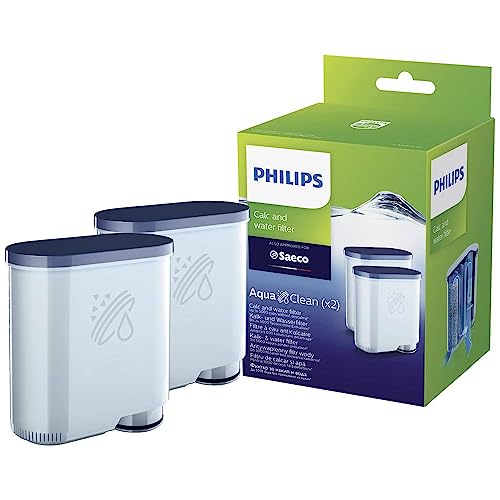
| Philips AquaClean CA6903/22 | Different filter system, two filters, up to 625 cups per filter according to Philips | approx. €19.99 | 8.9 | your bean-to-cup machine is from Philips or Saeco and carries the AquaClean sticker on the water tank |
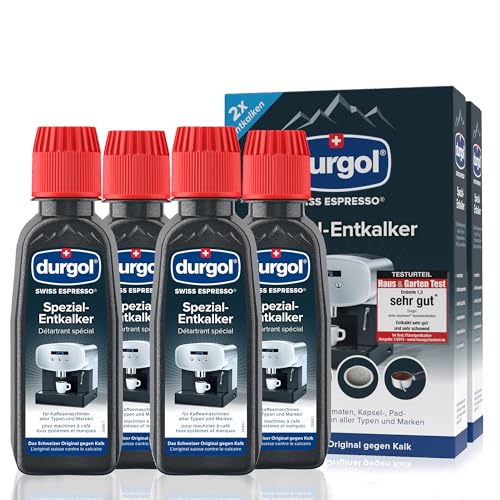
| durgol swiss espresso | Amidosulfonic acid, according to durgol suitable for coffee machines of all brands | approx. €13.80 | 9.3 | your household has machines of different brands |
Prices are as of September 2026; the ratings are our editorial assessment based on the available data and features, and nothing was measured for them. Filter and descaler sit side by side here although they do different jobs. For Siemens bean-to-cup machines we list the Siemens BRITA Intenza as a separate review; the whole category is under Cleaning & Care.
Who the DLSC002 suits and who it does not
If you have a bean-to-cup machine from Philips, Saeco, Siemens or another brand, the DLSC002 is the wrong purchase, no matter what it costs. The section on machines above shows which De’Longhi ranges appear on the two lists. If your tank lacks the coupling, the cartridge is of no use.
For water, a number helps more than a feeling. Your waterworks must publish the hardness. According to the manufacturers’ manuals, a hardness strip shows it after about a minute, on the De’Longhi Magnifica Plus as one to four red squares, that is as a level without a figure in °dH (German degrees of hardness). The German Washing and Cleaning Agents Act (Wasch- und Reinigungsmittelgesetz, which applies in Germany) divides water into three ranges: soft below 1.5 millimoles of calcium carbonate per litre (8.4 °dH), medium up to 2.5 millimoles (14 °dH), hard above that. If your water is in the soft range, the ion exchanger has little to do, and we would rather put the roughly €45 a year into the descaler. With hard water it is the other way round, because that is where the most limescale precipitates per litre, and the resin catches exactly that before it reaches the heater. In the medium range, the amount that runs through the machine every day decides for us. How both work is explained in our guide to water hardness.
If you draw coffee every day, you fall, by our reading, under the normal use for which De’Longhi allows about two months. If you often leave the machine standing for weeks, for example in a holiday home or with a lot of travelling, you run into the three-week limit from the section on replacement and idle periods and will change filters more often than the annual calculation above assumes, or remove the filter beforehand.