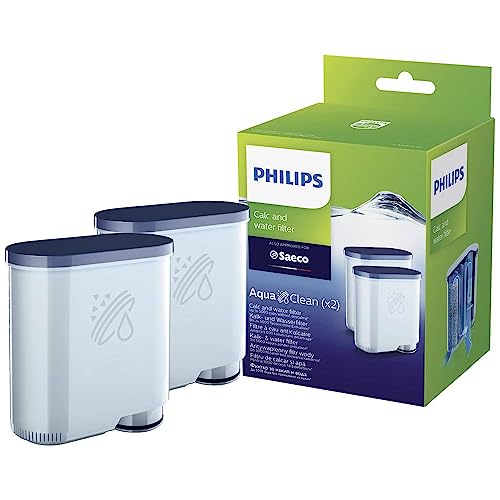
The Philips AquaClean CA6903/22 is a twin pack of water filters for Philips and Saeco bean-to-cup machines. The cartridge sits in the water tank and is meant to hold back limescale before it reaches the machine’s pipes and heater. Two cost approx. €19.99 on Amazon.de (as of September 2026).
Philips advertises 5,000 cups without descaling. How the figure comes about is stated right alongside it on the product page: by replacing the filter eight times. It therefore has little to do with a single filter, and nothing to do with this twin pack either.
We did not have the filters in our hands and have not run a machine with them. Our sources are the product page on philips.de (retrieved on 24 September 2026), two Philips data sheets from November 2020 and November 2023, the user manual with a print date of 26 June 2025 and the Amazon catalogue data from 7 September 2026, according to which the listing has existed since 20 February 2018. The manual is on the document server of Versuni, the brand licensee of Philips, through which support also runs.
Two plastic cartridges and a sticker
The box contains two AquaClean filters and a sticker on which you write the activation date. Philips names plastic as the main material, and the filter needs no power. The product photo shows two white cartridges with a dark blue cap, and on the box the words “Calc and water filter” are followed by “also approved for” with the Saeco logo. According to the product page, the CA6903/22 is identical to the CA6903/01 filter.
Inside, there are two stages. According to Philips, an ion-exchange technology is meant to take the limescale out of the water before it gets into the machine, and a microporous filter is meant to catch impurities so they do not clog the machine. The product page also speaks of the “original Philips water path”, where the 2020 data sheet mentioned a patented water line in the same place.
According to Philips, the packaging measures 15 x 13 x 10 centimetres. It is made of 70 per cent recycled materials, and the enclosed user manual of more than 75 per cent recycled paper.
The cartridge is inserted in the water container, and Philips calls the system Click&Go. Machines built for it carry an AquaClean sticker on the water container. As compatible series, the product page lists the 800, 1200, 2200, 3200, 4300, 4400, 5400 and 5500 Series, plus GranAroma and Xelsis.
In detail: how 625 cups become 5,000
An ion exchanger is a resin that holds ions loosely on its surface and swaps them for others. Limescale comes from dissolved calcium and magnesium ions in tap water. The resin holds on to these ions and gives off others in return. The instructions offer a clue: the sodium content of the water may rise slightly during filtering. In our reading, that fits a resin that swaps at least part of the hardness for sodium.
Every resin is exhausted at some point. Once the exchange sites are occupied, the limescale runs through again, which is why such a filter has a capacity. Philips states it in cups: up to 625 per filter, if it is replaced promptly when the machine prompts you.
Physically, this capacity depends on the amount of hardness passing through, that is, on litres times degree of hardness. A cup count turns that into a tangible unit and swallows both: a large mug draws more water through the resin than an espresso, and hard water occupies the exchange sites faster than soft water. The footnote on the product page hints at this: the actual number of cups depends on the choice of drinks and on the machine’s cleaning and rinsing cycles.
The 5,000 comes about in the machine. When you activate an AquaClean, it switches off its descaling indicator, and according to Philips it only switches the indicator back on after the eighth filter replacement. The machine therefore has to count the replacements, and eight filters at 625 cups each give the advertised figure.
How many cups does the 2-pack handle?
Up to 1,250 cups, two times 625 on paper. It ends sooner if time runs out: the instructions require you to replace the filter at least every 3 months or when the machine prompts you. The pack therefore lasts six months at most.
Which of the two limits applies first depends on your consumption. 625 cups in around 90 days is just under 7 cups a day. If you use less, you replace a filter after three months that has not reached its cup count. If you use more, you get the prompt earlier: at 10 cups a day, 625 would be used up after a good two months. This calculation is ours and assumes that the machine really calls for replacement at 625 cups. When it does so is decided by its own count, which includes the rinsing and cleaning cycles from the footnote.
For the whole chain up to the first descaling you need eight filters. At 3 cups a day, eight replacements take 24 months because of the three-month limit, adding up to around 2,200 cups. Only those who use up each filter before the three months are over reach the 5,000.
Installation according to the instructions: seven steps
Just inserting it is not enough. The instructions describe the preparation in these steps:
- Take the filter out of the packaging and shake it for approx. 5 seconds.
- Dip the filter upside down into a cup of cold water and wait until no more bubbles come out.
- Take the water tank out of the machine, place the filter vertically on the filter connector and press down until it no longer moves.
- Fill the tank with fresh, clean water and put it back into the machine.
- Write the date of filter activation on the enclosed sticker and attach it to the water tank.
- If the machine has a display, activate the filter in the menu, following the instructions for the machine.
- To rinse the filter, run half a litre of water through the coffee outlet or the steam wand and pour this water away.
For the shaking and soaking, we have an explanation that comes from filter technology and not from Philips. A dry resin bed holds air between the grains. Air bubbles displace water from the surface where the exchange takes place and can slow the flow. Shaking loosens the filling, and submerging drives the air out until no more bubbles rise.
The sticker from step 5 is more than tidiness: it lets you read off when the three months are up, even if the machine has not yet prompted you.
What the instructions prescribe on water, health and descaling
Under “Caution”, the German instructions list six points, given here in full:
- The AquaClean water filter is only suitable for use with municipally treated tap water that is constantly monitored and, in accordance with legal regulations, safe to drink, and likewise for water from private sources that has proven drinking water quality. If the authorities order municipal water to be boiled, the water for the tank must also be boiled and cooled before filling. Once boiling is no longer required by the authorities, you clean the entire coffee machine and insert a new filter cartridge.
- Clean the water tank regularly.
- For certain groups of people, such as people with weakened immune systems and babies, it is generally recommended to fill the water container with purified water or boiled tap water even with the filter inserted.
- If you suffer from a kidney disease, are a dialysis patient and/or follow a low-sodium diet, note that the sodium content may rise slightly during filtering. The instructions recommend asking a doctor before using the filtered water.
- To descale the coffee machine, remove the AquaClean water filter from the water tank, then clean the entire tank thoroughly and reinsert the filter.
- The manufacturer rejects any responsibility and liability if the above recommendations on use and replacement are not followed.
Under “Attention” follow seven more:
- Store spare filters cool, dry and in the sealed original packaging.
- Because water is a foodstuff, the water in the water tank must be used up within 1 to 2 days.
- If the machine has not been used for a longer time (for example during a holiday), the installation was more than 3 months ago or the filter has to be replaced, carry out the steps from the chapter “Preparing for use”.
- Contains microplastics.
- Never try to open the cartridge.
- If the contents leak, they must not be held under water.
- When disposing of it, observe the local regulations of the country.
If you live with a private well without proof of drinking water quality, you fall outside intended use. The 1 to 2 days of standing time in the tank argue, in a household with two cups a day, for filling the tank only partly.
The note on microplastics is brief. The instructions do not say which component is meant. Ion exchange resins are usually manufactured as small plastic beads, which would be an obvious explanation, but Philips has not confirmed it. Practically, two things follow: the cartridge stays closed, and where the used cartridge goes is governed by the local regulations the instructions refer to. If in doubt, ask your local waste disposal service.
What a filter costs and what a cup costs
At approx. €19.99 for the twin pack, a filter costs around €10. Spread over 625 cups, that is 1.6 cents per cup, and that is the lower limit, because 625 is the maximum. At 3 cups a day it is around 270 cups per filter and therefore approx. 3.7 cents per cup.
Because of the three-month limit, you need at least four filters a year, so two packs for approx. €39.98 together. At 10 cups a day, by our calculation you get to just under six filters (3,650 cups divided by 625), which is three packs and approx. €59.97. The full chain of eight up to the next descaling costs four packs, approx. €79.96, after which a descaler comes on top once.
What Philips does not state
For the CA6903/22 there is no capacity in litres and no statement on how water hardness affects the cup count. Also open are the measurement conditions or a standard behind the cup counts, the resin type and the pore size of the microporous filter, a shelf life of unopened spare filters, a commitment to availability over a period, the market year (only the Amazon date is known) and which certifications are meant when the product page notes “Certifications: Yes”. Dimensions and weight of a single filter are also missing. The Amazon catalogue lists approx. 8.8 x 8.2 x 8.4 centimetres and approx. 310 grams without saying whether this is the pack or one cartridge; the figures do not match Philips’ packaging dimensions.
On the country of manufacture, the sources contradict each other: the product page named China on 24 September 2026, the data sheets from 2020 and 2023 named Switzerland.
It also remains unclear whether machines without an AquaClean sticker physically accept the filter and how machines without a display activate it. Step 6 of the instructions expressly applies only to machines with a display.
Which filter belongs in which machine
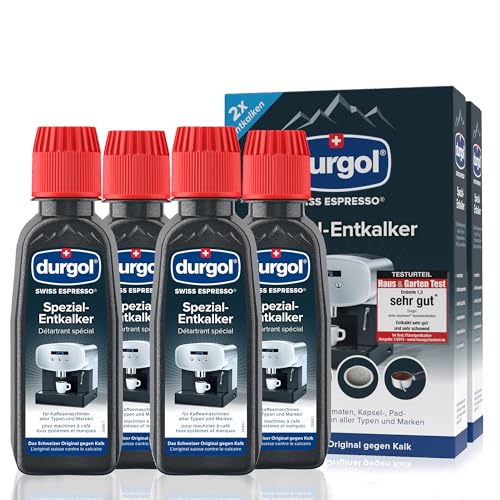
Our catalogue contains two more water filters, both for machines of other brands, plus two descalers, of which we list the durgol swiss espresso here. If you own a Philips or Saeco, you choose between AquaClean and a descaler, not between three filters.
| Model | The difference | Price | Our rating | Choose this if |
|---|---|---|---|---|
| Philips AquaClean CA6903/22 (this one) | up to 625 cups per filter, replace after 3 months at the latest, two filters | approx. €19.99 | 8.9 | your Philips or Saeco carries the AquaClean sticker on the water tank |
| Siemens BRITA Intenza 3-pack | Brita filter for Siemens bean-to-cup machines, three pieces for the same pack price | approx. €19.99 | 8.7 | there is a Siemens bean-to-cup machine in your kitchen |
| DeLonghi water filter DLSC002 | De’Longhi filter with ion-exchange resin and activated carbon, in use for up to 2 months according to the manufacturer | approx. €7.49 | 8.6 | you have a De’Longhi with a filter coupling in the tank, such as an ECAM model (ETAM and EPAM are only named by the Amazon listing; if in doubt, the appliance instructions decide) |
| durgol swiss espresso | Descaler with amidosulfonic acid: dissolves limescale that has already settled | approx. €13.80 | 9.3 | your machine has no AquaClean sticker and its instructions do not prescribe a particular descaling agent |
The prices apply to the whole pack as of September 2026, and the packs contain different things: two filters, three filters, one filter, four bottles. You cannot read a price per month of limescale protection from this column. The rating is our editorial assessment based on the available data and features. You will find all filters, descalers and cleaners in the category Cleaning & care, and the top-rated ones in the best cleaning and care products list.
When AquaClean, when something else?
The tank first. If the AquaClean sticker is on it, the filter is, in our assessment, the obvious choice, as long as you take the replacements seriously. If it is missing, the limescale promise does not apply, and then we would descale according to the machine’s instructions, for example with the durgol swiss espresso, provided your machine’s instructions do not prescribe a particular agent. How a descaling programme works is explained in our guide Descaling a bean-to-cup machine.
Then the cup count. If you are below the 7-cup limit from above, at 3 cups a day you pay approx. 3.7 instead of 1.6 cents per cup. Whether two years without descaling are worth approx. €40 a year to you is for you to decide. If you prefer to descale at the rhythm the machine shows without a filter, you need no cartridges, but you do need descaler and the time for the programme. What the hardness of your tap water means for the machine is covered in the guide Water hardness and coffee; your water supplier can tell you the degree of hardness itself.
Replacement discipline is the point we weight most, because the descaling indicator rests while a filter is in use. If you know you tend to dismiss the filter prompt, you are better protected with a descaler and the indicator switched on, because then the machine itself reports as soon as limescale is due.