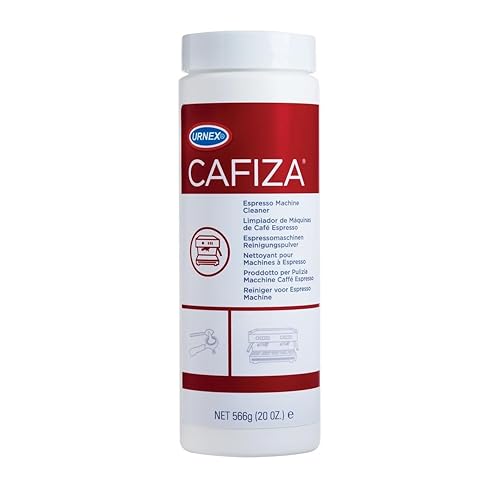
Cafiza is a cleaning powder for portafilter espresso machines. According to Urnex it removes coffee residue and oils from brew groups, valves and lines, and it is used when backflushing with a blind basket. The tin holds 566 grams (20 ounces). For the standard recipe in this size Urnex gives the product code 12-ESP20, and the manufacturer also offers a phosphate-free Cafiza powder (see the question on phosphate below). On Amazon.de the tin costs approx. €12.55 according to our price box.
Urnex is a US company and gives 1936 as its founding year on its website. By its own account it focuses 100 per cent on cleaning coffee and tea equipment, and its products are available in over 70 countries. The data sheet gives the address as Urnex Brands, LLC in Elmsford in the state of New York, while the website gives an address in Gurnee, Illinois. Alongside the powder, the range for commercial espresso machines includes the Cafiza tablets E16, E31 and E46 as well as powders and tablets of the Puro and Biocaf lines.
The Amazon listing is titled “Urnex Cafiza Kaffeevollautomat Reinigungspulver” (bean-to-cup machine cleaning powder). That fits the manufacturer’s instructions poorly, because they presuppose a blind basket in the portafilter from the very first step. The Amazon catalogue data gives 1 August 2023 as the release date. The field does not make clear whether this means the start of the listing, and the year Cafiza was launched cannot be read from it.
We have not had the tin in our hands and have not cleaned any machine with the powder. Our basis: the product page on urnex.com with the instructions for use, the data sheet, the safety data sheet, the ingredient list, the Urnex FAQ and the Amazon catalogue data from 7 September 2026.
What is in the tin
The ingredient list for 12-ESP20 names seven substances: trisodium phosphate dodecahydrate, sodium sulfate, sodium percarbonate, a phosphate salt that is not named, tetrasodium pyrophosphate, ethoxylated alcohols and sodium hydroxide.
The safety data sheet gives quantities for four of them. Sodium percarbonate makes up 10 to 30 per cent and is thus the largest declared share. Tetrasodium pyrophosphate and the ethoxylated C9-11 alcohols are each at 0.5 to 1.5 per cent, sodium hydroxide at 0.1 to 1 per cent. For a ten per cent solution the sheet gives a pH of 11 to 11.49, which is distinctly alkaline. The powder itself is described there as white granules, odour: none. The product page also calls Cafiza odourless and lists two certifications, NSF and kosher (pareve). What lies behind the NSF statement is covered below under the questions on seals.
The product photo shows a cylindrical white tin with a white lid and a red, multilingual label that reads “Espressomaschinen Reinigungspulver” in German. Amazon lists six languages, and the label in the photo shows the same ones: German, English, Italian, Spanish, French and Dutch. If you want to compare the tin in specialist shops, the data sheet gives the UPC 754631530206 on the single tin.
In detail: why an alkaline powder dissolves coffee fat
Coffee oils are fats. They dissolve poorly in water, even hot water, and what settles of them in the shower screen, brew group and valve largely stays put when you rinse with clear water.
According to general detergent chemistry, not according to Urnex, the recipe can be read like this: sodium percarbonate is soda with hydrogen peroxide attached, and in water it breaks down into these two components again. The peroxide oxidises coloured residues. Together with the sodium hydroxide, the soda raises the pH, and in strongly alkaline solution fats are partly saponified, that is, converted into water-soluble soaps. The ethoxylated alcohols are non-ionic surfactants; they envelop oil droplets so that the water can carry them away. The phosphates bind calcium and magnesium from the tap water, which would otherwise slow the effect of the surfactants.
Urnex itself puts it more briefly: a concentrate tuned to a balance of solubility and foaming. Our reading of that is that a poorly soluble powder stays behind as residue in the blind basket and that a strongly foaming solution is hard to rinse out of the valve and drain again. The product page also says the powder keeps shower screens and filters clear for even extraction. That makes technical sense: a shower screen whose openings are partly blocked distributes the water unevenly over the coffee puck.
Now to backflushing itself. A blind basket has no holes, so the pump builds up pressure in the brew group, and the water dissolves the powder in the process. When you stop the shot, on machines with a 3-way solenoid valve the valve opens and releases the pressure towards the drain. The solution flows backwards through the shower screen and valve into the drip tray. Each cycle of pumping and stopping repeats this flow, and that is exactly why the instructions work with intervals. If the valve is missing, then by our deduction the return path is missing too, and the solution stays in the portafilter.
Urnex expressly separates cleaning and descaling in its FAQ: one removes coffee oils, the other mineral deposits. For Cafiza the manufacturer claims no descaling effect, and chemically none would be expected, because limescale dissolves in acid, not in alkali. In our assessment, an acidic descaler and Cafiza also do not belong in the same solution, because they would neutralise each other.
How much Cafiza goes into a backflush?
At most half a teaspoon, which according to Urnex is 3 grams. The pictograms on the data sheet show the same 3 g. By this conversion, a whole teaspoon would already be double the amount.
The instructions on the product page have six steps. Here they are in full:
- Insert the blind basket into the portafilter and add up to 1/2 teaspoon (3 g) of Cafiza.
- Insert the portafilter into the brew group. Run the brew cycle for 10 seconds, stop for 10 seconds, repeat five times.
- Remove the portafilter, start the brew cycle and rinse the portafilter under the water stream from the brew group.
- Reinsert the portafilter without cleaning powder, then again five cycles of 10 seconds of brewing and 10 seconds of pause.
- Swap the blind basket for the normal basket and pull an espresso to remove cleaner residue.
- Pour this espresso away, do not drink it.
Added up, the two rounds each run five times 10 seconds of pump and 10 seconds of pause; by our calculation from the Urnex cycles that comes to 200 seconds, so a good three minutes. On top of that come rinsing the portafilter between the rounds and the espresso at the end.
For step one you need a blind basket that fits your portafilter. Portafilters come in different diameters, 51, 54 and 58 millimetres being common, and the blind basket has to match your machine’s size.
Soaking: portafilter, baskets and shower screen
Urnex expressly names the second route, and it also works without a blind basket: a soaking solution for portafilters, baskets, shower screens and other parts. For every litre of hot water you add 6 g of powder. You put the dirty part in, and with the portafilter you avoid immersing the handle. After 30 minutes of contact time you take it out and rinse it with fresh water. One litre of soaking solution thus uses as much powder as two backflushes at full dose.
How often to backflush, and how long the tin lasts
Urnex has cafés in mind. The data sheet calls Cafiza a fixed part of the daily backflushing routine, and according to the Amazon catalogue the powder was developed for cleaning heavily soiled equipment and is thus intended for cafés and restaurants. For a machine that makes two espressos a day at home, Urnex gives no rhythm of its own.
The range can still be worked out, from dose and price. 566 g divided by 3 g gives around 188 backflushes at full dose, correspondingly more with less powder. Applied to the price of approx. €12.55, one backflush costs around 7 cents. Anyone who follows the data sheet’s daily routine needs 1,095 g a year, so just under two tins. Pro rata that is around €24 a year, though you buy two tins for approx. €25.10.
Soaking baths come on top, each with a litre of solution for around 13 cents. You buy a blind basket once. Then there is water for the rinse cycles and, with each backflush, a portion of coffee for the espresso that gets poured away at the end.
What the safety data sheet prescribes
Urnex has published a US version under the American hazard communication standard HazCom, revision 2020. It classifies Cafiza with the pictogram GHS07 and the signal word Warning, and the hazard statement reads: causes serious eye irritation, category 2A.
For handling, the sheet requires avoiding skin and eye contact, not swallowing the powder, and opening and handling the container carefully. During use there should be no eating, drinking or smoking. Dust should not be allowed to form in the first place and should not be inhaled, and good housekeeping should prevent dust from accumulating.
First aid in the sheet is divided by type of contact. Anyone who has trouble breathing after inhalation is moved into fresh air and rests in a position that makes breathing easier; if feeling unwell, seek medical advice or help. If the powder irritates the skin, rinse with plenty of water, and if the irritation persists, see a doctor. After eye contact, rinse carefully with water for several minutes, remove contact lenses if this is easy to do, keep rinsing, and if the irritation persists seek medical advice or help. After swallowing, do not induce vomiting unless a doctor advises it, never give anything by mouth to an unconscious person, and if feeling unwell get medical advice or treatment. We would still read the sheet through once in full before first use.
Cafiza is stored out of reach of children, in a tightly closed container, dry, cool and well ventilated. Heat and incompatible substances are to be avoided, by which the sheet means strong oxidising agents. Under normal conditions the powder is stable and non-flammable, and in transport it is not classed as dangerous goods under DOT, IATA, IMDG and TDG. It can be harmful in water bodies in the long term, and disposal follows local and national regulations.
One practical conclusion we draw ourselves: a white, odourless granulate does not belong in the same cupboard as sugar or salt.
What Urnex does not state
For the tin, dimensions and empty weight are missing (Amazon gives 7 x 2 x 2 inches, approx. 17.8 x 5.1 x 5.1 cm, which Urnex nowhere confirms; the catalogue weight of 1.248 pounds corresponds exactly to the 566 g of contents), as are the material (Amazon’s colour field says “plastic”) and the type of closure. Also open are the country of manufacture, a water temperature for backflushing (for soaking only hot water is given), compatibility with individual materials (see the question on seals), the year of market launch and a warranty. A French press, a glass jug or a thermos flask is not in the list of parts that Urnex names for soaking. We found no figures on market share or prevalence among baristas. And a German safety data sheet under EU CLP (the EU classification and labelling regulation) is not available; for other countries Urnex refers to its info address.
Powder, tablet or descaler: what else comes into question
In our category, Cafiza is the only powder for backflushing. The three other products in the table share with it the care of a coffee machine or are easily confused with it: two tablets for bean-to-cup machines and a descaler.
| Model | The difference | Price | Our rating | Choose this if |
|---|---|---|---|---|
| Urnex Cafiza 566 g (this one) | Powder for backflushing with a blind basket and for soaking | approx. €12.55 | 9.0 | you have a portafilter machine with a 3-way valve and a blind basket |
| Coffeeano Reinigungstabletten | 80 tablets for the cleaning programme of bean-to-cup machines | approx. €12.99 | 8.3 | you have a bean-to-cup machine with a cleaning programme and no portafilter machine |
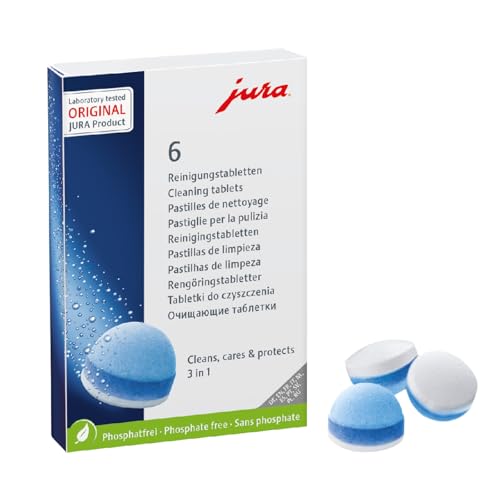
| JURA 3-Phasen-Reinigungstabletten | 6 original tablets, according to JURA developed specially for JURA bean-to-cup machines | approx. €9.99 | 8.8 | you have a JURA bean-to-cup machine and want to stay with manufacturer accessories |
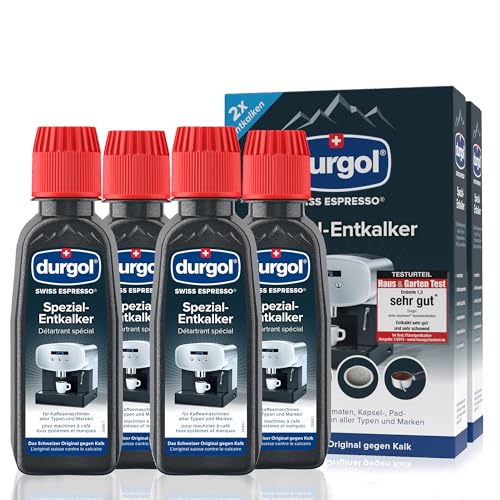
| durgol swiss espresso | Acid-based descaler against limescale, does not dissolve coffee fat | approx. €13.80 | 9.3 | your machine also needs descaling in addition to fat cleaning |
The prices are the guide values from our price boxes for the whole pack, and the packs go very different distances. Converted, a Coffeeano tablet costs around 16 cents, and with JURA it is approx. €1.67 per use. The rating is our editorial assessment from the available data and area of use, not a measurement result. You can find further cleaners, descalers and filters in the category Cleaning & Care, and the top-rated ones in the best cleaning and care list.
When Cafiza, when something else?
First the machine. Cafiza suits a portafilter machine that may be backflushed, and according to Sage UK backflushing presupposes a 3-way valve. Whether your machine has one is in its manual. What the valve does and why, by our deduction, backflushing without a valve lacks the pressure release is covered in our guide to barista accessories essentials. If your machine has none, all that is left of Cafiza for you is the soaking bath. If it has one, often all that is missing is a blind basket in the diameter of your portafilter; the common sizes are given above at the instructions.
If you have a bean-to-cup machine, the powder is the wrong choice. Urnex itself offers tablets for these machines, with details in the questions below. For bean-to-cup machines with a cleaning programme, our catalogue offers for example the Coffeeano Reinigungstabletten, and for a JURA we would stay with the original tablets.
Then the quantity. For its recipes Urnex gives 24 months of shelf life at room temperature, which is around 104 weeks. Spreading the tin’s range from above over this period gives 1.8 backflushes per week. Anyone who backflushes less often will not get the tin empty within the period, and every soaking bath with 6 g pushes the limit down a little further. For this case Urnex offers the Cafiza E16 tablets: according to the instructions one tablet goes into the blind basket per backflush, and the 100 pieces in the tin last just under two years at one backflush a week.
Limescale is a separate matter; for that there are descalers such as the durgol swiss espresso. How often, with which product and in which order a portafilter machine is descaled is in the machine’s manual, and with double-circuit and dual-boiler machines this look is especially worthwhile.
If you do not want to measure out, you are better served by tablets. With the powder you handle a spoon and an open tin every time, and that with a substance that irritates the eyes severely. If you value a phosphate-free product, read the question on phosphate before ordering.
In our assessment, Cafiza is the wrong choice for anyone who wants to use it to clean an aluminium moka pot. Aluminium is attacked by alkalis, and Cafiza makes an alkaline solution in water.