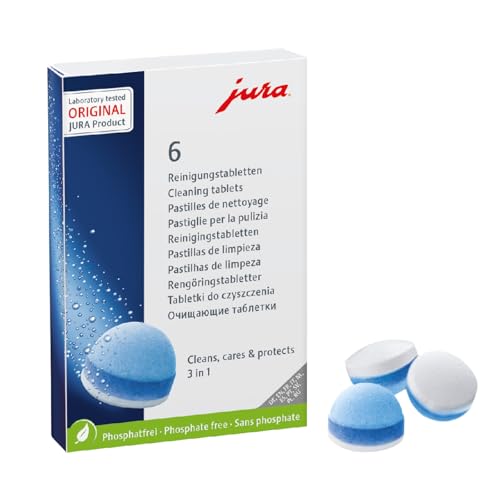
With the 3-phase cleaning tablets, JURA feeds the cleaning programme of its own bean-to-cup machines. JURA lists the pack of six under article number 24225; according to the product information sheet, this is a folding carton with six tablets in blister packs. Amazon lists the same number as the model designation, with 1 March 2022 as the release date. You pay approx. €9.99 on Amazon.de (as of September 2026): that was the price on 7 September in the Amazon catalogue and on 24 September in the German JURA online shop.
We have not held a pack, and we have not cleaned any machine with it. What is written here comes mainly from five documents: the product page on de.jura.com, the product information sheet in version V5 from April 2026 (the tablet has no separate user manual, the sheet takes its role), the safety data sheet in version 5.0 of 2 February 2026, and the manuals of the Z10 and the A1. In addition there are the older product information sheet from February 2024, two pages from the German JURA shop and the Amazon catalogue data.
Shape, colours, ingredients
The product photo shows round tablets made of three layers, white at the bottom, dark blue in the middle, light blue on top, and that is exactly what the data sheet says. There the shape is described as cylindrical, domed at the bottom, hemispherical on top. One tablet measures 16.1 millimetres in diameter (plus or minus 0.1), is under 15.2 millimetres high and weighs 3.4 grams (plus or minus 0.1).
JURA calls them alkaline cleaning tablets, developed specifically for JURA bean-to-cup machines. The ingredients are listed in the product information sheet according to the Detergents Regulation (EC) No 648/2004 (an EU regulation), in this order: Sodium Carbonate, Sodium Gluconate, Sodium Carbonate Peroxide, Citric Acid, Sodium Sulfate, Adipic Acid, Sodium Lauryl Sulfate, Sodium C12-18 Alkyl Sulfate, Sodium C14-16 Olefin Sulfonate, Magnesium Stearate, TAED and a colourant.
Quantities are only revealed by the safety data sheet, as ranges and only for the components that must be declared. Sodium carbonate, that is soda, makes up 25 to under 50 per cent of the tablet, sodium percarbonate 10 to under 17 per cent. Citric acid and adipic acid are each at 2.5 to under 10 per cent. According to the labelling for cleaning products, it contains 15 to under 30 per cent oxygen-based bleaching agents and 5 to under 15 per cent anionic surfactants. In a five per cent solution at 20 °C, the safety data sheet measures a pH of 10.2, which is clearly alkaline.
Phosphate is not on the list, and that is deliberate. According to the product page, JURA uses an exclusively phosphate-free composition for the original cleaning tablets.
In detail: three phases in one programme run
JURA sums up the effect as “cleaning, care and protection in one” and attaches a phase to each word. In the first, the machine rinses the brew unit and brew sieve with water at 80 °C, while the tablet, according to the manufacturer, dissolves residues of coffee fat and oil that can distort the taste and quality of the coffee. In the second, active ingredients seal the surfaces of the affected components so that coffee residues and fats do not settle straight back. JURA describes the third as newly developed: complexing agents are meant to protect the bean-to-cup machine from deposits caused by minerals. According to the product page, the route in question runs from the brew unit to the coffee spout, and all lines would be sealed along the way.
Which substance belongs to which phase is stated neither on the product page nor in the product information sheet or the safety data sheet. Our reading, using basic knowledge from detergent chemistry: soda makes the rinse water alkaline, and fats and oils dissolve more easily in lye than in neutral water. The three anionic surfactants lift the film from the surfaces and hold it in suspension until the water carries it away. In water, sodium percarbonate breaks down into soda and hydrogen peroxide. TAED activates the peroxide so that it has an oxidising effect even below boiling temperature; the same pairing is found in many heavy-duty laundry detergents.
Carbonate and acid in one pressed tablet is the disintegration principle of an effervescent tablet. When water meets the pressed tablet, acid and carbonate react, and the carbon dioxide drives it apart from the inside. Sodium sulfate usually serves as a filler in pressed tablets, magnesium stearate as a pressing aid.
And the complexing agents of the third phase? Most likely sodium gluconate, which is second on the list. Gluconate binds calcium and magnesium ions and keeps them dissolved. The citrate from the citric acid can do that too.
This protection phase does not replace descaling, even if the sentence about minerals sounds like it. Complexing agents keep the hardness-forming minerals in solution in the rinse water while the programme runs; they do not remove a layer of limescale that has built up over months in the heating system. In the Z10 manual, descaling is a programme of its own, whose frequency depends on the hardness of the water, and anyone who uses a CLARIS Smart filter cartridge gets no prompt to descale at all. How hard the water is where you live and what follows from that for the machine is covered in the guide Water hardness and coffee. In the product information sheet, JURA also promises gentle cleaning that extends the life of the bean-to-cup machine.
How long does a pack of six last?
With four cups a day around nine months, with two cups and switching on twice a day around eight. That is our calculation. JURA itself counts in preparations, not in months.
The manuals of the Z10 and the A1 require a cleaning after 180 preparations or after 80 switch-on rinses, and each cleaning uses one tablet. Six tablets last for at most 1,080 preparations.
Which of the two counters triggers first depends on your habits, if you read the “or” as “whichever is full first”, and that is how we read it. Anyone who takes four cups a day and switches the machine on once reaches the 180 preparations after 45 days, long before the 80th rinse. The pack then lasts around 270 days. It is different for the household with two cups that switches the machine on in the morning and evening and lets it rinse each time: for them the rinse counter is full after 40 days, and the box is empty after around 240 days. Whoever drinks half as much coffee cleans more often in this example.
Per cleaning, the tablet costs approx. €1.67, which spread over 180 preparations is just under one cent per cup. In the four-cup household, eight cleanings a year are due, together approx. €13.32. The Coffeeano tablets cost approx. €12.99 for 80, which is approx. €0.16 per cleaning and, for the same eight runs, approx. €1.30 a year. The Coffeeano pack is thus around €3 more expensive than the JURA box, but a single JURA cleaning costs about ten times as much.
If you buy filter cartridges anyway, the JURA shop has the Care Kit Basic (article no. 25067) for approx. €54.99, with three CLARIS Smart+ filter cartridges and a pack of six of these tablets. We did not look up what the cartridges cost individually, so we do not work out a saving.
Drop it in when the machine asks: the procedure
The product information sheet describes the use in four steps:
- Place a container under the coffee spout.
- Start the cleaning process as described in the machine’s manual.
- Drop the tablet into the funnel for pre-ground coffee at the requested moment.
- For the rest of the process, follow the manual again.
The tablet goes into the powder chute, not into the water tank or the bean hopper, and only when the machine asks for it.
On the Z10 it looks like this. You tap Cleaning in the cockpit and then Start, empty the drip tray and the coffee grounds container, place a container under the combined spout and press the Rotary Switch. After the first stage the process stops, and the display reads “Insert cleaning tablet”. Once the tablet is in the funnel, you tap Continue, and at the end you empty the drip tray and the coffee grounds container a second time. According to the product page, the brew unit of every JURA bean-to-cup machine is maintenance-free and cleans itself at the push of a button.
Original or third-party tablet: what the manual requires
The Z10 and A1 manuals carry an identical CAUTION-level notice: “Damage to the appliance and residues in the water due to unsuitable cleaners cannot be ruled out. Use only original JURA care products.” (our translation from the German manuals)
This sentence does not mention the warranty. We found no place, in either of the two manuals or on the product page, where JURA ties warranty claims to original tablets. Our assessment nonetheless: anyone who talks to customer service after damage and has used third-party tablets has acted against a sentence in their own manual, and that is not a good starting position.
The TÜV appears on the product page and in the Amazon listing, so we looked closely. According to the product page, TÜV Rheinland has awarded JURA the certificate for microbiologically sound bean-to-cup machines. What is certified is therefore the machines. JURA ties the certificate to the tablet through the sentence that the original care products, matched exactly to the electronically controlled programmes, “guarantee TÜV-certified hygiene and cleanliness for every JURA bean-to-cup machine” (our translation). A separate certificate for the tablet appears in none of our sources.
Coffeeano sees the matter differently. In the Amazon title of its 80-pack, the seller counts Jura among the brands the tablets are intended for, alongside DeLonghi, Siemens, Krups, Bosch, Miele, Melitta, WMF and others. The machine manufacturer requires its own care product in its manual, while the tablet seller offers its own for the same machine. You have to decide between these two statements.
Warnings, and where the documents contradict each other
The safety data sheet classifies the tablet as Eye Irrit. 2, with the pictogram GHS07 and the signal word Warning. The associated hazard statement H319 reads: “Causes serious eye irritation.”
The product information sheet gives five precautionary statements, reproduced here in full. P101: If medical advice is needed, have product container or label at hand. P102: Keep out of reach of children. P264: Wash hands thoroughly after handling. P305+P351+P338: If in eyes, rinse cautiously with water for several minutes, remove contact lenses if present and easy to do, continue rinsing. P337+P313: If eye irritation persists, get medical advice or attention.
On skin, JURA’s own papers disagree. Under the Warning, the product page still shows “Causes skin irritation”, the wording of H315. This sentence was in the older product information sheet from February 2024 (UFI AD70-Q04A-300P-Q9TM), which also had a different ingredient list; the formula has changed since then. The current sheet V5 (UFI FS02-50AC-N00V-DGP7) and the safety data sheet 5.0 only know H319, and according to the safety data sheet the product is generally not skin-irritating. The toxicology section of the V5 sheet, by contrast, states that short-term, prolonged or repeated contact with eyes and skin may cause inflammation.
Which version is in your box is shown by the UFI code, which under the CLP Regulation (an EU regulation) belongs on the label of classified mixtures. In the kitchen the contradiction changes little. The stock goes in a cupboard that children cannot reach, and after dropping the tablet in you wash your hands, as P264 requires.
What JURA leaves open
Collected together, what is stated in none of the documents: a shelf life or best-before date; a list of the JURA models the tablet is intended for (the Compatibility tab on the product page was empty when retrieved on 24 September); any statement about machines of other brands; the exact proportions of all ingredients beyond the ranges in the safety data sheet; whether the three colour layers correspond to the three phases; a country of origin on the pack; whether each of the six tablets is sealed individually, since the data sheet says only “folding carton with 6 tablets in blister”; and measurement data on how thoroughly it cleans compared with other tablets.
One gap is on us. We only read up the cleaning intervals in the manuals of the Z10 and the A1. For the E8, ENA, S8 or GIGA they are in those machines’ own manuals, which we have not checked.
Tablet, descaler or powder: what else comes into question
In our catalogue, only one tablet competes directly with the one from JURA. The two other products take on adjacent tasks that can still arise in a JURA household.
| Model | The difference | Price | Our rating | Choose this if |
|---|---|---|---|---|
| JURA 3-phase cleaning tablets, 6 pack (this one) | Original from the machine manufacturer, required by the JURA manual | approx. €9.99 | 8.8 | you own a JURA and want to follow the care instruction in its manual |
| Coffeeano cleaning tablets | 80 instead of 6 tablets, offered across brands | approx. €12.99 | 8.3 | you want to save per cleaning or look after bean-to-cup machines of several brands |
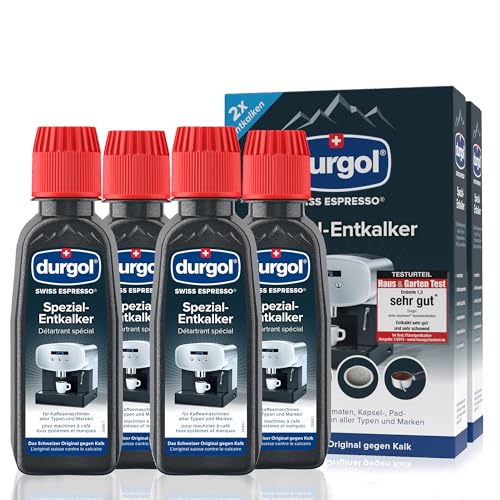
| durgol swiss espresso | Descaler, dissolves limescale rather than coffee fat | approx. €13.80 | 9.3 | your machine runs without a filter cartridge and asks for descaling |
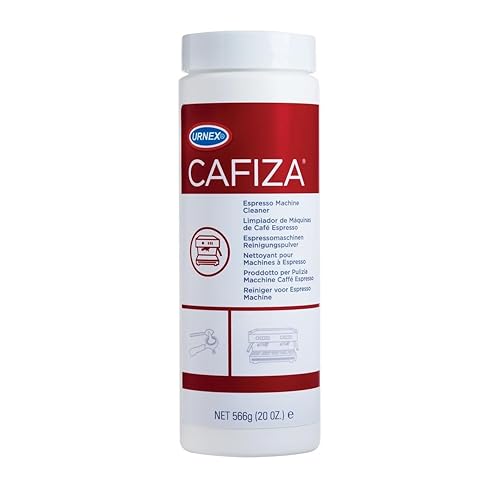
| Urnex Cafiza | Powder for backflushing with a blind basket in the portafilter | approx. €12.55 | 9.0 | there is an espresso machine with a portafilter in your kitchen besides the JURA |
The prices apply to the whole pack and come from our price boxes; the column says little about the cost of a single use, because the packs contain very different amounts. The rating is our editorial assessment based on the available data and features; nobody has measured it. You can find more descalers, filters and cleaners in the category Cleaning & Care.
When the JURA original, when something else?
Without a JURA bean-to-cup machine the question does not arise, at least not for cleaning the machine. JURA designates the tablet for its own machines, and the use assumes a cleaning programme including a funnel for pre-ground coffee. For an espresso machine with backflushing, a powder like the Urnex Cafiza is intended.
If you have a JURA that is still under warranty, we recommend the original, for the reason given above at the CAUTION notice. In the four-cup example it costs you around €12 a year compared with Coffeeano.
After the warranty has expired it becomes a trade-off. If you look after bean-to-cup machines of several brands, the point in favour of Coffeeano is that the seller offers its pack for many brands at once, Jura included (the list from the Amazon title is given above). Water is a separate matter, as described above under the protection phase. JURA sells its own descaling tablets in the German shop, and because the CAUTION sentence speaks of care products in general, you face the same question with the descaler as with the tablet. Anyone who still wants to descale independently of brand will find Jura among the example brands in the Amazon listing of the durgol swiss espresso. The procedure for different machine types is described in our guide Descaling a bean-to-cup machine.
The wrong choice is the pack of six for an office bean-to-cup machine that makes dozens of cups every day. Calculated with the interval of the Z10 and the A1, at 30 preparations a day a cleaning is due every six days, and the box is empty after a good five weeks. For this consumption the tins of 25 and 100 are more suitable, which JURA does not stock in its household shop in this country. If the office has a JURA model other than the Z10 or A1, the interval from that model’s own manual applies in any case.