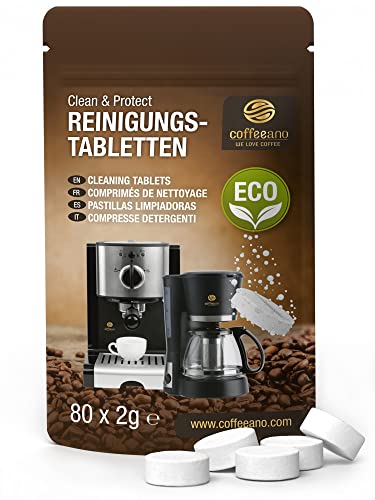
Coffeeano sells its cleaning tablets for coffee machines in a bag of 80. The pack costs approx. €12.99 on Amazon.de (as of September 2026), so one tablet comes to around 16 cents. The brand is run by Veano One GmbH in Burgkirchen. On its company page Coffeeano tells its own origin story like this: it began with a broken Jura bean-to-cup machine, and the company traces that defect back to a lack of care or the wrong care. According to the manufacturer’s page, the tablets are made in Germany.
We have not held a bag in our hands, and we have not cleaned a machine with it. The information here comes from the Amazon catalogue (retrieved 7 September 2026), the product overview and the frequently asked questions on coffeeano.com, the freely downloadable complete Coffeeano instructions, two safety data sheets and two care articles from the Coffeeano blog, all retrieved on 25 September 2026.
Kraft paper bag, 15 mm tablet, two formulas
Amazon describes the pack as ECO packaging made of kraft paper, with 95 per cent less plastic. On coffeeano.com it sounds more cautious, saying “up to 95%”. The product photo shows a brown printed bag with “80 x 2g” on it and the product name in five languages. Amazon gives the pack size as roughly 22.5 by 12 by 2.5 centimetres.
According to Coffeeano, each tablet has a diameter of 15 millimetres and weighs 2 grams. The photo shows white, flat discs. Together, 80 tablets make 160 grams of tablet mass, which is our own calculation from the two manufacturer figures.
For the “Clean & Protect Reinigungstabs” Coffeeano provides two safety data sheets. Sheet I applies to tins with a screw cap and stand-up pouches, carries the material number R-CTI0002 and is dated 28.11.2022. Sheet K applies to tins with a clip-on lid and is dated 03.05.2021. Coffeeano does not explicitly say which of them covers the ECO bag. Because only sheet I mentions a bag at all, we consider formula I the more likely one, but this is not certain.
According to the data sheet, formula I consists of 25 to 50 per cent sodium carbonate, i.e. soda. In addition there are 10 to 20 per cent sodium percarbonate, 5 to 10 per cent anhydrous citric acid and under 5 per cent potassium peroxymonosulfate. The labelling under the EU Detergents Regulation lists 15 to under 30 per cent oxygen-based bleaching agents, 5 to under 15 per cent phosphonates and a non-ionic surfactant (polyethylene glycol). In a ten per cent solution the pH is 10.5; the tablets are white and, according to the sheet, odourless.
Formula K is described more briefly: sodium carbonate, sodium percarbonate (named there as disodium carbonate, compound with hydrogen peroxide), 5 to 15 per cent citric acid and a fatty alcohol alkoxylate as surfactant. Its pH is 10.2 at 20 °C.
And the 4.9 per cent hydrogen peroxide that the Amazon listing advertises? As an ingredient in its own right, hydrogen peroxide appears in neither sheet. But it is present in the percarbonate: roughly a third of the compound’s mass is bound hydrogen peroxide, which is released when it dissolves. With 10 to 20 per cent percarbonate in formula I, that would work out at roughly 3.3 to 6.5 per cent. The Amazon figure lies within that range, but that still does not document it.
Alkali and oxygen instead of acid
Coffee grease is a film of oils that settles in the brew unit, the brew chamber and the spout. Coffeeano promises that the tablet removes coffee deposits, fats and oils. How this is likely to work chemically can be read from the ingredient list, and this is our reading, based on general knowledge of detergent chemistry.
Soda makes the water alkaline. In an alkaline solution with a pH above 10, fats and oils dissolve much more easily than in neutral water; the surfactant lifts the film off the surface and keeps it in suspension. The percarbonate breaks down into soda and hydrogen peroxide, and the peroxide oxidises brown coffee residues, just like oxygen bleach in washing powder. Potassium peroxymonosulfate is a second oxidising agent. Citric acid and carbonate in the same pressed tablet react as soon as water is added, and the carbon dioxide that forms bursts the tablet apart from the inside. The phosphonates bind calcium and magnesium from hard water so that they do not form a new deposit with the soda.
That is exactly why the tablet does not descale, even though citric acid is in it. Limescale dissolves in acid, and the solution from this tablet is alkaline at pH 10.5; the acid is neutralised by the excess soda as it dissolves. Coffeeano says so clearly in the instructions: like all cleaning tablets, the Clean & Protect tablets contain no descaling components, and descaling must be carried out in addition.
For the effect, Coffeeano advertises two names that it marks with ®, the ForceClean® formula and the PermaSeal® effect. PermaSeal is meant to leave an especially smooth surface after cleaning, to which dirt and deposits stick less easily, and the two together are meant to extend the life of the machines. None of the documents explains which ingredient provides this sealing. We therefore treat both names as advertising claims. The instructions recommend always dissolving the tablets in warm water.
Does the tablet fit my bean-to-cup machine?
In almost every one, says Coffeeano: the cleaning formula works with all machines and brands. Coffeeano itself names one exception, and it is mechanical: on very few models, such as the Krups EA models, the drop-in chute is too narrow for 15 millimetres, and there you dissolve the tablet in 500 millilitres of water in the water tank instead.
Which brands are explicitly meant depends on where you read. On coffeeano.com it says Jura, WMF, Siemens, Delonghi and Melitta, followed by three dots, and as machine types bean-to-cup machines, coffee machines, and pod and capsule machines. The Amazon title lists Delonghi, Siemens, EQ Series, Jura, Krups, Bosch, Miele, Melitta and WMF. In one of the Amazon bullet points Sage also appears, along with espresso machines and portafilter machines. All three lists end open-ended with “etc.” or ellipsis dots. They are examples, not a list of checked models.
More important than any brand list is a sentence that Coffeeano itself writes in its instructions, as the first sentence in the section for bean-to-cup machines with a cleaning programme: “Please observe the instructions of the machine manufacturer. These always take precedence.” If your machine’s manual requires a particular cleaning product, the tablet supplier thus puts itself at the back of the queue. What this looks like at JURA, we put together in the review of the JURA 3-Phase Cleaning Tablets from the manuals of two JURA models.
How cleaning works according to the Coffeeano instructions
The instructions can be downloaded from coffeeano.com without registration, in German, English, French, Spanish and Italian. For bean-to-cup machines they distinguish three cases, and which one applies to you depends on two questions: does your machine have a cleaning programme, and does it have a compartment for ground coffee?
With a cleaning programme it is short. The tablet goes into the ground coffee compartment, then you start the cleaning programme. Afterwards you rinse with 500 millilitres of clear water, via the machine’s programme. On most machines, according to Coffeeano, this clear rinse does not run through the ground coffee compartment at all.
With a ground coffee compartment but without a cleaning programme, you use the tablet to simulate a cup of ground coffee:
- Put one tablet in the ground coffee compartment.
- Place an empty cup under the spout.
- Start the programme for one cup of ground coffee.
- Wait about a minute.
- Repeat the process without a tablet until the water in the cup is clear, according to the instructions about three to four times. For these rinse runs you may skip the waiting.
Without a ground coffee compartment and without a programme it gets more laborious; the instructions split the route into manual work and a machine run. First you dissolve one tablet in a cup of hot water, take the brew unit out of the machine and rinse it thoroughly under running water. With the solution you clean the spout, the brew chamber and the brew unit; for this the instructions mention brushes or even a toothbrush. The solution works for 1 to 2 minutes, then you rinse with clear water, dry off and put the unit back.
The second part is expressly permitted only without coffee beans in the bean hopper. One tablet dissolves in around 400 millilitres of water in the water tank. Once it has dissolved completely, you start the coffee programme with an empty cup under the spout, empty the cup, wait about a minute, start the programme once more and wait another minute. After that you rinse the water tank with clear water, refill it and run the coffee programme three times to rinse clear.
For the Krups EA exception, Coffeeano gives 500 millilitres of water in the tank in the FAQ, and for the tank route in the instructions approx. 400 millilitres. Both figures appear in Coffeeano sources; they refer to different situations. At the end there is a note that all steps may differ slightly depending on the machine. The instructions also have separate sections for filter coffee machines with and without a drip stop, for pod and capsule machines, for thermos flasks and for portafilter machines; we answer some of them in the questions below.
How often to clean, and how far do 80 tablets go?
Coffeeano gives two different intervals. The instructions say that bean-to-cup machines should be cleaned at least once a week. A blog article with six care tips for coffee machines, on the other hand, gives every 10 to 14 days, according to the blog approx. 30 to 40 cups, and likewise refers to the machine manufacturer’s instructions. If your machine requests cleaning through its own counter, go by the counter.
The calculation for both intervals, based on approx. €12.99 for 80:
With weekly cleaning the bag lasts 80 weeks, so a good year and a half. 52 tablets are used per year, which comes to approx. €8.44. With a cleaning every 14 days, 26 tablets are needed per year, approx. €4.22, and the bag lasts a good three years.
The original JURA tablet costs approx. €9.99 for six in our catalogue, around €1.67 per tablet. Per cleaning you therefore pay about a tenth with Coffeeano. Coffeeano itself advertises that its products are up to 20 times cheaper than the original products of the machine manufacturers.
A descaler is always needed as well. In the same blog article Coffeeano advises descaling about once a month; what your machine actually demands depends on its counter and on the hardness of your water. How this works for each machine type is described in our guide Descaling and cleaning.
Hazard statements, phosphonates, disposal
Formula I is classified as Skin Irrit. 2 and Eye Dam. 1, and the signal word is Danger. The hazard statements for this are H315, causes skin irritation, and H318, causes serious eye damage. Formula K is one level lower, as Eye Irrit. 2 with H319 (causes serious eye irritation) and the signal word Warning.
The Coffeeano instructions carry a warning, quoted here in full: “Danger of serious eye damage. Must not get into the hands of children. Avoid contact with eyes and skin.”
Safety data sheet I lists seven precautionary statements, reproduced here in sense. P102: keep out of reach of children. P264: wash hands and face. P280: wear protective gloves, protective clothing, eye protection and face protection. P302+P352: in case of skin contact, wash with plenty of water and soap. P305+P351+P338: in case of eye contact, rinse the eyes. P310: immediately call a poison information centre or a doctor. P332+P313: if skin irritation occurs, get medical advice. For dropping in a dry tablet P280 sounds strict. For the manual cleaning route without a ground coffee compartment, where you work on the brew unit with a toothbrush and solution, we would wear gloves.
On the environment: formula I contains phosphonates, and the data sheet notes that they can contribute to the eutrophication of waters. The water hazard class given there is WGK 2, clearly hazardous to water (a German classification). For small quantities the disposal instruction is to dilute them with plenty of water. Within the meaning of the transport regulations the product is not dangerous goods.
What Coffeeano leaves open
A collection of what is stated in none of the documents: a shelf life or best-before date, not even for the opened bag; the total weight of the pack (the 160 grams above are only 80 times 2 grams); a dissolving time and a water temperature in degrees, as the instructions only say warm or hot; whether the tablet works in phases and in how many; measured values that document the PermaSeal effect; inspection seals, certificates or approvals from individual machine manufacturers; a guarantee or liability commitment in case a machine is damaged; a list of specifically checked machine models or a model number, apart from the material number from data sheet I; a product page of its own for the 80-pack ECO bag, because the product overview names the ECO variant without a quantity and the subpage on the Cleaning Tabs contains only a registration form; a statement on the milk system, for which Coffeeano offers a separate cleaning product; and the year since which the brand or this pack has existed.
Tablet, original, powder or descaler?
In our catalogue only one tablet competes directly with Coffeeano. The two other products take on tasks alongside it that come up in the same kitchen.
| Model | The difference | Price | Our rating | Choose this if |
|---|---|---|---|---|
| Coffeeano Cleaning Tablets, 80 pieces (this one) | tablet offered across brands, around 16 cents per cleaning | approx. €12.99 | 8.3 | you clean weekly or every 14 days and want to save per tablet |
| JURA 3-Phase Cleaning Tablets | machine manufacturer’s original, 6 instead of 80 tablets | approx. €9.99 | 8.8 | you have a JURA and want to follow its care specification |
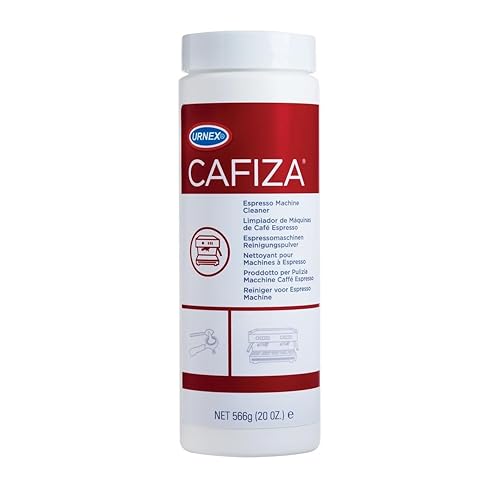
| Urnex Cafiza | powder for backflushing with a blind basket, not a tablet | approx. €12.55 | 9.0 | you backflush an espresso machine (portafilter) regularly |
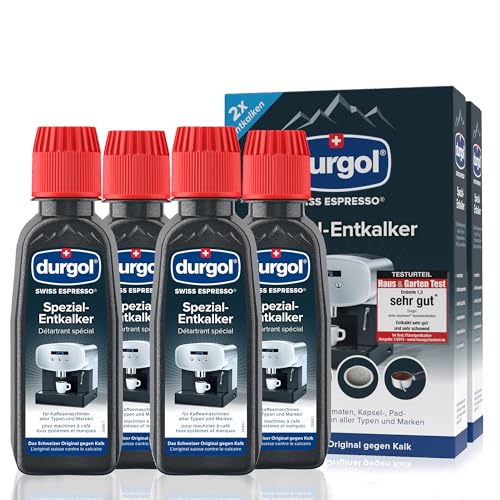
| durgol swiss espresso | descaler, dissolves limescale rather than coffee grease | approx. €13.80 | 9.3 | your machine requests descaling |
The prices are for the whole pack and come from our price boxes (as of September 2026); because the packs last very different lengths of time, the column says little about the cost of a single use. The rating is our editorial assessment based on the available data and features. More filters, descalers and cleaners are in the Cleaning & Care category.
When Coffeeano, when something else?
The clearest case for this pack is a bean-to-cup machine with a cleaning programme and a ground coffee chute. There you take a tablet, drop it in, done. With weekly cleaning you save around €78 a year compared with JURA tablets at the catalogue price, and with a cleaning every 14 days around €39.
If your manual says that only the machine manufacturer’s cleaning products are to be used, we would stay with the original, at least as long as the machine is under warranty. A dispute over damage starts badly if you have cleaned against your own manual.
Several machines in the household speak rather for Coffeeano. According to the instructions, the same tablet covers a bean-to-cup machine, filter machine, pod or capsule machine, espresso machine (portafilter) and thermos flask. For regular backflushing of an espresso machine with a blind basket, however, a dosable powder such as Urnex Cafiza is built; the Coffeeano instructions describe only soaking the removed parts for portafilter machines. Limescale is a separate matter, and for that the durgol swiss espresso is in the table.
This bag is the wrong choice for two groups. Anyone who deliberately wants to clean without phosphonates should pick something else, because formula I, which we consider the more likely one for the bag, contains them. And anyone with small children and no lockable cupboard for cleaning products should know the classification above, under the hazard statements, before the bag goes on an open shelf.