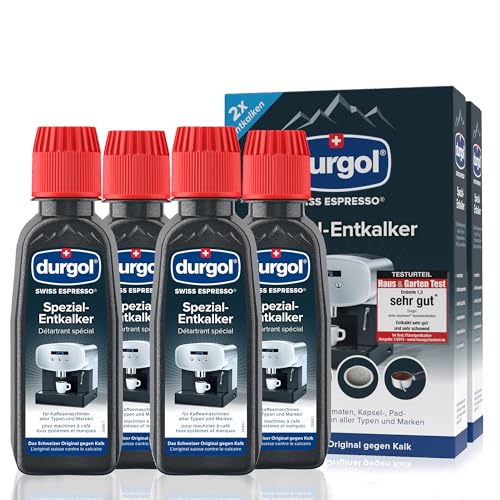
The durgol swiss espresso is a liquid descaler from Switzerland, filled into bottles of 125 millilitres. One bottle is one descaling, which is how the manufacturer calculates it. The pack covered here contains four of them, at approx. €13.80 on Amazon.de (as of September 2026). The offer has been listed there since 29 June 2018, and the catalogue gives the model number as 766.
Behind it is Düring AG of Dällikon. According to its company history, the durgol brand has existed since 1951, and the idea for the first descaling product came to Maria Düring-Keller while she was cleaning, the grandmother of the three current owners. According to the company, development and production take place exclusively in Switzerland, and durgol is available in over 40 countries.
We have not handled the bottles and have not descaled a machine with them. Our sources are durgol.com, the instructions for use available there as a PDF, a safety data sheet from Düring AG and the Amazon catalogue data of 7 September 2026.
What is in the bottle
The ingredient declaration under EU Detergents Regulation 648/2004 is short: Aqua, Sulfamic Acid, care and auxiliary substances. Sulfamic acid is called Amidosulfonsäure or Sulfamidsäure in German; the instructions speak more generally of an inorganic acid.
The proportion is only revealed by the safety data sheet (version 1 of 6 October 2023, product number 70005): 10 to 15 per cent by weight, CAS number 5329-14-6. The same sheet gives a pH value below 1 and a relative density of 1.08, and describes the product as a colourless liquid with a characteristic smell. We did not find the document linked on durgol.com, but on the server of a third-party provider. The values taken from it are given here with the note “according to the safety data sheet”.
The sheet also carries a UFI code: UESH-3027-9205-Q9V9. This identifier refers to the formulation that a manufacturer files with the poison information centres. If a child has drunk from the bottle, the poison helpline can identify the composition unambiguously via the code, so it is worth having it ready on the phone in an emergency.
The product page adds environmental claims: no phosphorus, no aromatic hydrocarbons. durgol also calls the product food-safe and residue-free. The Amazon listing is more precise, saying residue-free “after descaling & rinsing” (nach dem Entkalken & Spülen). So the rinsing is part of the promise.
The product photo shows black bottles with red, ribbed caps. The label is bilingual, German and French (“Spezial-Entkalker”, “Détartrant spécial”).
In detail: why durgol mixes a separate formula for bean-to-cup machines
On its Swiss site, durgol points to the quick descaler durgol express for filter coffee machines, tea kettles and kettles. For bean-to-cup, capsule, pod and espresso machines, the manufacturer expressly recommends its special product swiss espresso on the express page, and its own product page adds portafilter machines.
The reason is foam. According to durgol, closed systems need a formula with markedly lower foam formation, because foam can damage pipes and valves. Gas is unavoidably produced during descaling: limescale consists essentially of calcium carbonate, and every acid releases carbon dioxide as it dissolves it. In an open kettle the gas rises and escapes. In a bean-to-cup machine, a pump pushes the solution through those very pipes and valves, and gas bubbles and foam are out of place there, because at these points the machine expects water.
A little chemistry on the acid itself, which does not come from durgol: sulfamic acid forms a readily water-soluble salt with calcium. With citric acid, the other common active ingredient in descalers, calcium citrate forms, and it dissolves less well in hot water than in cold. Anyone descaling hot with citric acid risks new deposits. On the first page of the durgol instructions, which consists only of pictograms, “hot” is crossed out and “cold” is ticked. We read this as an instruction to fill the tank with cold water.
For descaling itself, durgol cites its own figure: according to the manufacturer’s internal trials, one millimetre of limescale increases energy consumption by 8.1 per cent. The direction is physically plausible, because limescale conducts heat much worse than the metal of a heating element and sits as an insulating layer between the heating and the water.
Do I have to dilute durgol swiss espresso?
Yes. In both procedures the instructions dilute the 125 millilitres with water: for machines with a descaling programme to the total quantity specified by the machine manufacturer, for machines without a programme in a 1:1 ratio. The concentrate does not go into the tank neat.
The instructions open with a sentence that frames everything that follows: for the descaling and rinsing process, the instructions for use of your coffee machine take priority. durgol supplies the product, the machine determines the procedure.
With a programme, called “Automatic” in the instructions, there are three steps. Put one portion into the water tank, fill the tank with water up to the total quantity your machine’s manufacturer recommends, then the programme starts by itself, or you start it.
Without a programme (“Manual”), you likewise put one portion into the tank and add the same quantity of water, so 125 millilitres. You let this solution run through the hot water outlet, and the instructions put a warning in front of it: do not produce steam. If the machine has no hot water outlet, it goes through the coffee outlet. The empty bottle is good for measuring the water, since it was filled with exactly this quantity.
From here on both routes are the same. You catch the liquid that comes out in a sufficiently large glass or plastic container. The instructions warn: “Vorsicht: Flüssigkeit kann heiss sein!” (Caution: liquid may be hot!). The used solution should cool before being poured away, and then it is flushed away with plenty of water. Then rinse the water tank with water and rinse the machine with 1 to 2 tank fills of water, for appliances with a programme as their own instructions provide. As a final tip, durgol recommends wiping the machine with a damp cloth to remove splashes of the descaling solution.
“No soaking time” in this procedure only means that the solution does not have to stand in the system before the next step. durgol gives no figure in minutes; the duration of a run including rinsing depends on the programme and the tank size of your machine.
How often to descale, and what it costs per year
The instructions name three triggers. As soon as the machine’s descaling indicator lights up, descale. At the latest when the coffee takes longer to run through or the brewing noises increase. And as a guideline: regularly and early, ideally at least every 3 months.
There is also a requirement that is easily overlooked. The machine should be set to the local water hardness. Many bean-to-cup machines calculate from the set hardness and the amount of water that has run through when descaling is due, and anyone who has never changed the factory setting may get the indicator too early or too late. The hardness value for your location is usually published by the local waterworks; more in the guide Water hardness and coffee.
The cost depends on a rule from the Important Notes in the instructions: for appliances with a water tank larger than 1 litre, 2 portions should be used. durgol draws the line at the tank, not at the boiler or heating system.
Why exactly there can be worked out, and the calculation is ours. At the density of 1.08 from the safety data sheet, 125 millilitres weigh around 135 grams, containing about 13.5 to 20 grams of sulfamic acid at a 10 to 15 per cent share. If your machine manufacturer specifies a total of one litre, the solution is roughly 1.4 to 2 per cent acid. In two litres, with one bottle it would be only half that. The second portion therefore keeps the solution in a large tank about as strong as in a small one.
With a tank of up to 1 litre, one descaling costs approx. €3.45 at the Amazon price above. Four runs a year, that is the three-month rhythm of the instructions, need exactly one pack. Over one litre, each run costs approx. €6.90, the pack lasts for two, and over a year that is two packs, approx. €27.60. On top of that comes tap water for topping up and the one or two rinse runs, nothing else.
What the instructions and safety data sheet prescribe
The instructions have an “Important Notes” block with six points, given here in full. First: the product contains inorganic acid, care and auxiliary substances. Second: contact with acid-sensitive materials is to be avoided, as these can be attacked. Third: it must not get into the hands of children. Fourth: in case of eye contact, rinse immediately with water, and consult a doctor if irritation persists. Fifth: if swallowed, drink water, and consult a doctor if you feel unwell. Sixth, the two-portion rule for large tanks from the cost section.
No promise that the product is gentle on seals or hoses can be read from the second point, and durgol does not expressly promise anything for these components elsewhere either. In general the manufacturer writes that the protection and care formula extends the life of the coffee machine, but does not say which materials benefit. It only becomes specific in the warning. This may mean aluminium and zinc, for example, which dissolve in strong acid, and marble or limestone, which themselves consist of calcium carbonate, that is, exactly what the descaler is meant to dissolve. A splash on a worktop of marble or limestone can therefore leave stains. We would apply the damp-cloth tip that durgol gives for the machine to the worktop as well.
The safety data sheet additionally regulates storage: keep the container tightly closed, store in the original container, accessible only to authorised persons. In view of point three, the supply therefore belongs in a cupboard that children cannot reach.
What durgol does not state
For swiss espresso, the following are missing: a limescale-dissolving capacity in grams per bottle, the duration of a run, a shelf life before and after opening, details of the bottle material and closure, dimensions and weight of the bottles (the Amazon dimensions of one centimetre per edge are clearly placeholders), the year of market launch, approvals from individual machine manufacturers, and any statement on whether a third-party descaler affects your machine’s warranty. There is likewise no speed comparison with citric acid or vinegar for this product, nor descaling intervals in weeks for each hardness range. It also remains open under what conditions the 8.1 per cent extra consumption was determined. And on portafilter machines with a steam boiler or dual boiler, the instructions contain only the one sentence that no steam should be produced.
Descaler, filter or tablet: what else comes into question
In our catalogue, swiss espresso competes with only one other descaler. The other two products in the table solve a neighbouring task, and what a bean-to-cup machine needs in the way of care is decided precisely between these three.
| Model | The difference | Price | Our rating | Choose this if |
|---|---|---|---|---|
| durgol swiss espresso 4 x 125 ml (this one) | Sulfamic acid, brand-independent, pre-portioned | approx. €13.80 | 9.3 | you want to descale machines of different brands with one product |
| DeLonghi EcoDecalk | Descaler from the machine manufacturer De’Longhi itself | approx. €7.98 | 8.7 | you have a De’Longhi machine and want to stay with the machine manufacturer for care |
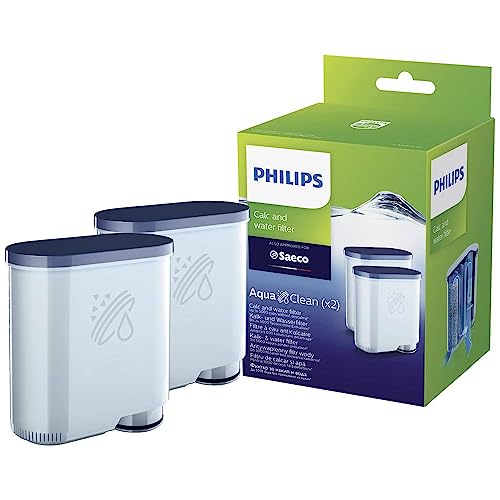
| Philips AquaClean CA6903/22 | Water filter: holds back limescale instead of dissolving deposited scale | approx. €19.99 | 8.9 | your machine takes an AquaClean filter |
| Coffeeano Reinigungstabletten (cleaning tablets) | 80 tablets against coffee grease, a different purpose from limescale | approx. €12.99 | 8.3 | your bean-to-cup machine shows a cleaning programme |
The prices apply to the whole pack as of September 2026, and the packs contain very different things, so a price per descaling cannot be read from this column. The rating is our editorial assessment based on the available data and features. The other descalers, filters and cleaners are in our category Cleaning & Care, and the top-rated ones in the best cleaning and care list.
When durgol, when something else?
First the appliance. In our assessment swiss espresso fits best in a household with several coffee machines of different brands, for example a bean-to-cup machine in the kitchen and a capsule machine in the study. As examples, durgol lists Delonghi, Nespresso, Jura, Senseo, Saeco, Krups and WMF. If you only have a filter machine or a kettle, this is the wrong product (see above).
Then the instructions of your machine. According to durgol they take priority, as described in the procedure above, and some machine manufacturers name a particular care product there. If yours does, we advise sticking to it, especially while the machine is under warranty. For a De’Longhi machine, the EcoDecalk is then the obvious choice.
The tank size decides the cost, as calculated above. Anyone with a large tank and hard water who therefore descales more often than four times a year uses two bottles on each run, and the annual bill grows with it.
A water filter shifts the question. It holds back part of the hardness before it settles as limescale, whereas a descaler dissolves what is already there. If your machine takes a filter such as the Philips AquaClean, you descale less often.
Independently of that, a bean-to-cup machine with a cleaning programme needs tablets against coffee grease, such as the Coffeeano Reinigungstabletten. The descaler does not replace them, and they do not replace the descaler. Our guide Descaling and cleaning goes through the steps for bean-to-cup machine, portafilter machine, filter machine and moka pot individually.
That leaves the portafilter machine with a steam boiler or dual boiler. What the durgol instructions offer on this is given above under the missing details, and it is little. Before descaling a steam boiler, it is therefore worth consulting the machine manufacturer’s documents.
The wrong choice is swiss espresso for an aluminium moka pot that sits on the hob. Stovetop pots do not appear in the appliance lists of swiss espresso and the quick descaler, and in our assessment aluminium counts among the acid-sensitive materials that the second note in the instructions warns about.