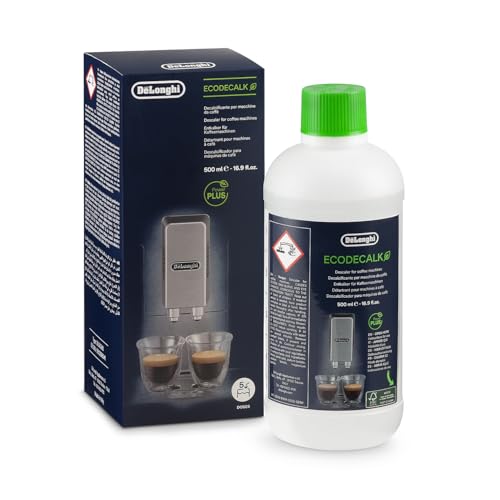
The EcoDecalk is the liquid descaler that De’Longhi sells for its own coffee machines: a bottle of 500 millilitres, intended for five descaling runs of 100 millilitres each. In our price box it stands at approx. €7.98 on Amazon.de, and the Amazon catalogue listed a price of €7.99 on 7 September 2026.
We have not handled the bottle and have not descaled any machine with it. What follows comes from De’Longhi’s German online shop, the leaflet and an ingredient list from the manufacturer’s media database, a safety data sheet from its support area, and the Amazon catalogue data.
EcoDecalk becomes Decalk Care
If you look for the descaler at De’Longhi, you will find it under a different name. The German shop sells the bottle as Decalk Care, with the same model number DLSC500 that appears in the Amazon catalogue. The downloadable leaflet and ingredient list still carry the old name, and on the product photo at Amazon, ECODECALK is printed on the bottle and the box.
According to the shop, the family includes three pack sizes: DLSC101 with one 100 ml bottle, DLSC200 with two of them, and the DLSC500 reviewed here. There is also a care set with the number DLSC306, in which Decalk Care is packed together with other care products. The leaflet names De’Longhi Appliances s.r.l., Via L. Seitz 47, 31100 Treviso, as the manufacturer.
What is in the bottle
The ingredient list under the EU Detergents Regulation 648/2004 has five items: water, L-(+)-lactic acid, sodium lactate, calcium lactate and magnesium lactate. An English version for the US market assigns each ingredient its job. Lactic acid descales and, as a complexing agent, binds metal ions; the three lactates buffer; water is the solvent.
The quantities appear only in the safety data sheet, and in the support area only the US version in English is available, revision 04 of 1 March 2022, valid for ECODECALK and ECODECALK Mini. It gives 30 to 50 percent lactic acid, a pH of approx. 2.5 and a relative density of 1.21 kg/l. Appearance: colourless liquid. The sheet does not say whether the product sold in Germany is composed in the same way, which is why the figures taken from it carry the qualifier US data sheet here.
The density leads to a contradiction in the Amazon data. 500 millilitres at 1.21 kg/l weigh about 605 grams, and that is without the bottle. The catalogue gives about 500 grams for the item, which does not fit the density from the US data sheet.
The dimensions from the same catalogue, 7.9 by 7.9 by 19.0 centimetres, do fit the proportions on the product photo. It shows a round white bottle with a green cap, next to it the dark blue box.
In detail: lactic acid as a descaler
Limescale in a coffee machine consists essentially of calcium carbonate. Any acid dissolves it; calcium goes into solution and carbon dioxide escapes. What happens to the calcium afterwards is what distinguishes the active ingredients. Lactic acid forms calcium lactate, a salt that dissolves readily in water. Citric acid forms calcium citrate, which dissolves poorly, and even worse in hot water than in cold. In a hot boiler, citric acid can therefore leave new deposits behind.
Against this background stands the advertising claim on the shop page that the product is “faster and more effective than conventional citric-acid-based descalers”. De’Longhi publishes no measurement for it. The chemistry makes the direction plausible, but that does not make it documented. The same applies to the second promise, that the product extends the life of the machine, ensures energy efficiency and preserves the taste of the coffee. At least the energy part can be justified physically: limescale conducts heat worse than metal and sits as an insulating layer on the heating element.
Sulfamic acid, the active ingredient in the durgol swiss espresso, is the considerably stronger acid: its pKa is around 1, that of lactic acid about 3.9. The finished products are also far apart, below pH 1 according to durgol’s safety data sheet and approx. 2.5 for the EcoDecalk. The pH scale is logarithmic; a gap of just 1.5 units means roughly 30 times the concentration of hydrogen ions, and the gap here is rather larger. We explain why the value is not lower despite the high acid content by the lactates. A weak acid together with its salt is a buffer, and that is exactly the role the US ingredient list assigns to the three lactates. De’Longhi describes the descaler only in general terms as “gentle on your coffee machine”.
A calculation of ours, not a manufacturer’s statement: 100 millilitres at 1.21 kg/l weigh about 121 grams, and according to the US data sheet they contain 36 to 60 grams of lactic acid. Two molecules of lactic acid react with one molecule of calcium carbonate. On paper, one dose is therefore enough for 20 to 33 grams of limescale. No machine reaches this upper limit, because the solution flows through and does not react completely, and nobody knows how much limescale is in the system before descaling anyway.
That leaves the addition “of plant origin” on the shop page. The L-(+) in the ingredient list fits it. Lactic acid in this form is produced when lactic acid bacteria ferment sugar or starch, whereas chemical synthesis yields a mixture of both mirror-image forms.
Why does a descaler that is meant to be gentle say “Danger”?
Because the concentrate is corrosive, and the advertising line speaks of the machine, not of your skin. The German leaflet carries the signal word GEFAHR (danger) and the corrosion pictogram; the symbol can also be seen on the bottle label in the product photo.
The US data sheet classifies the product as skin corrosive category 1C and as causing serious eye damage category 1. The Amazon listing, by contrast, says the descaler is not corrosive and is safe to use. For us, the manufacturer’s leaflet applies. The liquid goes into the machine diluted, with the amount of water given in the machine’s instructions or, failing that, with 1 litre. The classification describes what comes out of the bottle.
The safety instructions on the German leaflet read:
- Causes severe skin burns and serious eye damage. Corrosive to the respiratory tract.
- Keep out of the reach of children.
- If medical advice is needed, have the packaging or label to hand.
- Wash hands thoroughly after use. Do not breathe vapour.
- If on skin (or hair): take off all contaminated clothing immediately. Take a shower.
- If swallowed: rinse the mouth. Do not induce vomiting.
- If in eyes: rinse cautiously with water for several minutes. Remove contact lenses, if present and easy to do. Continue rinsing.
- Dispose of contents/container in accordance with local regulations.
- Contains lactic acid.
In transport, the descaler is dangerous goods according to the US data sheet: UN 3265, class 8 for corrosive substances, packing group III. Within the class, that is the group with the lowest hazard.
How a descaling run goes according to the leaflet
The instructions have four steps. Empty the water tank and pour in 100 ml of EcoDecalk. Dilute the 100 ml with water, using the amount given in the coffee machine’s instructions, or 1 litre of water if nothing is stated there. Start the descaling cycle as described in the instructions. Finally, rinse the water tank several times with clean water, as the machine’s instructions specify.
Three of the four steps refer to your machine. How much water, how long and how often it rinses is determined by its programme; the descaler supplies the acid.
Below them are four warnings. One dose (100 ml) is sufficient for efficient descaling each time. The descaler can damage delicate surfaces, so please wipe up spills immediately. Read the leaflet carefully and keep it. Please do not use other products that are not suitable for descaling.
The first note becomes interesting with large tanks. De’Longhi ties the one dose to no tank size, whereas durgol recommends two bottles of its swiss espresso for tanks over 1 litre.
You have to measure out the dose yourself, because the bottle holds five doses in one. Whether the cap or label carries a 100 ml mark is left open by the product photo. We would use a measuring jug made of glass or plastic and rinse it thoroughly afterwards. It is better to take the tank out of the machine to fill it, and to fill it over the sink rather than pouring over the worktop. Marble and limestone are especially sensitive to acid, as they themselves consist of calcium carbonate, exactly the substance the descaler is meant to dissolve. With a skin-corrosive concentrate, we consider household gloves sensible.
What a descaling costs
At approx. €7.98 for five uses, you arrive at about €1.60 per use. In the De’Longhi shop, the same bottle cost €12.49 on 25 September 2026, which is about €2.50 per use.
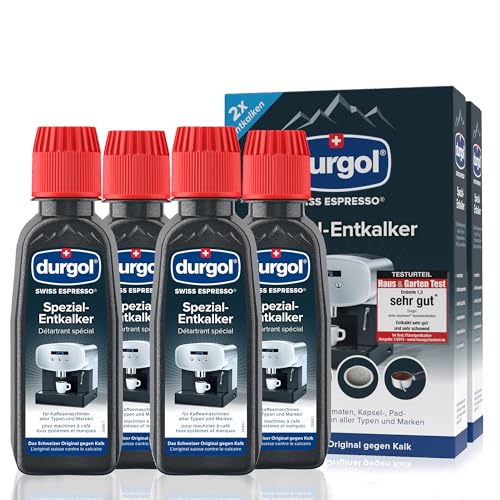
The durgol swiss espresso stands in our price box at approx. €13.80 for four bottles of 125 ml, so about €3.45 per use. For a tank over 1 litre, durgol recommends two bottles, which makes about €6.90 per use. Compared with the EcoDecalk, you pay a good double with durgol, and more than four times as much with a large tank.
How often these costs arise is decided by your machine and your tap water. Bean-to-cup machines with a descaling indicator usually calculate the time from the set water hardness and the amount of water that has run through. Which hardness range applies where you live and how to set it is explained in the guide Water hardness and coffee. Two examples: with four descaling runs a year, one bottle lasts 15 months; with six, 10 months.
What De’Longhi leaves open
The following are missing for this descaler: dimensions and weight of the bottle from the manufacturer (there are only the Amazon values from above), the material of the bottle and closure, the duration of a descaling run or a contact time, a descaling interval by water hardness, a shelf-life statement for the unopened bottle, a limescale-dissolving capacity in grams, a comparison with sulfamic acid, the place of production (only the company address in Treviso is known), the year of market launch, a manufacturer’s warranty of its own, and notes on recycling the bottle. Beyond the blanket suitability statement further down, you learn nothing about kettles, filter machines or individual third-party brands, and nothing about how aluminium parts tolerate the descaler.
Descaler, filter or tablet: what else comes into question
In our category, the EcoDecalk faces a second liquid descaler. The other two products in the table handle neighbouring tasks, and what a machine needs in the way of care is decided among these three.
| Model | The difference | Price | Our rating | Choose this if |
|---|---|---|---|---|
| DeLonghi EcoDecalk 500 ml (this one) | Lactic acid, one bottle for five doses of 100 ml | approx. €7.98 | 8.7 | you are descaling a De’Longhi machine and are happy to measure the dose yourself |
| durgol swiss espresso | Sulfamic acid, four pre-portioned 125 ml bottles | approx. €13.80 | 9.3 | you have machines of different brands and do not want to measure anything |
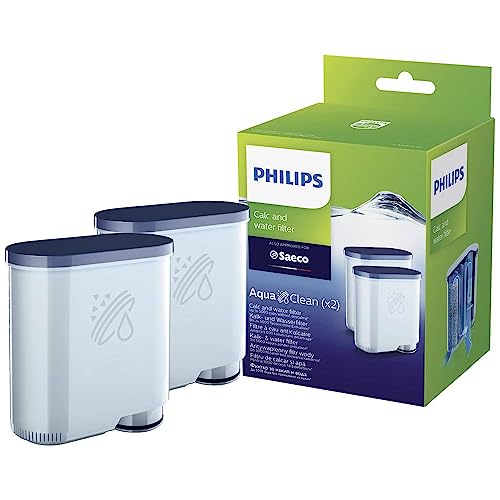
| DeLonghi water filter DLSC002 | Filter in the water path: holds back hardness instead of dissolving deposited limescale | approx. €7.49 | 8.6 | your De’Longhi machine is, according to the manufacturer, compatible with this filter and you want to catch limescale before the heating system |
| Coffeeano cleaning tablets | 80 tablets against coffee oils, do not dissolve limescale | approx. €12.99 | 8.3 | your bean-to-cup machine prompts you to clean, not to descale |
The prices are the guide values from our price boxes in September 2026 and apply to the whole pack; what one use costs is in the cost section. The rating is our editorial assessment based on the available data and features. You will find further descalers, filters and cleaners in the category Cleaning & care, and the top-rated ones in the best cleaning and care list.
When EcoDecalk, when something else?
With a De’Longhi machine, it is simple. De’Longhi writes that this original care product is recommended for all De’Longhi coffee machines, and in our assessment there is no reason to deviate from that.
The manufacturer does not rule out other brands. The shop page says: “This descaler is suitable for all coffee machines.” If your machine’s instructions prescribe a particular product, we would stick to that requirement, all the more so while the machine is under warranty. The amount of water for the dilution comes from those instructions anyway.
If you have two machines of different brands, the durgol swiss espresso gives you a product that comes from neither of the two machine manufacturers. With a tank over one litre, however, the price gap from the cost section becomes more than twice as large.
The classification can also be a criterion. The safety data sheet of the durgol carries the signal word Warning and lists skin irritation and serious eye irritation, whereas the EcoDecalk carries DANGER with skin burns. If you have small children at home, you must lock away both bottles. If you have ever spilled while filling, we would lean towards the more weakly classified product.
A water filter such as the DeLonghi DLSC002 only shifts the question. It holds back part of the hardness before it settles, while the descaler dissolves what is already there. If your bean-to-cup machine instead prompts you to run the cleaning programme, it is about coffee oils, and tablets like those from Coffeeano are intended for that. The steps for bean-to-cup machines, espresso machines, filter machines and moka pots are explained in our guide Descaling and cleaning.
For the kettle, the EcoDecalk is in our assessment the wrong choice. De’Longhi describes it exclusively as a product for coffee machines, and all four steps of the instructions assume a water tank and a descaling programme.