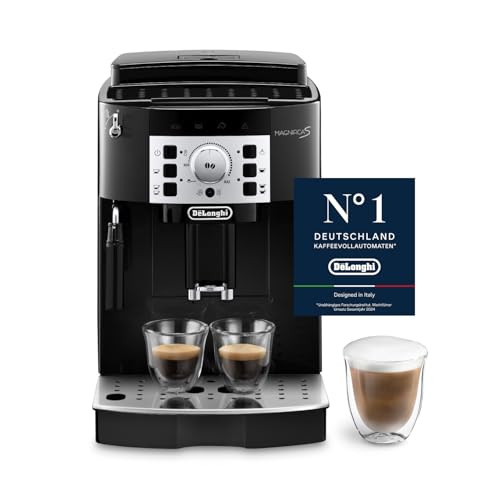
The Magnifica S ECAM22.110.B is a bean-to-cup coffee machine from De’Longhi with a built-in grinder, buttons instead of a display and a classic steam nozzle for milk foam. On the German product page it is called “Magnifica S Black”, and the finish is listed there as Glossy. In our price box it stands at approx. €319.90 on Amazon.de (as of September 2026); in the De’Longhi online shop it cost €349 on 1 October 2026. As its release date the Amazon catalogue carries 1 August 2017.
In our bean-to-cup machine comparison it has 8.3 points and the label Value pick. We have not handled the machine. What is written here comes from the product page, including the data record in its source code, from the manual that De’Longhi issues for the whole ECAM11.1XX to 22.1XX series, from the safety booklet and from the product data sheet. In that data record the country of origin is entered as Romania. One inconsistency up front: in the Amazon catalogue the colour field says “Schwarz Silber, 3 Getränke” (black silver, 3 drinks), while the title of the listing says “Schwarz” (black), and the model number ECAM22.110.B belongs to the black version at De’Longhi.
How much space does the Magnifica S need?
A niche at least 30 centimetres wide, 46 centimetres deep and 50 centimetres high up to the wall cabinet. The manual gives 24 x 43 x 35 centimetres (width, depth, height). On top of that come 3 centimetres of clearance to the side walls and rear wall and 15 centimetres above (safety booklet).
The product page lists somewhat smaller figures, 230x430x340, without a unit and without assignment to the axes. The weight is similar: the manual gives 8.9 kilograms, the product page simply 9.299, and Amazon, converted, 9.0 kilograms. For planning we would use the larger dimensions from the manual. According to the data record, cups up to 140 millimetres high fit under the coffee spout, whose height you can adjust.
Two further requirements from the safety booklet concern the location. Under CAUTION it says that the worktop must be more than 850 millimetres above the floor. And during operation the machine does not belong inside a cupboard.
It runs on 220 to 240 volts and draws 1450 watts. The socket must be earthed, rated for at least 10 amperes and always within reach, so that you can pull the plug if necessary.
Buttons, dial, two cups
The Magnifica S has no display. In the data record it says “Icon” instead, meaning indicator lights: a strip with ECO, grounds container, water tank and a warning triangle, plus a light with a thermometer symbol next to the on/off button that blinks while heating up. The buttons carry symbols instead of labels.
Coffee comes via four buttons: small cup, two small cups, large cup, two large cups. From the factory a small cup is about 40 ml and a large one about 120 ml, doubled for the double-cup buttons. The product page lists no coffee drinks beyond espresso and espresso lungo, plus hot water. You change the volume by holding a button until its light blinks and the coffee runs, and pressing it again at the fill level you want. If something should still run after a brew, you hold one of the dispensing buttons for 3 seconds. For two cups you put both under the spouts and lower the spout as close as possible to the rims, which according to the manual gives better crema.
How strong the coffee turns out is decided by the rotary dial B6 in the middle of the panel. The manual once calls it the selector for coffee volume and elsewhere the rotary dial for coffee strength. What is meant is the amount of beans: the closer to MAX, the more the machine grinds. We would not turn it all the way to the stop, because then the coffee may only come out drop by drop, especially with two cups. You set the coffee temperature to LOW or HIGH.
The manufacturer text in the Amazon catalogue promises to store aroma, coffee volume and milk volume for all drinks. The manual knows storing only for the coffee volume per button. You froth milk yourself on this machine anyway.
Grinder, pressure, heating: what is documented
According to the manual, the water tank holds 1.8 litres at most and the bean container 250 grams. About the grinder itself, the product page and the manual say nothing. “Kegelmahlwerk” (conical burr grinder) and “13-stufig” (13 settings) come from the manufacturer text in the Amazon catalogue, and our title takes the word from there too. The numbers 7, 5, 3 and 1 with intermediate marks are printed on the grind size dial.
The grinder is set at the factory, so at least at first you do not need to change anything. It is adjusted only while it is running at the start of a preparation, and only ever by one position. If the coffee runs too slowly, you turn one step to the right towards 7. If you want it stronger and with more crema, one to the left. The effect shows only after at least two coffees in a row. For thin coffee with little crema the troubleshooting table sees two causes, a grind that is too coarse or unsuitable beans, and then advises coffee for espresso machines. Caramelised and candied beans are forbidden because they stick to the grinder and can damage it. According to the safety booklet, only roasted beans belong in the container. Powder residues in a new machine are normal: the grinder is run in before sale for adjustment.
For pressure the manual gives 1.5 MPa, that is 15 bar. That describes what the pump can deliver. How much pressure reaches the coffee grounds is determined by the resistance of the coffee bed: how finely the coffee is ground, how much of it is in the brew chamber and how densely it is pressed. That is why the manual starts with the grind size when coffee runs too slowly.
On the heating system the sources contradict each other. The data record on the product page says thermoblock, while the manual speaks of the boiler in the chapter on switching on. A thermoblock heats the water as it flows through a heated metal block, whereas a boiler keeps a reserve warm. Which statement is right cannot be decided from the documents.
The sequence is certain. Every time you switch it on, the machine heats up and rinses, with hot water running from the coffee spout into the drip tray, and this process cannot be cancelled. When you switch it off it rinses once more, provided coffee was brewed beforehand. If the green ECO light is on, energy-saving mode is on, and a few seconds more can pass before the first coffee.
If the coffee arrives too cool in the cup, the troubleshooting table lists three reasons: cold cups, a brew group that has cooled down two to three minutes after the last brew, and a temperature set too low. The data record on the product page lists a cup warmer; according to the safety booklet the cup tray can become hot during operation. Remedies are a rinse cycle with the rinse button before brewing, cups preheated with hot water, and the HIGH setting.
Milk foam at the steam nozzle
There is no milk system with a jug or tube. The milk frother, A18 in the manual, sits on the left of the housing in the product photo.
You fill a jug with approx. 100 ml of milk per cappuccino, press the steam button, dip the frother in and turn the steam dial to I as soon as the light blinks. You turn the jug slowly from bottom to top while the volume grows to double or triple. Steam should not flow for longer than 3 minutes, and after 3 minutes a safety device interrupts the output anyway. Whole or semi-skimmed milk at fridge temperature, about 5 °C, is recommended. According to the manual, large bubbles in the foam have two causes: the milk is too warm, or it is not semi-skimmed.
After every use the frother comes off, so that no milk residues build up and nothing clogs. The steps: let some water run out for a few seconds, let it cool, turn the frother to the left and pull it off, pull off the steam nozzle, check its holes and clear them with a toothpick if necessary (with a blocked wand, extreme caution is required because of the residual steam, says the safety booklet), clean the parts with a sponge and lukewarm water, and put everything back on until it clicks into place.
Hot water for tea also comes through the same frother: a vessel underneath, steam dial to I, back to 0 to stop. You should not leave the machine unattended while doing so, and you touch the tube only by the handle.
Our assessment: one or two cappuccinos a day are quite manageable this way. If you need four milk drinks in a row, you stand at the nozzle for each one yourself and clean it afterwards. How fine-pored foam is made at a steam wand is shown in the guide How to froth milk.
From first switch-on to descaling
Before the first coffee you rinse all removable parts that come into contact with water or milk with hot water. Then you fill the tank to MAX, put a vessel of at least 100 ml under the milk frother and let water run through via the steam dial. Because the water circuit is empty on first use, the machine can be very loud according to the manual; the noise gets quieter as the circuit fills. The safety booklet requires you to pour away 5 coffees prepared hot, 3 preparations with steam and 3 with hot water on first use. According to the manufacturer, the result only becomes satisfactory after 4 to 5 coffees or cappuccinos.
For regular cleaning, chapter 13.1 of the manual lists nine places: the internal circuit, the grounds container, the drip and condensation trays, the water tank, the spouts of the coffee outlet, the milk frother, the coffee powder chute, the brew group behind the service door and the control panel. Solvents, abrasives and alcohol are excluded, and you do not tackle encrustations with metal objects, because they can scratch surfaces of metal or plastic. According to De’Longhi the cleaning needs no chemical additives. The safety booklet adds alkaline cleaners and other flammable liquids and allows a soft cloth, if necessary with a neutral cleaning agent. You never immerse the machine itself in liquid for cleaning. On the dishwasher the manufacturer sources disagree; that is covered below in the questions.
The brew group has to come out at least once a month, the safety booklet says every 30 days, and never while the machine is switched on. You switch off, pull the water tank, open the service door on the right, press the two coloured release buttons inward and pull the group out. It soaks in water for about five minutes and is then rinsed under the tap, without cleaning agent. Before inserting it you clean the housing. The group is seated when it clicks into place at PUSH; afterwards you check the two buttons, close the door and put the tank back.
You empty the grounds container when its light blinks; while it blinks, the machine prepares no coffee. According to the product page it holds 14 portions. If you pull out the drip tray, you empty the grounds container every time as well, even if there is hardly anything in it. The tray has a red float and is emptied before it protrudes from the cup grid, otherwise water can leak and damage the machine or the surface it stands on. About once a month, with the plug pulled, you look inside the machine and remove deposits with a sponge; at the same interval you check the powder chute for blockages. According to the safety booklet you change the water in the tank at least every three days, and you clean the tank itself monthly and after every filter change with a soft cloth and a little mild detergent.
You descale when the rinse button light blinks, and exclusively with De’Longhi descaler. According to the manual, unsuitable products or irregular descaling can cause defects that are not covered by the manufacturer’s warranty. You empty the drip tray, grounds container and tank, take out the filter and pour in descaler up to the printed mark A, which corresponds to a 100 ml pack, then water up to mark B at one litre. A vessel of 2 litres goes underneath. You start by holding the rinse button for at least 5 seconds and turning the steam dial to I. After about 25 minutes the programme pauses, followed by two rinse cycles with a full tank, and if you do not fill the tank to MAX for them, you get a third. For the whole run the manual allows about 45 minutes. If it is interrupted, for example by a power cut, you repeat it. Spilled descaler is wiped up immediately, as it can damage delicate surfaces. The general procedure is explained in the guide Descaling a bean-to-cup machine.
Accessories, running costs and what De’Longhi leaves open
As accessories the manual lists a measuring spoon, descaler and a water filter, the last two with the addition “if provided”. Whether they are in the box with the ECAM22.110.B, we would check when unpacking.
The manual recommends this water filter, part C3 in its accessories list. If none is included, authorised customer service points sell it. With normal use it lasts two months, and it comes out before every descaling.
The running costs can only be put into figures in part. A De’Longhi descaler such as the EcoDecalk stands in our price box at approx. €7.98 for 500 ml, which at 100 ml per run is around €1.60 per use. You can only extrapolate that to a year when you know how often your machine prompts for descaling. Anyone using the filter continuously needs six a year; we set no price for that as long as the matching filter type is open. The manual does not provide for cleaning tablets.
We searched the product page, manual, safety booklet and data sheet for the following points, without result:
- pump type and pressure at the coffee grounds during brewing
- brewing temperature in degrees
- heat-up time until the first coffee
- noise level in decibels
- a descaling interval in weeks or cups
- type and article number of the matching water filter
- whether the steam nozzle can be swivelled
- the adjustment range of the coffee spout
- the cable length
- material of grinder, brew group, tank and drip tray; for the housing the data record says plastic
- how long spare parts are available
- when the series came onto the market
Magnifica S, Solo, LatteGo or E8?
| Model | The difference | Price | Our rating | Choose this if |
|---|---|---|---|---|
| DeLonghi Magnifica S ECAM22.110.B (this one) | Manual steam nozzle, removable brew group | approx. €319.90 | 8.3 | you mainly drink espresso and only froth milk yourself now and then |
| Melitta Solo | neither steam nozzle nor hot water, 20 cm wide | approx. €268.98 | 8.2 | you never froth milk and every centimetre of width counts |
| Philips LatteGo 5400 | LatteGo milk system in two parts without tubes | approx. €424.48 | 8.6 | you want cappuccino at the press of a button every day |
| Jura E8 | fixed brewing unit, cleaned via a tablet programme | approx. €1,049 | 9.4 | you never want to take the brew group out yourself |
The prices are guide values from our price boxes, as of September 2026, and can differ on the day you buy. The rating is our editorial assessment from data sheets and manuals; we have measured none of the four machines.
When the Magnifica S fits, and when another machine does
If you never drink milk and every centimetre counts, take a look at the Melitta Solo. According to Melitta it is 20 centimetres wide, 4 less than the Magnifica S, and in our price box it costs around €51 less. In return it has neither a steam nozzle nor hot water output, its tank holds 1.2 litres and its bean container 125 grams. Melitta gives the brewing temperature in degrees, 85, 90 or 95 °C. For a household with tea drinkers we would stay with the Magnifica S because of the hot water.
From three cappuccinos a day we advise an automatic milk system. The Philips LatteGo 5400 costs around €105 more in our price box; according to Philips its LatteGo consists of two parts without tubes, all of which may go in the dishwasher. According to Philips, however, it does not make two milk drinks at the same time. If you want to stay with De’Longhi, you will find LatteCrema Hot, a touch display and 18 drinks in the Magnifica Plus, but in our price box you pay around €330 more, so a good double.
If you never want to handle the brew group, the Magnifica S is the wrong choice. On the Jura E8 the brewing unit is fixed, and it is cleaned through a programme with a cleaning tablet, which according to Jura is due after 180 preparations or 80 switch-on rinses. In our price box the E8 is around €729 above the Magnifica S, more than three times the price.
For the office tea kitchen it is ruled out according to the safety booklet. It says there: “Dieses Gerät ist ausschließlich für den Hausgebrauch bestimmt. Der Gebrauch ist nicht vorgesehen in: Räumen, die als Küchen für das Personal von Geschäften, Büros und anderen Arbeitsbereichen eingerichtet sind, in landwirtschaftlichen touristischen Einrichtungen, Hotels, Zimmervermietungen, Motels und sonstigen Übernachtungsbetrieben.” (In English: this appliance is intended exclusively for household use. Use is not intended in rooms set up as kitchens for staff in shops, offices and other work areas, in agricultural tourist facilities, hotels, room rentals, motels and other accommodation businesses.) A rented holiday flat falls under room rentals in our reading.