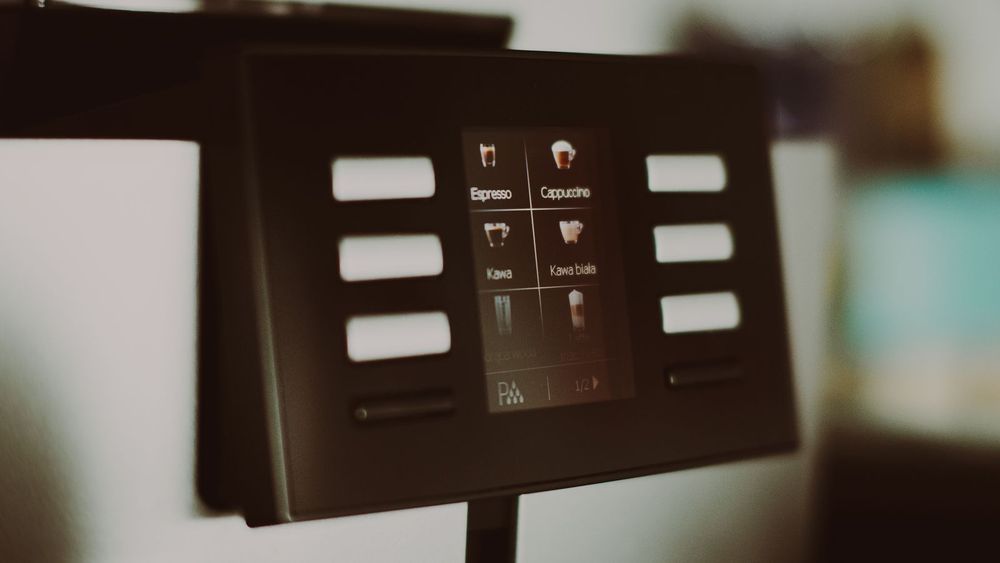
The E6 that JURA sells in September 2026 is not the E6 from older brochures. It currently runs as the ED variant with model year 2026 and has 17 programmed specialities. The earlier EC variant with model year 2022 managed eleven and did not yet have Light Brew preparation. Because both generations carry the same name, every figure here states where it comes from.
Which E6 you get and what it costs
JURA offers the ED in three colours: Dark Inox (item number 15828), Piano Black (15642) and Piano White (15643). The technical data in this review applies to all three. On design, JURA describes high-gloss front panels, with lacquered and chrome-plated details on Dark Inox. In the technical data of the manual, JURA lists the E6 as JURA Type 782.
According to the product page, the E6 is built in Portugal. The company itself is Swiss: JURA Elektroapparate AG was founded in Switzerland in 1931 and is based in Niederbuchsiten, with German sales in Nuremberg. Where you buy the E6 matters for the manufacturer’s warranty; more on that in the questions below.
If you have a used machine or an old listing in front of you, you can recognise the EC in three places: its colour display measures 2.8 inches, its grinder is called Professional Aroma Grinder (P.A.G.), and JURA gives it as 9.1 kilograms at 28 x 35.1 x 44.6 centimetres.
On price, two figures are far apart. Our price box lists approx. €699 on Amazon.de. In the JURA online shop the E6 cost €899 in Piano Black on 24 September 2026, and €979 each in Dark Inox and Piano White. So the colour makes €80 of difference at the manufacturer. The guide price in our price box is €200 below the cheapest price in the JURA online shop. Whether an offer means the current ED or still the older EC, you can tell from the item number and display size.
In our bean-to-cup machine comparison the E6 stands in second place with 9.2, behind the Jura E8. The rating is our editorial assessment, based on manufacturer and catalogue data.
Dimensions, power and counter space
27 centimetres wide, 34.8 high, 44.6 deep, approx. 9.7 kilograms. The mains cable measures approx. 1.1 metres and, depending on the version, is either fixed or plugs into the back.
For installation JURA requires a level surface that is insensitive to water, with the ventilation slots left clear. Connect directly to a household socket, because the manual warns of overheating with multi-socket strips and extension cables. Together with the short cable, that means where the E6 can stand is determined by the position of the wall socket. A surface that is cleaned with a jet of water is expressly ruled out.
Electrically it is designed for 220 to 240 volts at 50 hertz, with 1450 watts and 10 amperes. Switched off, it draws 0 watts according to the manual. You set the automatic switch-off to 15 minutes, 30 minutes or 1 to 9 hours after the last action.
The water tank holds 1.9 litres, measured without a filter. The bean hopper with aroma-protection lid takes 280 grams, and the coffee grounds container a maximum of 16 portions. The coffee, cappuccino and hot water outlets can each be adjusted in height between 65 and 111 millimetres, so a glass taller than about 11 centimetres will not fit underneath.
In detail: grinder, thermoblock and two modes
The grinder is called P.A.G.2 and has seven settings. It is adjusted with a rotary knob under a cover behind the bean hopper. The manual says to match the grind setting to the roast level and gives a visible criterion for it: the coffee flows evenly from the outlet and a fine, dense crema forms.
In addition there are ten levels for coffee strength and three each for brewing and hot water temperature. Coffee water quantity, milk quantity and milk foam quantity can also be programmed. The brew unit is variable and processes 5 to 16 grams of ground coffee per drink.
Heating is by a thermoblock, that is, in flow rather than in a boiler. For the pump, JURA gives a static maximum of 15 bar. Static means measured without flow, against a closed outlet. As soon as water flows through the coffee, the pressure drops, and around 9 bar at the coffee bed is usual for espresso. As a figure for comparing two machines, the pump specification therefore says little. The product page lists the Pulse Extraction Process (P.E.P.) as standard equipment.
The two modes are more tangible. Hot Brew is the classic, hot brewing method. According to the manual, Light Brew works with less powder and a reduced brewing temperature and is therefore easier to digest and ready to drink immediately; the product page gives around 60 °C. You decide which mode applies. Neither the manual nor the product page says anything about an automatic that switches over by itself for light roasts. Instead, in the menu you set whether the E6 asks for the choice after every switch-on.
The drinks list has espresso, coffee, americano, lungo, espresso doppio, espresso macchiato, cappuccino, latte macchiato, a portion of milk foam and hot water. In addition there are 2 x espresso and 2 x coffee, plus five Light Brew versions of espresso, coffee, espresso macchiato, cappuccino and latte macchiato. At JURA, espresso doppio means two espressos one after the other. Americano and lungo combine the coffee with additional hot water, the quantity of which you can change.
What may go into the grinder is tightly regulated by the manual. Only roasted coffee beans without any further treatment are permitted. Beans treated with additives or caramelised, and ground or freeze-dried coffee in the bean hopper, damage it.
How much manual work is in a cappuccino?
More than a press of a button. You choose the drink, open the rotary knob by hand as soon as the display asks for it, and close it again afterwards. After every milk preparation the E6 calls for a milk system rinse, and on every day with milk a clean is due.
The milk comes through a tube from an external container or milk cooler. On the machine sit the HP1 connector and the replaceable CX3 milk outlet. As the main criterion for frothing, the manual names a milk temperature of 4 to 8 °C and therefore recommends a milk cooler or milk container. JURA sells the Cool Control for this; in the JURA online shop on 24 September 2026 it cost €189 with 0.6 litres and €219 with 1.0 litres. If the fridge is standing next to the machine anyway, in our view a milk container that you put back in the cold between drinks is enough.
Hot water also runs through the same rotary knob. For that you pull the fine foam nozzle off downwards and push on the hot water nozzle supplied. The manual warns here of scalding from hot water splashes.
The daily milk system clean works only with JURA milk system cleaner in the container supplied and, according to the product page, takes about two minutes. If you switch off after a milk drink, the E6 asks for it; after 30 seconds it carries on switching off, even without the clean. Once a week JURA recommends taking the fine foam nozzle apart and rinsing the parts under running water. For dried-on residues you first soak them in 250 millilitres of water with one dose of milk system cleaner. According to the care table you replace the milk tube with HP1 and the CX3 outlet roughly every three months.
One point in the manual does not fit together. For the connection to the cleaning container, the milk tube is supposed to carry an HP3 connector, although the same manual describes the E6 with HP1. This can only be clarified with the retailer or with JURA itself.
Cleaning, descaling and what may go in the dishwasher
The brew unit is cleaned by the machine: after 180 preparations or 80 switch-on rinses the E6 calls for a clean that runs for approx. 20 minutes. Midway you drop a JURA cleaning tablet into the funnel for ground coffee. You should not interrupt the programme, because according to the manual that impairs the cleaning quality.
You can trigger a coffee rinse by hand at any time. When switching off, the E6 rinses only if coffee was drawn beforehand. You empty the coffee grounds container while the machine is switched on, because only then does the grounds counter reset.
The care table lists daily: empty the drip tray and coffee grounds container and rinse them with warm water, rinse the milk tube and water tank, and wipe the outside of the machine with a clean, soft, damp cloth. You change the water in the tank every day. As needed, add: clean the milk system thoroughly, brush the inner walls of the tank, and clean the top and underside of the cup platform.
On the dishwasher, the manual is split in two. The safety instructions say: “Do not put the E6 and its individual parts in the dishwasher.” The care table expressly exempts three parts and names them as dishwasher safe: the insert for the drip tray, the drip tray itself and the coffee grounds container. For all other parts the ban applies.
Before cleaning you switch the E6 off. It is always wiped damp, but never wet, protected from permanent splashing water and never with a jet of water. You may immerse neither the machine nor the mains cable. Alkaline or alcoholic cleaning agents are taboo; mild agents and a soft cloth are allowed.
With CLARIS Smart+ inserted, the E6 does not need descaling according to the manual, and a prompt does not even appear. Without a filter it asks for descaling itself, calculated from the water hardness you set at first start-up: 1 to 30 °dH (German degrees of hardness), determined with the Aquadur strip supplied. The run needs three JURA descaling tablets in 500 millilitres of water, takes around 20 minutes and must run through completely. Avoid skin and eye contact with the agent, and wipe splashes off marble and other sensitive surfaces straight away.
Two jobs remain even in filter operation. You descale the water tank from time to time with three tablets in a full tank over several hours, with the cartridge taken out beforehand. And you occasionally wipe out the bean hopper with a dry, soft cloth, because the beans leave a layer of oil. How the programmes fit together is explained in the guide Descaling and cleaning.
What running it costs
All prices in this section come from the JURA online shop, as of 24 September 2026.
A three-pack of CLARIS Smart+ (item no. 24233) costs €46.99, so a cartridge costs around €15.66. How far it goes depends solely on the water hardness: up to 65 litres at 1 to 5 °dH, 60 litres at 6 to 10, 55 at 11 to 15, 50 at 16 to 20, 45 at 21 to 25 and 40 litres at 26 to 30 °dH. JURA gives no figure in months on the CLARIS page, the E6 product page or in the manual. Your water supplier will tell you what hardness comes out of your tap; what it means for the coffee is covered in the guide Water hardness and coffee.
Cleaning tablets come in a pack of six (item no. 24225) for €9.99, around €1.67 each. At four drinks a day, that works out at a good eight cleans and about €13.50 a year. If you switch the machine on often, the switch-on rinses can trigger the clean sooner.
Milk is where the money goes. The original bottle of JURA milk system cleaner with 90 grams is enough for 30 cleans and costs €14.99, the refill bottle €13.99. Anyone who draws a milk drink every day of the year cleans 365 times and needs a good twelve original bottles, around €182 a year for the cleaner alone. The accessory set for milk system HP1 (item no. 24115) costs €18.99; bought four times a year that would be €75.96.
If you run without a filter, nine descaling tablets (3 x 3, item no. 61848) cost €13.99. That covers three descalings at around €4.66 each.
By our calculation, a household with four drinks a day, one of them a milk drink, ends up at around €272 a year for cleaner, tablets and milk parts, not yet counting the filter cartridges. Two thirds of that goes on the milk cleaner.
The manual rules out switching to cheaper material from other suppliers. It requires exclusively original JURA care products, saying others could damage the E6. The warranty terms draw the consequence: with filters, cleaning or descaling tablets that do not meet the original specifications, any warranty is void.
What JURA does not state
A few figures you would like to have before buying are missing from the manual and the product page: the heat-up time to the first drink, the Hot Brew brewing temperature in degrees (there are only the three levels), the temperature of the milk foam, a decibel figure for the grinder, the millilitres per drink as supplied, and the brewing time. The energy efficiency class and annual consumption are also missing on the E6 page.
On the grinder, the page gives only the name P.A.G.2. Material and design remain open, so terms such as conical burrs or hardened steel cannot be documented for the E6. The long form Professional Aroma Grinder appears only in documents for the earlier variant. The housing material is equally open. What the Pulse Extraction Process does technically stays with the name on the product page; the 2026 manual manages without it.
That the brew unit is permanently installed is not stated in so many words anywhere; we infer it from the fact that the manual never lists it as a part to be taken out. For the time after purchase, there are no figures on service life, repair costs and spare part availability. Which milk containers from JURA fit in detail, and what exactly the HP1 accessory set contains, cannot be seen from the shop data we have.
And one gap is on our side: we have not handled the E6 ourselves. How loud it grinds and how firm the foam gets are therefore things we cannot tell you.
The E6 next to three alternatives from our catalogue
| Model | The difference | Price | Our rating | Choose this if |
|---|---|---|---|---|
| Jura E6 (this machine) | Brew unit stays in the machine, milk by tube and rotary knob | approx. €699 | 9.2 | you mostly drink black coffee and do not want to clean the brew unit yourself |
| Jura E8 | 27 specialities and Sweet Foam as a third mode | approx. €1,049 | 9.4 | you want milk specialities such as flat white directly on the home screen |
| Nivona NICR 790 | Brew unit that can be taken out and rinsed | approx. €750 | 9.0 | you want to check the brew unit yourself and are willing to plan the monthly job |
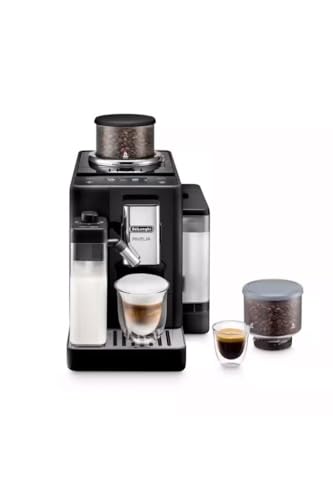
| DeLonghi Rivelia | Two interchangeable bean hoppers of 250 g each | approx. €660 | 8.9 | two varieties of beans are in use in your household |
The prices are the guide prices from our price boxes and not manufacturer prices, and the ratings are our editorial assessment. For the Nivona we looked up the brew unit in its operating manual, and for the Rivelia the bean hoppers on the DeLonghi product page; the table deliberately does not compare further properties of the three.
When the E6 suits and when one of the other machines does
Start with your drinks. Given the dosing range of the brew unit, one filling of the bean hopper arithmetically lasts for 17 to 56 drinks. The coffee grounds container fills faster: at four drinks a day it is at its limit after four days, at eight after two. For two people with two cups each, that is routine. At a breakfast with six guests you empty it in between.
Milk is the point on which the E6 is decided. If you have a cappuccino in the morning, you turn the knob for the drink and the rinse and clean once a day for about two minutes. If you draw five milk drinks in a row for visitors, you stand at the machine the whole time. And if you like to skip the daily clean, this system is the wrong machine for you.
If you want to see the brew group yourself, the Nivona NICR 790 is the alternative; in our price box it costs €51 more. According to the current Nivona manual for the NICR 7.. series, you take the brew unit out as needed, but at least once a month, and clean it only under running cold water without detergent. With the E6 this step falls away.
If two varieties of beans are in use in your household, say a strong one for espresso and a mild one for the big mug, the E6 keeps up only with portions from the powder funnel. According to DeLonghi, the DeLonghi Rivelia has two interchangeable bean hoppers of 250 grams each and, in our price box, sits €39 below the E6.
If you rarely go into the menu, with the Jura E8 you pay €350 more for drinks you never call up. Conversely, if you want flat white and sweetened milk foam without detours, you will find both on the E8 and not on the E6.
Under a wall cabinet, the housing height of 34.8 centimetres alone is not enough as a measure. The water tank and bean hopper have their own covers, and JURA does not say how much clearance they need to open. So allow clearance for the lids above the housing height, or plan the E6 for a spot without an upper cabinet. If you are still undecided between machine types, the coffee finder helps narrow it down.
For an office kitchen, the E6 is the wrong purchase according to the wording of the manual. It says the machine is intended for private household use and serves only to prepare coffee and heat milk and water. Any other use is considered improper.