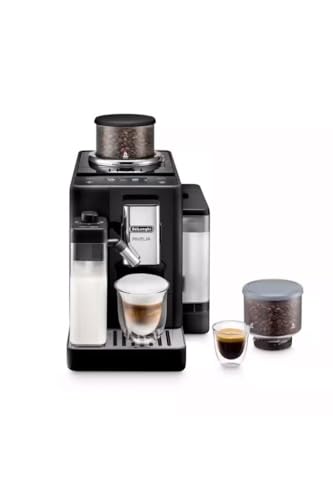
Nivona is a brand from Nuremberg, founded in 2005 as NIVONA Apparate GmbH, and says it sells its bean-to-cup machines only through specialist retailers. Our shop link leads to an Amazon search, not to a specific offer. On nivona.com the machine is called NICR 7’90. It is the same model in black/chrome, article number 300 700 790.
What the NICR 790 is and what it costs
Our price box lists the NICR 790 at around €750 on Amazon.de. In its data sheet Nivona gives a somewhat higher recommended retail price, which specialist retailers are not bound to.
The 790 is a bean-to-cup machine with a milk system for seven drinks: espresso, coffee, americano, cappuccino, latte macchiato, milk foam and hot water. It is described here from the German manual, version Rev.03 of 19 April 2025, plus the data sheet, the series page, the warranty terms and the manufacturer’s FAQ.
On Stiftung Warentest (Germany’s consumer testing foundation): on test.de the NICR 790 appears in the bean-to-cup machine programme 06/2025, published on 26 June 2025. The grade and ranking are behind the paywall there.
In our bean-to-cup machine comparison the NICR 790 scores 9.0, which puts it third behind the Jura E8 and the Jura E6. The score is our editorial assessment based on manufacturer and catalogue data.
Dimensions, power and space in the kitchen
The data sheet and manual give approx. 24 × 34 × 46 centimetres, in the order width, height, depth. More important than the narrow front is the right-hand side. The service door is there, and behind it are both the grind size slider and the brew unit. If the machine stands against a wall or tall cupboard on the right, you pull it forward for both. Rear castors, which would make this easier, are fitted only to the sister models 795 and 796, according to the series page and the manual.
The manual requires a dry, level, stable surface indoors, never on hot surfaces, never next to appliances that get hot such as a hob or deep fryer, and never near flames. The machine must not run inside cupboards or enclosed furniture, the ventilation slots must stay clear, and operation above 2,000 metres above sea level is prohibited.
It connects to a properly installed socket. The cable measures approx. 1.1 metres, and the rest disappears into the cable compartment at the back. Nivona states 1455 watts maximum power consumption at 220 to 240 volts. If the rotary dial is left untouched for a while, the machine switches to ECO mode with a screensaver. You set the automatic switch-off time in the TIMES menu; the manual itself points out that a longer switch-off time increases energy consumption. If you are away for several days, the manual says to always pull out the mains plug.
You always remove the water tank to fill it. According to the data sheet and manual it holds approx. 2.2 litres. The bean hopper with aroma-protection lid takes approx. 250 grams, and the grounds container holds approx. 7 to 11 portions depending on coffee strength. For all Nivona bean-to-cup machines the manufacturer states 7 to 11 grams of ground coffee per cup in its FAQ. Applied to the bean hopper, that is roughly 23 to 36 cups per fill, a rough calculation of ours. The 790 has no bean sensor. It shows FILL IN COFFEE BEANS as soon as the grinding chamber is empty.
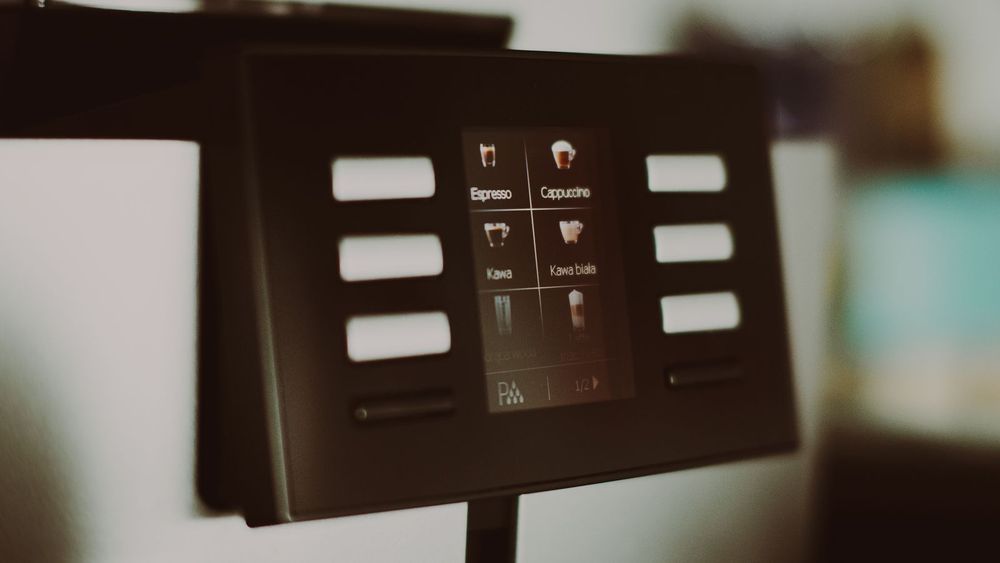
You operate it with the rotary, a dial that you turn, press briefly or press and hold. Above it sits a 2.4-inch TFT colour display. Via Bluetooth you pair the machine with the NIVONA app from Google Play or the App Store.
What Nivona leaves open, and where the information contradicts itself
None of the documents we reviewed state: the year of market launch, the country of manufacture of the 7 series, the housing material, the pump type and the pressure at the coffee grounds, the brewing temperature in degrees, the heat-up time, the noise level in decibels, the power consumption in kilowatt hours (the manual refers to a QR code for this), the number of grind size steps, a descaling interval in litres or cycles, a minimum clearance above or to the wall (for the question of a wall cupboard this would be the decisive figure) and how long spare parts remain available.
The manufacturer contradicts itself four times. For weight, the data sheet gives approx. 8.7 kilograms, the manual approx. 11 kilograms, and the series page once 10 and once 12 kilograms. The series page lists the water tank at 1.8 litres in the block with the dimensions, and at the data sheet value in the technical block. For depth it gives 480 millimetres, two centimetres more than the data sheet. And the milk system is called OneTouch SPUMATORE plus in the data sheet and SoloPlus on the series page. We stick to the data sheet and manual. For carrying we would assume the higher weight.
In detail: conical burr, aroma profiles and 15 bar
Grinding is done by a hardened steel conical burr. Stainless steel is not mentioned anywhere in Nivona’s documents, and neither is the word stepless. Adjustment is by a slider at the top right behind the service door, finer to the left, coarser to the right, and only while the grinder is grinding. The manual presents this sentence as a warning with an exclamation mark.
Only roasted, untreated coffee beans belong in the grinder, no other foods and no foreign objects. Nivona recommends leaving the slider as close to the middle as possible, grinding light roasts finer and dark roasts coarser.
The Aroma Balance System, introduced by Nivona in 2016, works elsewhere. According to the manual, its three profiles DYNAMIC, CONSTANT and INTENSE change the brewing process and the extraction level, and leave the grind size alone. With these Nivona promises a different taste from the same bean, the same coffee strength and the same water quantity. We cannot judge whether that holds. So if you change beans, you still adjust the grind size by hand, and you can additionally change the profile.
On top of that there are five levels of coffee strength, three for coffee temperature and three for hot water for tea. The coffee quantity ranges from approx. 20 to 240 millilitres. You can also change strength, quantity and aroma profile during a cycle and save the result as a new standard recipe. Under My Coffee you create up to five drinks of your own and give them names. A pre-brewing system is built in.
For the pump Nivona states a static maximum of 15 bar. Static means measured against a closed outlet, without flow. As soon as water flows through the coffee grounds the pressure drops, and the usual rule of thumb for espresso is around 9 bar at the coffee bed. As a figure for comparing two machines, the pump specification is therefore of little use.
How much manual work goes into a cappuccino?
Little at the machine, a bit more afterwards. Cappuccino and latte macchiato come at the touch of a button, but after milk drinks the display prompts you to rinse the frother, and for that you move the milk tube.
The machine draws the milk through a tube that hangs on the height-adjustable spout. You put the other end in a container that you provide yourself; as examples the manual names a milk container, a milk refrigerator or the carton. All the manufacturer cares about is that the milk is fresh and chilled. For cappuccino you set in the recipe menu whether the milk or the coffee goes into the cup first; Nivona calls this Cappuccino Connoisseur.
For rinsing you place a container of at least 0.5 litres underneath. It should run as soon as possible, at the latest before you switch off, and the programme is not interrupted. When the display asks for cleaning, milk system cleaner goes into a container with at least 0.3 litres of water. Nivona recommends its own CreamClean for this and refers to the cleaner’s manufacturer for the mixing ratio.
You also take the frother completely apart, according to the manual ideally before every longer pause in preparation, and in any case regularly. Remove the cover plate, take the frother out downwards and forwards, take it apart into its individual parts, clean them and reassemble. Frother, tube and spout also need regular cleaning. The reason Nivona insists is stated right there: dried milk residues are hard to remove, so clean everything immediately once it has cooled. If you only drink black coffee, this chapter does not concern you. For more on the technique of frothing, see our guide How to froth milk.
Brew unit, descaling, tank: care according to the manual
This is how the brew unit comes out: remove the service door on the right, push the red switch upwards, turn the handle to the left as far as it goes until it clicks into place, and pull the unit out by the handle. It goes back in the reverse order. It is cleaned under running water, and the manual is clear: on no account detergent, only pure, cold water. Nivona requires this at least once a month.
Two programmes run via the CARE menu. You rinse the system from time to time. For system cleaning you put a cleaning tablet into the round opening of the brew unit, but only when the machine asks for it. Until then you can keep drawing drinks, but Nivona advises starting the cleaning as soon as possible. Progress bars in the care status show what is due when.
The display also reports descaling itself, and you can start it by hand at any time. Before that the filter must come out of the water tank. Then water goes into the tank up to the 0.5-litre mark first and only afterwards the descaling agent, never the other way round. The programme runs without interruption, and you work through the display prompts exactly in their order. At the end you wipe descaler residue off the housing with a damp cloth. Which products are allowed is covered in the questions below, and our guide Descaling and cleaning explains why limescale harms a bean-to-cup machine.
You clean the housing inside and out only with a soft, damp cloth without detergent. You never immerse the appliance in water, and before maintenance and cleaning you switch it off and pull out the mains plug. You empty the drip tray and grounds container at the latest when the display tells you to, and only with the machine switched on, because only then does it register that the trays have been emptied. At the back of the drip tray there are two metal contacts which, together with the gaps between them, must stay clean and dry.
You rinse the tank daily with clear water and top it up with fresh, cool water. How hard your tap water is and what that means for the machine is covered in the guide Water hardness and coffee. No other liquids belong in it, and none with carbonation. Nivona’s FAQ advises against mineral water and recommends clear tap water, regular descaling and the CLARIS filter. According to the manual you do not store beans in the refrigerator.
Running costs and manufacturer’s warranty
According to the manual the box contains a CLARIS fresh water filter, two cleaning tablets, test strips for water hardness, a measuring spoon and the connection tube for milk, plus the manual and warranty terms.
After that you buy refills. In the Nivona shop on 24 September 2026 a CLARIS filter cost €13.95, the set of three €39.95, and PREMIUM liquid descaler, cleaning tablets and CreamClean were also €13.95 each. Only the filters can be projected over a year, because for descaler, tablets and CreamClean Nivona gives no number of uses per pack. You replace the filter after approx. 50 litres of throughput, which the display indicates. With low consumption it is finished after two months at the latest, then without a message. You reach 50 litres after about two months at roughly 0.8 litres a day; if you run more water through the machine, you change sooner. That adds up to at least six filters a year: €83.70 individually, €79.90 in two sets of three.
The manufacturer’s warranty runs for 24 months from the day the retailer sells the machine to the first end user. It applies only to machines bought from a NIVONA-authorised specialist retailer in an EU member state and operated in the EU. You claim it within the period by letter, email or telephone from your country’s central service. Nivona then repairs, replaces defective parts or the whole machine, at its choice, and the warranty period does not start again as a result. According to clause 8, the warranty provides for no claims other than repair or replacement. Clause 7 excludes, among other things, defects caused by installation, use or maintenance contrary to the manual, plus damage from a fall, overvoltage, external impact or interference by unauthorised persons. Also excluded are wear parts such as seals and valves, together with damage from foreign objects in the grinder, such as stones, and the replacement of consumables such as filters, plus cleaning and maintenance work, unless needed for the repair.
In several places the manual ties the warranty to care. Anyone who ignores the cleaning and descaling instructions or cleans parts in the dishwasher loses warranty claims, and likewise if foods other than roasted, untreated beans or foreign objects get into the grinder. Other or carbonated liquids in the tank void the warranty. If you clean the brew unit less often than required above, claims may lapse. Nivona recommends system cleaning and descaling soon after the display message so as not to endanger warranty claims.
What else is worth considering?
| Model | The difference | Price | Our score | Choose this if |
|---|---|---|---|---|
| Nivona NICR 790 (this one) | Removable brew unit, milk drinks at the touch of a button | approx. €750 | 9.0 | about 240 ml of coffee per cup is enough for you, you do not need pots and you are happy to remove the brew unit at least once a month |
| Jura E6 | Brew unit stays in the machine (the Jura manual does not list it as a removable part), cleaning by tablet programme; milk by rotary knob by hand | approx. €699 | 9.2 | you never want to touch the brew unit and accept the rotary knob for milk drinks |
| Siemens EQ600 iAroma | according to the Siemens catalogue text drinks up to 480 ml and a pot function | approx. €779 | 8.8 | you often draw large mugs or pots for several people |
| Jura E8 | with the CLARIS Smart+ filter cartridge no more descaling, according to Jura | approx. €1,049 | 9.4 | you have hard water and want to be rid of descaling altogether |
The prices are the guide values from our price boxes, and the score is our editorial assessment. The details on the three other machines come from the Jura manuals and from the Siemens manufacturer text in the Amazon catalogue respectively; a ranking by coffee quality cannot be derived from them.
When the NICR 790, when another machine?
The brew unit decides first. With the NICR 790 you take it out every month, according to the care section. With the Jura E6 this does not apply; it costs €51 less in our price box and in return needs a turn of the rotary knob for every milk drink.
Large mugs are the second point. The quantity limit from the technical section and a spout that can be pushed up to 14 centimetres are enough for cups, not for pots. The Siemens EQ600 iAroma costs €29 more than the NICR 790 and, by Siemens’ own catalogue description, is built for exactly these drink sizes.
From 15 °dH, which is level 3 on the test strip, it is worth looking at descaling. With the CLARIS filter you descale the NICR 790 less often, but you do descale. According to Jura, the Jura E8 no longer needs descaling at all with the CLARIS Smart+ cartridge. It is, however, €299 above the NICR 790.
How many cups a day? By our calculation from above, one hopper of beans takes you roughly 23 to 36 cups, and the grounds container wants emptying after 7 to 11 portions. For a two-person household with two cups each, that means: on a strong setting the grounds container is full after just under two days, on a mild one after just under three.
And the purchase route. If you order on Amazon, settle the warranty question from the costs section first; if you are going to a specialist shop anyway, you have already done so. Add the filters to the purchase price. If you are unsure whether a bean-to-cup machine is the right type of machine at all, our bean-to-cup machine buying guide helps; the coffee finder narrows down which coffee profile suits you.
For use outside your own kitchen, the NICR 790 is the wrong choice according to the manufacturer’s documents. The manual permits use only in private households and excludes commercial use, otherwise warranty claims lapse. Clause 7 of the warranty terms also excludes machines used to prepare coffee and hot drinks in catering and hotels, as well as display and demonstration machines.
For an office kitchen we would have the specialist retailer clarify before purchase whether Nivona treats it as commercial use.