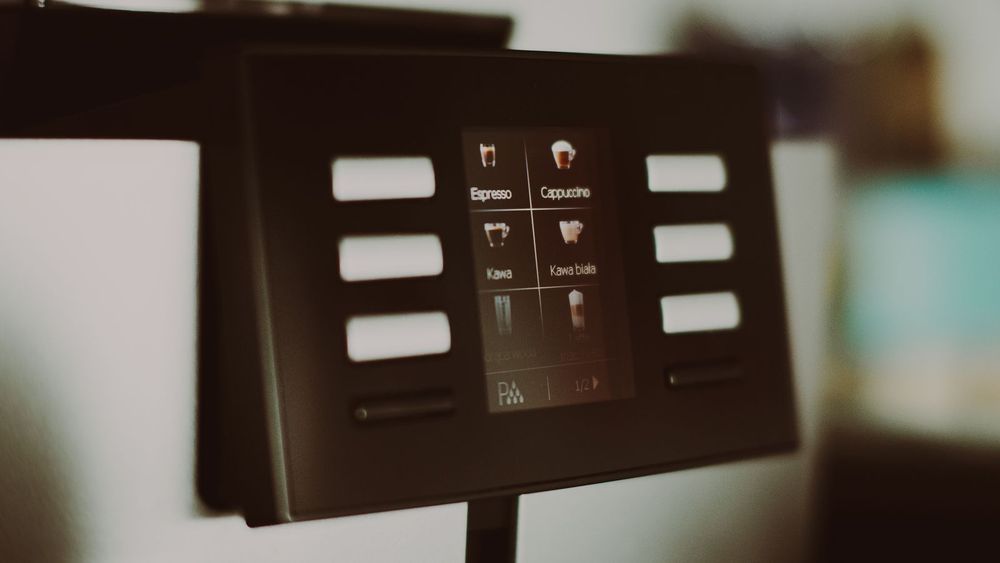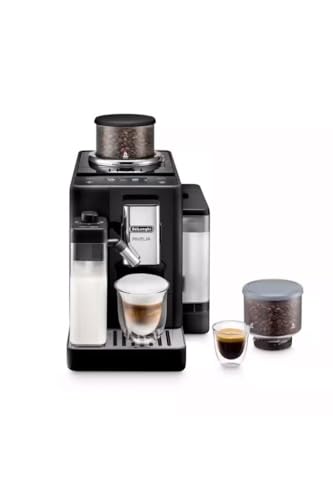
The Rivelia EXAM440.55.B is a bean-to-cup machine from De’Longhi that comes with two bean hoppers of 250 grams each: one sits on top of the machine, the other waits beside it until you change variety. On Amazon.de it costs approx. €660 (as of September 2026). In the De’Longhi shop it stood at €699.00 on 24 September, against a recommended retail price of €799.90. In the product data that De’Longhi supplies in the source code of the product page, 1 September 2023 is entered as the availability date.
On the product page, De’Longhi advertises the Rivelia as the winner of a Stiftung Warentest (Germany’s consumer testing foundation) comparison, and names neither the issue nor the grade. The related item is in the De’Longhi Group newsroom, dated 21 November 2024. How the EXAM440.55.B currently stands in the foundation’s assessments, we have not looked up on test.de, and we deliberately do not reproduce grades here.
We have not handled the machine. What is written here comes from the 65-page German instruction manual (FEB4455), the safety booklet, the product data sheet, the product page at De’Longhi and the Amazon catalogue.
Two hoppers share one grinder
This is the point on which the Bean Switch System hangs. There are two hoppers but only one grinder, and after every brew there are still beans of the old variety in the grinder. The manual says on page 38 what happens if you simply swap: then the coffee is “prepared with a mixture of old and new beans”.
For a clean switch there is the switch mode. It empties the grinder in one of two ways. Either you prepare a last cup with the old variety, or the machine grinds the remainder and you keep that powder. Afterwards you turn the hopper to the unlocking position, lift it off and fit the other one.
De’Longhi sells a third hopper as an accessory, the DLSC403 for €19.90 in the manufacturer’s shop. With it you keep three varieties to hand.
What it is worth is obvious: regular coffee in the morning and decaf in the evening, or a dark espresso roast beside a lighter bean for long drinks. How decaffeinated beans are made and what to look for when buying is in the guide Decaf coffee. If you only drink one variety, you pay for the system without using it.
Does the Rivelia fit under a wall cabinet?
Allow at least 54 centimetres between the worktop and the underside of the cabinet. The manual gives 390 millimetres of height, and the safety booklet requires at least 15 centimetres of clearance above the machine and at least 3 centimetres at the sides and back.
Width and depth according to the manual: 250 and 430 millimetres. The product page gives 245 x 430 x 385, without unit and without axes, and the Amazon catalogue converts to the same 24.5 x 43.0 x 38.5 centimetres. In the product photo the milk jug is attached at the front left of the machine, the water tank sits on the right side, and the fitted bean hopper projects from the top of the housing. Whether it is included in the 390 millimetres, the manual leaves open. If space is tight, we would measure on a display unit.
The Rivelia weighs 9.7 kilograms. The power cable is 1200 millimetres long and ends in a Schuko plug (the standard German earthed plug), and the output is 1450 watts at 220 to 240 volts. According to the safety booklet, the socket must be “always easily accessible”, and the work surface must be more than 850 millimetres above the floor. On location, it also says: “Do not place the appliance near taps or sinks.” During operation the machine must not stand inside a cabinet.
Cups up to 140 millimetres tall fit under the spout. According to the embedded product data, the housing is made of metal and plastic with a matt finish.
In detail: Bean Adapt recommends, you turn the grind dial
The Amazon catalogue says the technology matches grind size, brewing temperature and dosing to your beans. The manual describes a more modest process on page 27. You first choose the bean type, 100 percent Arabica or a blend of Arabica and Robusta, then the roast level in four steps: Light, Medium, Dark, Extra dark. Then you prepare an espresso and rate it on the display. The machine then recommends a coffee temperature, an intensity and a grind size.
You then set the grind size yourself, at the grind dial, and only while the grinder is running. The manual also requires that at least 3 cups of coffee are prepared before any change to the grinder. Anyone following a recommendation therefore sees the effect only a few brews later. Bean Adapt exists exclusively for espresso. Up to 6 bean profiles can be stored, which is enough for the two hoppers and a few more varieties.
Our assessment: for someone who has never adjusted a grind size, we still consider this useful, because the machine gives the direction. Anyone looking for a machine that measures in a new bean by itself will not find it here.
The adjustable variables that De’Longhi lists in the page data: 13 grind settings, 5 aroma levels, 3 levels for coffee temperature. In the manual the two upper temperature levels are called Medium and Max. According to the same data, heating is by thermoblock. A thermoblock heats the water as it flows through a heated metal block, rather than keeping a reserve hot in a boiler. Every time it is switched on, a preheating and rinsing cycle runs that cannot be cancelled, and when it is switched off it rinses if a coffee was prepared beforehand.
Page 64 gives the pressure: 1.9 MPa, that is 19 bar. This generally means the pump pressure. For espresso, around 9 bar at the coffee puck is usual, which is why a high pump figure alone says little about extraction.
Milk, plant drinks and the Cool set
On the LatteCrema Hot jug there is a dial with three foam positions, Fine, Creamy and Firm, and a fourth position called Clean for cleaning. The product page lists eight hot milk drinks: caffè latte, cappuccino, cappuccino mix, cortado, espresso macchiato, flat white, hot milk and latte macchiato.
According to the table on page 29, whole milk, low-fat milk and skimmed milk as well as soy, almond and oat drinks work with the Hot jug. The milk should be at fridge temperature, the manual gives 5 °C, and for plant drinks De’Longhi recommends the barista versions. Raw milk is excluded. For households with allergies, the safety booklet contains a sentence worth knowing: “The cleaning systems described in the enclosed instruction manual do not guarantee the complete removal of allergens.”
Cold coffees work without accessories, namely cold coffee, cold espresso and cold Americano; the machine suggests an amount of ice cubes for them. Cold milk drinks only come with the LatteCrema Cool Upgrade Set DLSC032, which according to the product page unlocks 6 cold milk specialities and costs €99.90 in the manufacturer’s shop. With the Cool jug the choice of milk narrows: whole milk and low-fat milk are not suitable according to the same table, skimmed milk and the three plant drinks are.
How many drinks the Rivelia can make, De’Longhi answers inconsistently. The category page, product subtitle and Amazon title speak of 16, one bullet point on the product page of 8 preset drinks. Adding up the drinks lists on the product page, we arrive at 17 entries: 5 hot coffees, 8 milk drinks, 3 cold coffees and hot water.
Two points concern runs of milk drinks. After many in a row, the machine blocks further milk drinks until it has cooled down, and the display then reports “I have overheated”. And the metal cup grille gets hot in the process; the manual says: “Do not touch it until it has cooled down and only hold it at the front.”
Cleaning according to the manual: daily, every two days, monthly
After every milk drink, the Rivelia prompts for the Clean function. For this you turn the dial on the jug to Clean, and hot water and steam flow out of the milk spout. The manual on this: “The function is automatic. Its sequence must not be interrupted.” After that the jug goes into the fridge, the Hot jug for 2 days at most.
If the jug is empty after use or has stood outside the fridge for more than 30 minutes, it is taken apart and cleaned completely. The parts are lid, milk spout, extension, the silicone milk suction tube, milk foam regulator and connector. The dishwasher at 50 °C is recommended. By hand, you put the parts in water at 40 to 50 °C with washing-up liquid for at least 30 minutes.
Besides the dismantled jug, according to page 40 the grille of the drip tray and the drip tray itself may go in the dishwasher, the cup grille may not. You clean the ground coffee chute about once a month under water at 40 to 50 °C or in the dishwasher at 50 °C.
The brew unit has to come out at least once a month. This only works with the machine switched off: remove the water tank, open the service flap on the right, take out the brew unit. It then sits in fresh water for about five minutes and is rinsed under the tap. Page 44 states in capital letters that only water is an option for this, no detergent and no dishwasher.
According to the product page, the grounds container holds 10 servings. The machine also reports it as due for emptying 72 hours after the first preparation, even if it is not full; for this count to be right, it should not be disconnected from the mains. If you take out the drip tray, you always empty the grounds container with it. The drip tray has a red float; it should be emptied before the float emerges from the cup grille.
You clean the bean hopper regularly according to the manual: empty the grinder, remove and empty the hopper, clean inside and out with a soft, damp cloth, clean the seat with brush, cloth and crumb vacuum, let everything dry completely. You rinse the water tank about once a month and after every filter change with water at 40 to 50 °C, and according to the safety booklet the water in it should be changed at least every 3 days. About monthly there is also a look inside the machine behind the drip tray, switched off and unplugged beforehand.
For the housing: “Do not use solvents, abrasives or alcohol to clean the bean-to-cup machine.” The safety booklet names a soft cloth and, if necessary, a neutral detergent. The machine is never immersed in liquid.
Descaling, filter, power: the running costs
You measure the water hardness with the included strip. It shows 1 to 4 red squares, each stands for one level, and you set that level on the machine. After that, the Rivelia requests descaling after an operating time that depends on the hardness set. How to find out the hardness where you live is explained in the guide Water hardness and coffee.
A descaling run takes around 30 minutes. The descaler goes into the tank up to marking A, which is a 100 ml pack or single dose, then water up to marking B (1 litre), and a vessel of at least 1.5 litres belongs under the spout. You may use only De’Longhi descaler. The safety booklet says why: “The use of unsuitable descalers can lead to defects that are not covered by the manufacturer’s warranty.” We have described the De’Longhi EcoDecalk separately, and the general sequence of steps is in the guide Descaling and cleaning a bean-to-cup machine.
According to the manual, the De’Longhi water filter (EAN 8004399327252) lasts two months in normal use, and 3 weeks at most if the machine is idle. Used continuously, that is six filters a year. The accessories list on page 8 shows one filter, with the proviso that the type and number of accessories vary by model.
The manual does not provide for cleaning tablets for the brew unit or milk system. It puts it like this: “With De’Longhi bean-to-cup machines you need no chemical additives to clean the appliance.” That sets it apart from the two Jura machines below, whose brew unit is cleaned through a tablet programme according to the Jura manual.
On power, the data sheet gives at most 0.5 watts in standby and at most 0.3 watts in off mode, and the machine goes into standby after less than 30 minutes without operation. De’Longhi recommends setting the auto switch-off to 15 minutes and removing the milk jug after preparation.
What De’Longhi leaves open
Some details one looks for when comparing bean-to-cup machines are missing from the manual, data sheet and product page. We have collected them instead of estimating them:
- the type and material of the grinder, for example conical or flat burrs, steel or ceramic
- the amount of powder per brew in grams; the manual works only with intensity levels
- the brewing temperature in degrees Celsius and the pressure at the brew unit
- the capacity of the milk jug; the page data contains only a 500 without a clear unit
- after how many milk drinks in a row the overheating protection kicks in
- noise level in decibels and heat-up time in seconds
- the energy efficiency class, the field for it is empty on the product page
- materials of the jug and bean hoppers, apart from the silicone milk suction tube
- how long spare parts remain available; in the shop the only individual part is the bean hopper DLSC403
Rivelia beside Jura E6, E8 and Dinamica Plus
| Model | The difference | Price | Our rating | Choose this if |
|---|---|---|---|---|
| DeLonghi Rivelia EXAM440.55.B (this one) | two bean hoppers of 250 g each used in turn, 1.4 l tank, milk from the jug | approx. €660 | 8.9 | you have two varieties in the house and don’t mind emptying the grinder when switching |
| Jura E6 | one bean hopper with 280 g, 1.9 l tank, milk via a tube from an external container | approx. €699 | 9.2 | you get by with one variety and want the larger tank |
| Jura E8 | 1.9 l tank and 280 g hopper like the E6, the milk system rinse starts by itself 15 minutes after the milk drink | approx. €1,049 | 9.4 | you don’t want to start the milk rinse yourself and the budget stretches beyond €1,000 |
| DeLonghi Dinamica Plus 380.95 | 1.8 l tank, grounds container for 14 servings, coffee pot function | approx. €589 | 8.7 | you often need several cups in a row for guests |
The prices are guide values from our price boxes. For the Rivelia and the Dinamica Plus 380.95 they come from the Amazon catalogue of 7 September 2026; for the Jura E6 and E8 we have no exact retrieval date. The rating is our editorial assessment from manuals and data sheets; we measured nothing on any of the four machines.
When the Rivelia, when one of the others?
The first question is about the beans. If two people at your home drink different varieties, or decaf should go in the cup in the evening, the Rivelia is the machine in this table built for exactly that. If you get by with one variety, we would rather reach for the Jura E6: it costs €39 more in our price box, sits ahead of the Rivelia in our comparison at 9.2 against 8.9 and has the larger tank.
With the milk system the trade-off is less clear-cut. After every milk drink the Rivelia requires the turn to Clean, and after two days in the fridge at the latest the complete cleaning, though it needs no separate milk system cleaner for this (see above under running costs). With the E6, according to the Jura manual, you open and close a dial at every milk dispense, and the milk system is cleaned daily with Jura milk system cleaner when milk has been prepared.
Then the quantity. With the factory setting of 180 ml for a coffee, the 1.4-litre tank is enough for seven cups on paper, less the rinse water on switching on and off, whose amount we do not know, and the grounds container is full after 10 servings. Anyone who makes coffee for six people at the weekend is better served by the DeLonghi Dinamica Plus 380.95: it has a coffee pot function, and in our price box it sits €71 below the Rivelia.
The Jura E8 costs €389 more than the Rivelia in our price box. From our point of view this is mainly worth it if you do not want to do the turn to Clean after every milk drink yourself: with the E8 the milk system rinse starts by itself 15 minutes after the milk drink.
According to the manufacturer, the Rivelia is not intended for a group. The safety booklet says: “This appliance is intended for household use only. Use is not intended in: rooms set up as staff kitchens for shops, offices and other work areas, in agricultural tourist facilities, hotels, guest rooms, motels and other accommodation.” That rules it out for the office kitchenette and the holiday flat. More household machines are in the bean-to-cup machines overview, and which questions to settle before buying is collected in the Bean-to-cup machine buying guide.