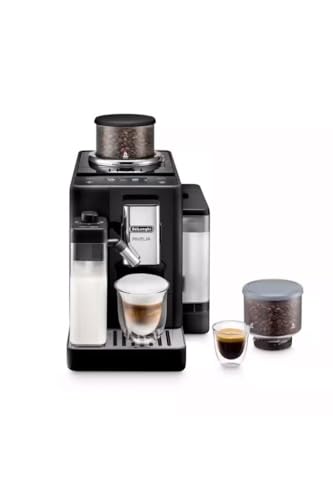
Jura currently sells the E8 as the ED variant with model year 2025. Before that, the same series ran as the EC with model year 2023, and the two differ in one number that is easy to overlook when ordering: the ED lists 27 programmed specialities, the EC 17. Anyone who takes a figure from a brochure or a forum post therefore has to say which variant was meant.
Price, variant and country of manufacture
The E8 has no manufacturer’s recommended price against which a discount could be measured: JURA shows no price on its own product pages. The approx. €1,049 (as of September 2026) is a retail price. If you are hunting for percentages, you therefore compare retailer against retailer rather than offer against list price.
In our bean-to-cup machine comparison the E8 leads with 9.4 and therefore carries the label Comparison winner 2026. The rating comes from manufacturer and catalogue data and from a comparison with its siblings in our catalogue.
A few details that tend to get mixed up in retail: JURA lists the machine as Type 790, the article number of the Midnight Silver colour (ED) is 15712, the EAN 7610917157129. There are also Cosmic Black, Piano Black and Piano White. As the country of manufacture, JURA names Portugal on the pages for the ED and EC. What is Swiss about this machine is the brand: the company writes about itself that it has stood for its quality standards since 1931, and it reports the group’s key figures in Swiss francs, most recently 624.4 million francs in turnover with 923 full-time positions.
Dimensions, power and space on the worktop
27 centimetres wide, 34.8 centimetres high, 44.6 centimetres deep, around 10 kilograms in weight. The E8 is a slim machine that makes up for it by reaching far back, and the power cable is only approx. 1.1 metres long. So measure the depth of your worktop and the position of the socket before you order, not just the width.
The water tank holds 1.9 litres, according to the manual without a filter. The bean container holds 280 grams, and at 5 to 16 grams per cup one filling lasts for 17 to 56 cups depending on the setting. The coffee grounds container takes a maximum of 16 portions. The coffee spout can be adjusted from 65 to 111 millimetres: measure your tallest glass, anything taller than eleven centimetres no longer fits underneath.
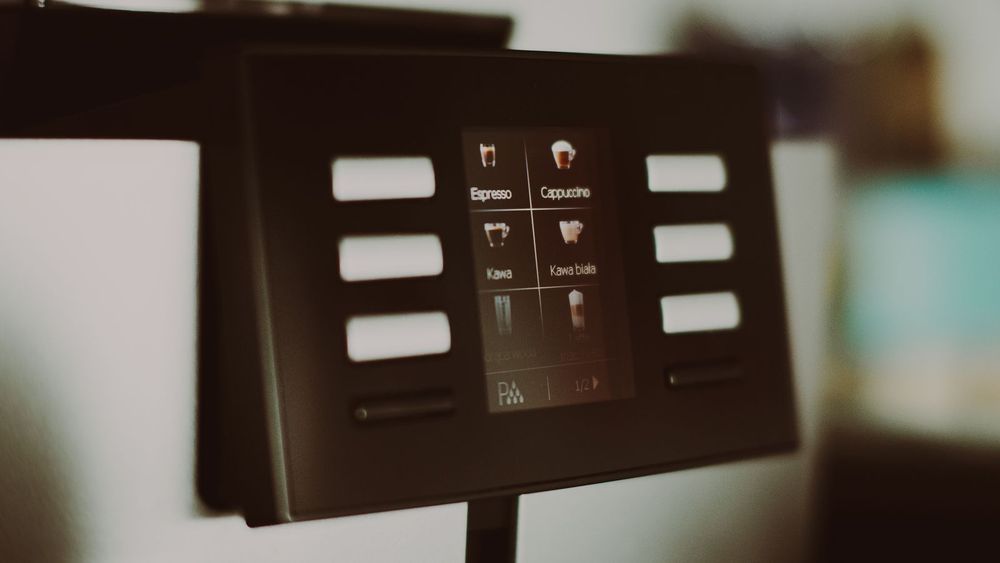
The E8 has no control dial, even though retail descriptions regularly claim it does. Neither the 2025 manual nor the one for the 2018 generation lists one, there is a rotary knob, and it sits at the grind setting adjustment. The machine is operated through a 3.5-inch colour display with buttons.
On power, the figures are unambiguous: 220 to 240 volts, 50 hertz, 1450 watts, 10 amperes. JURA states 57.6 kilowatt hours per year and energy efficiency class A, and when switched off the manual states 0 watts. Since off really does mean zero, the automatic switch-off time decides everything that adds up besides the cups. It can be set to 15 minutes, 30 minutes or 1 to 9 hours.
Grinder, brewing unit and extraction
JURA calls the grinder P.A.G.2, and according to the product page it returns to its starting position after every grinding cycle. You set the seven grind settings with a rotary knob that sits behind a cover behind the bean container. The manual explicitly names adapting to the roast level of your coffee as the purpose. In addition there are ten coffee strength levels, three brewing temperature levels and a variable brewing unit that handles 5 to 16 grams of ground coffee per cup. The product page lists the Pulse Extraction Process (P.E.P.) as a further feature of the E8.
JURA gives the pump pressure as a static maximum of 15 bar, which is the pressure of the pump against a closed circuit. Once water flows, it drops, and for espresso around 9 bar usually act on the coffee grounds. As a yardstick for comparing two machines, the 15 bar figure is therefore of little use.
More tangible are the three taste worlds that the manual describes. Classic Hot Brew is the normal preparation. Light Brew works with less powder and a reduced brewing temperature and, according to JURA, is easier to digest and ready to drink immediately. Sweet Foam prepares sweet milk foam, for which a syrup attachment is included. The start screen shows Espresso, Americano, Coffee, Cappuccino, Cortado, Milk foam, Flat White, Latte macchiato, Espresso macchiato, Lungo, Espresso doppio and Hot water. Two cups at the same time are possible by pressing the preparation button twice within two seconds.
What else is in the box is listed by JURA only on the product page of the EC variant: milk tube with connector, a container for milk system cleaning, milk system cleaner as mini tabs, 3-phase cleaning tablets, a CLARIS Smart+ filter cartridge, a filter extension and the operating manual. Binding for the current ED are only the measuring spoon and syrup attachment, everything else is in your retailer’s packing details. In the machine menu you can also switch on the Quality Assistant, which according to the manual is a help that guides you through the steps of operation and care.
Why can’t the brewing unit be removed?
Because JURA did not intend it as a user part.
In the E8 manual, the brewing unit appears neither among the control elements nor in the care table. The machine cleans it itself, with a tablet and water. Specifically, the E8 asks for a cleaning after 180 preparations or 80 switch-on rinses, the programme runs approx. 20 minutes and needs a JURA cleaning tablet. Between two such programmes you empty the coffee grounds container around eleven times.
Emptying should be done while the machine is switched on. In the manual this appears as a half-sentence. If you do it while the machine is switched off, the E8 does not count the emptying and the coffee grounds counter stays put.
The brew groups of the Nivona NICR 790 and the Siemens EQ600 are built to be taken out and rinsed under running water. Our assessment: we would take the closed system as long as the cleaning programme is not regularly dismissed. If you want to take out and rinse the brewing unit yourself, the Nivona is the more suitable machine.
Milk system: HP3, CX3 and the 4 to 8 degrees
The E8 draws milk through a tube from an external container. Fitted are the HP3 connector and the replaceable CX3 milk spout. As the main criterion for frothing, the manual names the milk temperature, 4 to 8 degrees Celsius. For that range you need a refrigerator within reach or chilled accessories. JURA sells the Cool Control 1.0 l for this (item no. 24261), 1.1 litres capacity, which cools the milk to 4 degrees Celsius. As a chilled container next to the machine it works independently of any wireless connection, which is enough for the temperature requirement in the manual.
The milk system rinse starts automatically 15 minutes after a milk drink, and by hand it can be run at any time. In addition, JURA recommends taking the fine foam nozzle apart and rinsing it once a week. The milk tube with HP3 connector and CX3 milk spout are listed in the manual as wear parts to be replaced roughly every three months, from our point of view the most tiresome part of the maintenance: it is the only one that regularly needs new parts, while the rest of the care costs time and consumables such as tablets and filter cartridges.
Water, filter and running costs
The widespread claim that the filter lasts about two months does not come from the manufacturer. JURA ties the capacity to water hardness, up to 65 litres at 1 to 5 °dH and up to 40 litres at 26 to 30 °dH. For the same amount of water you therefore need around 60 per cent more cartridges in a region with very hard water than in a soft one. The cartridge is called CLARIS Smart+ and carries an RFID chip, which the E8 reads in the 13.56 megahertz frequency band, so you have nothing to confirm.
With a CLARIS Smart+ inserted, the E8 does not need descaling at all according to the manual. Without a filter it scales up through use and requests descaling itself, the programme takes approx. 20 minutes and needs three JURA descaling tablets dissolved in 500 millilitres of water. For the calculation behind this to be right, you have to set the water hardness in the menu, 1 °dH to 30 °dH is possible. Which value to use is covered in the guide Water hardness and coffee, and the order of the care programmes is in the guide Descaling and cleaning.
For daily care, JURA requires you to change the water in the tank every day. The insert for the drip tray, the drip tray itself and the coffee grounds container may go in the dishwasher. The machine and its other individual parts expressly may not, which is stated as a prohibition in the manual.
What running it costs per year depends on your retailer’s prices, so we do not work out an annual total for you. The quantities are documented: one cleaning tablet per 180 cups, three descaling tablets per descaling if you run without a filter, one filter cartridge as soon as the litre figure for your water hardness is reached, plus the two wear parts of the milk system.
It does not get cheaper by switching to third-party accessories, and there is a reason that JURA itself writes down. The operating manual requires exclusively original JURA care products, and the warranty terms draw the consequence: anyone who uses water filters, cleaning tablets or descaling tablets from other manufacturers that do not meet the original specifications loses any warranty under these terms.
What JURA does not state
Four figures that a buyer would expect appear neither in the manual nor on the product page: the brewing temperature in degrees, the heat-up time until the first cup, the temperature of the milk foam and a decibel value for grinding. We are not filling any of them in here.
Then there are the materials. For the grinder, JURA gives only the designation P.A.G.2, without material and without design, and for the housing there is nothing at all. That is why the wordings circulating in retail, such as hardened steel, conical burr grinder or aluminium elements, do not appear here, nor does the long form Professional Aroma Grinder, which is missing from the current product pages. The company also explains nowhere what the Pulse Extraction Process means technically in the E8: the 2025 manual no longer mentions it in the running text, the product page gives only the name.
For operation, exactly the figures you would want to calculate with are missing: the millilitres per drink, the brewing time per cup, the remaining volume of the water tank with a filter cartridge inserted and the prices for filter cartridges, cleaning and descaling tablets. For the time after purchase, there are no figures on service life and repair rate, and how long spare parts are available is stated on none of the pages checked.
Finally, three details come only from the page of the predecessor variant EC: the thermoblock as heating system, the cappuccino spout with 107 to 153 millimetres and the cup lighting. For the current ED, JURA does not list them. And what we do not supply ourselves: how fine the milk foam turns out and how loud the grinder runs. We have not had the machine in our hands.
The three alternatives from our catalogue
| Model | The difference | Price | Our rating | Choose this if |
|---|---|---|---|---|
| Jura E8 (this machine) | Fixed brewing unit, cleaned by tablet programme | approx. €1,049 | 9.4 | you want milk drinks at the touch of a button and leave the care to a programme |
| Jura E6 | Same platform, fewer programmed drinks | approx. €699 | 9.2 | you make two to four of the same drinks every day |
| Nivona NICR 790 | Brewing unit you can take out and rinse | approx. €750 | 9.0 | you have already sent a machine in for repair because of a gummed-up brew group |
| Siemens EQ600 iAroma | XL drinks up to 480 ml and pot function | approx. €779 | 8.8 | guests often come round or you drink from big mugs rather than cups |
The prices are retail prices as of September 2026, the ratings our editorial assessment based on manufacturer and catalogue data.
Who the E8 suits and when another machine is better
For a two-person household with four to six cups a day, the tank and bean container are comfortably enough. At this pace the coffee grounds container is arithmetically full after just under three to four days, though milk drinks and double cups shift the calculation. If you pull six large mugs in a row in the morning or have guests often, you will refill much more often. For large mugs and guests, the Siemens EQ600 offers XL drinks up to 480 millilitres and a pot function, but those functions alone do not change the refilling.
The milk container stands open next to the machine and can be rinsed independently of it, and you choose the size yourself. The temperature requirement from the manual applies to it. If your refrigerator is on the other side of the kitchen, factor in the Cool Control or go straight for a bean-to-cup machine with a milk container inside the housing.
How often you buy cartridges again is decided by the water hardness where you live, see the capacity figures further up. It also affects extraction, though differently from what the single °dH figure suggests. The acidity is buffered by carbonate hardness, meaning the hydrogen carbonate in the water, and very soft, low-mineral water makes coffee seem flat, because few dissolved substances carry the aroma compounds. That is how water chemistry for coffee describes it in general. With very hard water you can do without the filter and descale instead, but that is not necessarily cheaper, since the E8 needs three tablets per descaling.
With 27 specialities and Sweet Foam as the third taste world, the E8 offers a lot of choice. If you never go into the menu, you are paying with the E8 for part of the machine that you do not use. In that case the Jura E6 at approx. €699 is the more honest purchase, as the brewing system in it is the same.
Two items are not on the price tag. J.O.E. and the Coffee Timer, which programmes a preparation up to 16 hours in advance, only run via the separately sold JURA Wi-Fi Connect on the 2.4 GHz network, the transmitter plugs into the service interface and is not included with the machine. And on top of the approx. €1,049 come filter cartridges, tablets and the wear parts of the milk system, a budget that every buyer has to set according to their own retailer’s prices.
That leaves the household the E8 is built for: two to six drinks a day, some of them with milk, and someone who really does switch between Hot Brew, Light Brew and Sweet Foam. Anyone who instead wants to hold the brewing unit in their own hand or buy the consumables from the cheapest supplier is in the wrong place here: JURA did not intend the one, and the other costs you the warranty. If you are still torn between several machine types, the Coffee Finder sorts that out beforehand.