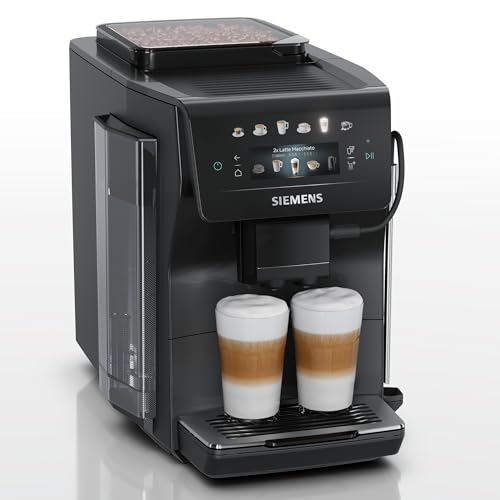
The Siemens EQ600 iAroma TP601E09 is a bean-to-cup coffee machine in piano black. It costs approx. €779 on Amazon.de (as of September 2026, retrieved on 7 September); in the Siemens online shop it stood at €749 on 25 September. The Amazon catalogue gives 17 June 2026 as the release date, and Siemens presents the range on its category page as “new EQ600 iAroma bean-to-cup machines”. In our bean-to-cup comparison it is the second most expensive of 18 machines, after the Jura E8.
We have not handled the EQ600 and have not drunk any coffee from it. What is written here comes from the manufacturer’s documents: the product page and data sheet of the TP601E09, the product information on standby consumption under Regulation (EU) 2023/826 (an EU regulation) and the German part of instruction manual 8001347206 (pages 7 to 37), which names BSH Hausgeräte GmbH of Munich as the manufacturer. This manual applies to the whole EQ600 TP6 series, and some equipment is marked there with the addition “depending on appliance equipment”. Where the manual and the data sheet differ, both values are given below.
Which EQ600 is this?
Siemens lists ten models on its EQ600 category page. Eight of them had a price in the Siemens shop on 25 September: the TP601E09 for €749, TP601E19 and TP6X3B08 for €799 each, TP603E07, TP603E08, TP605EM3 and TP6X7BT8 for €899 each and the TP607ET8 for €949. TP603EF6 and TP607EF5 only point to retailers.
Only two of the ten product pages have an Amazon button. The one for the TP601E09 leads to the ASIN B0GZL2P3WM, exactly the listing this page links to; the other belongs to the TP605EM3 in stainless steel. For the other models you end up at Otto, Euronics or Expert.
Right next to it is the TP601E19, also in piano black. According to the two data sheets, the machines have the same equipment and the same dimensions. The data sheets name no further differences; the TP601E19 weighs 100 grams more, carries its own EAN (4242003980194 instead of 4242003969830) and cost €50 more in the Siemens shop.
One equipment level up is the TP603E07 in Inox silver metallic, €899 in the Siemens shop. Its data sheet lists an illuminated coffee spout, up to 10 saved favourites (the TP601E09 saves 5) and the cold specialities cold brew, slow brew and cold brew macchiato directly in the appliance. The set of cleaning and descaling tablets that comes with the TP601E09 is missing from its contents.
Will the EQ600 fit under your wall cupboard?
Only if more than 38.2 centimetres are free between the worktop and the cupboard, and you need extra clearance above that for refilling the beans. Siemens gives no minimum clearance upwards. According to the manual, the EQ600 is 38.2 centimetres high; the data sheet says 37.8.
On the product photo, the bean hopper sits on top of the housing, and its lid has to be opened to refill. Allow for that space or pull the machine forward to fill it.
The width is 28.4 centimetres in both sources. The depth differs: 47.2 centimetres in the data sheet, 46.9 in the manual. Net, the TP601E09 weighs 8.5 kilograms according to the data sheet; for the series the manual gives 8 to 9 kilograms unfilled. It is delivered in a carton of 50.5 x 36.0 x 42.0 centimetres, which weighs 10.2 kilograms gross.
The removable water tank holds 1.8 litres; the manual specifies: without a filter inserted. There is a single bean hopper with an aroma-protection lid. The data sheet and product page give 300 grams, the manual 275 grams. Go with 275 grams, the smaller value.
It connects with 1500 watts to 220 to 240 volts and 50 or 60 hertz, through a Schuko plug on a cable 100 centimetres long. The manual does not allow a detour through a power strip: “Do not use extension cords or multiple socket strips. Use only adapters and power cords approved by the manufacturer.” The socket therefore has to be within reach of that one metre. If the cable does not reach and no longer one is available, you are meant to have an electrician adapt the household installation.
For the location, the manual requires a level, sufficiently load-bearing and waterproof surface in an enclosed, frost-free room, plus adequate ventilation and the sentence “Never operate the appliance in a cupboard.” There is a reason for waterproof: during operation, water droplets can form at the ventilation slots and above the brew chamber door, and steam can also escape. If the EQ600 was transported or stored below 0 °C, wait 3 hours at room temperature before first use.
The appliance contains permanent magnets. According to the manual, people with electronic implants must keep a minimum distance of 10 centimetres from the appliance, the removed water tank and the brew unit.
In detail: ceramic grinder, flow heater and 15 bar
Siemens calls the grinder ceramDrive, and it is made of ceramic. The data sheet advertises it as low-noise and wear-free, and on the product page the superSilent feature is marked No.
You set the grind size with a rotary selector in 6 steps: anticlockwise for finer, for light-roasted beans, clockwise for coarser, for dark-roasted ones. The manual attaches two conditions. You only turn it while the grinder is running, otherwise damage is possible. And the new setting only takes effect after the second cup, so if you readjust, you judge the third cup at the earliest. The grinder is preset at the factory. With a new bean, it is therefore best to turn only one step at a time and judge the third cup before turning further. The guide Bean-to-cup machine settings describes how to feel your way towards a new bean.
According to the manual, only “pure, roasted espresso or bean-to-cup blends” belong in the hopper. Glazed beans, caramelised beans, beans with sugary additives and powdered coffee are excluded. The chapter on faults adds a further case: beans that are too oily do not fall into the grinder, and the manual advises against them. Oil comes to the surface mainly with very dark roasts, so jet-black, shiny espresso beans are candidates for this fault.
For brewing, Siemens describes an interplay of the ceramic grinder, an “intelligent flow heater”, a “smart water pump” and the brew unit. A flow heater heats the water as it flows through, instead of keeping a supply hot in a boiler.
On pressure, the manual gives a single value: 15 bar, maximum static pump pressure. Static means measured against a closed outlet, with no water flowing. Siemens does not state the pressure that actually acts on the brew unit while brewing, and it cannot be read from the 15 bar, because it also depends on the resistance of the coffee grounds. For espresso, around 9 bar at the coffee grounds is usually used.
For large drinks there is aromaDouble Shot. The machine grinds and brews twice, and Siemens promises a “reduced bitter content in large drinks”. The reasoning behind it is simple: when a lot of water runs through a single portion of coffee grounds, mainly bitter compounds dissolve towards the end of extraction, and two shorter runs avoid that late phase.
According to the product page, you can set strength, size, milk mixing ratio and aromaSelect, an aroma profile with the levels mild, balanced and strong. The series manual also lists a brewing temperature that can be set in steps, as well as the order of milk and coffee and the length of the pause for the latte macchiato.
After first start-up, after a service programme and after a longer break, the first drink does not yet have its full aroma according to the manual, and the instruction on this is simply: “Do not drink the beverage.” Siemens only holds out the prospect of a permanently fine-pored crema once a few cups have been drawn.
Six on the display, 22 in the appliance, 41 with the app
Three numbers circulate for the drink selection, and all three come from Siemens. Six specialities sit on the coffeeSelect display as a quick selection. 22 drinks are stored in the appliance, including the XL variants Americano XL, Cappuccino XL, Latte macchiato XL, XL coffee and Hot water XL, plus Babyccino, Flat white and the coffee jug. The data sheet arrives at 41 when the Home Connect app is counted, with milk, milk foam and hot water included. The other 19 programmes run only through the app on the TP601E09, for example Black eye, Café cortado, Café con leche, Cortado, Cold brew, Cold brew macchiato and Slow brew.
XL drinks go up to 480 ml. So that a large mug fits underneath, the drip tray is height-adjustable, and you set the coffee spout between 8.5 and 16.3 centimetres.
According to the product page, the jug function prepares up to 6 cups of caffè crema at the touch of a button. For guests who simply want coffee in a cup, we think this is the machine’s most useful function. As special accessory for it, Siemens lists the thermal coffee jug TZ40001.
oneTouch DoubleCup is more complicated. The product page promises two drinks at the same time, milk specialities included, and the product photo shows two latte macchiatos side by side under the spout. The manual describes the process like this: depending on the drink, the double serving is made in 2 steps, and the beans are ground in 2 grinding cycles. “At the same time” therefore means two glasses with one press, not necessarily half the time. While the doubleShot function is active, two cups cannot be drawn at once.
From standby, quickCup starts a drink from the quick selection when you hold it for 2 seconds: the EQ600 switches on, skips the rinse and starts straight away. Otherwise it rinses when switching on and off, and when switching off it also steams off into the drip tray. You switch the child lock on and off again by pressing for at least 3 seconds.
The EQ600 connects to the Home Connect app over Wi-Fi in the 2.4 and 5 GHz bands. According to the data sheet, this includes remote access, software updates, online support and the coffeePlaylist, in which you enter several drinks that are then prepared in your order. It can also be controlled with Amazon Alexa through a skill. Networked, it uses 2.0 watts in standby according to the product information and 0.5 watts with the display off, and it switches to both states by itself after 30 minutes at the latest. To save power, the manual advises setting the switch-off interval to the smallest value, not cancelling a drink early and descaling regularly.
Milk through a tube instead of from a carafe
Siemens calls the milk system a flexible Cappuccinatore: the milk is drawn in through a tube, and according to the data sheet this works with any type of milk container. In the box are a connecting tube to the milk nozzle and a stainless steel milk riser tube. When assembling, the manual requires you always to insert the suction tube on the side with the stainless steel sleeve.
Plant-based drinks work too; the manual names soy as an example and adds that foam quality depends on the variety. For milk foam that is too cold, the fault table has a simple answer: the milk is too cold, use lukewarm milk.
After every drink, autoMilk Clean cleans the milk system with steam, without you having to press anything. You start the additional cleaning programme for the milk system as a direct selection from the coffeeSelect display.
Cleaning and descaling according to the manual
Every day you empty and clean the drip tray and the coffee grounds container “to avoid deposits”. The water tank gets fresh, cold, still drinking water every day. Appliance cleaning also includes rinsing it with fresh, clear water. You clean the housing, high-gloss surfaces and control panel with a microfibre cloth, and the dispensing system after a drink with a soft, damp cloth. If the EQ600 has stood idle for a longer time, on holiday for example, the manual requires cleaning the complete appliance including the brew unit and water tank.
For the surfaces: “Do not use harsh or abrasive cleaning agents. Do not use cleaning agents containing alcohol or spirits.” Hard scouring pads are likewise excluded. Two sentences come from the safety notes: “Never immerse the appliance or the power cord in water. No liquid may overflow onto the appliance connector.” Steam cleaners and high-pressure cleaners are forbidden. New sponge cloths are washed out thoroughly beforehand, and residues are removed at once, because according to the manual salts can cause rust film on stainless steel surfaces.
The following may go in the dishwasher: the cover of the drink dispenser, the drink dispenser, the drip tray with insert, cover and drip plate, the coffee grounds container as well as the milk tube and suction tube, and only in programmes that do not heat the parts above 60 °C. Not in the dishwasher: the lid of the bean hopper, brew unit and brew chamber door, the water tank with handle and the drip tray panel.
In addition to automatic rinsing, you take out the brew unit regularly and clean it. The manual gives three sentences on this: “Do not use washing-up liquid. Do not use vinegar-based or acidic cleaning agents. Do not clean in the dishwasher.”
The manual lists eight service programmes: INTENZA filter, milk system cleaning, Calc’n Clean, cleaning, descaling, brew unit cleaning, drink spout cleaning and residual water drainage. The cleaning programme works with a tablet, calc’nClean combines cleaning and descaling in one run, and the EQ600 itself reports when it is due. It also reminds you to change the filter. Before transport or storage, residual water drainage empties the pipework so that nothing freezes in it.
For descaling, the tablets developed specifically for it are intended. The manual expressly rules out: “Do not use pure citric acid, vinegar or vinegar-based products for descaling. Do not use any descaler containing phosphoric acid.”
How often descaling is needed depends on the water hardness setting. The manual knows four levels: 1 to 7 °dH (German degrees of hardness), 8 to 14 °dH, 15 to 21 °dH and 22 to 30 °dH. Level 4 is the factory setting, and you determine your value with the strip supplied. If the hardness is above 21 °dH, you may fill the tank with pre-filtered water. How to find out and classify the hardness of your tap water is explained in the guide Water hardness and coffee.
A BRITA INTENZA filter is supplied as standard and has to be replaced after 2 months at the latest. With the filter you descale less often; without it, the EQ600 runs as well. Anyone using it continuously needs at least six filters a year.
Besides the filter, according to the data sheet the box contains a set of cleaning and descaling tablets, plus the strip and a welcome box. After that you buy replacements, and Siemens has its own numbers for them: cleaning tablets TZ80001A, descaling tablets TZ80002A, the set TZ80003A, the care set TZ80004A and the descaler multipack TZ80032A.
What Siemens leaves open
Some figures you look for when comparing bean-to-cup machines appear neither on the product page nor in the data sheet nor in the manual:
- how many portions the coffee grounds container holds and how much the drip tray holds
- the brewing temperature in degrees Celsius and the number of temperature levels; the TP601E09 product page does not even list temperature among the adjustable parameters, only the series manual knows it
- how finely the six grind levels are graduated, that is, how far one level shifts the grind
- the heat-up time
- the volume in decibels
- annual energy consumption and energy efficiency class; only the standby values are documented
- the number and output of the heating systems
- the amount of ground coffee per drink in grams and the fill volumes of the individual drinks below the XL limit, including how much one cup of the jug function holds
- after how many weeks or drinks descaling and cleaning are due, and after how many drinks the appliance locks if you put off descaling
- how many litres the INTENZA filter handles
- what filters, tablets and care sets cost; an annual total for running costs therefore cannot be formed from the Siemens documents
- a daily capacity for continuous use, for example in an office kitchen
- what material the housing, water tank, bean hopper and drip tray are made of; for the housing, only the colour piano black is given
- the display diagonal; Siemens speaks of a TFT touch display, the Amazon catalogue of 3.7 inches
- the country of manufacture
- an official market launch; the date at the very top comes from the Amazon catalogue
The EQ600 or one of the other three?
| Model | The difference | Price | Our rating | Choose this if |
|---|---|---|---|---|
| Siemens EQ600 iAroma TP601E09 (this one) | 22 drinks in the appliance, XL up to 480 ml, jug up to 6 cups | approx. €779 | 8.8 | you often fill large mugs or look after guests with coffee |
| Siemens EQ6 plus s700 | 12 drinks according to the Amazon title, in the Amazon catalogue since 2017 | approx. €748 | 8.6 | you stick to standard sizes and can manage with 12 drinks |
| Nivona NICR 790 | Ground-coffee chute for one portion of ground coffee | approx. €750 | 9.0 | you occasionally want decaf in the evening without emptying the bean hopper |
| Jura E8 | with the CLARIS Smart+ filter, no more descaling according to Jura | approx. €1,049 | 9.4 | you have hard water and want to be rid of descaling altogether |
The prices are guide values from our price boxes; only the one for the EQ600 can be backed with a date (Amazon, 7 September 2026). The rating is our editorial assessment from data sheets and manuals; for none of the four machines is it based on our own measurements.
Who the EQ600 suits, and when to choose another bean-to-cup machine
If you drink only espresso from small cups, you pay for XL drinks and the jug with the EQ600 without needing them.
The Siemens EQ6 plus is the older machine, in the Amazon catalogue since 2017. In our price box it is around €31 below the EQ600. With so small a gap, we would reach for the EQ600, unless your retailer happens to have the EQ6 plus noticeably cheaper.
If your water is above 21 °dH, that is, in the top hardness level (22 to 30 °dH), descaling remains with the EQ600 (see care). According to Jura, the Jura E8 does not need descaling at all with the CLARIS Smart+ cartridge inserted. For that you pay €270 more in our price box. We would only plan for that premium if the descaling programme really bothers you. You have ongoing filter costs with both machines.
If you want cold brew without a smartphone: we have not checked the other models in the range for this, but on the TP603E07 cold brew, slow brew and cold brew macchiato are stored in the appliance according to the data sheet. We have no review of our own for it. In the Siemens shop it costs €899, which is €150 more than the TP601E09 there.
The Nivona NICR 790 has a ground-coffee chute, the EQ600 only a bean hopper. The chute does not hold a supply for the second variety, though: according to the Nivona manual, only one portion goes in at a time. The Nivona costs €29 less in our price box and ranks ahead of the EQ600 in our rating.