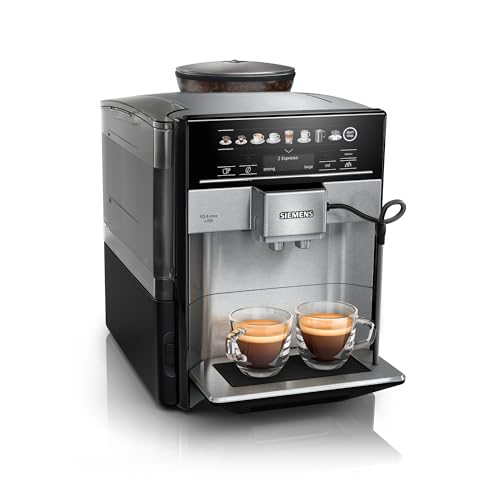
The Siemens EQ6 plus s700 with model number TE657503DE is a bean-to-cup machine with a ceramic grinder, a milk system that draws milk up through a tube, and a chute for ground coffee. On Amazon.de it costs approx. €748 (as of September 2026, retrieved on 7 September). The Amazon catalogue gives 1 September 2017 as the release date. In our bean-to-cup machine comparison it scores 8.6, behind the three machines we compare it with further down.
The manufacturer is BSH Hausgeräte GmbH, which uses the Siemens name under a brand licence from Siemens AG. We have not handled the EQ6 plus and have not drunk coffee from it. What is written here comes from the Siemens product page and the data sheet of the TE657503DE, from user manual 8001320328, which applies to the whole TE651 to TE657 series, from quick guide 8001054522, from the product information under Regulation (EU) 2023/826 (an EU regulation) and from the EU declaration of conformity. Where two of these sources contradict each other, both values are given.
Which EQ6 plus is this?
On its EQ6 plus category page, Siemens shows seven models. On 1 October 2026, three of them had a price in the Siemens shop: the s300 TE653501DE in silver for €699, the TE657503DE reviewed here for €799 with a delivery time of 4 to 6 weeks, and the TE657M03DE for €549, so €250 below the TE657503DE, in stock. The s400 in sapphire black metallic, an s700 in Dark inox and the two extraKlasse models had no shop price.
If you buy directly from Siemens, you should know the TE657M03DE. It has the same name, EQ6 plus s700 stainless steel, and according to the data sheet also includes an insulated milk container with fresh-lock, 0.50 litres according to the product page. The two data sheets also show small differences in dimensions and weight: the TE657M03DE is 1 millimetre wider, 3 millimetres deeper and 200 grams heavier, so 10.3 kg net. If you were going to buy a container anyway, it is best to put this variant next to the Amazon offer.
Above it, Siemens separates the s700 from the extraKlasse: its models TE657F03DE and TE657F09DE have 13 drinks and a jug function according to the product page, while the s700 has 12 drinks and no jug. The cheaper s300 lacks the cup lighting and oneTouch DoubleCup, and has 11 drinks and 15 instead of 19 bar pump pressure.
We link to an Amazon offer whose catalogue entry carries the model number TE657503DE. None of the seven Siemens product pages refers to Amazon, so the match rests on this number. The Amazon dimensions of approx. 38.5 x 28.0 x 46.5 cm (converted) fit the TE657503DE, whereas the Amazon weight of approx. 10.3 kg (converted) fits the TE657M03DE. Check in the offer whether a milk container is listed.
Does the EQ6 plus fit under your wall cabinet?
With more than 38.5 centimetres of clear height, it fits underneath. For filling, though, you need to reach it from above: according to the machine illustration in the manual, the bean hopper and the water tank lid sit on top of the housing, and the tank itself on the left side. If the machine stands tight under the cabinet, you pull it forward a little to refill.
The TE657503DE is 28 centimetres wide. For depth, the sources differ by 3 millimetres: the manual gives 468 instead of the 465 millimetres from the data sheet. According to the data sheet it weighs 10.1 kilograms net; the series manual calculates approx. 10 to 12 kilograms unfilled. The removable water tank holds 1.7 litres, which according to the manual is its maximum capacity without a filter. The shipping carton measures 510 x 345 x 425 mm, and gross weight is 11.5 kilograms.
The connected load is 1500 watts at 220 to 240 volts and 50 or 60 hertz, and the plug is an earthed Schuko plug. The cable is 1 metre long and can be stowed in a cable compartment. Under the heading fire hazard, the manual requires: ventilate adequately, never operate the machine in a cupboard, use no extension cables and no multi-socket strips, use only adapters and cables approved by the manufacturer, and if the cable is too short, call a qualified electrician. So the socket must be within that metre.
According to the manual, the room must be frost-free. If the machine comes from transport or storage at below 0 °C, you wait 3 hours at room temperature before starting it up. The surface should be level, sufficiently load-bearing and waterproof, the ventilation slots must stay clear, and after each connection to the properly installed earthed socket you wait approx. 5 seconds.
The machine contains permanent magnets. According to the manual, anyone with an electronic implant keeps 10 centimetres away from the machine and from the removed water tank.
In detail: ceramic grinder, 19 bar and the second grinding pass
The grinder is called ceramDrive, and in the data sheet Siemens describes it as a grinder “made of wear-free ceramic”. You set the grind size in steps with a rotary selector: anticlockwise for finer, for light roasted beans, clockwise for coarser, for dark roasted beans.
The manual attaches two rules to this. You may only turn it while the grinder is running, otherwise it can be damaged. And a new setting only takes effect after the second cup, so you can judge it at the earliest on the third. For troubleshooting, it gives the direction: if the coffee only drips, you go coarser; if it runs too fast with little crema, finer. If crema is missing entirely, Siemens also recommends freshly roasted beans and a blend with a higher Robusta share. For how to feel your way step by step to a new bean, see the guide Bean-to-cup machine settings.
According to the manual, the bean hopper takes “only pure, roasted espresso or bean-to-cup machine bean blends”. Glazed, caramelised and sugar-treated beans are excluded, as is ground coffee. The manual advises against oily beans because they do not fall into the grinder. The hopper holds 300 grams and has an aroma-protection lid; according to Siemens, the beans can stay in it for several days without losing aroma. The EQ6 plus has no second bean hopper.
On pressure, the manual gives a single value for the TE657 series: 19 bar maximum pump pressure, static. Siemens does not state the pressure during brewing itself. Static means measured against a closed outlet, with no water flowing. During brewing, the resistance of the coffee grounds determines how much pressure actually builds up at the grounds. For context, and this is our explanation, not a Siemens statement: as a rule of thumb, espresso is brewed at around 9 bar at the grounds. The 19 bar therefore say little about brewing pressure; they describe the maximum the pump can deliver.
For large drinks there is aromaDouble Shot. According to the manual, after half of the prepared quantity, beans are ground and brewed again; Amazon speaks of “2 grinding and brewing cycles”. The function is not available for all drinks and fill quantities. Why it is built this way, we explain to ourselves from standard extraction theory: if a great deal of water runs through a single portion of grounds, over-extraction threatens towards the end, where more bitter substances go into the cup. Two shorter runs with fresh grounds avoid this late phase.
When switched on from cold and when switched off after a coffee has been brewed, the EQ6 plus rinses automatically. After first start-up, after a service programme and after a long break, the first drink does not yet have full aroma according to the manual and should not be drunk. Siemens only holds out a fine-pored crema after a few cups.
Twelve drinks on the coffeeSelect display
Espresso, espresso macchiato, coffee, americano, cappuccino, flat white, kleiner Brauner, latte macchiato and milchkaffee, plus frothed milk, warm milk and hot water: that is how the product page lists the range. Three of these therefore contain no coffee. There is no connectivity; the Home Connect feature says No.
You set coffee drinks to seven strengths, which the manual calls very mild, mild, normal, strong, very strong, doubleshot strong and doubleshot strong+. Added to this are the fill quantities small, medium and large, three temperature levels (normal, high, max.) and, according to the data sheet, an adjustable ratio of milk to espresso for all drinks. For milk foam, warm milk and hot water, the manual gives only the fill quantity as a setting. You save up to four custom settings as favourites, the display language is selectable, and according to the data sheet a short user guide is kept ready to hand in the machine.
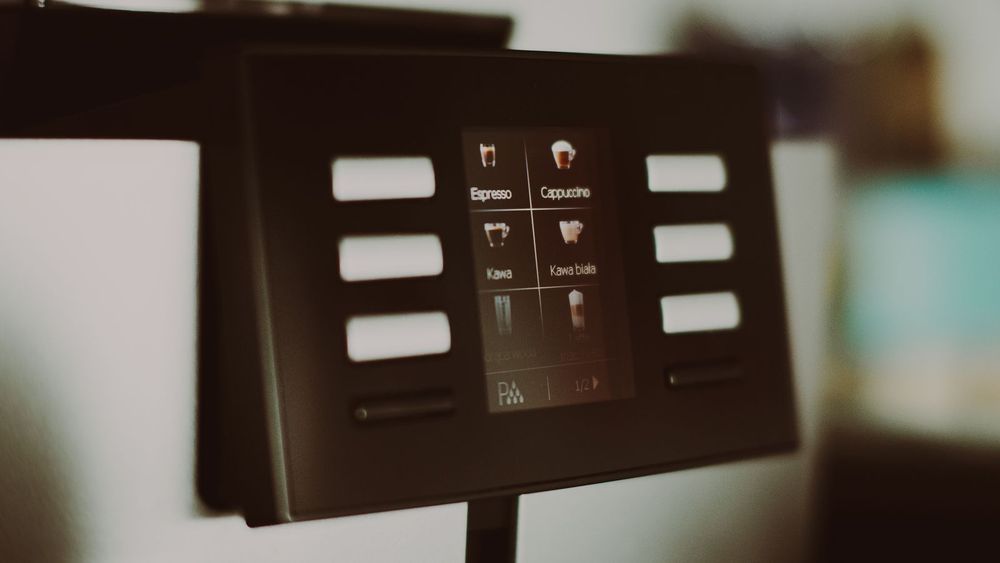
Siemens calls the display the coffeeSelect display. It is in colour, and the product page gives LCD as the display concept. “Large touch display” is in the Amazon title; Siemens itself mentions neither touch nor a size in its documents. According to the manual, the control panel carries symbols for start stop, menu, back, down and ok, for two cups, coffee strength and fill quantity, and one for favourites and child lock. You switch the child lock on and off by pressing for at least 3 seconds.
Siemens lights the keys and the coffee spout. According to the product page, the EQ6 plus has no cup warmer; the manual instead recommends warming the cups with hot water. You adjust the spout between 8.6 and 14.1 centimetres.
Two cups at the press of one button are called oneTouch DoubleCup, and the product page promises this “even with milk”. The manual describes the process more soberly: the drink is made in 2 steps, and the beans are ground in 2 grinding passes. It also adds that double brews apply only to coffee drinks depending on the machine type. For the TE657503DE we go by the model-specific product page, and that says: also with milk.
There is a separate chute for ground coffee; the rules for it are below in the questions. When switched off, the EQ6 plus draws 0.3 watts according to the product information and goes into this state after 30 minutes at the latest. After how long it switches itself off following the last drink, you set in the basic settings. The data sheet also lists zeroEnergy Auto-off, according to Siemens an automatic disconnection from the mains after a preset time.
Milk via tube: what autoMilk Clean does and what it does not
Siemens calls the milk system a flexible Cappuccinatore. The milk is drawn up through a tube and suction pipe, either from a separately available milk container or from another vessel, expressly including the milk carton. Into the cup goes first the milk or milk foam, then the coffee.
After every milk drink, autoMilk Clean cleans the system with a short burst of steam, without you having to press anything. That does not make the milk system self-cleaning, and the manual says so clearly: “Milk residues can dry on and are difficult to remove. Clean the milk system after every use.” For this there is the service programme Clean milk system, which the display guides you through. According to the quick guide it takes approx. 1 minute, after which you empty the glass and clean the suction pipe.
Manual work is added regularly: you take out the milk system, take the upper and lower parts apart, separate the tube and suction pipe, clean everything with washing-up liquid and a soft cloth, rinse with clear water and let the parts dry.
The EQ6 plus dispenses hot water only with the milk tube pulled off. If the milk system has not been cleaned, small amounts of milk can come out with the water, according to the manual. For tea, that means: clean the tube before pulling it off.
Cleaning and descaling according to the manual
Every day you empty and clean the drip tray and the coffee grounds container, and you wipe the mechanical level indicator with a damp cloth. The water tank gets fresh, cold, still drinking water every day and is rinsed with fresh, clear water. You open the coffee powder drawer and clean it with a cloth, and brush powder residues into the chute with a soft brush.
In addition to the automatic rinsing, you take out the brew unit regularly. Switch off the machine, open the brew chamber door, slide the red lock all the way to the left, press the ejector lever down and pull the unit out by the finger recesses. You clean it under running water, the sieve under the water jet. The manual on this, verbatim: “Do not clean the brew unit in the dishwasher and without washing-up liquid.”
According to the manual, the dishwasher may take the drip tray, drip plate, coffee grounds container, powder scoop and the upper and lower parts of the milk system, and only in programmes that do not heat the parts above 60 °C. The drip tray cover, the cover of the drink outlet, the brew unit and the water tank do not go in. The product page lists something different as dishwasher-safe: drip plate, drinks outlet, milk nozzle, milk tube, coffee grounds container and drip tray. For the drinks outlet, the two sources contradict each other, and the milk tube is missing from the manual’s list. We would stick to the stricter manual and wash the outlet cover and tube by hand.
You clean the housing, high-gloss surfaces and control panel with a microfibre cloth. Sharp, abrasive, alcohol-based or spirit-based cleaners are ruled out, as are hard scouring pads. You wash new sponge cloths thoroughly beforehand because, according to the manual, salts can cause rust film on stainless steel surfaces, and you remove residues immediately. On moisture, the safety notes require: never immerse the machine or its power cable in water, do not let liquid get onto the appliance connector, use the machine only indoors, do not expose it to great heat and wet, and do not use a steam or high-pressure cleaner.
The EQ6 plus itself reports which service programme is due. These include Clean milk system, Descaling, Cleaning and calc’nClean, which combines cleaning and descaling in one run. Under Info service programmes, the display shows how many drinks remain until the next one. Cleaning runs with a tablet, and for descaling you use only the tablets developed specifically for the machine. “Do not use pure citric acid, vinegar or vinegar-based products for descaling”, says the manual, and it rules out phosphoric acid as well.
When descaling is due, the machine works out from the water hardness setting. Siemens therefore gives no fixed interval in weeks. The manual knows four levels: 1 soft with 1 to 7 °dH (German degrees of hardness), 2 medium with 8 to 14, 3 hard with 15 to 21 and 4 very hard with 22 to 30 °dH. Level 4 is the factory setting, and there is a separate setting for water from a softening system. If the hardness is above 21 °dH (3.8 mmol/l), you may fill the tank with pre-filtered water. For how to classify the hardness of your tap water, see the guide Water hardness and coffee.
According to Siemens, the supplied BRITA INTENZA filter reduces the limescale content and must be replaced after 2 months at the latest. With the filter you descale less often, but descaling does not go away. Before transport or storage, the Frost protection programme empties the pipework and switches the machine off.
Accessories, running costs and what Siemens leaves open
According to the data sheet, the box contains a measuring spoon, a strip for determining water hardness, a connecting tube to the milk nozzle, a milk riser pipe, a BRITA INTENZA filter cartridge and a set of cleaning and descaling tablets. You can buy more from Siemens under their own numbers: cleaning tablets TZ80001A or TZ80001B, descaling tablets TZ80002A or TZ80002B, the water filter TZ70003 and the care set TZ80004A or TZ80004B. The manual advises original accessories because they are matched to the machine.
On running costs, only the quantity is documented: anyone who uses the filter continuously uses at least six a year, plus tablets whenever the machine asks for a programme. For longer absences, the manual requires cleaning the whole machine, including brew unit and water tank.
As optional accessory, the data sheet also lists coffee beans under their own order numbers (Y988081300 to Y988081305), for example the Milano and Roma varieties at 1000 grams each, Gunpowder at 500 grams and a pack of 4 x 250 grams.
We searched the product page, data sheet and manual in vain for the following details:
- the country of manufacture; the declaration of conformity for the appliance type CTES32X, which applies to several brands such as Siemens and Bosch, names only Traunreut as the place of issue
- the material of the front, sides and drip plate; stainless steel is the Siemens colour, with black as secondary colour
- the number of grind size steps
- the fill quantities in millilitres and the brewing temperature in degrees
- the heating system, that is, whether thermoblock or flow heater and how many
- the heat-up time; the data sheet only says “fast first cup”
- the noise level in decibels
- how much the coffee grounds container and drip tray hold
- how long descaling, cleaning and calc’nClean take
- how many litres the INTENZA filter manages
- what tablets, filters and care set cost
- the capacity of the separately sold TZ80009N milk container
- energy consumption per cup or per year
- the material of the milk tube and suction pipe
- an official market launch; the date above comes from the Amazon catalogue
The EQ6 plus or one of the other three?
| Model | The difference | Price | Our rating | Choose this if |
|---|---|---|---|---|
| Siemens EQ6 plus s700 TE657503DE (this one) | Chute for coffee powder (unlike the EQ600), 12 drinks, milk via tube with steam rinse | approx. €748 | 8.6 | you want to use ground coffee as well as beans and can manage with glasses up to 14 cm |
| Siemens EQ600 iAroma | according to Siemens 22 drinks in the machine and XL up to 480 ml, but no chute for ground coffee | approx. €779 | 8.8 | you fill large cups and drink only one type of bean |
| Philips LatteGo 5500 | milk system without automatic cleaning according to Philips, remove and rinse after every use | approx. €515 | 8.7 | you want to spend less and rinse the milk vessel after every drink anyway |
| Jura E8 | with the CLARIS Smart+ filter, no more descaling according to Jura | approx. €1,049 | 9.4 | you have hard water and want to be rid of descaling altogether |
The prices are guide values from our price boxes; we can document with a date only that of the EQ6 plus (Amazon, 7 September 2026). The rating is our editorial assessment from data sheets and manuals; we have not measured anything on any of the four machines.
Who it suits, and when another bean-to-cup machine fits better
Compared with the Siemens EQ600, its clearest advantage is the powder chute that, according to Siemens, the EQ600 lacks. The Philips LatteGo 5500 and the Jura E8 also have a chute for ground coffee according to their manuals, so it does not set it apart from those two. The EQ600 costs around €31 more in our price box and sits ahead of the EQ6 plus in our rating. For large cups we would prefer it, because according to Siemens, latte macchiato glasses up to 14 centimetres fit under the spout of the EQ6 plus, and no taller.
For milk drinks, the difference to the Philips is smaller than the name autoMilk Clean suggests. According to Philips, the LatteGo 5500 has no automatic cleaning and is removed and rinsed after every use. In our price box the Philips LatteGo 5500 costs around €233 less. In our assessment, anyone who mainly drinks cappuccino saves money there, because they have to clean the milk system on both.
If you have hard water (level 3 or 4, so from 15 °dH) and never want to start a descaling programme again, the EQ6 plus is the wrong choice. According to Jura, the Jura E8 no longer needs descaling with the CLARIS Smart+ filter inserted, and it costs around €300 more in our price box. We think the premium only makes sense if descaling really bothers you. You keep buying filters for both.
If you want to start drinks from an app, you need a different machine. As described above, the EQ6 plus is not connected, whereas the EQ600 can be operated via the Home Connect app, according to Siemens.