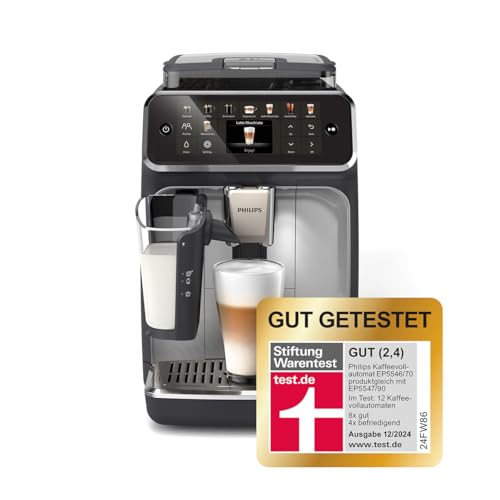
The Philips EP5546/70 from the Series 5500 is a bean-to-cup machine whose milk drinks come from LatteGo, a milk container that works without tubes. Our price box lists it at approx. €515 on Amazon.de (as of September 2026). In the Philips shop the same machine was listed on 25 September 2026 at €799.99, marked as out of stock.
Philips gives the colour as black; the data sheet says more precisely “black, silver lacquered”, and on Amazon the same model number is sold as silver. The machine is built in China. Which other bean-to-cup machines we cover is listed in our bean-to-cup machine comparison.
Housing, dimensions and control panel
According to the product page, the 5500 is 24.6 centimetres wide, 43.3 deep and 37.1 high. The user manual, which covers the 4400 and 5500 series together, gives a height of 37.7 centimetres and a depth of 43.4, and a weight of 7.5 to 8 kilograms where the product page states a round 8. For the space you need, it is safer to plan with the larger values.
The main material is plastic, with metal given as the secondary material on the product page. The water container holds 1.8 litres, the bean hopper 275 grams and the coffee grounds container 12 portions. The spout is height-adjustable between 88 and 145 millimetres, so a latte macchiato glass must not be taller than the upper mark. In the product photo the bean hopper sits on top under a lid.
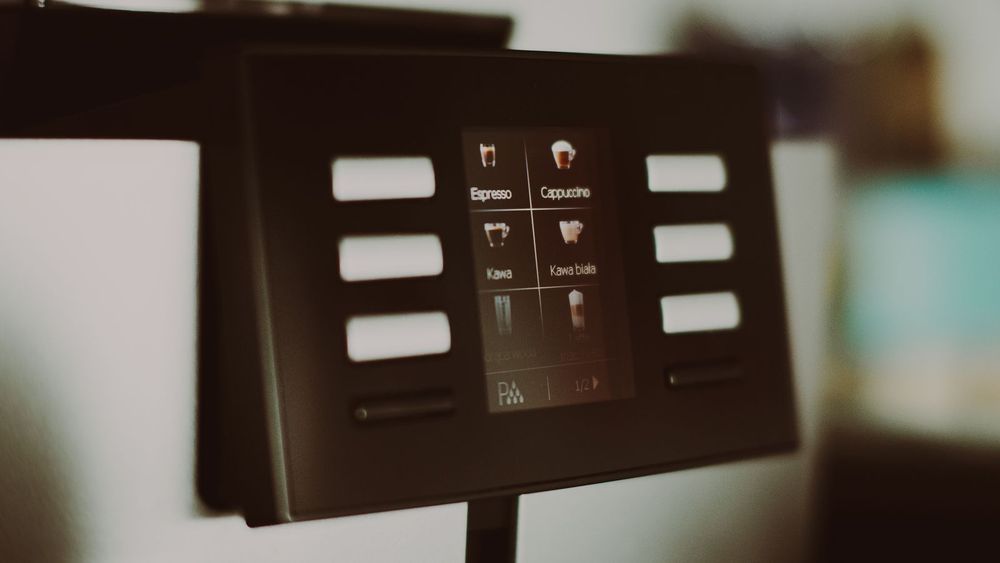
The machine is operated through a TFT display with symbol fields that you tap. Six drinks have their own one-touch symbol: espresso, coffee, americano, cappuccino, latte macchiato and iced latte, and the rest are in the menu. Two user profiles store customised recipes. There is also a guest profile in which everything can be adjusted without the machine remembering anything. The 5500 cannot be controlled by app; under connectivity the product page simply says no. Philips’ HomeID app provides information about the machine and recipes.
Power consumption is 1,500 watts at 230 volts. In standby the machine draws 0.2 watts according to Philips, measured to EN 50564:2011, and the product page lists it in energy efficiency class A. According to the product page it goes into standby after 30 minutes; the manual gives 15, 60 or 180 minutes as alternatives, and the safety leaflet notes that energy consumption increases if you change this time. Five energy-saving settings dim the light earlier, reduce the brightness, save rinse water or send the machine into standby sooner.
Philips describes QuickStart as switching on and making coffee straight away, with the machine heating up depending on the recipe. SilentBrew is the name for the combination of sound insulation and quieter grinding. The result is meant to be 40 percent less noise, compared, according to a footnote in the data sheet, with earlier Philips bean-to-cup machines, so with Philips’ own previous models and not with machines from other brands. According to Philips the machine is also Quiet Mark certified. It still does not become completely silent: the user manual explicitly calls audible noises during operation normal.
In detail: how LatteGo is built and why it does not clean itself
Many bean-to-cup machines draw the milk through a tube from a container or straight from the carton, mix it with steam and air in the frothing head and send it into the cup. Residues stay behind in the tube and in the head (how steam and air form the foam is explained in the guide How to froth milk). That is why such machines rinse after a milk drink, and tubes are wear parts: Jura, for instance, has the E8 rinse automatically 15 minutes after a milk drink and gives a replacement interval of roughly every three months for the tube and connector.
LatteGo does without the tube. The container sits directly on the machine, and for frothing Philips names a cyclone frothing technology. The product page speaks of two parts. The manual lists three, milk container, frame and storage lid, and the third is explained by another instruction: leftover milk stays in the LatteGo and so goes into the fridge. On capacity the sources differ slightly: the product page gives 0.26 litres, the manual 250 millilitres.
Philips advertises that the milk system is cleaned in under 10 seconds, in the dishwasher or under running water. The footnote in the data sheet limits the claim “fastest to clean” to milk systems in one-touch espresso bean-to-cup machines. LatteGo has no automatic cleaning, and Philips says so openly: “Philips does not offer automatic cleaning, as the parts require additional cleaning.” (translated from the German)
The routine after every milk drink is in the manual. First you start the quick cleaning programme Quick Milk Clean while LatteGo is still attached to the machine; this is a short rinse, and the actual cleaning follows afterwards. Then you take it off and rinse it under water or put it in the dishwasher, as all parts are dishwasher safe according to the leaflet. If you clean by hand, follow the wording of the safety leaflet: “Take the milk system apart, rinse it under warm water, and clean it with a food-safe cleaning agent. Only reassemble it once it has dried.” (translated from the German)
The same leaflet warns that jets of milk and steam can escape before dispensing. You may only remove LatteGo once the dispensing cycle has finished, only water and milk belong in it, and it comes off for descaling and hot water dispensing. For good results the milk should come straight from the fridge.
For cappuccino, flat white, latte macchiato, iced cappuccino and iced latte the machine dispenses milk first and then coffee; for caffè latte, milky coffee, iced caffè latte and iced café au lait it is the other way round. The order comes from the shared manual for the 4400 and 5500 series, which is why some drinks have different names there than in the product page list, where for example there is no milky coffee but there is a café au lait.
How finely can the 5500 be adjusted?
In our assessment, quite well, with one restriction: 12 grind settings, 5 aroma strengths, 3 brewing temperatures and 5 quantity levels each for coffee and milk. If you want to readjust the grind often, you need to know that this only works while grinding and only one step at a time.
According to the data sheet the grinder is made of 100 percent ceramic. It is adjusted with a dial in the bean hopper, and the manual is clear on the step rule: turn only one position at a time, “to prevent damage to the grinder”. There is also a piece of advice about patience. Philips recommends changing the setting only after 100 to 150 cups, which corresponds to roughly a month of use, and expects a difference to show only after two to three drinks.
The reason is given a few pages further on. The machine adjusts the amount it grinds by itself, and so that this self-adjustment process can finish, you should first prepare 5 cups. It starts again when you change the type of bean or have not used the machine for a longer time. Our reading: the first brews after unpacking or after changing beans say little about the right grind setting.
When brewing, the Aroma Extract System keeps the water temperature between 90 and 98 °C according to Philips and regulates the flow rate. The pump is rated at 15 bar. This refers to the pump pressure; at the coffee puck, around 9 bar is usual for espresso.
ExtraShot adds an extra ristretto shot on top of any recipe, but then always for one cup only. Without ExtraShot the 5500 brews two cups at once if you tap the drink symbol twice. Caramelised or flavoured beans are not allowed: according to the safety leaflet they can permanently damage the machine, and the warranty does not cover such damage. How to find grind size and quantity step by step is described in the guide Setting up a bean-to-cup machine.
Iced coffee from a machine without cooling
The drinks list on the product page has 22 entries. If you subtract milk foam and hot water, that leaves the 20 coffee specialities (the travel mug entry is counted too), and eight of them are iced variants: Iced Coffee, Iced Latte Macchiato, Iced Americano, Iced Caffé Crema, Iced Cappuccino, Iced Café au Lait, Iced Caffé Latte and Iced Espresso.
Nothing is cooled in the process. According to the manual the coffee is made with warm water, and Philips advises brewing over ice cubes for the best results, with the glass two thirds full of ice, at aroma strength 3. The product page says the brewing system is calibrated so that iced coffees taste like hot drinks.
More important in everyday use is a sentence from the safety leaflet. The water in the tank should be used up within 1 to 2 days, and after three days or more without use the tank must be emptied, rinsed thoroughly and filled with fresh drinking water. The leaflet stresses this explicitly for cold drinks.
What else is worth considering?
| Model | The difference | Price | Our rating | Choose this if |
|---|---|---|---|---|
| Philips LatteGo 5500 EP5546/70 (this page) | LatteGo without a tube, cleaning by hand or in the dishwasher, 20 recipes with eight iced variants | approx. €515 | 8.7 | you want iced coffee at the touch of a button and can manage with two profiles |
| Philips LatteGo 5400 | according to the Amazon catalogue 12 coffee specialities and memory for up to 4 people | approx. €424 | 8.6 | you want to save around €90 and care more about extra profiles than extra recipes |
| DeLonghi Dinamica Plus 370.70 | LatteCrema milk carafe with CLEAN rinse via a dial, pot function with 250, 500 or 750 ml, De’Longhi does not mention an app for this model | approx. €599 | 8.6 | you want to brew a pot for guests |
| Jura E8 | brewing unit stays in the machine and is cleaned by a tablet programme, milk via a tube with automatic rinsing | approx. €1,049 | 9.4 | you do not want to remove, rinse and grease the brewing unit yourself and your budget is around double |
The prices come from our price boxes (as of September 2026). The rating is our editorial assessment of the manufacturer data, with no measurement behind it. For the 5400 the difference column is based on its Amazon catalogue text, for the Dinamica on De’Longhi’s product page and manual, and for the E8 on the Jura manual; we have not checked it against the manufacturer’s page for the 5400.
When the 5500, when one of the others?
Milk first. With the 5500 you rinse one part after every milk drink or put it in the dishwasher, so with two cappuccinos a day that is twice. It is little work, but it stays with you. With the Dinamica Plus 370.70 it also stays with you: after every milk drink you turn the dial of its LatteCrema carafe to CLEAN, and then the machine rinses with steam and hot water. Every two days you take the carafe apart and clean it, and its parts may go in the top rack of the dishwasher. According to the manual it also brews 2, 4 or 6 cups (250, 500 or 750 ml) in one go and costs around €84 more than the 5500. The Jura E8 rinses its milk system itself, but costs around €534 more than the 5500 and comes with a tube that needs replacing regularly.
With the brew group the picture reverses. On the 5500 you pull it out and look after it yourself; the routine is described further down under cleaning. The E8 keeps its brewing unit in the housing and cleans it through a tablet programme. In our assessment, anyone who never wants to touch the brew group will be happier with the Jura; anyone who wants to see what happens in the brew group will be happier with the Philips.
In a household with three or four coffee drinkers with fixed preferences, two profiles become tight. The Series 5400 stores up to 4 people according to the Amazon catalogue and is around €90 cheaper than the 5500. Whether its recipes include iced coffees is not stated in the catalogue text.
Under a wall cupboard the bare height of the machine is not enough, because the bean hopper is filled from above. Allow space for the open lid beyond the 37.7 centimetres from the manual. The data sheet does not say how much it needs, so check before buying whether you can pull the machine forward for refilling.
Cleaning, descaling and what it costs per year
The brew group comes out with the PUSH button after you open the service door. Weekly you rinse it under running tap water, monthly you clean it with a Philips tablet for dissolving coffee grease, and every two months Philips recommends greasing the piston, shaft and guide rails with Philips lubricating grease. For this the leaflet requires grease suitable for food contact (approved H1 grease). It is equally clear on what is forbidden: “Do not clean the brew group in the dishwasher, and do not use washing-up liquid or cleaning agents.” (translated from the German) Afterwards the brew group dries in the air, not with a cloth, so that no fluff gets in.
The rest is routine. You empty the drip tray as soon as the red indicator becomes visible and clean it weekly; it may go in the dishwasher. The same applies to the coffee grounds container, except for the front, which is explicitly not dishwasher safe, and you should only remove it while the machine is switched on. Weekly you also rinse the water container under running water, check the pre-ground coffee compartment, which can clog, and wipe the front with a non-abrasive cloth. For the housing the leaflet says: “Never clean the machine with a scouring pad or abrasive, or with aggressive liquids such as petrol or acetone. Simply use a soft cloth moistened with water.” (translated from the German) You never immerse the machine, plug or power cord in water. It is normal for the drip tray to fill even without a coffee being brewed: the machine rinses its internal circuit and the brew group.
You descale when the display tells you to. The process takes about 30 minutes, consists of a descaling and a rinse cycle, and needs a whole bottle of Philips descaler and a container for 1.5 litres placed underneath. The leaflet rules out descalers based on sulphuric, hydrochloric, sulfamic or acetic acid (for example vinegar). You never drink the solution that is dispensed. According to the manual the warranty lapses without descaling, and if missing cleaning or maintenance leads to a defect or to mould, you pay for the repair yourself according to the leaflet; if mould forms, you should clean more often. You set the water hardness in five levels, and from the factory it is on 4 for hard water; with the right setting you descale no more often than necessary. More on this in the guide Descaling and cleaning.
The alternative is the AquaClean filter, and here the small print is worth reading. According to the manual a filter works until 95 litres have passed through, and must come out after 3 months at the latest, even if the machine has not yet asked for it. Inserting it is not enough: the machine does not recognise the filter by itself, you activate each new one in the cleaning menu, which takes about 5 minutes, and only in a machine that is free of limescale. If you change it too late, the AquaClean indicator goes out, and a descaling comes before the next filter. According to the manual, Brita filters do not fit. The advertised up to 5,000 cups without descaling apply only after eight filter changes, and the filter comes out of the tank when you descale.
Worked out, it looks like this. The three-month interval forces at least four filters a year, so two double packs of AquaClean CA6903/22 at approx. €19.99, about €40 per year in total. If on average you send more than roughly one litre a day through the machine, rinse water included, you reach the 95 litres before the three months are up and need correspondingly more. On top come twelve degreasing tablets and six greasings a year. You find spare parts through the model number in Philips’ online spare parts list, and you book repairs through the support page home.id, according to Philips also for some products outside the warranty.
What Philips leaves open
Some things that bean-to-cup machine buyers like to know are not in any of the Philips documents we reviewed (product page, data sheet, user manual and safety leaflet):
- the noise level in dB(A)
- the year of market launch; the data sheet carries only the publication date of 9 February 2026
- the heat-up time in seconds; QuickStart stays at “immediately”
- the temperatures of the three brewing levels; only the range of 90 to 98 °C is known
- the design and diameter of the ceramic grinder
- the materials of individual parts such as LatteGo, drip tray and front
- the display size
- the capacity of the drip tray
- how many years spare parts remain available
- the prices of Philips descaler, degreasing tablets and lubricating grease, so an annual calculation for the route without a filter is missing
Who the 5500 is not meant for
The 5500 is the wrong choice for the office kitchen, because of the terms of use. The safety leaflet says: “This machine is intended for normal household use only. It is not intended for use in staff kitchens, offices, farms or other commercial environments.” (translated from the German)
It also does not belong in an unheated holiday home where it freezes. According to the safety leaflet the machine must not be exposed to temperatures below 0 °C, because water remaining in the heating system can freeze and damage it. To prevent this, Philips requires the water circuit to be emptied, and with longer periods of non-use no water should be left in the tank anyway.