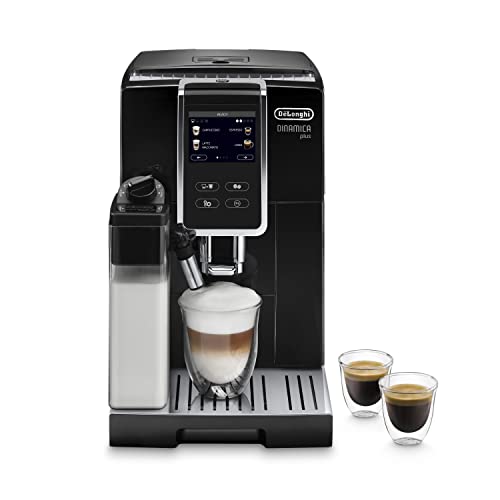
The Dinamica Plus ECAM370.70.B is a black bean-to-cup machine from De’Longhi with a LatteCrema milk carafe and a 3.5-inch touch display. On Amazon.de it costs approx. €599 (as of September 2026, retrieved on 7 September), and the release date field gives 9 March 2021. In our catalogue it is filed under bean-to-cup machines.
It no longer appears in De’Longhi’s German shop. Its German product address returned only an error page on 25 September 2026; the 370.70.B is still listed on De’Longhi’s English-language site, with a product page and a support page. Under Dinamica Plus the German shop lists three other machines: ECAM380.85.SB, ECAM380.95.TB and ECAM382.70.B.
We have not handled the machine and have not drunk any coffee from it. What is written here comes from the German manual for the ECAM37X.70 series (28 pages), from the safety booklet De’Longhi issues for all its coffee machines, from the Swiss energy label, the international product page and the Amazon catalogue.
Does the 370.70 have app control?
According to De’Longhi’s documents, no. The product page for the ECAM370.70.B places recipes and profiles on the display (“via display”), and the embedded product data lacks the connectivity field. Only the Amazon title speaks of app control.
Even there it stays with the title. In the five bullet points Amazon shows underneath, no app appears.
One detail in the manual is a little confusing. The 28 pages never mention an app, pairing or a smartphone, yet they state a frequency range of 2400 to 2483.5 MHz and a maximum transmission power of 10 mW. That is the 2.4 GHz band in which Bluetooth and Wi-Fi operate. However, the manual covers the whole ECAM37X.70 series and not just the 370.70.B, so the radio data do not prove that this exact machine has a radio module.
Our assessment: if you buy the 370.70.B, plan around the display and not around your phone. De’Longhi advertises two sister models with an app whose model number differs only in the ending; which ones they are is in the questions below.
Display, buttons and drinks
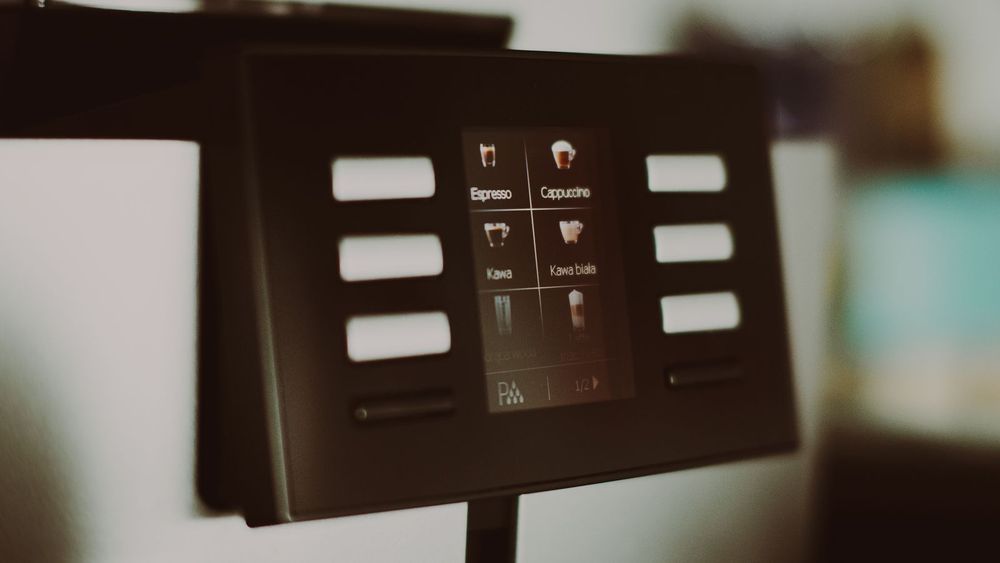
Below the touch display are four buttons, C1 to C4 in the manual. The bean symbol selects the aroma, “my” opens the menu for your own drinks, the cogwheel leads to the machine settings, and the cup sets the quantity. You tap the drink itself on the display. The alarms for descaling, cleaning the milk container and filter replacement also appear there. In the product photo the carafe sits front left, right next to the coffee spout.
De’Longhi states 12 recipes, 6 of them via One Touch. As coffee drinks the manual lists espresso, coffee, long, Doppio+ and 2X espresso, plus eight with milk: cappuccino, cappuccino+, cappuccino mix, latte macchiato, caffelatte, flat white, espresso macchiato and hot milk. Hot water and the pot of coffee are added. That makes 15 entries in total, while De’Longhi counts 12.
Two cups at the same time only work with espresso. While the first espresso is running, you press 2X.
Before every brew you set aroma and quantity. The aroma has five levels, X-MILD, MILD, MEDIUM, STRONG and X-STRONG, plus the setting for pre-ground coffee; the quantity has four, from SMALL to X-LARGE. After dispensing, both jump back to the default. If you want your cappuccino the same every morning, save it via my: for milk drinks you first save the coffee aroma, then milk and coffee quantity separately. Each drink can be reset individually to factory settings in the menu.
The factory quantities according to the manual’s table: espresso 40 ml, programmable from 20 to 180 ml. Coffee 180 ml (100 to 240 ml), long 160 ml (115 to 250 ml), Doppio+ 120 ml (80 to 180 ml). Hot water runs at 250 ml and can be set between 20 and 420 ml.
On the technical side, the manual gives 1450 W at 220 to 240 V and 50 to 60 Hz, a water tank of 1.8 l and at most 300 g in the bean hopper. The power cable measures 1750 mm, is detachable and plugs in at the back, where the main switch is also located. When switched on, the machine preheats and rinses, and you cannot cancel this process. When switched off it rinses once more, provided coffee has been prepared. According to the manual you never press the main switch while the machine is switched on.
In detail: grinder, grind setting and the 19 bar
On knob A5, the manual shows only a scale with the numbers 7, 5, 3 and 1 and intermediate marks. The number of settings, the design and the material are not stated there, and no De’Longhi source documents that the grinder is made of steel. Only the Amazon catalogue speaks of a 13-setting conical grinder.
How to adjust it, on the other hand, the manual regulates precisely. Only while the grinder is running, in the initial phase of a brew. If the coffee runs too slowly, one position to the right towards 7; if it should be stronger and have more crema, one position to the left towards 1. Never more than one position at a time, and judge only after at least 2 coffees. The grind is preset at the factory, so at least at first you do not need to touch it. In what order to tackle grind, quantity and aroma is explained in our guide Bean-to-cup machine settings.
According to the safety booklet, only roasted beans go into the container. The manual excludes green, caramelised or candied beans, which can stick to the grinder and damage it. If the coffee becomes thin and has little crema, the troubleshooting section recommends coffee for espresso machines.
That leaves the 19 bar, given as 1.9 MPa in the technical data. Espresso is usually brewed at about 9 bar at the coffee grounds. A pressure figure on a data sheet describes the pump’s maximum pressure. What pressure actually builds up in the coffee bed results from the resistance of the compacted powder: fine grounds slow the water, the pressure rises, coarse ones let it through faster. The 19 bar therefore say little about extraction, rather something about the pump’s reserve.
LatteCrema carafe: setting the foam, rinsing, taking it apart
The carafe is also the milk container. According to the manual it consists of the milk foam regulator with CLEAN function, the lid, the container, the milk intake tube and the adjustable milk dispensing tube. You press it firmly onto nozzle A8 until a signal tone sounds, and pull the dispensing tube down to the cup. Each line on the side corresponds to roughly 100 ml of milk, and you do not fill above the MAX line.
De’Longhi calls the technology LatteCrema Hot and advertises the carafe as self-cleaning. You still regulate the foam by hand (how milk foam forms at all is explained in the guide How to froth milk). The display recommends a position, and you turn the knob on the lid, which has three positions: NO FOAM for hot milk and caffelatte, VERY LITTLE FOAM for latte macchiato and flat white, VERY MUCH FOAM for the cappuccino variants, espresso macchiato and frothed milk.
After every milk drink the display shows TURN KNOB TO CLEAN. If you turn it, the machine cleans itself with steam and hot water, and the milk may stay in the carafe. For several milk drinks in a row, you press Esc at the message and only clean after the last one. After that the carafe may go in the fridge for 2 days at most. If it was empty or out for longer than 30 minutes, it has to be taken apart and freed of all residues.
It is taken apart every two days anyway. Lid off, dispensing and intake tubes out, turn the regulator to INSERT and pull it out, then clean everything with hot water and mild washing-up liquid; a blocked channel is cleared with a toothpick. All parts of the carafe may go in the dishwasher, but only on the top rack. You wipe nozzle A8 on the machine with a sponge after every milk preparation and remove milk residues from the seals as you do so.
For households with a milk allergy, the safety booklet contains a sentence worth knowing: “The cleaning systems described in the supplied manual do not guarantee the complete removal of allergens.” And with several cappuccinos in a row, the metal cup grid gets hot, so you should only touch it at the front.
Care, descaling and running costs
According to De’Longhi, cleaning needs no chemical additives. According to the manual, solvents, abrasives and alcohol are off limits; the safety booklet adds alkaline cleaners and flammable liquids and advises a soft cloth, if necessary with a neutral detergent. You do not tackle encrusted deposits with metal objects, and the machine is never immersed in liquid for cleaning. Of the machine’s own parts, according to the manual only two may go in the dishwasher: the drip tray grid and the milk container.
The brew group comes out at least once a month; the safety booklet says every 30 days. Only with the machine switched off: take out the water tank, open the service door on the right, press the two coloured release buttons inwards and pull the group out at the same time. It then sits in water for about five minutes and is rinsed under the tap. The sheet states in capital letters “RINSE WITH WATER ONLY”, “NO DETERGENTS” and “NO DISHWASHER”. It goes back in with firm pressure on the PUSH label until it clicks into place; afterwards the coloured buttons must stick out. If it goes in stiffly, press the two levers beforehand.
You empty the coffee grounds container when the machine reports it, but at the latest 72 hours after the first preparation, because the message appears then too. This count only works if you never switch off via the main switch. According to the product data on the manufacturer’s page, the container holds 14 portions. You pull out the drip tray while the machine is switched on and, each time, also empty the grounds container, otherwise a blockage threatens; the brush has a scraper for the grounds. The tray is due before the red float sticks out of the cup grid.
About once a month the interior and the tank are due. You clean the interior switched off and disconnected from the mains with a brush, sponge or vacuum cleaner. You wipe out the tank with a damp cloth and mild detergent, also after every filter change, and with the filter inserted you then run off approx. 100 ml of hot water. You change the water in the tank at least every 3 days.
After a break of more than 3 to 4 days, the manual requires 2 to 3 rinse cycles and a few seconds of hot water; water in the grounds container is normal afterwards. The safety booklet goes further: after more than 3 days of standstill the tank is emptied, and when switching on again you pour away one hot water and one hot coffee.
The descaling prompt comes after an operating time that depends on the water hardness setting. From the factory the machine is set to hardness level 4, very hard water. You measure your tap water with the supplied reaction strip, one to four red squares correspond to the four levels, and De’Longhi advises doing this as soon as possible. How else to find out your water hardness is in the guide Water hardness and coffee.
One run takes about 45 minutes, and how the descaler is dosed is in the questions below. Under the spouts goes a container of at least 2 l, because hot, acidic water comes out of the hot water and coffee spouts. After about 25 minutes the actual descaling is over, and the rest is rinse cycles. The prompt can be postponed with Esc, and it then reappears every time you switch on. If the machine asks for two cycles in quick succession, that is normal according to the manual. You wipe up spilt descaler immediately, since it can damage delicate surfaces.
Only De’Longhi descaler is approved. The De’Longhi EcoDecalk is at approx. €7.98 in our price box for a 500 ml bottle with 5 uses, which is approx. €1.60 per use. An annual total cannot be derived from this, because De’Longhi gives the interval neither in litres nor in brews.
The manual’s accessories are a reaction strip for water hardness, a measuring spoon, descaler, a cleaning brush, a hot water spout and the power cable. It lists the water filter with the note “on some models” and recommends inserting it. According to the manual it lasts two months in normal use and at most three weeks when the machine is idle, and is available from authorised customer service centres. The De’Longhi water filter DLSC002 is intended for ECAM machines according to the Amazon catalogue, and De’Longhi’s US site lists “all ECAM”. At approx. €7.49 in our price box and six filters a year, continuous use comes to approx. €44.94 per year. General care steps are summarised in the guide Descaling and cleaning a bean-to-cup machine.
What De’Longhi leaves open
These are details buyers look for when comparing, and they are missing from the manual, the safety booklet and the product page. We collect them in one place instead of estimating them:
- Pump type and pressure at the coffee grounds
- Milk foam temperature in degrees Celsius
- Heat-up time and noise level in decibels
- The carafe’s capacity beyond the 100 ml lines
- Whether the bean hopper can be removed and on which side the water tank comes out
- Housing material and country of manufacture
- Whether a water filter and coffee pot are in the box with the ECAM370.70.B
- Which switch-off time is set at the factory
- Number of user profiles and radio standard
- Whether light filter roasts or very oily beans are suitable
- Spare parts availability, a recommended retail price and EU consumption figures
What else comes into question
| Model | The difference | Price | Our rating | Choose this if |
|---|---|---|---|---|
| DeLonghi Dinamica Plus 370.70 (this one) | 12 recipes, carafe docks onto the nozzle and may go in the fridge | approx. €599 | 8.6 | you can get it cheaper than the 380.95 |
| DeLonghi Dinamica Plus 380.95 | 24 instead of 12 drinks, tank and power the same according to De’Longhi | approx. €589 | 8.7 | you drink cortado or galão or simply take the lower price |
| Philips LatteGo 5500 | Two-part milk system without tubes, removable for rinsing | approx. €515 | 8.7 | you prefer to remove and rinse the milk container after the cappuccino |
| Jura E8 | Brew unit permanently installed, cleaning by tablet instead of taking it out | approx. €1,049 | 9.4 | you never want to handle the brew group yourself |
The prices are guide values from our price boxes, for the 370.70 from 7 September 2026, and not daily prices. The rating is our editorial assessment based on manuals and data sheets; we did not measure anything on any of the four machines.
When the 370.70, when one of the others?
Much depends on the price, because the cheaper sister has more drinks. In addition to the 370.70’s milk recipes, the Dinamica Plus 380.95 adds cortado, galão and café au lait among others according to De’Longhi, with the same tank and power. We would only reach for the 370.70 once its price falls below the 380.95’s €589 from our price box.
Then comes the question of how much care you are willing to give the milk system. What the 370.70’s carafe demands in care is described above. According to Philips, the Philips LatteGo 5500 has a two-part milk container without tubes, which you remove after use and clean under running water or in the dishwasher. Philips states under 10 seconds for cleaning and, according to the manual, 250 ml for the container. In our price box it costs around €84 less than the 370.70.
The Jura E8 turns it around. According to the Jura manual its brew unit is permanently installed and is cleaned by tablet after 180 preparations or 80 switch-on rinses, the milk comes through a tube from an external container, and the milk system is rinsed automatically 15 minutes after a milk drink. For the Jura E8 you pay €450 more than for the 370.70, and in our view this premium is mainly worthwhile for someone who is genuinely bothered by taking out the brew group every month.
On footprint, the manual gives 240 x 440 x 360 mm (width, depth, height) and 10 kg. The product data on the manufacturer’s page state 236 x 429 x 348 without a unit and 11.93 kg, exactly the packaging weight, and the Amazon catalogue converts to around 9.5 kg. The safety booklet requires 3 cm of clearance to the side walls and rear wall and 15 cm above. With the manual’s values that means: 30 cm width, 47 cm depth and 51 cm up to the underside of the wall cabinet. The worktop must be more than 850 mm above the floor, the machine does not belong in a cupboard during operation, and you should not set it up near a tap or sink. It is connected to an earthed socket of at least 10 A that remains accessible at all times.
For guests it has two ways, two espressos at once and the pot function, whose quantities are in the questions below. According to the product data, cups up to 133 mm fit under the height-adjustable spout.
And if you want an app, neither of the two cheaper alternatives gets you anywhere. According to the data sheet, the 380.95 has no wireless connection; the connectivity field says No; according to Philips, the LatteGo 5500 cannot be controlled by app, and the HomeID app provides only information and recipes. Of the four machines in the table, only the Jura E8 has an app connection according to the manufacturer, J.O.E. via the separately available Wi-Fi Connect.
Who is it suitable for?
The safety booklet designates the machine exclusively for household use and excludes staff kitchens, agricultural tourist establishments, hotels, room rentals, motels and bed-and-breakfast operations. The office coffee corner and the breakfast at a guesthouse are therefore ruled out.
It is also not intended for the unheated weekend house: according to the booklet it belongs indoors without extreme temperatures, protected from sun and moisture, not in a room where it freezes, and not higher than 2000 m above sea level.
Families will find two rules in the same booklet that do not fit together. A section for European markets permits use from age 8 under supervision or after instruction, cleaning and maintenance only by children over 8 and only supervised, and the appliance and cable should be out of reach of children under 8; no child may play with it. Elsewhere it says without qualification that the appliance must not be used by children. We would stick to the stricter sentence.