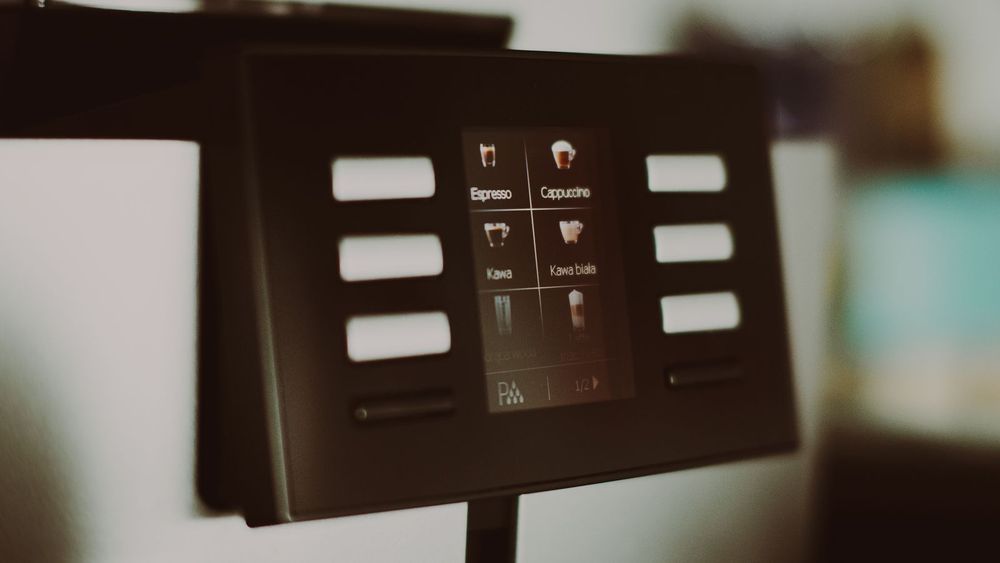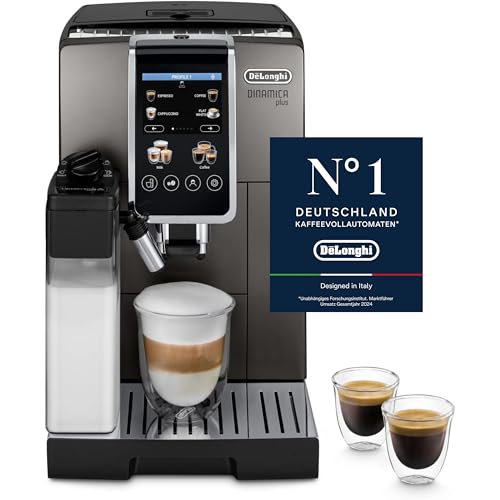
The Dinamica Plus ECAM380.95.TB is a bean-to-cup machine from De’Longhi that offers 24 drinks at the press of a button via a 3.5-inch colour display with touch icons. In the Amazon.de catalogue it stands at approx. €589 (as of September 2026). In the De’Longhi online shop, the price on 25 September was clearly above this guide value. The manufacturer calls the colour Titanium Black, and the front is lacquered in a titanium shade.
The product data supplied in the source code of the manufacturer’s page give 1 October 2023 as the availability date and Romania as the country of origin.
We have not handled the machine or drunk anything from it. What is written here comes from the 29-page German instruction manual for the ECAM38X.7Y, ECAM38X.8Y and ECAM38X.9Y series, the safety booklet, the product data sheet, De’Longhi’s product page and the Amazon catalogue.
What separates the 380.95 from the older 370.70
It is not the display. On its international page, De’Longhi also describes the ECAM370.70.B with a 3.5-inch full touch display through which recipes and profiles run. What separates the two is the drink selection: the 370.70 has 12 recipes there, the 380.95 has 24 drinks. De’Longhi advertises both with LatteCrema Hot. The three froth textures dense, creamy and delicate are named on the 380.95 page; whether the 370.70 has the same does not emerge from its page. As new drinks, the product page highlights Lungo, Café Con Leche, Café Au Lait and Galão. De’Longhi gives the same housing dimensions and water tank for both.
The documents contain no comparison of grinder, brew unit and pump with the predecessor.
In the German De’Longhi shop, the 370.70 has meanwhile disappeared, and its product address leads to an error page. The Dinamica Plus line there consists of three machines: this 380.95 in Titanium Black, the ECAM380.85.SB in silver and the ECAM382.70.B with fewer drinks. On Amazon.de, on 7 September 2026, the retrieval day of our price box, the Dinamica Plus 370.70 was €10 more expensive than the 380.95.
Our assessment: if you never order Galão, Café au Lait or Café con Leche, the newer machine gives you little that can be documented.
Does the 380.95 fit under a wall cabinet?
Allow 51 centimetres between the worktop and the underside of the cabinet. The manual gives a height of 360 mm, and the safety booklet requires at least 15 cm of free space above the machine. If you calculate with the height from the product page, you arrive at 49.8 centimetres.
De’Longhi gives the dimensions in two different ways. The manual says 240 x 440 x 360 mm (L x W x H), the product page 236 x 429 x 348, without unit and without axes. Converted, the Amazon catalogue arrives at the same values as the product page and lists the 23.6 centimetres as width and the 42.9 as length. In the manual, by contrast, the shorter edge stands at L and the longer one under W. If the narrow side is at the front, as the Amazon catalogue suggests, then with the required 3 cm clearance to side and rear walls you need, going by the larger values in the manual, around 30 centimetres of width and 47 centimetres of depth. On weight, the product page gives 9.86 kg, the manual 10 kg and the Amazon catalogue, converted, 9.5 kg.
Two requirements from the safety booklet also affect where you put it. The work surface must be more than 850 mm above the floor, and the machine must not stand inside a cabinet during operation. According to the booklet it also does not belong directly next to a tap or sink.
It connects to an earthed socket rated at least 10 A. The manual states 1450 W at 220 to 240 volts and 50 to 60 Hz, the power cable is 1250 mm long, and the product data list a Schuko plug. The socket must always remain accessible.
In detail: what the 24 drinks consist of
The manual breaks the number down. There are 12 coffee and water recipes and 12 milk recipes. In the first group De’Longhi counts, besides espresso, coffee, lungo, ristretto, espresso lungo, americano and extended coffee, also the double espresso, two espressos at once in two cups, an iced coffee (called Over Ice on the product page), the coffee pot and hot water. Among the milk recipes are cappuccino in three variants, caffè latte, latte macchiato, flat white, cortado, espresso macchiato, Galão, Café au Lait, Café con Leche and hot milk. By our reading, three of the 24 are therefore not a separate preparation but a portion size or hot water.
From the factory, an espresso runs at approx. 40 ml, adjustable from 20 to 180 ml. The coffee comes at 180 ml, the americano at 150 ml, and americano and extended coffee can be turned up to 480 ml. Hot water comes at 250 ml from the factory, adjustable from 20 to 420 ml.
Adjustments are made per profile, and there are up to four profiles. For coffee drinks you choose the strength in five steps from X-LIGHT to X-STRONG, plus the length in four quantities from SMALL to X-LARGE. For milk drinks the machine asks in turn for strength, milk quantity and coffee quantity. The coffee temperature, by contrast, is a machine setting for all drinks, with the values LOW, MEDIUM and HIGH without a degree value. If the coffee is to be hotter, the manual advises rinsing, preheating the cups with hot water and using the higher temperature level; this has the most effect on long drinks, it says. According to the Amazon catalogue, the machine sorts the recipes itself so that the most-drunk ones appear on the start page.
According to the product data, heating is by thermoblock. The water runs through a heated metal block and is heated as it flows, instead of standing hot in a boiler. Every switch-on starts a preheating and rinsing cycle that you cannot cancel, and when switching off, the machine rinses, provided coffee was prepared beforehand.
As pressure, the manual states 15 bar (1.5 MPa). By general understanding, this is the pump pressure, that is, what the pump can build up. The pressure at which the water actually passes through the coffee grounds additionally depends on the resistance that grind size and amount of powder create in the brew unit.
Grinding happens just before brewing. You adjust the grind size at the rotary dial A5, whose scale carries the numbers 7, 5, 3 and 1, with intermediate marks between them; the illustration in the manual shows 13 marks. Towards 7 it gets coarser and the coffee runs faster, towards 1 finer. You may only turn it while the grinder is running and only by one position at a time, and according to the manual the effect only shows after at least 2 coffees. No adjustment is needed at the start, as the grinder is preset at the factory. In what order to approach grind size, quantity and temperature is described in our guide Setting up a bean-to-cup machine.
Only roasted beans belong in the hopper. The manual rules out green, caramelised or candied beans, because they stick to the grinder and can damage it. The safety booklet, which applies to all De’Longhi coffee machines, also forbids touching the grinder while the machine is switched on and the bean hopper is missing. Whether the hopper of the 380.95 can be removed at all is one of the open points further below.
The milk jug: what runs automatically and what you turn
According to the manual, the jug consists of five parts: container, lid, milk intake tube, adjustable milk froth outlet tube and a rotary dial on the lid, which is both froth control and the switch for cleaning. A scale on the side shows the fill level; each mark corresponds to about 100 ml.
Which froth level a recipe requires is shown on the display. You do the turning yourself. DELICATE is meant for hot milk, milky coffee, Café au Lait and Café con Leche, CREAMY for latte macchiato, flat white and cortado, DENSE for the cappuccino variants and the espresso macchiato.
After every milk drink, a prompt appears to turn the dial to CLEAN. After that, cleaning runs by itself and stops automatically. The jug may then go in the fridge, but for 2 days at most. If it is empty or has stood outside for more than 30 minutes, it is taken apart and cleaned thoroughly, and once a week the machine reminds you of this by itself.
For the dishwasher, the manual recommends the upper rack and a 50 °C programme, such as Standard ECO. By hand, you soak the parts for at least 30 minutes in water of at least 40 °C with washing-up liquid. You wipe the hot water nozzle with a sponge after every milk preparation.
Anyone preparing milk drinks for people with allergies should know this sentence from the safety booklet (translated from the German): “The cleaning systems indicated in the supplied instruction manual do not guarantee the complete removal of allergens.” With several milk drinks in a row, the metal cup tray also becomes hot, and you should then touch it only at the front.
Cleaning and descaling according to the manual
The manual divides the removable parts into two groups. The drip tray grille, the milk jug and the drip tray may go in the dishwasher. Only hand-washed are the cup tray, water tank, brew unit and coffee grounds container. According to De’Longhi you need no chemical additives for cleaning, solvents, abrasives or alcohol are ruled out, and no metal objects should be used against encrustations. The machine is never immersed in liquid.
The brew unit comes out at least once a month, and only with the machine switched off. You open the flap on the right, press the two coloured release buttons inwards and pull the unit out at the same time. Then it sits in water for approx. 5 minutes. The manual writes in capital letters (translated from the German) “RINSE WITH WATER ONLY”, plus “NO DETERGENTS” and “NO DISHWASHER”.
You empty the coffee grounds container when the machine reports it, and it also reports it 72 hours after the first preparation, even if it is not yet full. Without the container inserted, it dispenses no coffee. If you take out the drip tray, you empty the grounds container each time as well, even if there is little in it, otherwise the machine can clog. On the drip tray a red float indicator rises; before it sticks out of the cup tray, the tray is due.
Roughly monthly, the water tank and the inside of the machine are added. You clean the tank with warm water and a non-abrasive cloth, the inside with brush, sponge and crumb vacuum, switched off and disconnected from the mains. Blocked holes in the coffee spout you clear with a toothpick.
For descaling, you first measure the water hardness with the water hardness strip from the accessories list and set one of 4 levels. The prompt then appears after an operating time that depends on this level. Where to find out the hardness of your tap water is explained in the guide Water hardness and coffee. One cycle takes approx. 30 minutes: descaler up to fill level A in the tank, which corresponds to a 100 ml pack, then water up to fill level B, that is 1 litre, a 2-litre vessel under the spout, and two rinses at the end.
De’Longhi is strict about the product. Only De’Longhi descaler is permitted, and according to the safety booklet an unsuitable product can cause defects that are not covered by the manufacturer’s warranty. The De’Longhi EcoDecalk costs approx. €7.98 for 500 ml in our price box (on Amazon.de); at 100 ml per cycle that is approx. €1.60 per use. The steps in general are explained in the guide Descaling a bean-to-cup machine.
According to the data sheet, the machine draws at most 0.5 W in standby and at most 0.3 W in off mode, and it switches to standby after less than 30 minutes without use. Automatic switch-off can be set to 15 or 30 minutes or 1, 2 or 3 hours. De’Longhi itself recommends 15 minutes and points out that any longer setting increases consumption.
What De’Longhi leaves open
Buyers look for the following details when comparing bean-to-cup machines, and they are missing in the manual, data sheet and product page alike. We list them here once together instead of estimating them:
- type and material of the grinder, that is cone or disc, steel or ceramic, and the number of grind settings as a stated figure
- brewing temperature, milk froth temperature and hot water temperature in degrees Celsius
- the pressure in the brew unit and the type of pump
- heat-up time until ready and noise level in decibels
- the capacity of the milk jug in millilitres, beyond the 100 ml marks
- the exact scope of delivery of the ECAM380.95.TB, because descaler, water filter and cleaning brush appear in the accessories list only with the note “for some models”
- whether the bean hopper can be taken out
- descaling intervals in litres or drinks per hardness level, and with them the annual costs for descaler and filter
- energy consumption per cup or per year
- how long spare parts remain available
Which machine comes into question otherwise?
| Model | The difference | Price | Our rating | Choose this if |
|---|---|---|---|---|
| DeLonghi Dinamica Plus 380.95 (this one) | 24 drinks with coffee pot function, one bean hopper with 300 g | approx. €589 | 8.7 | you often need several cups in a row for guests |
| DeLonghi Dinamica Plus 370.70 | 12 recipes instead of 24, same 3.5-inch display and same housing size | approx. €599 | 8.6 | you find it clearly cheaper somewhere and can do without Galão and Café au Lait |
| DeLonghi Rivelia | two interchangeable bean hoppers of 250 g each, 1.4 l tank | approx. €660 | 8.9 | you switch between two bean varieties every day |
| Jura E8 | fixed brewing unit with tablet cleaning, milk via tube from an external container | approx. €1,049 | 9.4 | you never want to rinse the brew unit by hand |
The prices are the guide values from our price boxes. For the 380.95, 370.70 and Rivelia they come from the Amazon.de catalogue of 7 September 2026; for the Jura E8 we have no exact retrieval day. The rating is our editorial assessment from manuals and data sheets; we have not taken measurements on any of the four machines.
When the 380.95, when another?
First the milk. Twelve of the 24 drinks need the jug, and with each of them two manual steps are due at the lid (see milk jug above). If you do not want to start that yourself, you end up at the Jura E8: according to the Jura manual, its milk system rinses by itself 15 minutes after a milk drink. In our price box it costs €460 more than the Dinamica Plus 380.95, and we would only pay that if exactly those manual steps bother you.
Then the beans. The 380.95 has one hopper; a second variety goes in only spoon by spoon via the pre-ground chute. If someone in your household regularly drinks decaf, the DeLonghi Rivelia with two interchangeable hoppers is the more suitable machine; in our price box it is €71 above the Dinamica Plus 380.95. In return you swap 1.8 for 1.4 litres of tank capacity. If guests come often, the pot function speaks for the 380.95 (details in the questions below), and the Rivelia has none.
For quantity we calculate with the factory setting of 180 ml per coffee: a full tank then lasts for ten cups, minus the rinsing water when switching on and off, whose quantity we do not know. The grounds container is full after 14 portions. For a household of two to four people, we consider that sufficient.
According to the product data on the manufacturer’s page, cups up to 133 mm in height fit under the spout, and the spout is height-adjustable. If you drink latte macchiato from tall glasses, it is best to measure your glasses beforehand.
And the budget: between our Amazon guide value and the De’Longhi shop there was a large gap on the retrieval day. Before buying, we would look at both prices and also consider the silver sister model ECAM380.85.SB, which according to the two product pages has the same key data (24 drinks, display, tank, dimensions).
Who is it suitable for?
For one household, and only for that. The safety booklet says (translated from the German): “This appliance is intended exclusively for domestic use. Use is not intended in: staff kitchen areas in shops, offices and other working environments, farm houses and tourist establishments, hotels, guest rooms, motels and other accommodation.” For the office kitchenette, the guesthouse and the holiday flat, the 380.95 is therefore ruled out.
Families with children will find two rules in the same booklet. A section that expressly applies only to European markets permits use from the age of 8 under supervision or after instruction, cleaning and maintenance only by children over 8 and only supervised, and children under 8 should be kept away from the appliance and cable. Without this restriction, it says elsewhere (translated from the German): “This appliance must not be used by children.” By our reading, the European rule applies in Germany, but in case of doubt we would still stick to the stricter sentence. You can find more bean-to-cup machines for home use in our bean-to-cup machine overview.