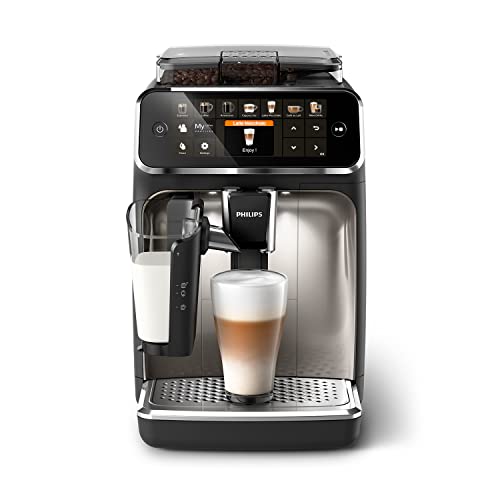
The Philips LatteGo 5400 with the model number EP5447/90 is a bean-to-cup coffee machine with a ceramic grinder and LatteGo, a milk jug without a tube that clips onto the front of the machine. Philips calls the colour black, and the front is chrome-finished. In our price box it stands at approx. €424 (as of September 2026). Philips itself sets the recommended retail price at €799.99 and sold it in its own shop on 25 September 2026 in a promotion for €439.00.
It is not new. In the Amazon catalogue, 4 July 2020 is entered as the release date, and the EU declaration of conformity from the manufacturer DAP B.V. in Drachten dates the CE marking to December 2020. The current German data sheet carries the publication date 1 March 2026.
We have not handled the machine and have not drunk anything from it. What is written here comes from the Philips product page, two data sheets (German from 2026, English from 2023), the shared manual for the 4300 and 5400 Series, the safety booklet and the Amazon catalogue. Where these sources contradict each other, both values are given.
What sets the 5400 apart from its siblings
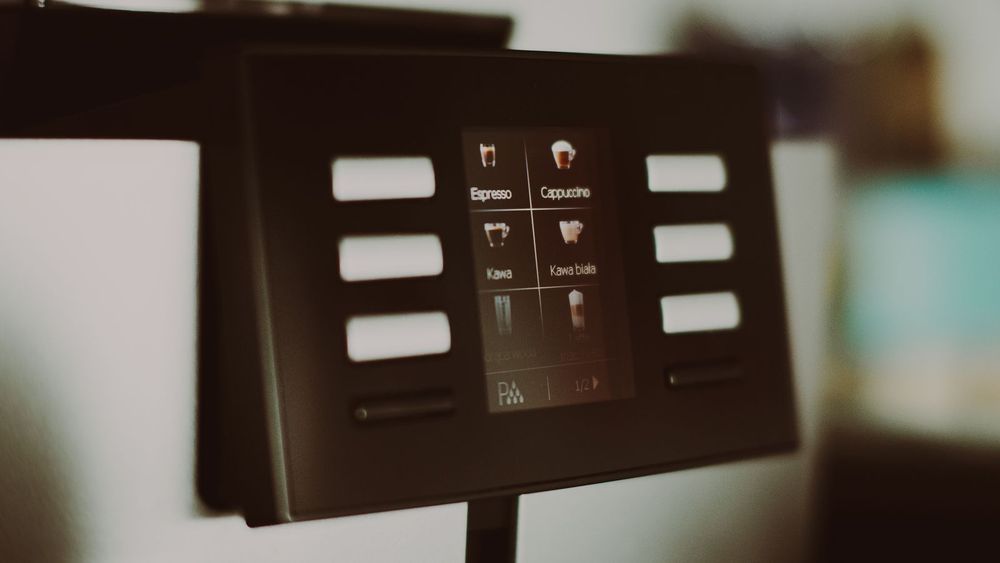
Philips counts 12 preset drinks. The product page lists espresso, coffee, americano, cappuccino, latte macchiato, flat white, café au lait, caffè latte, caffè crema, ristretto and espresso lungo, plus a travel mug function, milk froth and hot water. Leaving out milk froth and hot water, we count 12, with the travel mug function included. According to the manual, six of them have their own symbol on the control panel (espresso, coffee, americano, cappuccino, latte macchiato, café au lait), and you reach the rest through the “More drinks” menu.
Iced or cold drinks are not on the list. That is exactly where the two neighbours come in. In the Amazon catalogue the 5500 Series has 20 hot and cold specialities, including iced americano and iced espresso. And within the 5400 Series there is the EP5441/50, whose drinks list in the Philips shop includes an americano and an espresso with ice cubes. It only stores 2 profiles plus guest.
The manual lists six variants for the series: EP5447, EP5446, EP5444, EP5443, EP5441 and EP5144. In the German Philips shop on 25 September, three of them could be found: the EP5447/90 and the EP5441/50 in black and the EP5443/70 in white.
How much space does the 5400 need?
According to the manufacturer’s dimensions, it takes up just under 25 by a good 43 centimetres on the worktop, and according to the manual it is 37.7 centimetres tall. You need room above it for refilling, because the bean hopper sits on top under a lid.
Philips gives the dimensions two different ways. The product page states 433 mm length, 246 mm width and 371 mm height at 8 kg, the manual 246 x 377 x 434 mm (W x H x D) at 7 to 7.5 kg, and the English data sheet from 2023 arrives at 372 mm height. Above, we used the larger values. The figures in the Amazon catalogue, converted to approx. 30 x 50 x 48 cm and 10 kg, are close to the packaging dimensions, for which Philips states 491.5 x 287.5 x 487 mm and 10 to 12.3 kg.
You reach the water tank and the coffee grounds container from the front. The machine connects with 1,500 W at 230 V and 50 Hz, and the power cable measures 800 to 1200 mm according to the manual, 100 cm according to the 2023 data sheet. According to the product page, the housing is mainly made of plastic, with metal given as the secondary material.
On placement, the safety booklet sets five requirements. The machine belongs on a level, stable surface and stays upright, also during transport. It does not stand on a warming plate or directly next to a hot oven, a radiator or a similar heat source. It must not stand in a cupboard during use. Because the water container and drip tray can drip, damage to the table surface is not covered by the warranty. It should not be exposed to temperatures below 0 °C, because residual water can freeze; if so, you empty the water circuit.
In detail: LatteGo without a tube
In many bean-to-cup machines, a tube draws milk from a container or straight from the carton into a frothing head, where steam and air are added. Milk residue stays in the tube and the head. That is why such machines rinse after a milk drink, and the tubes become wear parts.
LatteGo has no tube. According to the manual, the system consists of a milk container, a frame and a storage lid. The two parts Philips advertises are, as we read it, the container and the frame; the lid only goes on for storage. The container holds 0.26 l according to the product page and 250 ml according to the manual.
The order in the glass depends on the recipe. For cappuccino, flat white and latte macchiato, milk runs first and then coffee; for caffè latte and café au lait, the other way round. For the milk temperature, Philips refers in a footnote to 70 to 82 °C.
Philips advertises cleaning in 15 seconds on the product page. The footnote in the 2023 data sheet explains what the figure is based on according to Philips: consumer trials in Germany from 2018 in which LatteGo was compared with leading one-touch bean-to-cup machines.
The safety booklet has a section of its own on the milk system. Jets of milk and steam can escape before dispensing, there is a risk of burns, and you should only remove the system once the dispensing cycle has ended. To clean it, you take it apart, rinse it under warm water, clean it with a food-safe cleaning agent and only reassemble it once it has dried. Before every milk drink you check that it is inserted as the manual shows, and you only use it if all parts are correctly assembled and undamaged. No liquids other than water and milk go into it. When descaling and when dispensing hot water, you always take it out. All its parts are dishwasher-safe.
Grinder, strength, temperature: what can be adjusted
According to Philips, the grinder is 100% ceramic and has 12 grind settings. It is adjusted with the dial in the bean hopper, only while the machine is grinding, and only by one position at a time. According to the manual, the effect shows after 2 to 3 drinks. Philips advises changing the setting only after 100 to 150 cups, which the manual equates with about a month. How to feel your way towards the right grind setting is described in the guide Setting up a bean-to-cup machine.
The hopper holds 275 g of beans. Caramelised or flavoured beans are ruled out, and according to the safety booklet, damage caused by them is not covered by the warranty. For a second type of bean, such as decaf in the evening, there is the ground coffee chute. It takes one measuring spoon of ground coffee, then the machine brews a single cup and leaves the aroma strength out. According to the booklet, only ground coffee and the Philips coffee degreasing tablets belong in that compartment.
For each drink you choose the aroma strength in 5 levels, and coffee and milk quantity in 5 amounts each. The brew temperature has 3 levels and is a machine setting. Philips states that it keeps the water between 90 °C and 98 °C when brewing. ExtraShot adds an extra shot of ristretto on top; that only works at the highest strength, and with ExtraShot only one drink runs at a time.
Control is via a TFT display, which the Amazon catalogue describes as a touchscreen. For connectivity the product page says No, so there is no app control. Four profiles plus guest can be created. After each drink the machine automatically saves the chosen settings in the active profile; in the guest profile you can adjust too, but the recipe is not kept there. The settings menu also holds water hardness, standby timer, display brightness in three levels, language, key tone and the choice between ml and oz. Everything can be reset to factory settings at any time.
In standby, according to the product page, the machine draws 0.2 W, measured to EN 50564:2011. From the factory it switches to standby after 30 minutes, and 15, 30, 60 or 180 minutes can be set. According to the booklet, changing the standby time increases energy consumption.
For pressure, the product page states 15 bar. That is the pump pressure, that is, what the pump can build up. How much of it reaches the coffee grounds depends on the resistance formed by grind setting and amount of grounds in the brew group; Philips gives no value for that. Among the features, the 2023 data sheet also lists Pre-Brew Aroma control, Aroma Seal, guided descaling and an ECO setting.
What else is there to consider?
| Model | The difference | Price | Our score | Pick this if |
|---|---|---|---|---|
| Philips LatteGo 5400 (this one) | 12 drinks, 4 profiles plus guest | approx. €424 | 8.6 | you make milk drinks for up to four people with fixed preferences |
| Philips LatteGo 5500 | 20 instead of 12 specialities according to Philips, cold ones too according to the Amazon catalogue | approx. €515 | 8.7 | you want iced coffee at the touch of a button |
| DeLonghi Magnifica S | steam wand instead of a milk jug according to the Amazon catalogue, 13-step conical grinder | approx. €320 | 8.3 | you mostly drink it black and only froth milk yourself now and then |
| Jura E8 | brew unit stays fixed in the machine and is cleaned by a tablet programme | approx. €1,049 | 9.4 | you do not want to remove, rinse and grease a brew group by hand |
The prices are the guide values from our price boxes (as of September 2026). The score is our editorial assessment based on manuals, data sheets and catalogue data; we measured none of the four machines. All machines in the category are in the bean-to-cup machine comparison.
When the 5400, when another one?
First, the question of whether you put milk in your cup at all. If it is almost only espresso and coffee, with the 5400 you pay for a jug that sits unused in the cupboard. According to our price box, the DeLonghi Magnifica S saves you around €105 compared with the 5400 Series and, according to the Amazon catalogue, has a steam wand with which you froth the milk yourself in a jug, depending on its design.
If you also want an iced americano from the machine in the morning, the EP5447/90 is the wrong choice; then there is the Philips 5500 Series or, within the 5400 Series, the EP5441/50, see above.
Then the size of the household. The water tank holds 1.8 l, and the booklet wants the water in it used up within 1 to 2 days. If you drink two cups a day on your own, in our assessment you are better off filling the tank only halfway. The coffee grounds container is the other way round: according to the manual it holds 12 portions. If four people drink two cups each a day, it is full after a day and a half.
For tall glasses the spout matters. According to the manual it can be adjusted between 88 and 145 mm, and the 2023 data sheet says 85 to 145 mm. A latte macchiato glass taller than 14.5 centimetres does not fit under it according to these figures.
And maintenance. The brew group of the 5400 comes out every week (the schedule is below under cleaning). If you never want to do that, you end up with the Jura E8, whose brew unit stays in the machine. For that you pay around €625 more according to our price box, and we would only pay it if exactly that step bothers you.
Cleaning and descaling according to the manual
After every milk drink it is the jug’s turn. You either start Quick Milk Clean on the machine or take off the LatteGo and rinse it under running water or in the dishwasher. For a thorough clean, you pour out milk residue, press the release button, take the milk container out of the frame and clean all parts in the dishwasher or under lukewarm running water with a little washing-up liquid. You empty the drip tray daily, as soon as its red indicator becomes visible.
Once a week the brew group comes out. You switch the machine off, take out the water container, open the service flap, press the PUSH button and pull the group out by the handle. It is rinsed under running tap water, according to the safety booklet not in the dishwasher and without rinsing or cleaning agents. According to the manual, you should not dry it with a cloth because lint sticks to it; it dries in the air.
In the same week you check the ground coffee compartment for blockages (pull the mains plug, take out the brew group, loosen residue with a spoon handle) and rinse the water container under running water. The drip tray and coffee grounds container are cleaned weekly; you also empty the grounds container when the machine asks for it, and always take it out with the machine switched on. It may go in washing-up liquid or in the dishwasher, except for its front, which according to the manual is not dishwasher-safe. The product page counts it among the dishwasher-safe parts without this restriction.
Monthly, you clean the brew group via the cleaning menu with a Philips tablet for removing coffee grease. Every two months Philips recommends greasing it thinly, on the piston, shaft and guide rails, according to the booklet only with food-grade, approved H1 grease.
You wipe the housing with a soft, damp cloth and at most a mild cleaning agent, the front once a week according to the manual; the booklet rules out scouring sponges, abrasives, petrol or acetone. You never immerse the machine, mains plug or power cable in water, otherwise there is a risk of electric shock. According to the booklet, you clean the hot water dispenser carefully, without blocking the air inlet and without letting water in. According to the booklet, if the machine is not cleaned and maintained, a defect or mould can result; if there is mould, you should clean more often, and the repair is then excluded from the warranty.
Descaling is done when the display prompts it. You set the water hardness in 5 levels; from the factory level 4 is set, for hard water, and you can determine it with the test strip supplied. One run takes about 30 minutes and consists of a descaling and a rinsing cycle: a whole bottle of Philips descaler into the tank, topped up with water to the CALC/CLEAN mark, with a container for 1.5 l placed underneath. You never drink the solution that is dispensed. According to the manual, if you do not descale, you risk your warranty. The steps in general are described in the guide Descaling and cleaning.
With the AquaClean filter, according to Philips, descaling is not needed for up to 5,000 cups, calculated with 8 filter changes as indicated. A filter is exhausted after 95 litres and must come out after 3 months at the latest, even if the machine does not ask for it. You activate each new filter in the cleaning menu, which takes about 5 minutes and only works when the machine is free of limescale. Beforehand you prepare it in cold water, otherwise, according to the manual, air gets into the system and the machine becomes loud.
The booklet sets limits on the filter. It is intended only for municipally treated tap water or water from private sources with proven drinking water quality; if a boil-water notice applies, you boil the water and let it cool, then clean the machine and insert a new cartridge. You clean the water tank regularly. For people with a weakened immune system and for babies, Philips recommends filtered and boiled water even with the filter. Filtering can slightly raise the sodium content; anyone with a kidney condition, on dialysis or on a low-sodium diet should ask a doctor first. When descaling, you take the filter out of the tank, clean the tank thoroughly and then put the filter back in. The manufacturer declines any liability if the recommendations on use and replacement are not followed.
Worked out: the three-month cycle requires at least four filters a year. The AquaClean twin pack CA6903/22 stands at approx. €19.99 in our price box; for one year you need two of them, together approx. €40. If you send on average more than a good litre a day through the machine, rinse water included, you reach the 95 litres before the three months are up and need correspondingly more. On top come twelve degreasing tablets and six greasings a year.
What Philips leaves open
Some details by which buyers compare bean-to-cup machines are missing from the product page, from both data sheets and from the manual. We collect them here instead of estimating them:
- the noise level in decibels, and what SilentBrew actually does on the EP5447/90
- the heat-up time, beyond the keyword quick start
- the temperature of each of the three brew levels
- the type of pump
- the material of the water tank, bean hopper, drip tray and brew group
- the volume of the drip tray and coffee grounds container in litres or grams
- the water hardness per level in °dH (German degrees of hardness)
- how often descaling is needed without the AquaClean filter, in cups or litres
- the power consumption per year in kWh
- the prices for descaler, degreasing tablets and grease
- how long spare parts remain available
- minimum clearances for installation
- the maximum cup height for the travel mug function
On the country of manufacture, the documents contradict each other. The product page and the 2026 data sheet say China, the 2023 data sheet says Designed in Italy, Made in Romania.
Who is it suitable for?
For a private household, and according to the safety booklet only for that. If you have children, the same booklet contains four rules. Children aged 8 and over, and people with reduced abilities or without experience, may only use the machine under supervision or after instruction, and only if they understand the dangers. Children do not carry out cleaning and maintenance unless they are older than 8 and supervised. Children under 8 should not get at the machine, accessories or cable, and children must not play with it.
According to the booklet, staff kitchens, offices, farms and other commercial environments are excluded. For the office kitchenette the 5400 is therefore the wrong choice, even if four profiles would seem to fit there at first glance.